PHYLUM
ECHINODERMATA
Echinoderms: Sea stars, brittle stars, feather stars, sea cucumbers, sea
urchins
CHARACTERISTICS
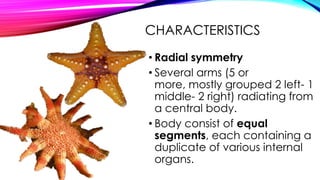
• Radial symmetry
• Several arms (5 or
more, mostly grouped 2 left- 1
middle- 2 right) radiating from
a central body.
• Body consist of equal
segments, each containing a
duplicate of various internal
organs.
CHARACTERISTICS

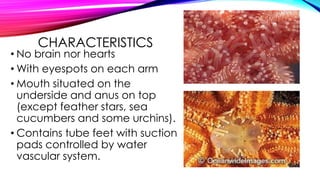
• No brain nor hearts
• With eyespots on each arm
• Mouth situated on the
underside and anus on top
(except feather stars, sea
cucumbers and some urchins).
• Contains tube feet with suction
pads controlled by water
vascular system.
CHARACTERISTICS
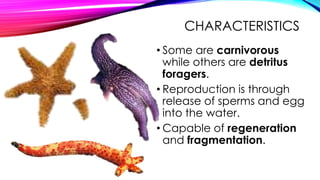
• Some are carnivorous
while others are detritus
foragers.
• Reproduction is through
release of sperms and egg
into the water.
• Capable of regeneration
and fragmentation.
TYPES OF ECHINODERMS

•Class Asteroidea
•Class Ophiurodea
•Class Echinoidea
•Class Holothuroidea
•Class Crinoidea
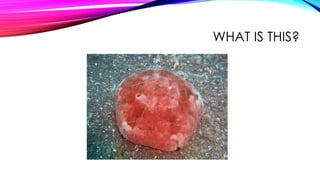
WHAT IS THIS?
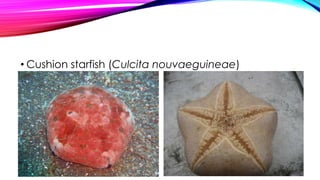
• Cushion starfish (Culcita nouvaeguineae)
CLASS ASTEROIDEA

• Carnivorous and feed on sponges and
molluscs some are specialized
feeders.(crown of thorns)
• Doesn’t have hard mouth parts to help
them capture prey.
TRIVIA
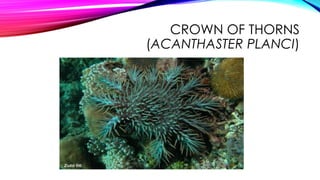
• Crown of thorns (Acanthaster planci)
• One of the largest and the most venomous
starfish.
• Size reaches up to 50 cm in diameter.
• 10 to 20 spiny arms with formidable thorn like toxic
spines
• Feed on coral polyps
• Predators: Triton shell and some puffer fish
CROWN OF THORNS
(ACANTHASTER PLANCI)
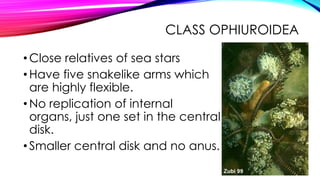
CLASS OPHIUROIDEA
• Close relatives of sea stars
• Have five snakelike arms which
are highly flexible.
• No replication of internal
organs, just one set in the central
disk.
• Smaller central disk and no anus.
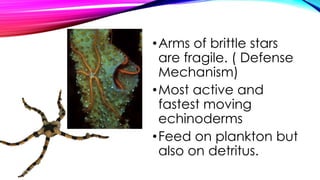
• Arms of brittle stars
are fragile. ( Defense
Mechanism)
• Most active and
fastest moving
echinoderms
• Feed on plankton but
also on detritus.
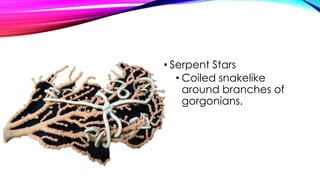
• Serpent Stars
• Coiled snakelike
around branches of
gorgonians.
TRIVIA
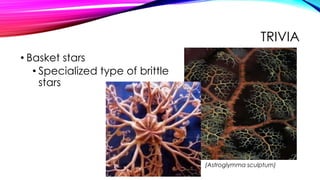
• Basket stars
• Specialized type of brittle
stars

(Astroglymma sculptum)
CLASS ECHINOIDEA
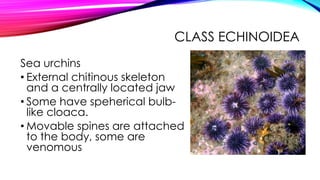
Sea urchins
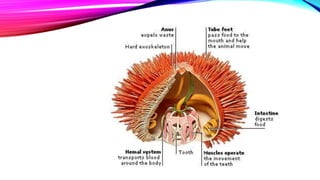
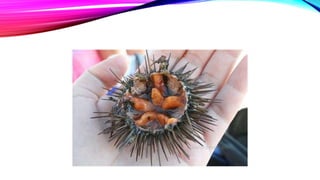
• External chitinous skeleton
and a centrally located jaw
• Some have speherical bulblike cloaca.
• Movable spines are attached
to the body, some are
venomous
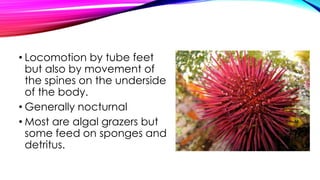
• Locomotion by tube feet
but also by movement of
the spines on the underside
of the body.
• Generally nocturnal
• Most are algal grazers but
some feed on sponges and
detritus.
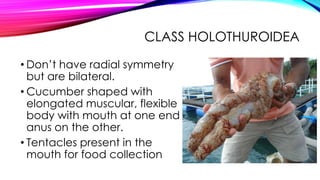
CLASS HOLOTHUROIDEA
• Don’t have radial symmetry
but are bilateral.
• Cucumber shaped with
elongated muscular, flexible
body with mouth at one end
anus on the other.
• Tentacles present in the
mouth for food collection
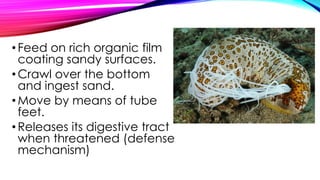
• Feed on rich organic film
coating sandy surfaces.
• Crawl over the bottom
and ingest sand.
• Move by means of tube
feet.
• Releases its digestive tract
when threatened (defense
mechanism)
PHYLUM CRINOIDEA
• Radial symmetry
• Cup-shaped body
• Numerous feathery arms project from a central
disc.
• Have 5 up to 200 arms (pinnules)
• Nocturnal
• Usually cling to sponges.
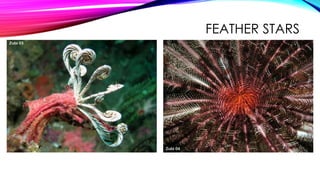
FEATHER STARS
• Source: http://www.starfish.ch/reef/echinoderms.html#starfish

Echinoderms

  • 1.
    PHYLUM ECHINODERMATA Echinoderms: Sea stars,brittle stars, feather stars, sea cucumbers, sea urchins
  • 2.
    CHARACTERISTICS • Radial symmetry •Several arms (5 or more, mostly grouped 2 left- 1 middle- 2 right) radiating from a central body. • Body consist of equal segments, each containing a duplicate of various internal organs.
  • 3.
    CHARACTERISTICS • No brainnor hearts • With eyespots on each arm • Mouth situated on the underside and anus on top (except feather stars, sea cucumbers and some urchins). • Contains tube feet with suction pads controlled by water vascular system.
  • 4.
    CHARACTERISTICS • Some arecarnivorous while others are detritus foragers. • Reproduction is through release of sperms and egg into the water. • Capable of regeneration and fragmentation.
  • 5.
    TYPES OF ECHINODERMS •ClassAsteroidea •Class Ophiurodea •Class Echinoidea •Class Holothuroidea •Class Crinoidea
  • 6.
  • 7.
    • Cushion starfish(Culcita nouvaeguineae)
  • 8.
    CLASS ASTEROIDEA • Carnivorousand feed on sponges and molluscs some are specialized feeders.(crown of thorns) • Doesn’t have hard mouth parts to help them capture prey.
  • 9.
    TRIVIA • Crown ofthorns (Acanthaster planci) • One of the largest and the most venomous starfish. • Size reaches up to 50 cm in diameter. • 10 to 20 spiny arms with formidable thorn like toxic spines • Feed on coral polyps • Predators: Triton shell and some puffer fish
  • 10.
  • 11.
    CLASS OPHIUROIDEA • Closerelatives of sea stars • Have five snakelike arms which are highly flexible. • No replication of internal organs, just one set in the central disk. • Smaller central disk and no anus.
  • 12.
    • Arms ofbrittle stars are fragile. ( Defense Mechanism) • Most active and fastest moving echinoderms • Feed on plankton but also on detritus.
  • 13.
    • Serpent Stars •Coiled snakelike around branches of gorgonians.
  • 14.
    TRIVIA • Basket stars •Specialized type of brittle stars (Astroglymma sculptum)
  • 15.
    CLASS ECHINOIDEA Sea urchins •External chitinous skeleton and a centrally located jaw • Some have speherical bulblike cloaca. • Movable spines are attached to the body, some are venomous
  • 16.
    • Locomotion bytube feet but also by movement of the spines on the underside of the body. • Generally nocturnal • Most are algal grazers but some feed on sponges and detritus.
  • 19.
    CLASS HOLOTHUROIDEA • Don’thave radial symmetry but are bilateral. • Cucumber shaped with elongated muscular, flexible body with mouth at one end anus on the other. • Tentacles present in the mouth for food collection
  • 20.
    • Feed onrich organic film coating sandy surfaces. • Crawl over the bottom and ingest sand. • Move by means of tube feet. • Releases its digestive tract when threatened (defense mechanism)
  • 22.
    PHYLUM CRINOIDEA • Radialsymmetry • Cup-shaped body • Numerous feathery arms project from a central disc. • Have 5 up to 200 arms (pinnules) • Nocturnal • Usually cling to sponges.
  • 23.
  • 24.