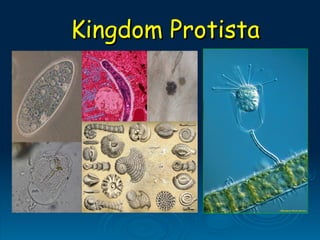
Kingdom Protista
Kingdom Protista
KEY CONCEPTS
KEY CONCEPTS
• Protists are a diverse group of
Protists are a diverse group of
eukaryotic organisms, most of which are
microscopic
microscopic
Protista
Protista
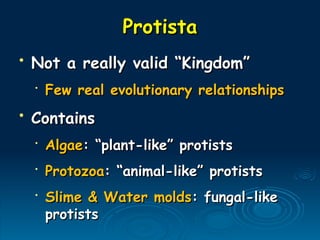
• Not a really valid “Kingdom”
Not a really valid “Kingdom”
•
Few real evolutionary relationships
• Contains
Contains
•
Algae
Algae: “plant-like” protists
: “plant-like” protists
•
Protozoa
Protozoa: “animal-like” protists
: “animal-like” protists
•
Slime & Water molds
Slime & Water molds: fungal-like
: fungal-like
protists
protists
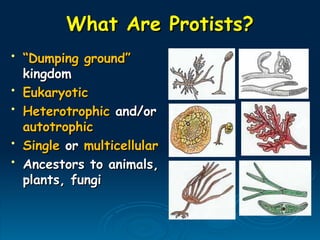
What Are Protists?
What Are Protists?
• “
“Dumping ground”
Dumping ground”
kingdom
kingdom
• Eukaryotic
Eukaryotic
• Heterotrophic
Heterotrophic and/or
and/or
autotrophic
autotrophic
• Single
Single or
or multicellular
multicellular
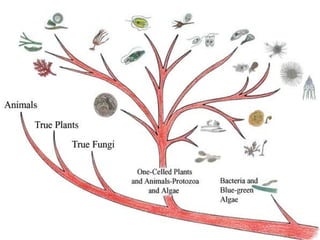
• Ancestors to animals,
Ancestors to animals,
plants, fungi
plants, fungi
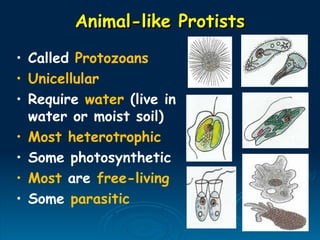
Animal-like Protists
• Called Protozoans
• Unicellular
• Require water (live in
water or moist soil)
• Most heterotrophic
• Some photosynthetic
• Most are free-living
• Some parasitic
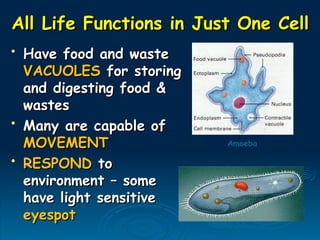
All Life Functions in Just One Cell
• Have food and waste
Have food and waste
VACUOLES
VACUOLES for storing
for storing
and digesting food &
wastes
wastes
• Many are capable of
Many are capable of
MOVEMENT
MOVEMENT
• RESPOND
RESPOND to
to
environment – some
environment – some
have light sensitive
eyespot
eyespot
Amoeba
Paramecium
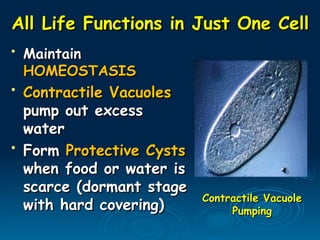
All Life Functions in Just One Cell
• Maintain
Maintain
HOMEOSTASIS
HOMEOSTASIS
• Contractile Vacuoles
Contractile Vacuoles
pump out excess
pump out excess
water
water
• Form
Form Protective Cysts
Protective Cysts
when food or water is
scarce (dormant stage
with hard covering)
with hard covering) Contractile Vacuole
Contractile Vacuole
Pumping
Pumping
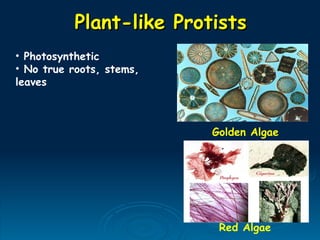
Plant-like Protists
Plant-like Protists
Red Algae
Golden Algae
• Photosynthetic
• No true roots, stems,
leaves
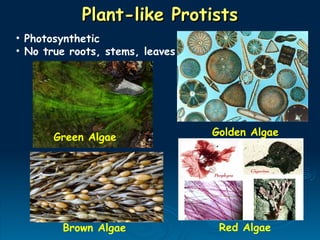
Plant-like Protists
Plant-like Protists
Green Algae
Red Algae
Brown Algae
Golden Algae
• Photosynthetic
• No true roots, stems, leaves
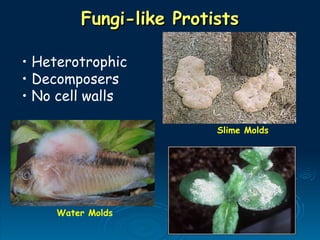
Fungi-like Protists
Fungi-like Protists
• Heterotrophic
• Decomposers
• No cell walls
Slime Molds
Water Molds
Reproduction
Reproduction
• Reproduction
Reproduction
•
Asexual:
Asexual: fission
fission
•
Sexual: produce
Sexual: produce gametes
gametes (specialized sex
(specialized sex
cells)
cells)
• Advantage: new combinations of genes
Advantage: new combinations of genes from
from
both parents (Red Queen Hypothesis)
Reproduction
Reproduction
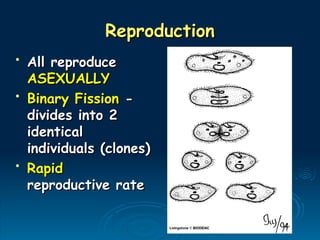
• All reproduce
All reproduce
ASEXUALLY
ASEXUALLY
• Binary Fission
Binary Fission -
-
divides into 2
divides into 2
identical
identical
individuals (clones)
• Rapid
Rapid
reproductive rate
reproductive rate
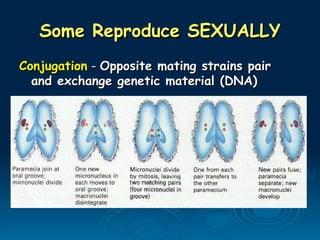
Some Reproduce SEXUALLY
Conjugation
Conjugation -
- Opposite mating strains pair
Opposite mating strains pair
and exchange genetic material (DNA)
Protist
Protist
Characteristics
Characteristics
General Characteristics
• Eukaryotic
Eukaryotic
• Unicellular
Unicellular
• Some may live in colonies
Some may live in colonies
• May be Autotrophic or
May be Autotrophic or
Heterotrophic or Both
• Some are motile
Some are motile
• Appeared about 1.5 BYA
Appeared about 1.5 BYA
Classified into Three Main Groups
• Animal-like
Animal-like… heterotrophs
… heterotrophs
capable of locomotion
• Plant-like
Plant-like… photosynthetic
… photosynthetic
autotrophs
autotrophs
• Fungus-like
Fungus-like… decomposers that
… decomposers that
reproduce by spores
reproduce by spores
• Some protists
Some protists may exhibit both
may exhibit both
animal-like & plant-like
characteristics
characteristics
Sizes of Protists
Sizes of Protists
• Unicellular
Unicellular organisms
organisms
•
microscopic
microscopic
• Colonies
Colonies
•
loosely connected groups of cells
• Coenocytes
Coenocytes
•
multinucleate masses of cytoplasm
• Multicellular
Multicellular organisms
organisms
•
composed of many cells
•
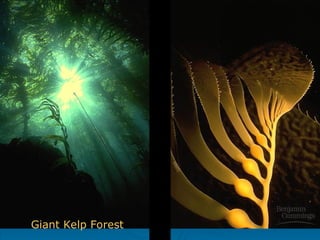
can get very large – some brown algae (the
giant kelps) can be 100 feet in length
Locomotion
Locomotion
• Protozoa used to be classified according to
Protozoa used to be classified according to
how they move.
how they move.
•
Ciliates use fine “hairs” called
Ciliates use fine “hairs” called cilia
cilia
•
Flagellates use longer, whip-like hairs called
flagella
flagella
•
Amoebas and their relatives use
Amoebas and their relatives use pseudopodia
pseudopodia
• Pseudopodia are also used to capture food
Pseudopodia are also used to capture food
•
Sporozoans (apicomplexans) don’t have any ability
to move (
to move (non-motile
non-motile)
)
Importance
Importance
• Importance of Protists
Importance of Protists
•
Heterotrophic
Heterotrophic protists =
protists = protozoa
protozoa
• Consume bacteria
Consume bacteria and other protists
and other protists
•
Components of aquatic and soil
Components of aquatic and soil food webs
food webs
•
help with
help with recycling nutrients
recycling nutrients
• Some cause
Some cause disease
disease
•
Malaria
Malaria
•
Dysentery
Dysentery
•
Sleeping sickness
Sleeping sickness
•
others
others
Interactions
Interactions
• Protists are free-living or
Protists are free-living or symbiotic
symbiotic
• Symbiotic relationships range from
Symbiotic relationships range from
mutualism
mutualism to
to parasitism
parasitism
Classification of Selected Medically
Important Protozoa
Important Protozoa
•
Four groups
Four groups
• Mastigophora - flagellates
Mastigophora - flagellates
• Sarcodina - amoebae
Sarcodina - amoebae
• Ciliophora - ciliates
Ciliophora - ciliates
• Apicomplexa – aka Sporozoans
Apicomplexa – aka Sporozoans
•
Based on:
Based on:
• Method of motility
Method of motility
• Mode of reproduction
Mode of reproduction
• Stages in the lifecycle
Stages in the lifecycle
Animal-like
Animal-like
Protists
Protists
classified by
classified by
method of
method of
movement
movement
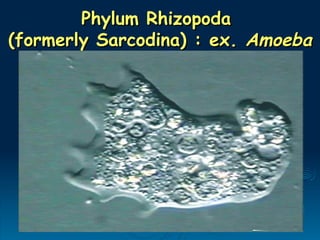
Phylum Rhizopoda
Phylum Rhizopoda
(formerly Sarcodina) : ex.
(formerly Sarcodina) : ex. Amoeba
Amoeba
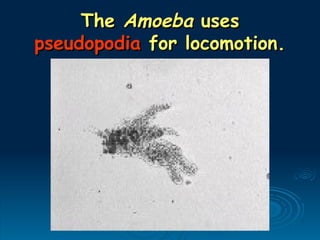
The
The Amoeba
Amoeba uses
uses
pseudopodia
pseudopodia for locomotion.
for locomotion.
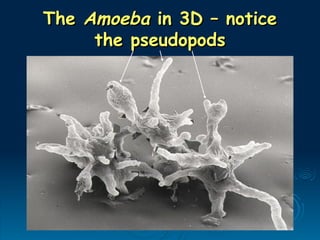
The
The Amoeba
Amoeba in 3D – notice
in 3D – notice
the pseudopods
the pseudopods
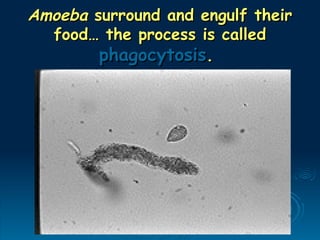
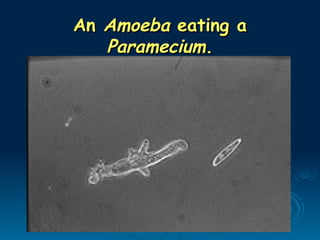
Amoeba
Amoeba surround and engulf their
surround and engulf their
food… the process is called
phagocytosis
phagocytosis.
.
An
An Amoeba
Amoeba eating a
eating a
Paramecium
Paramecium.
.
Ciliophora
Ciliophora
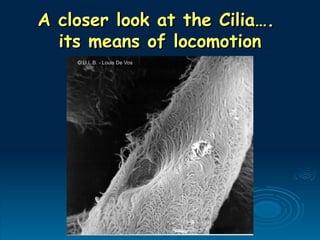
• all use cilia for movement
all use cilia for movement
• have many specialized structures,
have many specialized structures,
including mouths, anal pores,
contractile vacuoles, and two nuclei
(a large macronucleus and small
micronuclei)
micronuclei)
• Ex. –
Ex. – Paramecium
Paramecium and
and Stentor
Stentor
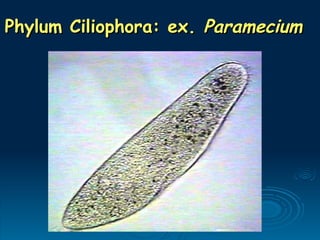
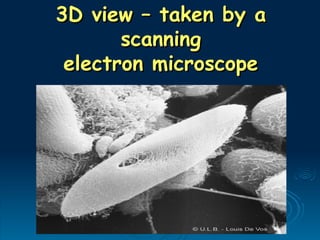
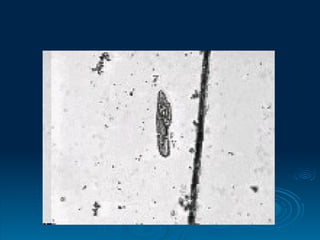
Phylum Ciliophora: ex.
Phylum Ciliophora: ex. Paramecium
Paramecium
3D view – taken by a
scanning
scanning
electron microscope
electron microscope
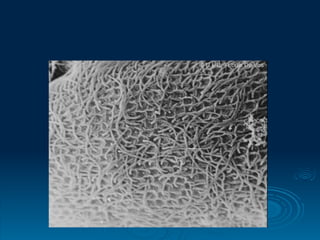
A closer look at the Cilia….
its means of locomotion
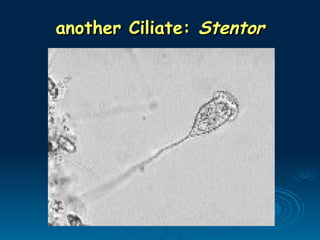
another Ciliate:
another Ciliate: Stentor
Stentor
Phylum
Phylum
Zoomastigophora
Zoomastigophora
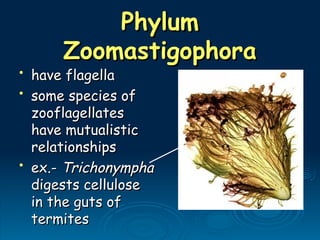
• have flagella
have flagella
• some species of
some species of
zooflagellates
zooflagellates
have mutualistic
have mutualistic
relationships
relationships
• ex.-
ex.- Trichonympha
Trichonympha
digests cellulose
digests cellulose
in the guts of
in the guts of
termites
termites
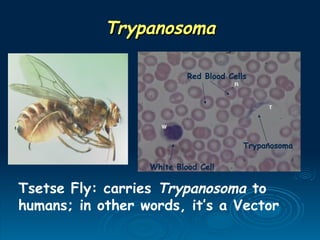
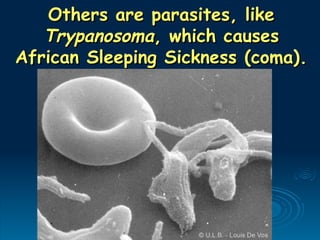
Others are parasites, like
Trypanosoma
Trypanosoma, which causes
, which causes
African Sleeping Sickness (coma).
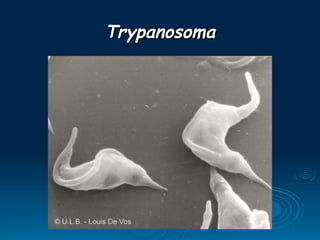
Trypanosoma
Trypanosoma
Trypanosoma
Trypanosoma
Tsetse Fly: carries Trypanosoma to
humans; in other words, it’s a Vector
White Blood Cell
Red Blood Cells
Trypanosoma
Phylum Sporozoa
Phylum Sporozoa
• are parasites
are parasites
• have no means of locomotion
have no means of locomotion
• form spores that are dispersed
form spores that are dispersed
by one or more hosts
• ex.
ex. Plasmodium
Plasmodium, which causes
, which causes
malaria
malaria
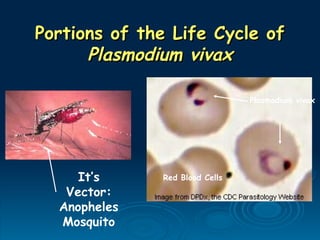
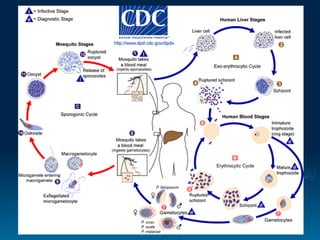
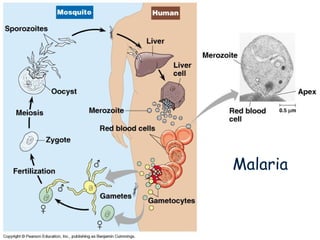
Portions of the Life Cycle of
Plasmodium vivax
Plasmodium vivax
It’s
Vector:
Anopheles
Mosquito
Plasmodium vivax
Red Blood Cells
Pathogenic Flagellates:
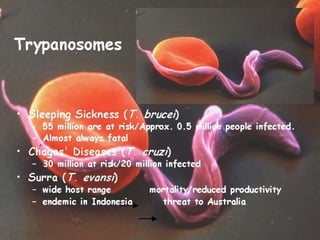
Trypanosomes
Trypanosomes
• Giardia lamblia
Giardia lamblia
• Trichomonas vaginalis
Trichomonas vaginalis
• Genus
Genus Trypanosoma
Trypanosoma
•
T. brucei
T. brucei causes sleeping sickness
causes sleeping sickness
•
T. cruzi
T. cruzi causes Chagas disease
causes Chagas disease
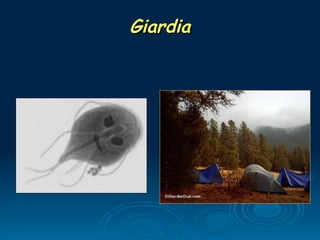
Giardia
Giardia
Giardiasis
Giardiasis
• Fecal-oral route of infection
Fecal-oral route of infection
•
recreational water, water, fomites, contaminated
uncooked food
uncooked food
• Symptoms normally begin 1 to 2 weeks (average 7 days)
Symptoms normally begin 1 to 2 weeks (average 7 days)
after becoming infected.
• Symptoms
Symptoms
•
Diarrhea
Diarrhea
•
Gas or flatulence
Gas or flatulence
•
Greasy stools that tend to float
•
Stomach or abdominal cramps
•
Upset stomach or nausea
• May lead to weight loss and dehydration
May lead to weight loss and dehydration
• Symptoms of giardiasis may last 2 to 6 weeks.
Symptoms of giardiasis may last 2 to 6 weeks.
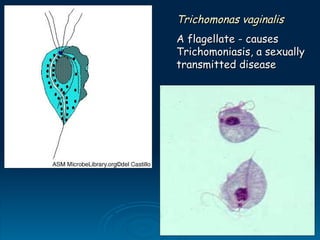
Trichomonas vaginalis
A flagellate - causes
Trichomoniasis, a sexually
transmitted disease
transmitted disease
Trichomoniasis
Trichomoniasis
• STD
STD
• Clinical Features:
Clinical Features:
•
Trichomonas vaginalis
Trichomonas vaginalis infection in women is
infection in women is
frequently symptomatic.
•
Vaginitis with a purulent discharge is the
prominent symptom, and can be accompanied by
vulvar and cervical lesions, abdominal pain, dysuria
and dyspareunia.
and dyspareunia.
•
The incubation period is 5 to 28 days.
•
In men, the infection is frequently asymptomatic;
occasionally, urethritis, epididymitis, and
prostatitis can occur.
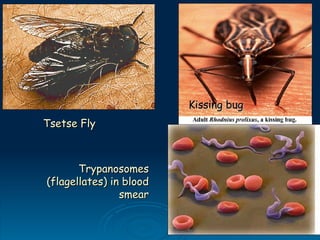
Tsetse fly
Trypanosomes
Trypanosomes
(flagellates) in blood
smear
smear
Kissing bug
Kissing bug
Tsetse Fly
Tsetse Fly
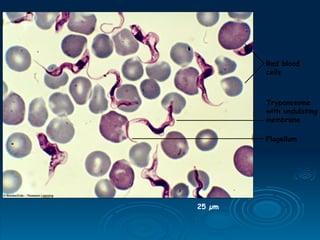
25 µm
Flagellum
Red blood
cells
Trypanosome
with undulating
membrane
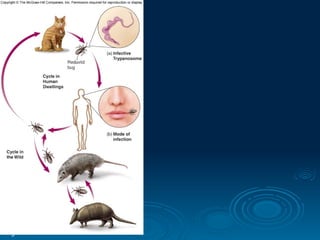
Figure 5.27
T. cruzi causes
Chagas disease
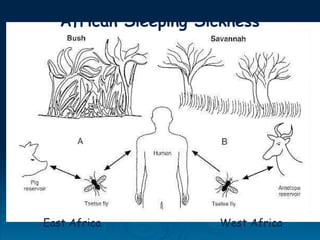
East Africa West Africa
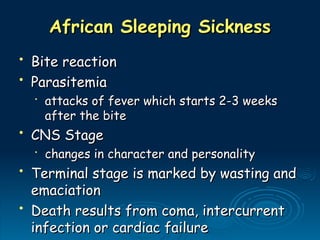
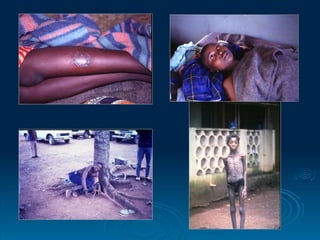
African Sleeping Sickness
• Bite reaction
Bite reaction
• Parasitemia
Parasitemia
•
attacks of fever which starts 2-3 weeks
after the bite
after the bite
• CNS Stage
CNS Stage
•
changes in character and personality
• Terminal stage is marked by wasting and
Terminal stage is marked by wasting and
emaciation
emaciation
• Death results from coma, intercurrent
Death results from coma, intercurrent
infection or cardiac failure
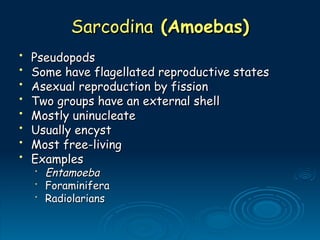
Sarcodina
Sarcodina (Amoebas)
(Amoebas)
• Pseudopods
Pseudopods
• Some have flagellated reproductive states
Some have flagellated reproductive states
• Asexual reproduction by fission
Asexual reproduction by fission
• Two groups have an external shell
Two groups have an external shell
• Mostly uninucleate
Mostly uninucleate
• Usually encyst
Usually encyst
• Most free-living
Most free-living
• Examples
Examples
•
Entamoeba
Entamoeba
•
Foraminifera
Foraminifera
•
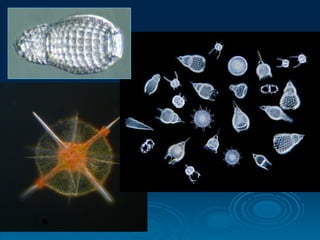
Radiolarians
Radiolarians
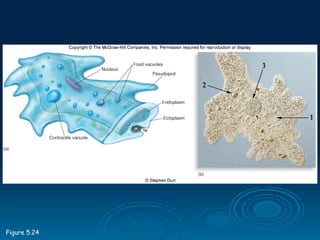
Figure 5.24
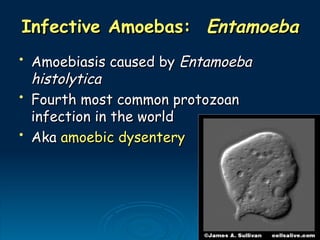
Infective Amoebas:
Infective Amoebas: Entamoeba
Entamoeba
• Amoebiasis caused by
Amoebiasis caused by Entamoeba
Entamoeba
histolytica
histolytica
• Fourth most common protozoan
Fourth most common protozoan
infection in the world
• Aka
Aka amoebic dysentery
amoebic dysentery
Figure 5.28
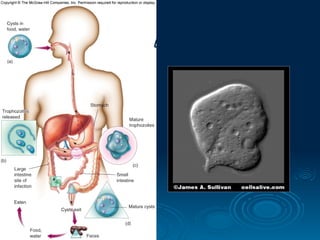
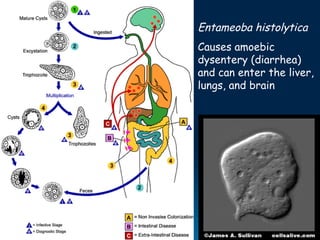
Entamoeba histolytica
Entameoba histolytica
Causes amoebic
dysentery (diarrhea)
and can enter the liver,
lungs, and brain
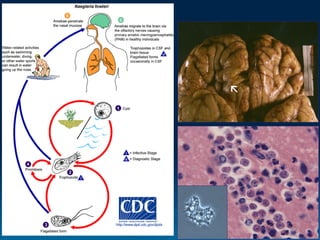
Naegleria fowleri
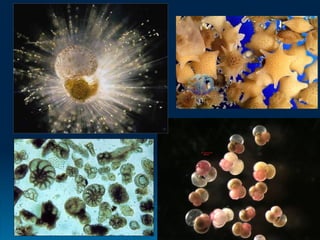
Foraminifera
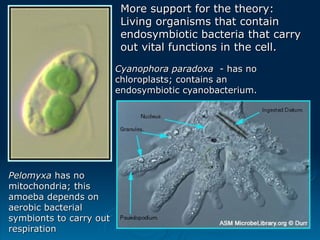
Cyanophora paradoxa
Cyanophora paradoxa - has no
- has no
chloroplasts; contains an
endosymbiotic cyanobacterium.
Pelomyxa
Pelomyxa has no
has no
mitochondria; this
mitochondria; this
amoeba depends on
amoeba depends on
aerobic bacterial
aerobic bacterial
symbionts to carry out
respiration
respiration
More support for the theory:
Living organisms that contain
endosymbiotic bacteria that carry
out vital functions in the cell.
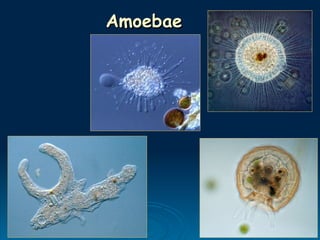
Amoebae
Amoebae
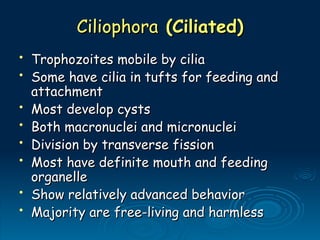
Ciliophora
Ciliophora (Ciliated)
(Ciliated)
• Trophozoites mobile by cilia
Trophozoites mobile by cilia
• Some have cilia in tufts for feeding and
Some have cilia in tufts for feeding and
attachment
attachment
• Most develop cysts
Most develop cysts
• Both macronuclei and micronuclei
Both macronuclei and micronuclei
• Division by transverse fission
Division by transverse fission
• Most have definite mouth and feeding
Most have definite mouth and feeding
organelle
organelle
• Show relatively advanced behavior
Show relatively advanced behavior
• Majority are free-living and harmless
Majority are free-living and harmless
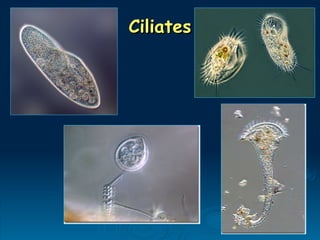
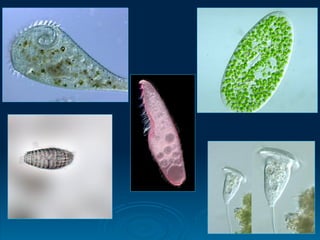
Ciliates
Ciliates
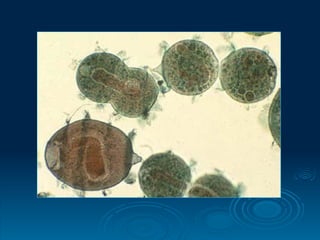
Balantidium coli
Balantidium coli
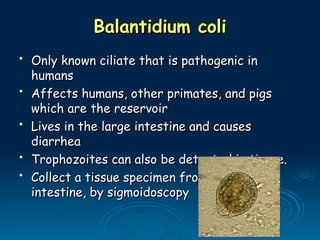
• Only known ciliate that is pathogenic in
Only known ciliate that is pathogenic in
humans
humans
• Affects humans, other primates, and pigs
Affects humans, other primates, and pigs
which are the reservoir
• Lives in the large intestine and causes
Lives in the large intestine and causes
diarrhea
diarrhea
• Trophozoites can also be detected in tissue.
Trophozoites can also be detected in tissue.
• Collect a tissue specimen from the large
Collect a tissue specimen from the large
intestine, by sigmoidoscopy
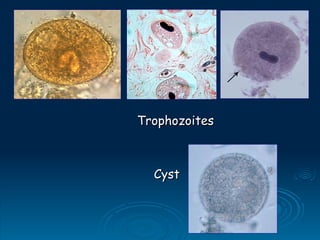
Trophozoites
Trophozoites
Cyst
Cyst
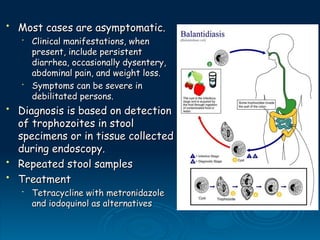
• Most cases are asymptomatic.
Most cases are asymptomatic.
•
Clinical manifestations, when
present, include persistent
diarrhea, occasionally dysentery,
abdominal pain, and weight loss.
•
Symptoms can be severe in
debilitated persons.
• Diagnosis is based on detection
Diagnosis is based on detection
of trophozoites in stool
specimens or in tissue collected
during endoscopy.
during endoscopy.
• Repeated stool samples
Repeated stool samples
• Treatment
Treatment
•
Tetracycline with metronidazole
and iodoquinol as alternatives
Apicomplexa
Apicomplexa (Sporozoa)
(Sporozoa)
• Most not motile except male gametes
Most not motile except male gametes
• Complex life cycles
Complex life cycles
• Produce
Produce sporozoites
sporozoites following sexual
following sexual
reproduction
reproduction
• Important in transmission of infections
Important in transmission of infections
• Most form oocysts
Most form oocysts
• Entire group is parasitic
Entire group is parasitic
• Examples
Examples
•
Plasmodium
Plasmodium spp
spp.
.
•
Toxoplasma gondii
Toxoplasma gondii
•
Cryptosporidium parvum
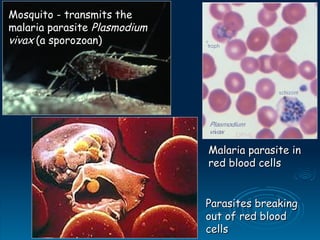
Mosquito - transmits the
malaria parasite
malaria parasite Plasmodium
Plasmodium
vivax
vivax (a sporozoan)
(a sporozoan)
Malaria parasite in
Malaria parasite in
red blood cells
red blood cells
Parasites breaking
Parasites breaking
out of red blood
out of red blood
cells
cells
Malaria
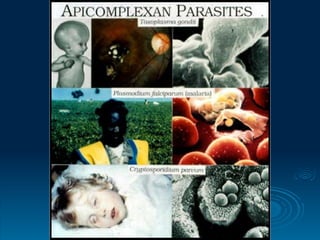
Toxoplasmosis
Toxoplasmosis
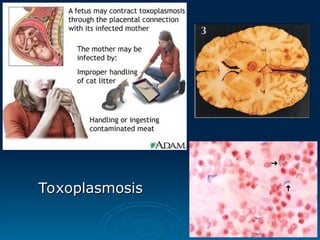
Toxoplasmosis
Toxoplasmosis
• Parasite causes eye and brain damage in a
Parasite causes eye and brain damage in a
baby, if untreated.
baby, if untreated.
• Acute infection in older children and adults
Acute infection in older children and adults
may be without symptoms, cause flu like
illness or enlarged lymph glands.
• Latent parasite occurs very commonly in
Latent parasite occurs very commonly in
people infecting approximately a third to a
half of all humans.
half of all humans.
•
Can cause active disease if a person becomes
immune compromised
immune compromised
Protozoan Identification and
Cultivation
Cultivation
• Shape and size of cell
Shape and size of cell
• Type, number, and distribution of
Type, number, and distribution of
locomotor structures
• Presence of special organelles or cysts
Presence of special organelles or cysts
• Number of nuclei
Number of nuclei
• Can be cultivated on artificial media or
Can be cultivated on artificial media or
in laboratory animals
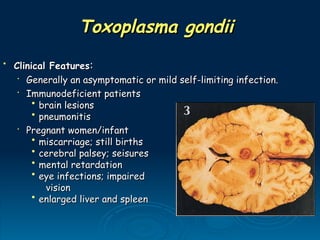
Toxoplasma gondii
Toxoplasma gondii
• Clinical Features
Clinical Features:
:
•
Generally an asymptomatic or mild self-limiting infection.
•
Immunodeficient patients
• brain lesions
brain lesions
• pneumonitis
pneumonitis
•
Pregnant women/infant
• miscarriage; still births
miscarriage; still births
• cerebral palsey; seisures
cerebral palsey; seisures
• mental retardation
mental retardation
• eye infections; impaired
eye infections; impaired
vision
vision
• enlarged liver and spleen
enlarged liver and spleen
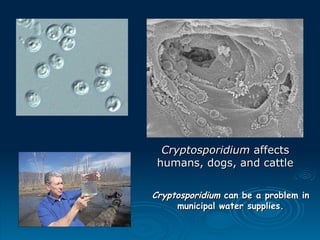
Cryptosporidium
Cryptosporidium can be a problem in
can be a problem in
municipal water supplies.
Cryptosporidium
Cryptosporidium affects
affects
humans, dogs, and cattle
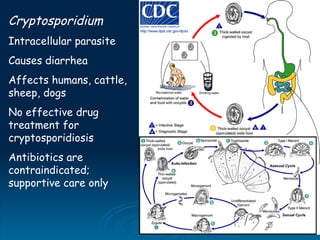
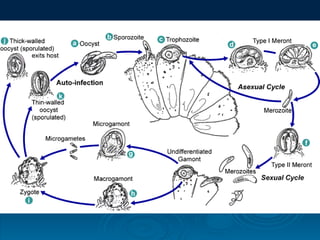
Cryptosporidium
Intracellular parasite
Causes diarrhea
Affects humans, cattle,
sheep, dogs
No effective drug
treatment for
cryptosporidiosis
Antibiotics are
contraindicated;
supportive care only
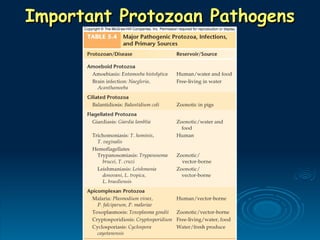
Important Protozoan Pathogens
Phylum Foraminifera
Phylum Foraminifera
• have a protective shell or TEST, usually
have a protective shell or TEST, usually
made of calcium carbonate
• layers of tests can deposit on the ocean
layers of tests can deposit on the ocean
floor
floor
•
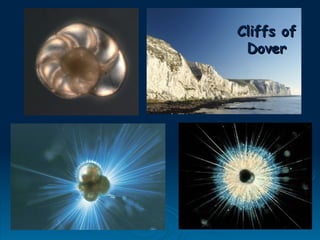
these can form limestone and chalk, like
the White Cliffs of Dover
•
Some species of forams are good indicators
of oil deposits below
Cliffs of
Cliffs of
Dover
Dover
Plant-like Protists
Plant-like Protists
are classified by
are classified by
C
CO
OL
LO
OR
R
Plant Like Protista
Plant Like Protista
• Importance of Protists
Importance of Protists
•
Autotrophic
Autotrophic protists =
protists = algae
algae
• Photosynthetic algae are the most important
Photosynthetic algae are the most important
primary producers
primary producers of the world’s freshwater and
of the world’s freshwater and
marine ecosystems
marine ecosystems
•
Many are microscopic
•
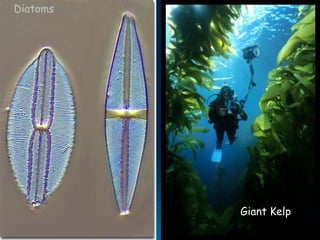
Some are huge: kelp
Some are huge: kelp
• Few cause disease
Few cause disease
•
Toxic blooms of dinoflagellates cause
• Red tides
Red tides
• shellfish poisoning
shellfish poisoning
Diatoms
Giant Kelp
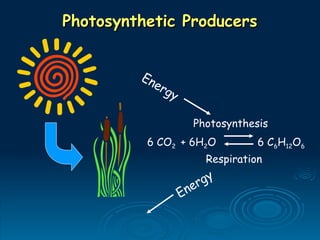
Photosynthetic Producers
6 CO2 + 6H2O 6 C6H12O6
Photosynthesis
Respiration
Energy
Energy
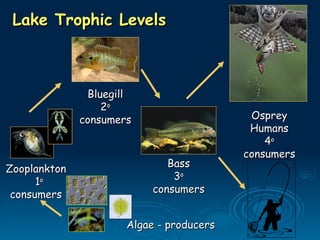
Lake Trophic Levels
Lake Trophic Levels
Zooplankton
Zooplankton
1
1o
o
consumers
consumers
Bluegill
Bluegill
2
2o
o
consumers
consumers
Algae - producers
Algae - producers
Bass
Bass
3
3o
o
consumers
consumers
Osprey
Osprey
Humans
Humans
4
4o
o
consumers
consumers
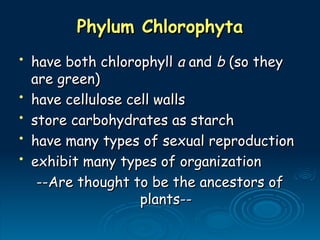
Phylum Chlorophyta
Phylum Chlorophyta
• have both chlorophyll
have both chlorophyll a
a and
and b
b (so they
(so they
are green)
are green)
• have cellulose cell walls
have cellulose cell walls
• store carbohydrates as starch
store carbohydrates as starch
• have many types of sexual reproduction
have many types of sexual reproduction
• exhibit many types of organization
exhibit many types of organization
--Are thought to be the ancestors of
plants--
plants--
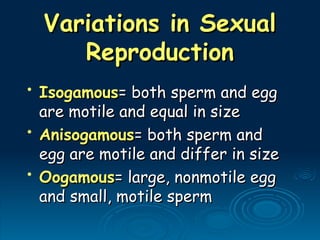
Variations in Sexual
Reproduction
Reproduction
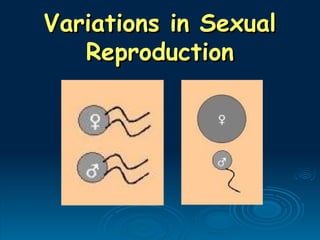
• Isogamous
Isogamous= both sperm and egg
= both sperm and egg
are motile and equal in size
• Anisogamous
Anisogamous= both sperm and
= both sperm and
egg are motile and differ in size
• Oogamous
Oogamous= large, nonmotile egg
= large, nonmotile egg
and small, motile sperm
Variations in Sexual
Reproduction
Reproduction
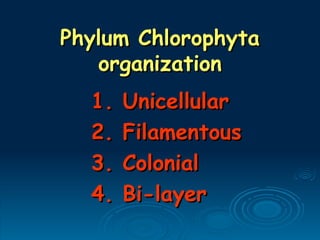
Phylum Chlorophyta
Phylum Chlorophyta
organization
organization
1. Unicellular
1. Unicellular
2. Filamentous
2. Filamentous
3. Colonial
3. Colonial
4. Bi-layer
4. Bi-layer
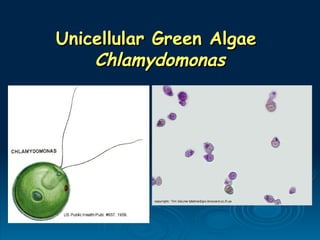
Unicellular Green Algae
Chlamydomonas
Chlamydomonas
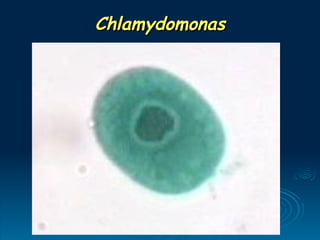
Chlamydomonas
Chlamydomonas
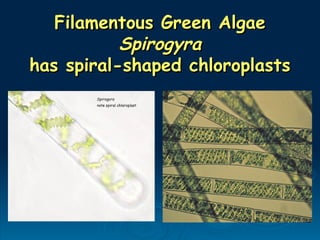
Filamentous Green Algae
Spirogyra
Spirogyra
has spiral-shaped chloroplasts
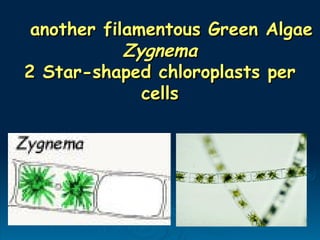
another filamentous Green Algae
Zygnema
Zygnema
2 Star-shaped chloroplasts per
cells
cells
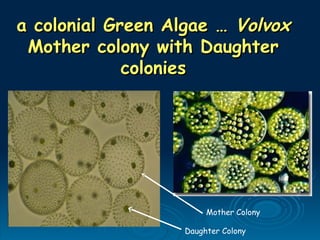
a colonial Green Algae …
a colonial Green Algae … Volvox
Volvox
Mother colony with Daughter
colonies
colonies
Mother Colony
Daughter Colony
a bi-layered Green
a bi-layered Green
Algae
Algae
Ulva
Ulva (sea lettuce)
(sea lettuce)
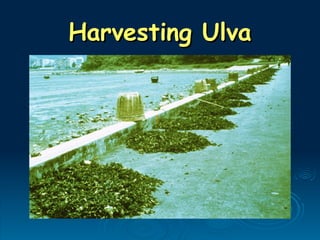
Harvesting Ulva
Harvesting Ulva
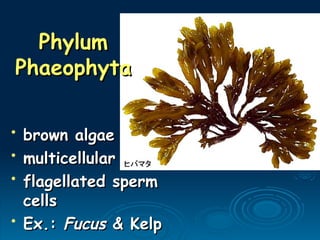
Phylum
Phylum
Phaeophyta
Phaeophyta
• brown algae
brown algae
• multicellular
multicellular
• flagellated sperm
flagellated sperm
cells
cells
• Ex.:
Ex.: Fucus
Fucus & Kelp
& Kelp
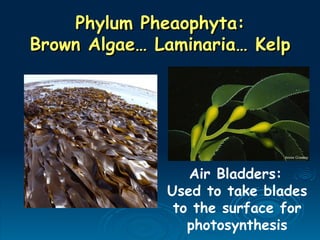
Phylum Pheaophyta:
Phylum Pheaophyta:
Brown Algae… Laminaria… Kelp
Air Bladders:
Used to take blades
to the surface for
photosynthesis
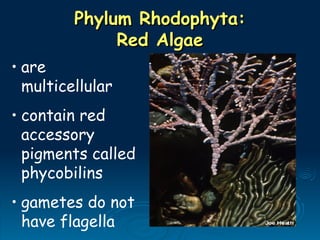
Phylum Rhodophyta:
Phylum Rhodophyta:
Red Algae
Red Algae
• are
multicellular
• contain red
accessory
pigments called
phycobilins
• gametes do not
have flagella
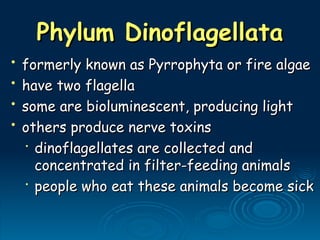
• formerly known as Pyrrophyta or fire algae
formerly known as Pyrrophyta or fire algae
• have two flagella
have two flagella
• some are bioluminescent, producing light
some are bioluminescent, producing light
• others produce nerve toxins
others produce nerve toxins
•
dinoflagellates are collected and
concentrated in filter-feeding animals
•
people who eat these animals become sick
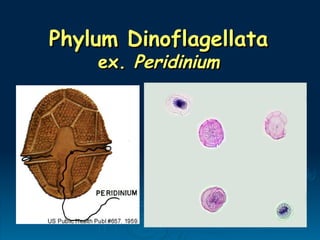
Phylum Dinoflagellata
ex.
ex. Peridinium
Peridinium
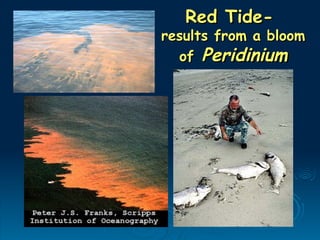
Red Tide-
Red Tide-
results from a bloom
of
of Peridinium
Peridinium
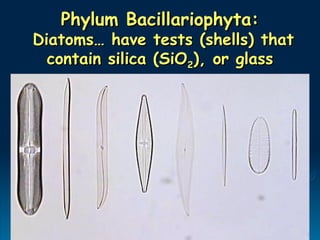
Phylum Bacillariophyta:
Diatoms… have tests (shells) that
contain silica (SiO
contain silica (SiO2
2), or glass
), or glass
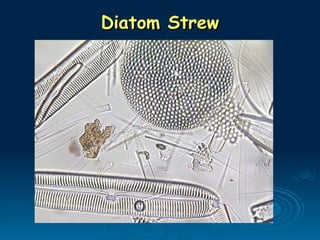
Diatom Strew
Diatom Strew
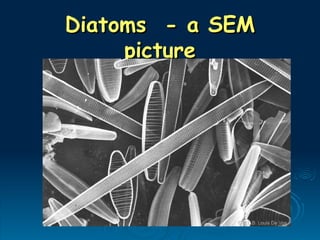
Diatoms - a SEM
Diatoms - a SEM
picture
picture
Phylum Euglenophyta
Phylum Euglenophyta
• have one to three flagella at their
have one to three flagella at their
leading (apical) end
• have thin protein strips called pellicles
have thin protein strips called pellicles
wrapped over their membranes
• have an eyespot that permits them to
have an eyespot that permits them to
swim toward light
swim toward light
• can become heterotrophic when there
can become heterotrophic when there
is no light
is no light
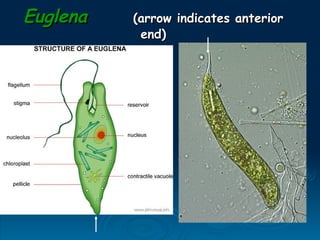
Euglena
Euglena (arrow indicates anterior
(arrow indicates anterior
end)
end)
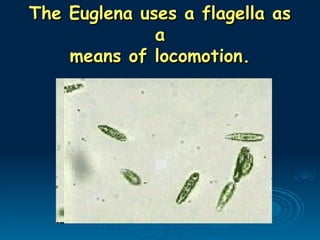
The Euglena uses a flagella as
a
a
means of locomotion.
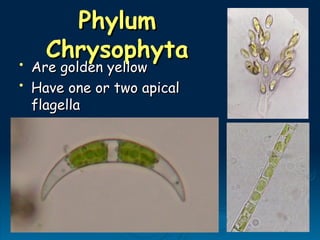
Phylum
Phylum
Chrysophyta
Chrysophyta
• Are golden yellow
Are golden yellow
• Have one or two apical
Have one or two apical
flagella
flagella
MORE
MORE
Examples of Autotrophic
Protists (Algae)
Protists (Algae)
Giant Kelp Forest
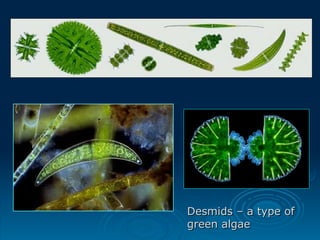
Desmids – a type of
Desmids – a type of
green algae
green algae
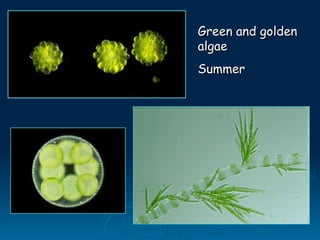
Green and golden
Green and golden
algae
algae
Summer
Summer
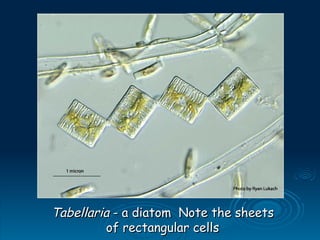
Tabellaria
Tabellaria - a diatom Note the sheets
- a diatom Note the sheets
of rectangular cells
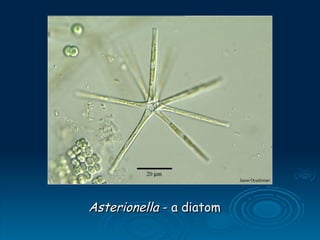
Asterionella
Asterionella - a diatom
- a diatom
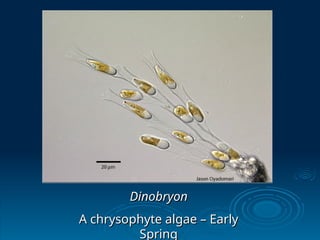
Dinobryon
Dinobryon
A chrysophyte algae – Early
Spring
Spring
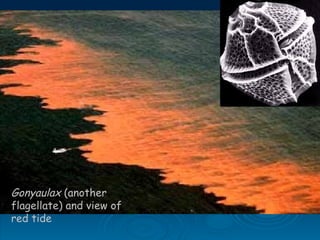
Gonyaulax (another
flagellate) and view of
red tide
Fungal Like
Fungal Like
Protists
Protists
Habitats
Habitats
• Most protists live in
Most protists live in
•
ocean
ocean
•
freshwater ponds
freshwater ponds
•
lakes
lakes
•
Streams
Streams
•
Soil
Soil
• Parasitic protists live in body fluids of
Parasitic protists live in body fluids of
hosts
hosts
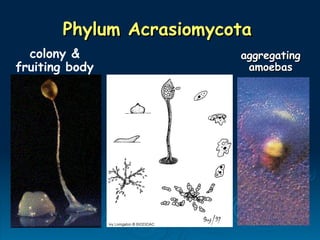
Phylum Acrasiomycota:
Cellular Slime Molds
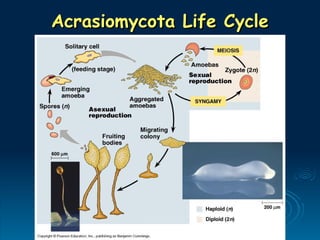
• have both fungus and protist characteristics
have both fungus and protist characteristics
• spores germinate into amoebas that feed on
spores germinate into amoebas that feed on
bacteria
bacteria
• When food is depleted,
When food is depleted, cyclic AMP
cyclic AMP is released,
is released,
causing amoebas to aggregate into one unit
• the crowd of amoebas form a slug that migrates
the crowd of amoebas form a slug that migrates
• cells from the slug form a stalk with a capsule,
cells from the slug form a stalk with a capsule,
which makes spores
which makes spores
• spores are released, and the cycle repeats
spores are released, and the cycle repeats
Acrasiomycota Life Cycle
Phylum Acrasiomycota
aggregating
aggregating
amoebas
amoebas
colony &
fruiting body
Phylum Myxomycota: Plasmodial
Slime Molds
Slime Molds
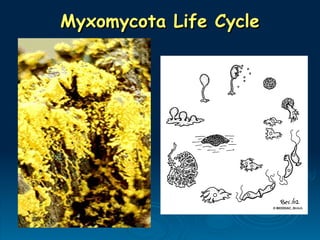
• grow as a single, spreading mass or plasmodium
grow as a single, spreading mass or plasmodium
• feed on decaying vegetation
feed on decaying vegetation
• when the environment becomes unfavorable (no
when the environment becomes unfavorable (no
food or water), they form stalks and spore-
producing capsules
producing capsules
• haploid spores germinate into amoeboid or
haploid spores germinate into amoeboid or
flagellated cells
flagellated cells
• these cells fuse to form a new diploid plasmodium
these cells fuse to form a new diploid plasmodium
Myxomycota Life Cycle
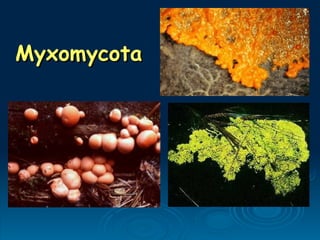
Myxomycota
Myxomycota
Phylum Oomycota
Phylum Oomycota
• are parasitic and saprophytic
are parasitic and saprophytic
• form filaments, or
form filaments, or hypha
hyphae (like fungi)
e (like fungi)
• secrete enzymes into surroundings &
secrete enzymes into surroundings &
absorb nutrients (like fungi)
• filaments lack
filaments lack septa
septa or
or cross walls
cross walls
resulting in many nuclei in a cell, they are
coenocytic
coenocytic
• have cell walls made of cellulose, not
have cell walls made of cellulose, not
chitin
chitin
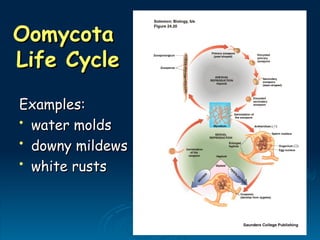
Examples:
Examples:
• water molds
water molds
• downy mildews
downy mildews
• white rusts
white rusts
Oomycota
Oomycota
Life Cycle
Life Cycle
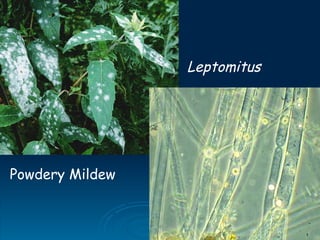
Leptomitus
Powdery Mildew
Phylum Oomycota
Phylum Oomycota
• potatoes are native to North America
potatoes are native to North America
• they were introduced to Europe and
they were introduced to Europe and
became a staple of the diet
• during the summer of 1846 most of
during the summer of 1846 most of
the potato crop was destroyed by
Phytophthora
Phytophthora (an oomycota)
(an oomycota)
• nearly 1,000,000 Irish people died, and
nearly 1,000,000 Irish people died, and
1,500,000 emigrated to other
countries, like the U.S.
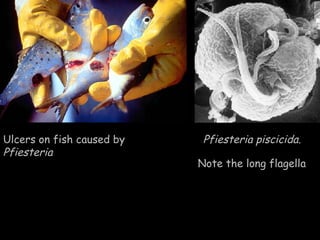
Pfiesteria piscicida.
Ulcers on fish caused by
Pfiesteria
Note the long flagella
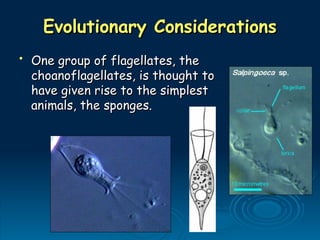
Evolutionary Considerations
• One group of flagellates, the
One group of flagellates, the
choanoflagellates, is thought to
have given rise to the simplest
animals, the sponges.
PROTISTA PPPPPPPPPPPPPPPPPPPCC revised.ppt

PROTISTA PPPPPPPPPPPPPPPPPPPCC revised.ppt

  • 1.
  • 2.
    KEY CONCEPTS KEY CONCEPTS •Protists are a diverse group of Protists are a diverse group of eukaryotic organisms, most of which are eukaryotic organisms, most of which are microscopic microscopic
  • 3.
    Protista Protista • Not areally valid “Kingdom” Not a really valid “Kingdom” • Few real evolutionary relationships Few real evolutionary relationships • Contains Contains • Algae Algae: “plant-like” protists : “plant-like” protists • Protozoa Protozoa: “animal-like” protists : “animal-like” protists • Slime & Water molds Slime & Water molds: fungal-like : fungal-like protists protists
  • 5.
    What Are Protists? WhatAre Protists? • “ “Dumping ground” Dumping ground” kingdom kingdom • Eukaryotic Eukaryotic • Heterotrophic Heterotrophic and/or and/or autotrophic autotrophic • Single Single or or multicellular multicellular • Ancestors to animals, Ancestors to animals, plants, fungi plants, fungi
  • 6.
    Animal-like Protists Animal-like Protists •Called Protozoans • Unicellular • Require water (live in water or moist soil) • Most heterotrophic • Some photosynthetic • Most are free-living • Some parasitic
  • 7.
    All Life Functionsin Just One Cell All Life Functions in Just One Cell • Have food and waste Have food and waste VACUOLES VACUOLES for storing for storing and digesting food & and digesting food & wastes wastes • Many are capable of Many are capable of MOVEMENT MOVEMENT • RESPOND RESPOND to to environment – some environment – some have light sensitive have light sensitive eyespot eyespot Amoeba Paramecium
  • 8.
    All Life Functionsin Just One Cell All Life Functions in Just One Cell • Maintain Maintain HOMEOSTASIS HOMEOSTASIS • Contractile Vacuoles Contractile Vacuoles pump out excess pump out excess water water • Form Form Protective Cysts Protective Cysts when food or water is when food or water is scarce (dormant stage scarce (dormant stage with hard covering) with hard covering) Contractile Vacuole Contractile Vacuole Pumping Pumping
  • 9.
    Plant-like Protists Plant-like Protists RedAlgae Golden Algae • Photosynthetic • No true roots, stems, leaves
  • 10.
    Plant-like Protists Plant-like Protists GreenAlgae Red Algae Brown Algae Golden Algae • Photosynthetic • No true roots, stems, leaves
  • 11.
    Fungi-like Protists Fungi-like Protists •Heterotrophic • Decomposers • No cell walls Slime Molds Water Molds
  • 12.
    Reproduction Reproduction • Reproduction Reproduction • Asexual: Asexual: fission fission • Sexual:produce Sexual: produce gametes gametes (specialized sex (specialized sex cells) cells) • Advantage: new combinations of genes Advantage: new combinations of genes from from both parents (Red Queen Hypothesis) both parents (Red Queen Hypothesis)
  • 13.
    Reproduction Reproduction • All reproduce Allreproduce ASEXUALLY ASEXUALLY • Binary Fission Binary Fission - - divides into 2 divides into 2 identical identical individuals (clones) individuals (clones) • Rapid Rapid reproductive rate reproductive rate
  • 14.
    Some Reproduce SEXUALLY SomeReproduce SEXUALLY Conjugation Conjugation - - Opposite mating strains pair Opposite mating strains pair and exchange genetic material (DNA) and exchange genetic material (DNA)
  • 15.
  • 16.
    General Characteristics General Characteristics •Eukaryotic Eukaryotic • Unicellular Unicellular • Some may live in colonies Some may live in colonies • May be Autotrophic or May be Autotrophic or Heterotrophic or Both Heterotrophic or Both • Some are motile Some are motile • Appeared about 1.5 BYA Appeared about 1.5 BYA
  • 17.
    Classified into ThreeMain Groups Classified into Three Main Groups • Animal-like Animal-like… heterotrophs … heterotrophs capable of locomotion capable of locomotion • Plant-like Plant-like… photosynthetic … photosynthetic autotrophs autotrophs • Fungus-like Fungus-like… decomposers that … decomposers that reproduce by spores reproduce by spores • Some protists Some protists may exhibit both may exhibit both animal-like & plant-like animal-like & plant-like characteristics characteristics
  • 18.
    Sizes of Protists Sizesof Protists • Unicellular Unicellular organisms organisms • microscopic microscopic • Colonies Colonies • loosely connected groups of cells loosely connected groups of cells • Coenocytes Coenocytes • multinucleate masses of cytoplasm multinucleate masses of cytoplasm • Multicellular Multicellular organisms organisms • composed of many cells composed of many cells • can get very large – some brown algae (the can get very large – some brown algae (the giant kelps) can be 100 feet in length giant kelps) can be 100 feet in length
  • 19.
    Locomotion Locomotion • Protozoa usedto be classified according to Protozoa used to be classified according to how they move. how they move. • Ciliates use fine “hairs” called Ciliates use fine “hairs” called cilia cilia • Flagellates use longer, whip-like hairs called Flagellates use longer, whip-like hairs called flagella flagella • Amoebas and their relatives use Amoebas and their relatives use pseudopodia pseudopodia • Pseudopodia are also used to capture food Pseudopodia are also used to capture food • Sporozoans (apicomplexans) don’t have any ability Sporozoans (apicomplexans) don’t have any ability to move ( to move (non-motile non-motile) )
  • 20.
    Importance Importance • Importance ofProtists Importance of Protists • Heterotrophic Heterotrophic protists = protists = protozoa protozoa • Consume bacteria Consume bacteria and other protists and other protists • Components of aquatic and soil Components of aquatic and soil food webs food webs • help with help with recycling nutrients recycling nutrients • Some cause Some cause disease disease • Malaria Malaria • Dysentery Dysentery • Sleeping sickness Sleeping sickness • others others
  • 21.
    Interactions Interactions • Protists arefree-living or Protists are free-living or symbiotic symbiotic • Symbiotic relationships range from Symbiotic relationships range from mutualism mutualism to to parasitism parasitism
  • 22.
    Classification of SelectedMedically Classification of Selected Medically Important Protozoa Important Protozoa • Four groups Four groups • Mastigophora - flagellates Mastigophora - flagellates • Sarcodina - amoebae Sarcodina - amoebae • Ciliophora - ciliates Ciliophora - ciliates • Apicomplexa – aka Sporozoans Apicomplexa – aka Sporozoans • Based on: Based on: • Method of motility Method of motility • Mode of reproduction Mode of reproduction • Stages in the lifecycle Stages in the lifecycle
  • 23.
  • 24.
    Phylum Rhizopoda Phylum Rhizopoda (formerlySarcodina) : ex. (formerly Sarcodina) : ex. Amoeba Amoeba
  • 25.
  • 26.
    The The Amoeba Amoeba in3D – notice in 3D – notice the pseudopods the pseudopods
  • 28.
    Amoeba Amoeba surround andengulf their surround and engulf their food… the process is called food… the process is called phagocytosis phagocytosis. .
  • 29.
    An An Amoeba Amoeba eatinga eating a Paramecium Paramecium. .
  • 30.
    Ciliophora Ciliophora • all usecilia for movement all use cilia for movement • have many specialized structures, have many specialized structures, including mouths, anal pores, including mouths, anal pores, contractile vacuoles, and two nuclei contractile vacuoles, and two nuclei (a large macronucleus and small (a large macronucleus and small micronuclei) micronuclei) • Ex. – Ex. – Paramecium Paramecium and and Stentor Stentor
  • 31.
    Phylum Ciliophora: ex. PhylumCiliophora: ex. Paramecium Paramecium
  • 32.
    3D view –taken by a 3D view – taken by a scanning scanning electron microscope electron microscope
  • 33.
    A closer lookat the Cilia…. A closer look at the Cilia…. its means of locomotion its means of locomotion
  • 36.
  • 37.
    Phylum Phylum Zoomastigophora Zoomastigophora • have flagella haveflagella • some species of some species of zooflagellates zooflagellates have mutualistic have mutualistic relationships relationships • ex.- ex.- Trichonympha Trichonympha digests cellulose digests cellulose in the guts of in the guts of termites termites
  • 38.
    Others are parasites,like Others are parasites, like Trypanosoma Trypanosoma, which causes , which causes African Sleeping Sickness (coma). African Sleeping Sickness (coma).
  • 39.
  • 40.
    Trypanosoma Trypanosoma Tsetse Fly: carriesTrypanosoma to humans; in other words, it’s a Vector White Blood Cell Red Blood Cells Trypanosoma
  • 42.
    Phylum Sporozoa Phylum Sporozoa •are parasites are parasites • have no means of locomotion have no means of locomotion • form spores that are dispersed form spores that are dispersed by one or more hosts by one or more hosts • ex. ex. Plasmodium Plasmodium, which causes , which causes malaria malaria
  • 43.
    Portions of theLife Cycle of Portions of the Life Cycle of Plasmodium vivax Plasmodium vivax It’s Vector: Anopheles Mosquito Plasmodium vivax Red Blood Cells
  • 45.
    Pathogenic Flagellates: Pathogenic Flagellates: Trypanosomes Trypanosomes •Giardia lamblia Giardia lamblia • Trichomonas vaginalis Trichomonas vaginalis • Genus Genus Trypanosoma Trypanosoma • T. brucei T. brucei causes sleeping sickness causes sleeping sickness • T. cruzi T. cruzi causes Chagas disease causes Chagas disease
  • 46.
  • 47.
    Giardiasis Giardiasis • Fecal-oral routeof infection Fecal-oral route of infection • recreational water, water, fomites, contaminated recreational water, water, fomites, contaminated uncooked food uncooked food • Symptoms normally begin 1 to 2 weeks (average 7 days) Symptoms normally begin 1 to 2 weeks (average 7 days) after becoming infected. after becoming infected. • Symptoms Symptoms • Diarrhea Diarrhea • Gas or flatulence Gas or flatulence • Greasy stools that tend to float Greasy stools that tend to float • Stomach or abdominal cramps Stomach or abdominal cramps • Upset stomach or nausea Upset stomach or nausea • May lead to weight loss and dehydration May lead to weight loss and dehydration • Symptoms of giardiasis may last 2 to 6 weeks. Symptoms of giardiasis may last 2 to 6 weeks.
  • 48.
    Trichomonas vaginalis Trichomonas vaginalis Aflagellate - causes A flagellate - causes Trichomoniasis, a sexually Trichomoniasis, a sexually transmitted disease transmitted disease
  • 49.
    Trichomoniasis Trichomoniasis • STD STD • ClinicalFeatures: Clinical Features: • Trichomonas vaginalis Trichomonas vaginalis infection in women is infection in women is frequently symptomatic. frequently symptomatic. • Vaginitis with a purulent discharge is the Vaginitis with a purulent discharge is the prominent symptom, and can be accompanied by prominent symptom, and can be accompanied by vulvar and cervical lesions, abdominal pain, dysuria vulvar and cervical lesions, abdominal pain, dysuria and dyspareunia. and dyspareunia. • The incubation period is 5 to 28 days. The incubation period is 5 to 28 days. • In men, the infection is frequently asymptomatic; In men, the infection is frequently asymptomatic; occasionally, urethritis, epididymitis, and occasionally, urethritis, epididymitis, and prostatitis can occur. prostatitis can occur.
  • 51.
    Tsetse fly Trypanosomes Trypanosomes (flagellates) inblood (flagellates) in blood smear smear Kissing bug Kissing bug Tsetse Fly Tsetse Fly
  • 52.
  • 53.
    Figure 5.27 T. cruzicauses Chagas disease
  • 54.
    East Africa WestAfrica African Sleeping Sickness
  • 55.
    African Sleeping Sickness AfricanSleeping Sickness • Bite reaction Bite reaction • Parasitemia Parasitemia • attacks of fever which starts 2-3 weeks attacks of fever which starts 2-3 weeks after the bite after the bite • CNS Stage CNS Stage • changes in character and personality changes in character and personality • Terminal stage is marked by wasting and Terminal stage is marked by wasting and emaciation emaciation • Death results from coma, intercurrent Death results from coma, intercurrent infection or cardiac failure infection or cardiac failure
  • 57.
    Sarcodina Sarcodina (Amoebas) (Amoebas) • Pseudopods Pseudopods •Some have flagellated reproductive states Some have flagellated reproductive states • Asexual reproduction by fission Asexual reproduction by fission • Two groups have an external shell Two groups have an external shell • Mostly uninucleate Mostly uninucleate • Usually encyst Usually encyst • Most free-living Most free-living • Examples Examples • Entamoeba Entamoeba • Foraminifera Foraminifera • Radiolarians Radiolarians
  • 58.
  • 59.
    Infective Amoebas: Infective Amoebas:Entamoeba Entamoeba • Amoebiasis caused by Amoebiasis caused by Entamoeba Entamoeba histolytica histolytica • Fourth most common protozoan Fourth most common protozoan infection in the world infection in the world • Aka Aka amoebic dysentery amoebic dysentery
  • 60.
  • 61.
    Entameoba histolytica Causes amoebic dysentery(diarrhea) and can enter the liver, lungs, and brain
  • 62.
  • 63.
  • 65.
    Cyanophora paradoxa Cyanophora paradoxa- has no - has no chloroplasts; contains an chloroplasts; contains an endosymbiotic cyanobacterium. endosymbiotic cyanobacterium. Pelomyxa Pelomyxa has no has no mitochondria; this mitochondria; this amoeba depends on amoeba depends on aerobic bacterial aerobic bacterial symbionts to carry out symbionts to carry out respiration respiration More support for the theory: More support for the theory: Living organisms that contain Living organisms that contain endosymbiotic bacteria that carry endosymbiotic bacteria that carry out vital functions in the cell. out vital functions in the cell.
  • 66.
  • 67.
    Ciliophora Ciliophora (Ciliated) (Ciliated) • Trophozoitesmobile by cilia Trophozoites mobile by cilia • Some have cilia in tufts for feeding and Some have cilia in tufts for feeding and attachment attachment • Most develop cysts Most develop cysts • Both macronuclei and micronuclei Both macronuclei and micronuclei • Division by transverse fission Division by transverse fission • Most have definite mouth and feeding Most have definite mouth and feeding organelle organelle • Show relatively advanced behavior Show relatively advanced behavior • Majority are free-living and harmless Majority are free-living and harmless
  • 68.
  • 71.
    Balantidium coli Balantidium coli •Only known ciliate that is pathogenic in Only known ciliate that is pathogenic in humans humans • Affects humans, other primates, and pigs Affects humans, other primates, and pigs which are the reservoir which are the reservoir • Lives in the large intestine and causes Lives in the large intestine and causes diarrhea diarrhea • Trophozoites can also be detected in tissue. Trophozoites can also be detected in tissue. • Collect a tissue specimen from the large Collect a tissue specimen from the large intestine, by sigmoidoscopy intestine, by sigmoidoscopy
  • 72.
  • 73.
    • Most casesare asymptomatic. Most cases are asymptomatic. • Clinical manifestations, when Clinical manifestations, when present, include persistent present, include persistent diarrhea, occasionally dysentery, diarrhea, occasionally dysentery, abdominal pain, and weight loss. abdominal pain, and weight loss. • Symptoms can be severe in Symptoms can be severe in debilitated persons. debilitated persons. • Diagnosis is based on detection Diagnosis is based on detection of trophozoites in stool of trophozoites in stool specimens or in tissue collected specimens or in tissue collected during endoscopy. during endoscopy. • Repeated stool samples Repeated stool samples • Treatment Treatment • Tetracycline with metronidazole Tetracycline with metronidazole and iodoquinol as alternatives and iodoquinol as alternatives
  • 75.
    Apicomplexa Apicomplexa (Sporozoa) (Sporozoa) • Mostnot motile except male gametes Most not motile except male gametes • Complex life cycles Complex life cycles • Produce Produce sporozoites sporozoites following sexual following sexual reproduction reproduction • Important in transmission of infections Important in transmission of infections • Most form oocysts Most form oocysts • Entire group is parasitic Entire group is parasitic • Examples Examples • Plasmodium Plasmodium spp spp. . • Toxoplasma gondii Toxoplasma gondii • Cryptosporidium parvum Cryptosporidium parvum
  • 77.
    Mosquito - transmitsthe Mosquito - transmits the malaria parasite malaria parasite Plasmodium Plasmodium vivax vivax (a sporozoan) (a sporozoan) Malaria parasite in Malaria parasite in red blood cells red blood cells Parasites breaking Parasites breaking out of red blood out of red blood cells cells
  • 78.
  • 79.
  • 80.
    Toxoplasmosis Toxoplasmosis • Parasite causeseye and brain damage in a Parasite causes eye and brain damage in a baby, if untreated. baby, if untreated. • Acute infection in older children and adults Acute infection in older children and adults may be without symptoms, cause flu like may be without symptoms, cause flu like illness or enlarged lymph glands. illness or enlarged lymph glands. • Latent parasite occurs very commonly in Latent parasite occurs very commonly in people infecting approximately a third to a people infecting approximately a third to a half of all humans. half of all humans. • Can cause active disease if a person becomes Can cause active disease if a person becomes immune compromised immune compromised
  • 81.
    Protozoan Identification and ProtozoanIdentification and Cultivation Cultivation • Shape and size of cell Shape and size of cell • Type, number, and distribution of Type, number, and distribution of locomotor structures locomotor structures • Presence of special organelles or cysts Presence of special organelles or cysts • Number of nuclei Number of nuclei • Can be cultivated on artificial media or Can be cultivated on artificial media or in laboratory animals in laboratory animals
  • 82.
    Toxoplasma gondii Toxoplasma gondii •Clinical Features Clinical Features: : • Generally an asymptomatic or mild self-limiting infection. Generally an asymptomatic or mild self-limiting infection. • Immunodeficient patients Immunodeficient patients • brain lesions brain lesions • pneumonitis pneumonitis • Pregnant women/infant Pregnant women/infant • miscarriage; still births miscarriage; still births • cerebral palsey; seisures cerebral palsey; seisures • mental retardation mental retardation • eye infections; impaired eye infections; impaired vision vision • enlarged liver and spleen enlarged liver and spleen
  • 83.
    Cryptosporidium Cryptosporidium can bea problem in can be a problem in municipal water supplies. municipal water supplies. Cryptosporidium Cryptosporidium affects affects humans, dogs, and cattle humans, dogs, and cattle
  • 84.
    Cryptosporidium Intracellular parasite Causes diarrhea Affectshumans, cattle, sheep, dogs No effective drug treatment for cryptosporidiosis Antibiotics are contraindicated; supportive care only
  • 87.
  • 88.
    Phylum Foraminifera Phylum Foraminifera •have a protective shell or TEST, usually have a protective shell or TEST, usually made of calcium carbonate made of calcium carbonate • layers of tests can deposit on the ocean layers of tests can deposit on the ocean floor floor • these can form limestone and chalk, like these can form limestone and chalk, like the White Cliffs of Dover the White Cliffs of Dover • Some species of forams are good indicators Some species of forams are good indicators of oil deposits below of oil deposits below
  • 89.
  • 90.
    Plant-like Protists Plant-like Protists areclassified by are classified by C CO OL LO OR R
  • 91.
    Plant Like Protista PlantLike Protista • Importance of Protists Importance of Protists • Autotrophic Autotrophic protists = protists = algae algae • Photosynthetic algae are the most important Photosynthetic algae are the most important primary producers primary producers of the world’s freshwater and of the world’s freshwater and marine ecosystems marine ecosystems • Many are microscopic Many are microscopic • Some are huge: kelp Some are huge: kelp • Few cause disease Few cause disease • Toxic blooms of dinoflagellates cause Toxic blooms of dinoflagellates cause • Red tides Red tides • shellfish poisoning shellfish poisoning
  • 92.
  • 93.
    Photosynthetic Producers Photosynthetic Producers 6CO2 + 6H2O 6 C6H12O6 Photosynthesis Respiration Energy Energy
  • 94.
    Lake Trophic Levels LakeTrophic Levels Zooplankton Zooplankton 1 1o o consumers consumers Bluegill Bluegill 2 2o o consumers consumers Algae - producers Algae - producers Bass Bass 3 3o o consumers consumers Osprey Osprey Humans Humans 4 4o o consumers consumers
  • 95.
    Phylum Chlorophyta Phylum Chlorophyta •have both chlorophyll have both chlorophyll a a and and b b (so they (so they are green) are green) • have cellulose cell walls have cellulose cell walls • store carbohydrates as starch store carbohydrates as starch • have many types of sexual reproduction have many types of sexual reproduction • exhibit many types of organization exhibit many types of organization --Are thought to be the ancestors of --Are thought to be the ancestors of plants-- plants--
  • 96.
    Variations in Sexual Variationsin Sexual Reproduction Reproduction • Isogamous Isogamous= both sperm and egg = both sperm and egg are motile and equal in size are motile and equal in size • Anisogamous Anisogamous= both sperm and = both sperm and egg are motile and differ in size egg are motile and differ in size • Oogamous Oogamous= large, nonmotile egg = large, nonmotile egg and small, motile sperm and small, motile sperm
  • 97.
    Variations in Sexual Variationsin Sexual Reproduction Reproduction
  • 98.
    Phylum Chlorophyta Phylum Chlorophyta organization organization 1.Unicellular 1. Unicellular 2. Filamentous 2. Filamentous 3. Colonial 3. Colonial 4. Bi-layer 4. Bi-layer
  • 99.
    Unicellular Green Algae UnicellularGreen Algae Chlamydomonas Chlamydomonas
  • 100.
  • 101.
    Filamentous Green Algae FilamentousGreen Algae Spirogyra Spirogyra has spiral-shaped chloroplasts has spiral-shaped chloroplasts
  • 102.
    another filamentous GreenAlgae another filamentous Green Algae Zygnema Zygnema 2 Star-shaped chloroplasts per 2 Star-shaped chloroplasts per cells cells
  • 103.
    a colonial GreenAlgae … a colonial Green Algae … Volvox Volvox Mother colony with Daughter Mother colony with Daughter colonies colonies Mother Colony Daughter Colony
  • 104.
    a bi-layered Green abi-layered Green Algae Algae Ulva Ulva (sea lettuce) (sea lettuce)
  • 106.
  • 107.
    Phylum Phylum Phaeophyta Phaeophyta • brown algae brownalgae • multicellular multicellular • flagellated sperm flagellated sperm cells cells • Ex.: Ex.: Fucus Fucus & Kelp & Kelp
  • 108.
    Phylum Pheaophyta: Phylum Pheaophyta: BrownAlgae… Laminaria… Kelp Brown Algae… Laminaria… Kelp Air Bladders: Used to take blades to the surface for photosynthesis
  • 109.
    Phylum Rhodophyta: Phylum Rhodophyta: RedAlgae Red Algae • are multicellular • contain red accessory pigments called phycobilins • gametes do not have flagella
  • 110.
    • formerly knownas Pyrrophyta or fire algae formerly known as Pyrrophyta or fire algae • have two flagella have two flagella • some are bioluminescent, producing light some are bioluminescent, producing light • others produce nerve toxins others produce nerve toxins • dinoflagellates are collected and dinoflagellates are collected and concentrated in filter-feeding animals concentrated in filter-feeding animals • people who eat these animals become sick people who eat these animals become sick Phylum Dinoflagellata Phylum Dinoflagellata
  • 111.
  • 112.
    Red Tide- Red Tide- resultsfrom a bloom results from a bloom of of Peridinium Peridinium
  • 113.
    Phylum Bacillariophyta: Phylum Bacillariophyta: Diatoms…have tests (shells) that Diatoms… have tests (shells) that contain silica (SiO contain silica (SiO2 2), or glass ), or glass
  • 114.
  • 115.
    Diatoms - aSEM Diatoms - a SEM picture picture
  • 116.
    Phylum Euglenophyta Phylum Euglenophyta •have one to three flagella at their have one to three flagella at their leading (apical) end leading (apical) end • have thin protein strips called pellicles have thin protein strips called pellicles wrapped over their membranes wrapped over their membranes • have an eyespot that permits them to have an eyespot that permits them to swim toward light swim toward light • can become heterotrophic when there can become heterotrophic when there is no light is no light
  • 117.
    Euglena Euglena (arrow indicatesanterior (arrow indicates anterior end) end)
  • 118.
    The Euglena usesa flagella as The Euglena uses a flagella as a a means of locomotion. means of locomotion.
  • 119.
    Phylum Phylum Chrysophyta Chrysophyta • Are goldenyellow Are golden yellow • Have one or two apical Have one or two apical flagella flagella
  • 120.
    MORE MORE Examples of Autotrophic Examplesof Autotrophic Protists (Algae) Protists (Algae)
  • 121.
  • 122.
    Desmids – atype of Desmids – a type of green algae green algae
  • 123.
    Green and golden Greenand golden algae algae Summer Summer
  • 124.
    Tabellaria Tabellaria - adiatom Note the sheets - a diatom Note the sheets of rectangular cells of rectangular cells
  • 125.
  • 126.
    Dinobryon Dinobryon A chrysophyte algae– Early A chrysophyte algae – Early Spring Spring
  • 127.
  • 128.
  • 129.
    Habitats Habitats • Most protistslive in Most protists live in • ocean ocean • freshwater ponds freshwater ponds • lakes lakes • Streams Streams • Soil Soil • Parasitic protists live in body fluids of Parasitic protists live in body fluids of hosts hosts
  • 130.
    Phylum Acrasiomycota: Phylum Acrasiomycota: CellularSlime Molds Cellular Slime Molds • have both fungus and protist characteristics have both fungus and protist characteristics • spores germinate into amoebas that feed on spores germinate into amoebas that feed on bacteria bacteria • When food is depleted, When food is depleted, cyclic AMP cyclic AMP is released, is released, causing amoebas to aggregate into one unit causing amoebas to aggregate into one unit • the crowd of amoebas form a slug that migrates the crowd of amoebas form a slug that migrates • cells from the slug form a stalk with a capsule, cells from the slug form a stalk with a capsule, which makes spores which makes spores • spores are released, and the cycle repeats spores are released, and the cycle repeats
  • 131.
  • 132.
  • 133.
    Phylum Myxomycota: Plasmodial PhylumMyxomycota: Plasmodial Slime Molds Slime Molds • grow as a single, spreading mass or plasmodium grow as a single, spreading mass or plasmodium • feed on decaying vegetation feed on decaying vegetation • when the environment becomes unfavorable (no when the environment becomes unfavorable (no food or water), they form stalks and spore- food or water), they form stalks and spore- producing capsules producing capsules • haploid spores germinate into amoeboid or haploid spores germinate into amoeboid or flagellated cells flagellated cells • these cells fuse to form a new diploid plasmodium these cells fuse to form a new diploid plasmodium
  • 134.
  • 135.
  • 136.
    Phylum Oomycota Phylum Oomycota •are parasitic and saprophytic are parasitic and saprophytic • form filaments, or form filaments, or hypha hyphae (like fungi) e (like fungi) • secrete enzymes into surroundings & secrete enzymes into surroundings & absorb nutrients (like fungi) absorb nutrients (like fungi) • filaments lack filaments lack septa septa or or cross walls cross walls resulting in many nuclei in a cell, they are resulting in many nuclei in a cell, they are coenocytic coenocytic • have cell walls made of cellulose, not have cell walls made of cellulose, not chitin chitin
  • 137.
    Examples: Examples: • water molds watermolds • downy mildews downy mildews • white rusts white rusts Oomycota Oomycota Life Cycle Life Cycle
  • 138.
  • 139.
    Phylum Oomycota Phylum Oomycota •potatoes are native to North America potatoes are native to North America • they were introduced to Europe and they were introduced to Europe and became a staple of the diet became a staple of the diet • during the summer of 1846 most of during the summer of 1846 most of the potato crop was destroyed by the potato crop was destroyed by Phytophthora Phytophthora (an oomycota) (an oomycota) • nearly 1,000,000 Irish people died, and nearly 1,000,000 Irish people died, and 1,500,000 emigrated to other 1,500,000 emigrated to other countries, like the U.S. countries, like the U.S.
  • 141.
    Pfiesteria piscicida. Ulcers onfish caused by Pfiesteria Note the long flagella
  • 142.
    Evolutionary Considerations Evolutionary Considerations •One group of flagellates, the One group of flagellates, the choanoflagellates, is thought to choanoflagellates, is thought to have given rise to the simplest have given rise to the simplest animals, the sponges. animals, the sponges.