Electronics
*Ebers Moll Model
*h parameter
*r parameter
*z parameter
Ebers MOLL Model For BJT
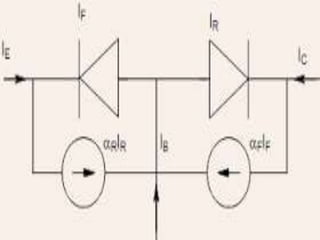
• It consist of two diode (p-n junction) which
are connected to back to back and the base is
common to both diodes
• In addition we have the two current sources
these current sources gives the coupling
between the two junctions
• These diode are not in insolation but are
interdependent it means that the total current
flowing in one diode it is influenced by the
other
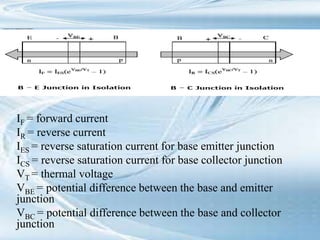
• When the diode are in insolation then they
are characterized by the normal diode
equation
IF = forward current
IR = reverse current
IES = reverse saturation current for base emitter junction
ICS = reverse saturation current for base collector junction
VT = thermal voltage
VBE = potential difference between the base and emitter
junction
VBC = potential difference between the base and collector
junction
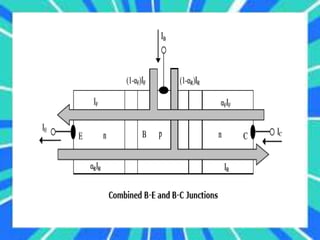
• When two junctions are combined to form a
transistor the base region is shared by both
• The idea of this model is that if u know about
applied voltages between junction we should
be able to evaluate the different currents
• Now we find the 3 terminals current
Forward mode operation :
• In the forward mode of operation αF
of the emittor current reaches the collector
This means that diode current passing through
the base-emitter junction contributes to the
current flowing through base-collector
junction. αF (0.98-0.99)
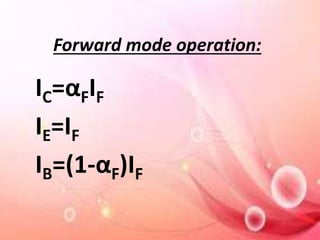
Forward mode operation:
IC=αFIF
IE=IF
IB=(1-αF)IF
Reverse mode operation :
In this case αR times the
collector current contributes
to the collector current αR
(0.1 to 0.5) (common
collector current gain )
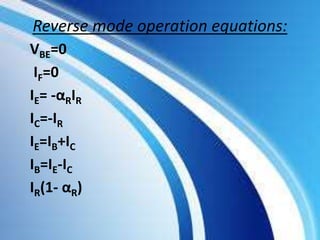
Reverse mode operation equations:
VBE=0
IF=0
IE= -αRIR
IC=-IR
IE=IB+IC
IB=IE-IC
IR(1- αR)
Normal mode operation
equations :
VBE≠0
VBC≠0
Then Ic=αFIF-IR
IE=IF-αRIR
IB=(1-αF)IF+IR(I-αR)
These are the Ebers moll model
equation or terminal currents
Ebers moll model

Ebers moll model

  • 1.
  • 2.
    *Ebers Moll Model *hparameter *r parameter *z parameter
  • 4.
    Ebers MOLL ModelFor BJT • It consist of two diode (p-n junction) which are connected to back to back and the base is common to both diodes • In addition we have the two current sources these current sources gives the coupling between the two junctions
  • 6.
    • These diodeare not in insolation but are interdependent it means that the total current flowing in one diode it is influenced by the other • When the diode are in insolation then they are characterized by the normal diode equation
  • 7.
    IF = forwardcurrent IR = reverse current IES = reverse saturation current for base emitter junction ICS = reverse saturation current for base collector junction VT = thermal voltage VBE = potential difference between the base and emitter junction VBC = potential difference between the base and collector junction
  • 8.
    • When twojunctions are combined to form a transistor the base region is shared by both • The idea of this model is that if u know about applied voltages between junction we should be able to evaluate the different currents • Now we find the 3 terminals current
  • 10.
    Forward mode operation: • In the forward mode of operation αF of the emittor current reaches the collector This means that diode current passing through the base-emitter junction contributes to the current flowing through base-collector junction. αF (0.98-0.99)
  • 11.
  • 12.
    Reverse mode operation: In this case αR times the collector current contributes to the collector current αR (0.1 to 0.5) (common collector current gain )
  • 13.
    Reverse mode operationequations: VBE=0 IF=0 IE= -αRIR IC=-IR IE=IB+IC IB=IE-IC IR(1- αR)
  • 14.
    Normal mode operation equations: VBE≠0 VBC≠0 Then Ic=αFIF-IR IE=IF-αRIR IB=(1-αF)IF+IR(I-αR) These are the Ebers moll model equation or terminal currents