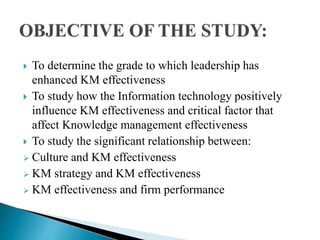
 To determine the grade to which leadership has
enhanced KM effectiveness
 To study how the Information technology positively
influence KM effectiveness and critical factor that
affect Knowledge management effectiveness
 To study the significant relationship between:
 Culture and KM effectiveness
 KM strategy and KM effectiveness
 KM effectiveness and firm performance
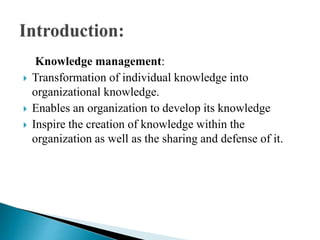
Knowledge management:
 Transformation of individual knowledge into
organizational knowledge.
 Enables an organization to develop its knowledge
 Inspire the creation of knowledge within the
organization as well as the sharing and defense of it.
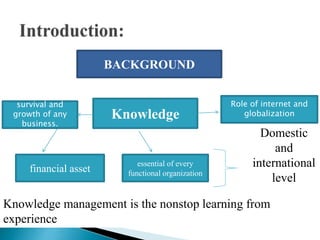
Knowledge
financial asset
essential of every
functional organization
Domestic
and
international
level
Knowledge management is the nonstop learning from
experience
survival and
growth of any
business.
Role of internet and
globalization
BACKGROUND
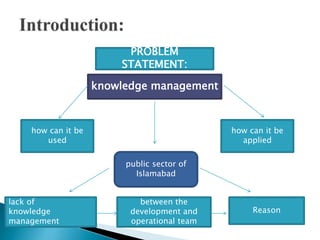
knowledge management
how can it be
used
how can it be
applied
public sector of
Islamabad
between the
development and
operational team
lack of
knowledge
management
Reason
PROBLEM
STATEMENT:
 Knowledge management
 Helps in creation and the transmission of
knowledge
 Enables individual knowledge to be
transformed into organizational knowledge
Leadership
 Creation and management of the knowledge
 Encourages the distribution of knowledge
 Share their knowledge for innovative ideas and
information (in organization)
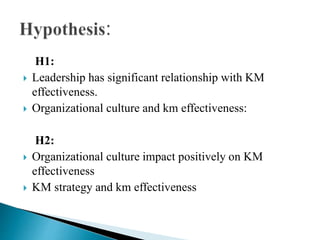
H1:
 Leadership has significant relationship with KM
effectiveness.
 Organizational culture and km effectiveness:
H2:
 Organizational culture impact positively on KM
effectiveness
 KM strategy and km effectiveness
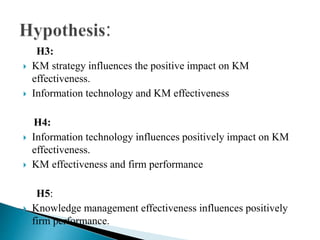
H3:
 KM strategy influences the positive impact on KM
effectiveness.
 Information technology and KM effectiveness
H4:
 Information technology influences positively impact on KM
effectiveness.
 KM effectiveness and firm performance
H5:
 Knowledge management effectiveness influences positively
firm performance.
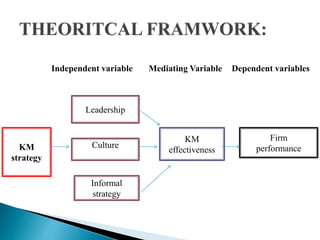
Dependent variablesMediating VariableIndependent variable
Leadership
Firm
performanceCulture
Informal
strategy
KM
effectivenessKM
strategy
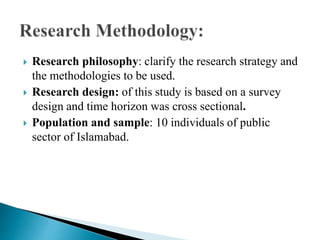
 Research philosophy: clarify the research strategy and
the methodologies to be used.
 Research design: of this study is based on a survey
design and time horizon was cross sectional.
 Population and sample: 10 individuals of public
sector of Islamabad.
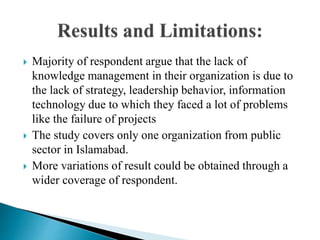
 Majority of respondent argue that the lack of
knowledge management in their organization is due to
the lack of strategy, leadership behavior, information
technology due to which they faced a lot of problems
like the failure of projects
 The study covers only one organization from public
sector in Islamabad.
 More variations of result could be obtained through a
wider coverage of respondent.
 Performance of firm is declined because of the lack of
knowledge management in public sector of Islamabad.
 KM effectiveness play mediating role to improve the
performance of organization.
 Investigates the impact of mediating variable KM
effectiveness on the relationship between KM factor
and organization performance in public sector of
Islamabad.. .
 Future research should
 Focus on validating the finding and conclusion of this
study by undertaking replicative researcher in other
organizations and in public sector
 Be carried out to investigate the moderating and
mediating role of other variables on the relationship
between knowledge management and organization
performance.
 Ahmed, P.K., K.K. Lim and M. Zairi, 1999.Measurement practice for
knowledge management. The
 Journal of Workspace Learning: Employee Counselling Today, 11 (8): 304-311.
 Akhavan, P., M. Jafari and M. Fathian, 2006. Critical success factors of
knowledge management systems:
 A multi-case analysis. Eur. Bus. Rev., 18: 97-113.
 Alavi, M. and D.E. Leidner, 1999. Knowledge management systems: Issues,
challenges and benefits.
 Commun. Assoc. Inform. Syst., 1: 2-41
 Alavi, M. and D.E. Leidner, 2001. Review: Knowledge management and
knowledge management
 systems: Conceptual foundations and research issues. MIS Q., 25: 107-136.
 American Productivity and Quality Center, 1999. Knowledge management:
Executive summary.
 Consortium Benchmarking Study Best-Practice Report, APQC, Houston,
TX.http://www.apqc.org
 Boca Raton, pp: 1-22. Bergeron, B., 2003. Essentials of Knowledge Management.John Wiley and Sons,
 Inc. New Jersey.
 Berlade, S. and C. Harman, 2000.Using human resources to put knowledge to work.Knowl. Manage.
 Rev., 3: 26-29.
 Bhatt, G., J. Gupta and F. Kitchens, 2005.An exploratory study of groupware use in the knowledge
 management process. J. Enterprise Inform. Manage., 18: 28-46.
 Bishop, J., D. Bouchlaghem, J. Glass and I. Matsumoto, 2008.Ensuring the effectiveness of a knowledge
 management initiative. J. Knowl. Manage., 12: 16-29.
 Borg, W.R. and J.P. Gall, 1993.Applying Educational Research: A Practical Guide.Longman Publishing
 Group, New York, USA.
 Borghoff, U.M., R. Pareschi, 1998. Information Technology for Knowledge Management. Springer-Verlag,
 Berlin Heidelberg, New York.
 Bose, R., 2002. Knowledge management capabilities and infrastructure for e-commerce. J. Comput.
 Inform. Syst., 42: 40-49.
 American Productivity and Quality Center, 2000.Successfully implementing knowledge management:
 Executive summary.Consortium Learning Forum Best-Practice Report, APQC, Houston,
 TX.http://www.apqc.org
 Antony, J. and R. Banuelas, 2002.Key ingredients for the effective implementation of six sigma
 program.Measur. Bus. Excellence, 6: 20-27.
 Armistead, C., 1999. Knowledge management and process performance. J. Knowl. Manag., 3: 143154.
 Arthur Anderson Business Consulting, 1999.Zukai Knowledge Management.TOKYO Keizai, Inc., Tokyo.
 Arthur Anderson Business Consulting and APQC, 1996. The Knowledge Management Assessment Tool:
 External Benchmarking Version, The American Productivity and Quality Centre, Houston, Texas
 Aurum, A., F. Daneshgar and J. Ward, 2008.Investigating knowledge management in software
 development organizations-an Australia experience. Inform. Software Technol., 50: 511-533.
 Aurum, A., R. Jeffery, C. Wohlin and M. Handzic, 2003. Managing Software Engineering Knowledge,
 Springer, Germany.
 Badri, M.A., D. Davis and D. Davis, 1995.A study of measuring the critical factors of quality management.
 Int. J. Qual. Reliab. Manage., 12: 3653.
 Chourides, P., D. Longbottom and W. Murphy, 2003.
 Barclay, R. and P. Murray, 1997. What is knowledge management.Knowledge Praxis.http://www.media-
 access.com/whatis.html
 Barton, L.D., 1995. Wellsprings of Knowledge: Building and Sustaining the Sources of Innovation.
Knowledge management factor and its impact on firm

Knowledge management factor and its impact on firm

  • 2.
     To determinethe grade to which leadership has enhanced KM effectiveness  To study how the Information technology positively influence KM effectiveness and critical factor that affect Knowledge management effectiveness  To study the significant relationship between:  Culture and KM effectiveness  KM strategy and KM effectiveness  KM effectiveness and firm performance
  • 3.
    Knowledge management:  Transformationof individual knowledge into organizational knowledge.  Enables an organization to develop its knowledge  Inspire the creation of knowledge within the organization as well as the sharing and defense of it.
  • 4.
    Knowledge financial asset essential ofevery functional organization Domestic and international level Knowledge management is the nonstop learning from experience survival and growth of any business. Role of internet and globalization BACKGROUND
  • 5.
    knowledge management how canit be used how can it be applied public sector of Islamabad between the development and operational team lack of knowledge management Reason PROBLEM STATEMENT:
  • 6.
     Knowledge management Helps in creation and the transmission of knowledge  Enables individual knowledge to be transformed into organizational knowledge
  • 7.
    Leadership  Creation andmanagement of the knowledge  Encourages the distribution of knowledge  Share their knowledge for innovative ideas and information (in organization)
  • 8.
    H1:  Leadership hassignificant relationship with KM effectiveness.  Organizational culture and km effectiveness: H2:  Organizational culture impact positively on KM effectiveness  KM strategy and km effectiveness
  • 9.
    H3:  KM strategyinfluences the positive impact on KM effectiveness.  Information technology and KM effectiveness H4:  Information technology influences positively impact on KM effectiveness.  KM effectiveness and firm performance H5:  Knowledge management effectiveness influences positively firm performance.
  • 10.
    Dependent variablesMediating VariableIndependentvariable Leadership Firm performanceCulture Informal strategy KM effectivenessKM strategy
  • 11.
     Research philosophy:clarify the research strategy and the methodologies to be used.  Research design: of this study is based on a survey design and time horizon was cross sectional.  Population and sample: 10 individuals of public sector of Islamabad.
  • 12.
     Majority ofrespondent argue that the lack of knowledge management in their organization is due to the lack of strategy, leadership behavior, information technology due to which they faced a lot of problems like the failure of projects  The study covers only one organization from public sector in Islamabad.  More variations of result could be obtained through a wider coverage of respondent.
  • 13.
     Performance offirm is declined because of the lack of knowledge management in public sector of Islamabad.  KM effectiveness play mediating role to improve the performance of organization.  Investigates the impact of mediating variable KM effectiveness on the relationship between KM factor and organization performance in public sector of Islamabad.. .
  • 14.
     Future researchshould  Focus on validating the finding and conclusion of this study by undertaking replicative researcher in other organizations and in public sector  Be carried out to investigate the moderating and mediating role of other variables on the relationship between knowledge management and organization performance.
  • 15.
     Ahmed, P.K.,K.K. Lim and M. Zairi, 1999.Measurement practice for knowledge management. The  Journal of Workspace Learning: Employee Counselling Today, 11 (8): 304-311.  Akhavan, P., M. Jafari and M. Fathian, 2006. Critical success factors of knowledge management systems:  A multi-case analysis. Eur. Bus. Rev., 18: 97-113.  Alavi, M. and D.E. Leidner, 1999. Knowledge management systems: Issues, challenges and benefits.  Commun. Assoc. Inform. Syst., 1: 2-41  Alavi, M. and D.E. Leidner, 2001. Review: Knowledge management and knowledge management  systems: Conceptual foundations and research issues. MIS Q., 25: 107-136.  American Productivity and Quality Center, 1999. Knowledge management: Executive summary.  Consortium Benchmarking Study Best-Practice Report, APQC, Houston, TX.http://www.apqc.org
  • 16.
     Boca Raton,pp: 1-22. Bergeron, B., 2003. Essentials of Knowledge Management.John Wiley and Sons,  Inc. New Jersey.  Berlade, S. and C. Harman, 2000.Using human resources to put knowledge to work.Knowl. Manage.  Rev., 3: 26-29.  Bhatt, G., J. Gupta and F. Kitchens, 2005.An exploratory study of groupware use in the knowledge  management process. J. Enterprise Inform. Manage., 18: 28-46.  Bishop, J., D. Bouchlaghem, J. Glass and I. Matsumoto, 2008.Ensuring the effectiveness of a knowledge  management initiative. J. Knowl. Manage., 12: 16-29.  Borg, W.R. and J.P. Gall, 1993.Applying Educational Research: A Practical Guide.Longman Publishing  Group, New York, USA.  Borghoff, U.M., R. Pareschi, 1998. Information Technology for Knowledge Management. Springer-Verlag,  Berlin Heidelberg, New York.  Bose, R., 2002. Knowledge management capabilities and infrastructure for e-commerce. J. Comput.  Inform. Syst., 42: 40-49.
  • 17.
     American Productivityand Quality Center, 2000.Successfully implementing knowledge management:  Executive summary.Consortium Learning Forum Best-Practice Report, APQC, Houston,  TX.http://www.apqc.org  Antony, J. and R. Banuelas, 2002.Key ingredients for the effective implementation of six sigma  program.Measur. Bus. Excellence, 6: 20-27.  Armistead, C., 1999. Knowledge management and process performance. J. Knowl. Manag., 3: 143154.  Arthur Anderson Business Consulting, 1999.Zukai Knowledge Management.TOKYO Keizai, Inc., Tokyo.  Arthur Anderson Business Consulting and APQC, 1996. The Knowledge Management Assessment Tool:  External Benchmarking Version, The American Productivity and Quality Centre, Houston, Texas  Aurum, A., F. Daneshgar and J. Ward, 2008.Investigating knowledge management in software  development organizations-an Australia experience. Inform. Software Technol., 50: 511-533.  Aurum, A., R. Jeffery, C. Wohlin and M. Handzic, 2003. Managing Software Engineering Knowledge,  Springer, Germany.  Badri, M.A., D. Davis and D. Davis, 1995.A study of measuring the critical factors of quality management.  Int. J. Qual. Reliab. Manage., 12: 3653.  Chourides, P., D. Longbottom and W. Murphy, 2003.  Barclay, R. and P. Murray, 1997. What is knowledge management.Knowledge Praxis.http://www.media-  access.com/whatis.html  Barton, L.D., 1995. Wellsprings of Knowledge: Building and Sustaining the Sources of Innovation.