SWIMMING POOL MECHANICAL DESIGN
Swimming pools can come in all forms and shapes. The typical ones are:-
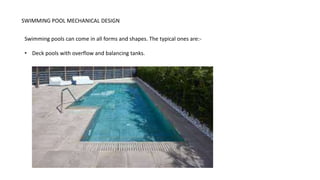
• Deck pools with overflow and balancing tanks.
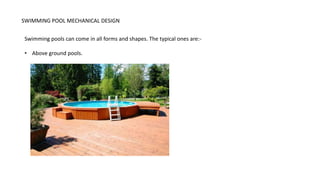
• Above ground pools.
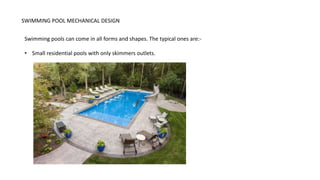
• Small residential pools with only skimmers outlets.
• Infinity pools.
SWIMMING POOL MECHANICAL DESIGN
Swimming pools can come in all forms and shapes. The typical ones are:-
• Deck pools with overflow and balancing tanks.
SWIMMING POOL MECHANICAL DESIGN
Swimming pools can come in all forms and shapes. The typical ones are:-
• Above ground pools.
SWIMMING POOL MECHANICAL DESIGN
Swimming pools can come in all forms and shapes. The typical ones are:-
• Small residential pools with only skimmers outlets.
SWIMMING POOL MECHANICAL DESIGN
Swimming pools can come in all forms and shapes. The typical ones are:-
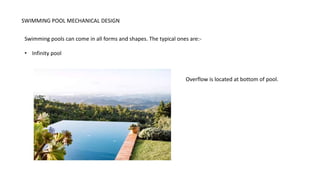
• Infinity pool
Overflow is located at bottom of pool.
SWIMMING POOL MECHANICAL DESIGN
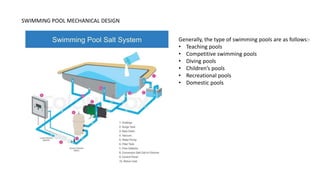
Generally, the type of swimming pools are as follows:-
• Teaching pools
• Competitive swimming pools
• Diving pools
• Children’s pools
• Recreational pools
• Domestic pools
SWIMMING POOL MECHANICAL DESIGN
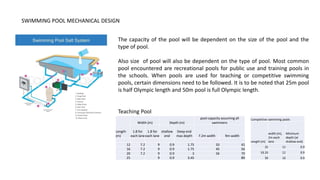
The capacity of the pool will be dependent on the size of the pool and the
type of pool.
Also size of pool will also be dependent on the type of pool. Most common
pool encountered are recreational pools for public use and training pools in
the schools. When pools are used for teaching or competitive swimming
pools, certain dimensions need to be followed. It is to be noted that 25m pool
is half Olympic length and 50m pool is full Olympic length.
Teaching Pool
Length
(m)
Width (m) Depth (m)
pool capacity assuming all
swimmers
1.8 for
each lane
1.8 for
each lane
shallow
end
Deep end
max depth 7.2m width 9m width
12 7.2 9 0.9 1.75 33 42
16 7.2 9 0.9 1.75 45 56
20 7.2 9 0.9 3 56 70
25 9 0.9 3.45 89
Competitive swimming pools
Length (m)
width (m),
2m each
lane
Minimum
depth (at
shallow end)
25 12 0.9
33.33 12 0.9
50 16 0.9
SWIMMING POOL MECHANICAL DESIGN
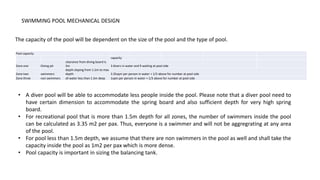
The capacity of the pool will be dependent on the size of the pool and the type of pool.
Pool capacity
capacity
Zone one Diving pit
clearance from diving board is
3m 3 divers in water and 9 waiting at pool side
Zone two swimmers
depth sloping from 1.5m to max
depth 3.35sqm per person in water + 1/3 above for number at pool side
Zone three non swimmers all water less than 1.5m deep 1sqm per person in water + 1/3 above for number at pool side
• A diver pool will be able to accommodate less people inside the pool. Please note that a diver pool need to
have certain dimension to accommodate the spring board and also sufficient depth for very high spring
board.
• For recreational pool that is more than 1.5m depth for all zones, the number of swimmers inside the pool
can be calculated as 3.35 m2 per pax. Thus, everyone is a swimmer and will not be aggregrating at any area
of the pool.
• For pool less than 1.5m depth, we assume that there are non swimmers in the pool as well and shall take the
capacity inside the pool as 1m2 per pax which is more dense.
• Pool capacity is important in sizing the balancing tank.
SWIMMING POOL MECHANICAL DESIGN
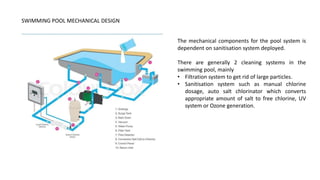
The mechanical components for the pool system is
dependent on sanitisation system deployed.
There are generally 2 cleaning systems in the
swimming pool, mainly
• Filtration system to get rid of large particles.
• Sanitisation system such as manual chlorine
dosage, auto salt chlorinator which converts
appropriate amount of salt to free chlorine, UV
system or Ozone generation.
SWIMMING POOL MECHANICAL DESIGN
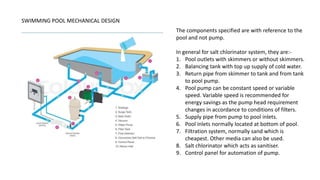
The components specified are with reference to the
pool and not pump.
In general for salt chlorinator system, they are:-
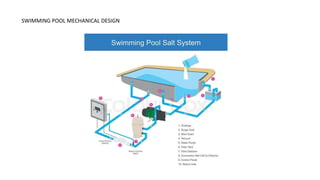
1. Pool outlets with skimmers or without skimmers.
2. Balancing tank with top up supply of cold water.
3. Return pipe from skimmer to tank and from tank
to pool pump.
4. Pool pump can be constant speed or variable
speed. Variable speed is recommended for
energy savings as the pump head requirement
changes in accordance to conditions of filters.
5. Supply pipe from pump to pool inlets.
6. Pool inlets normally located at bottom of pool.
7. Filtration system, normally sand which is
cheapest. Other media can also be used.
8. Salt chlorinator which acts as sanitiser.
9. Control panel for automation of pump.
SWIMMING POOL MECHANICAL DESIGN
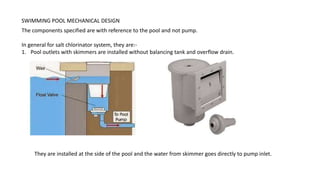
The components specified are with reference to the pool and not pump.
In general for salt chlorinator system, they are:-
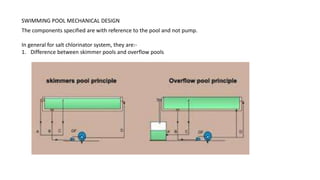
1. Pool outlets with skimmers are installed without balancing tank and overflow drain.
They are installed at the side of the pool and the water from skimmer goes directly to pump inlet.
SWIMMING POOL MECHANICAL DESIGN
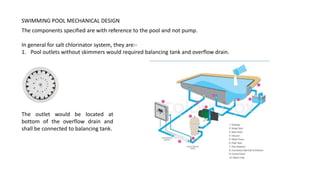
The components specified are with reference to the pool and not pump.
In general for salt chlorinator system, they are:-
1. Pool outlets without skimmers would required balancing tank and overflow drain.
The outlet would be located at
bottom of the overflow drain and
shall be connected to balancing tank.
SWIMMING POOL MECHANICAL DESIGN
The components specified are with reference to the pool and not pump.
In general for salt chlorinator system, they are:-
1. Difference between skimmer pools and overflow pools
SWIMMING POOL MECHANICAL DESIGN
The components specified are with reference to the pool and not pump.
In general for salt chlorinator system, they are:-
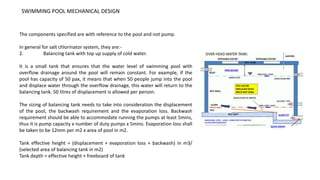
2. Balancing tank with top up supply of cold water.
It is a small tank that ensures that the water level of swimming pool with
overflow drainage around the pool will remain constant. For example, if the
pool has capacity of 50 pax, it means that when 50 people jump into the pool
and displace water through the overflow drainage, this water will return to the
balancing tank. 50 litres of displacement is allowed per person.
The sizing of balancing tank needs to take into consideration the displacement
of the pool, the backwash requirement and the evaporation loss. Backwash
requirement should be able to accommodate running the pumps at least 5mins,
thus it is pump capacity x number of duty pumps x 5mins. Evaporation loss shall
be taken to be 12mm per m2 x area of pool in m2.
Tank effective height = (displacement + evaporation loss + backwash) in m3/
(selected area of balancing tank in m2)
Tank depth = effective height + freeboard of tank
SWIMMING POOL MECHANICAL DESIGN
The components specified are with reference to the pool and not
pump.
In general for salt chlorinator system, they are:-
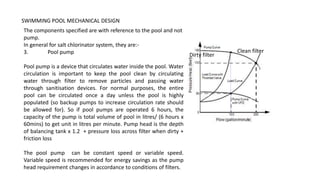
3. Pool pump
Pool pump is a device that circulates water inside the pool. Water
circulation is important to keep the pool clean by circulating
water through filter to remove particles and passing water
through sanitisation devices. For normal purposes, the entire
pool can be circulated once a day unless the pool is highly
populated (so backup pumps to increase circulation rate should
be allowed for). So if pool pumps are operated 6 hours, the
capacity of the pump is total volume of pool in litres/ (6 hours x
60mins) to get unit in litres per minute. Pump head is the depth
of balancing tank x 1.2 + pressure loss across filter when dirty +
friction loss
The pool pump can be constant speed or variable speed.
Variable speed is recommended for energy savings as the pump
head requirement changes in accordance to conditions of filters.
Dirty filter
Clean filter
SWIMMING POOL MECHANICAL DESIGN
The components specified are with reference to the pool and not pump.
In general for salt chlorinator system, they are:-
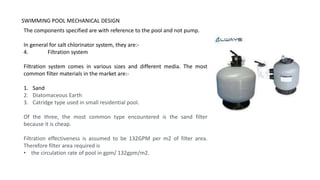
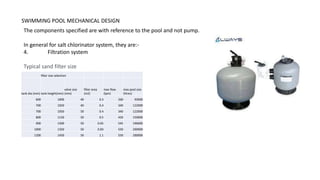
4. Filtration system
Filtration system comes in various sizes and different media. The most
common filter materials in the market are:-
1. Sand
2. Diatomaceous Earth
3. Catridge type used in small residential pool.
Of the three, the most common type encountered is the sand filter
because it is cheap.
Filtration effectiveness is assumed to be 132GPM per m2 of filter area.
Therefore filter area required is
• the circulation rate of pool in gpm/ 132gpm/m2.
SWIMMING POOL MECHANICAL DESIGN
The components specified are with reference to the pool and not pump.
In general for salt chlorinator system, they are:-
4. Filtration system
Typical sand filter size
filter size selection
tank dia (mm) tank height(mm)
valve size
(mm)
filter area
(m2)
max flow
(lpm)
max pool size
(litres)
600 1000 40 0.3 260 93000
700 1050 40 0.4 340 122000
700 1050 50 0.4 340 122000
800 1150 50 0.5 420 150000
900 1300 50 0.65 545 196000
1000 1350 50 0.83 550 200000
1200 1450 50 1.1 550 200000
SWIMMING POOL MECHANICAL DESIGN
The components specified are with reference to the pool and not pump.
In general for salt chlorinator system, they are:-
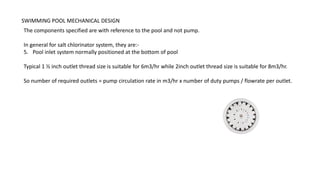
5. Pool inlet system normally positioned at the bottom of pool
Typical 1 ½ inch outlet thread size is suitable for 6m3/hr while 2inch outlet thread size is suitable for 8m3/hr.
So number of required outlets = pump circulation rate in m3/hr x number of duty pumps / flowrate per outlet.
SWIMMING POOL MECHANICAL DESIGN
The components specified are with reference
to the pool and not pump.
In general for salt chlorinator system, they
are:-
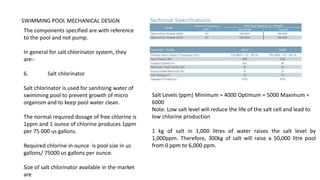
6. Salt chlorinator
Salt chlorinator is used for sanitising water of
swimming pool to prevent growth of micro
organism and to keep pool water clean.
The normal required dosage of free chlorine is
1ppm and 1 ounce of chlorine produces 1ppm
per 75 000 us gallons.
Required chlorine in ounce is pool size in us
gallons/ 75000 us gallons per ounce.
Size of salt chlorinator available in the market
are
Salt Levels (ppm) Minimum = 4000 Optimum = 5000 Maximum =
6000
Note: Low salt level will reduce the life of the salt cell and lead to
low chlorine production
1 kg of salt in 1,000 litres of water raises the salt level by
1,000ppm. Therefore, 300kg of salt will raise a 50,000 litre pool
from 0 ppm to 6,000 ppm.

Swimming pool mechanical components design.pptx

  • 1.
  • 2.
    SWIMMING POOL MECHANICALDESIGN Swimming pools can come in all forms and shapes. The typical ones are:- • Deck pools with overflow and balancing tanks. • Above ground pools. • Small residential pools with only skimmers outlets. • Infinity pools.
  • 3.
    SWIMMING POOL MECHANICALDESIGN Swimming pools can come in all forms and shapes. The typical ones are:- • Deck pools with overflow and balancing tanks.
  • 4.
    SWIMMING POOL MECHANICALDESIGN Swimming pools can come in all forms and shapes. The typical ones are:- • Above ground pools.
  • 5.
    SWIMMING POOL MECHANICALDESIGN Swimming pools can come in all forms and shapes. The typical ones are:- • Small residential pools with only skimmers outlets.
  • 6.
    SWIMMING POOL MECHANICALDESIGN Swimming pools can come in all forms and shapes. The typical ones are:- • Infinity pool Overflow is located at bottom of pool.
  • 7.
    SWIMMING POOL MECHANICALDESIGN Generally, the type of swimming pools are as follows:- • Teaching pools • Competitive swimming pools • Diving pools • Children’s pools • Recreational pools • Domestic pools
  • 8.
    SWIMMING POOL MECHANICALDESIGN The capacity of the pool will be dependent on the size of the pool and the type of pool. Also size of pool will also be dependent on the type of pool. Most common pool encountered are recreational pools for public use and training pools in the schools. When pools are used for teaching or competitive swimming pools, certain dimensions need to be followed. It is to be noted that 25m pool is half Olympic length and 50m pool is full Olympic length. Teaching Pool Length (m) Width (m) Depth (m) pool capacity assuming all swimmers 1.8 for each lane 1.8 for each lane shallow end Deep end max depth 7.2m width 9m width 12 7.2 9 0.9 1.75 33 42 16 7.2 9 0.9 1.75 45 56 20 7.2 9 0.9 3 56 70 25 9 0.9 3.45 89 Competitive swimming pools Length (m) width (m), 2m each lane Minimum depth (at shallow end) 25 12 0.9 33.33 12 0.9 50 16 0.9
  • 9.
    SWIMMING POOL MECHANICALDESIGN The capacity of the pool will be dependent on the size of the pool and the type of pool. Pool capacity capacity Zone one Diving pit clearance from diving board is 3m 3 divers in water and 9 waiting at pool side Zone two swimmers depth sloping from 1.5m to max depth 3.35sqm per person in water + 1/3 above for number at pool side Zone three non swimmers all water less than 1.5m deep 1sqm per person in water + 1/3 above for number at pool side • A diver pool will be able to accommodate less people inside the pool. Please note that a diver pool need to have certain dimension to accommodate the spring board and also sufficient depth for very high spring board. • For recreational pool that is more than 1.5m depth for all zones, the number of swimmers inside the pool can be calculated as 3.35 m2 per pax. Thus, everyone is a swimmer and will not be aggregrating at any area of the pool. • For pool less than 1.5m depth, we assume that there are non swimmers in the pool as well and shall take the capacity inside the pool as 1m2 per pax which is more dense. • Pool capacity is important in sizing the balancing tank.
  • 10.
    SWIMMING POOL MECHANICALDESIGN The mechanical components for the pool system is dependent on sanitisation system deployed. There are generally 2 cleaning systems in the swimming pool, mainly • Filtration system to get rid of large particles. • Sanitisation system such as manual chlorine dosage, auto salt chlorinator which converts appropriate amount of salt to free chlorine, UV system or Ozone generation.
  • 11.
    SWIMMING POOL MECHANICALDESIGN The components specified are with reference to the pool and not pump. In general for salt chlorinator system, they are:- 1. Pool outlets with skimmers or without skimmers. 2. Balancing tank with top up supply of cold water. 3. Return pipe from skimmer to tank and from tank to pool pump. 4. Pool pump can be constant speed or variable speed. Variable speed is recommended for energy savings as the pump head requirement changes in accordance to conditions of filters. 5. Supply pipe from pump to pool inlets. 6. Pool inlets normally located at bottom of pool. 7. Filtration system, normally sand which is cheapest. Other media can also be used. 8. Salt chlorinator which acts as sanitiser. 9. Control panel for automation of pump.
  • 12.
    SWIMMING POOL MECHANICALDESIGN The components specified are with reference to the pool and not pump. In general for salt chlorinator system, they are:- 1. Pool outlets with skimmers are installed without balancing tank and overflow drain. They are installed at the side of the pool and the water from skimmer goes directly to pump inlet.
  • 13.
    SWIMMING POOL MECHANICALDESIGN The components specified are with reference to the pool and not pump. In general for salt chlorinator system, they are:- 1. Pool outlets without skimmers would required balancing tank and overflow drain. The outlet would be located at bottom of the overflow drain and shall be connected to balancing tank.
  • 14.
    SWIMMING POOL MECHANICALDESIGN The components specified are with reference to the pool and not pump. In general for salt chlorinator system, they are:- 1. Difference between skimmer pools and overflow pools
  • 15.
    SWIMMING POOL MECHANICALDESIGN The components specified are with reference to the pool and not pump. In general for salt chlorinator system, they are:- 2. Balancing tank with top up supply of cold water. It is a small tank that ensures that the water level of swimming pool with overflow drainage around the pool will remain constant. For example, if the pool has capacity of 50 pax, it means that when 50 people jump into the pool and displace water through the overflow drainage, this water will return to the balancing tank. 50 litres of displacement is allowed per person. The sizing of balancing tank needs to take into consideration the displacement of the pool, the backwash requirement and the evaporation loss. Backwash requirement should be able to accommodate running the pumps at least 5mins, thus it is pump capacity x number of duty pumps x 5mins. Evaporation loss shall be taken to be 12mm per m2 x area of pool in m2. Tank effective height = (displacement + evaporation loss + backwash) in m3/ (selected area of balancing tank in m2) Tank depth = effective height + freeboard of tank
  • 16.
    SWIMMING POOL MECHANICALDESIGN The components specified are with reference to the pool and not pump. In general for salt chlorinator system, they are:- 3. Pool pump Pool pump is a device that circulates water inside the pool. Water circulation is important to keep the pool clean by circulating water through filter to remove particles and passing water through sanitisation devices. For normal purposes, the entire pool can be circulated once a day unless the pool is highly populated (so backup pumps to increase circulation rate should be allowed for). So if pool pumps are operated 6 hours, the capacity of the pump is total volume of pool in litres/ (6 hours x 60mins) to get unit in litres per minute. Pump head is the depth of balancing tank x 1.2 + pressure loss across filter when dirty + friction loss The pool pump can be constant speed or variable speed. Variable speed is recommended for energy savings as the pump head requirement changes in accordance to conditions of filters. Dirty filter Clean filter
  • 17.
    SWIMMING POOL MECHANICALDESIGN The components specified are with reference to the pool and not pump. In general for salt chlorinator system, they are:- 4. Filtration system Filtration system comes in various sizes and different media. The most common filter materials in the market are:- 1. Sand 2. Diatomaceous Earth 3. Catridge type used in small residential pool. Of the three, the most common type encountered is the sand filter because it is cheap. Filtration effectiveness is assumed to be 132GPM per m2 of filter area. Therefore filter area required is • the circulation rate of pool in gpm/ 132gpm/m2.
  • 18.
    SWIMMING POOL MECHANICALDESIGN The components specified are with reference to the pool and not pump. In general for salt chlorinator system, they are:- 4. Filtration system Typical sand filter size filter size selection tank dia (mm) tank height(mm) valve size (mm) filter area (m2) max flow (lpm) max pool size (litres) 600 1000 40 0.3 260 93000 700 1050 40 0.4 340 122000 700 1050 50 0.4 340 122000 800 1150 50 0.5 420 150000 900 1300 50 0.65 545 196000 1000 1350 50 0.83 550 200000 1200 1450 50 1.1 550 200000
  • 19.
    SWIMMING POOL MECHANICALDESIGN The components specified are with reference to the pool and not pump. In general for salt chlorinator system, they are:- 5. Pool inlet system normally positioned at the bottom of pool Typical 1 ½ inch outlet thread size is suitable for 6m3/hr while 2inch outlet thread size is suitable for 8m3/hr. So number of required outlets = pump circulation rate in m3/hr x number of duty pumps / flowrate per outlet.
  • 20.
    SWIMMING POOL MECHANICALDESIGN The components specified are with reference to the pool and not pump. In general for salt chlorinator system, they are:- 6. Salt chlorinator Salt chlorinator is used for sanitising water of swimming pool to prevent growth of micro organism and to keep pool water clean. The normal required dosage of free chlorine is 1ppm and 1 ounce of chlorine produces 1ppm per 75 000 us gallons. Required chlorine in ounce is pool size in us gallons/ 75000 us gallons per ounce. Size of salt chlorinator available in the market are Salt Levels (ppm) Minimum = 4000 Optimum = 5000 Maximum = 6000 Note: Low salt level will reduce the life of the salt cell and lead to low chlorine production 1 kg of salt in 1,000 litres of water raises the salt level by 1,000ppm. Therefore, 300kg of salt will raise a 50,000 litre pool from 0 ppm to 6,000 ppm.