Atomic Structure:
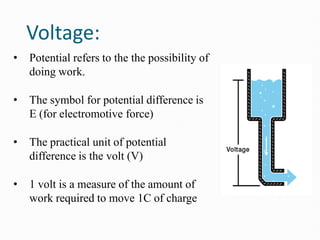
Voltage:
• Potential refers to the the possibility of
doing work.
• The symbol for potential difference is
E (for electromotive force)
• The practical unit of potential
difference is the volt (V)
• 1 volt is a measure of the amount of
work required to move 1C of charge
Current:
• When a charge is forced to move because of a potential
difference (voltage) current is produced.
• In conductors - free electrons can be forced to move with
relative ease, since they require little work to be moved.
• So current is charge in motion.
• The more electrons in motion the greater the current.
• Current indicates the intensity of the electricity in motion.
The symbol for current is I (for intensity) and is measured in
amperes.
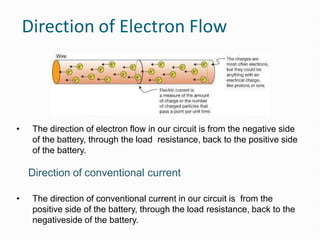
Direction of Electron Flow
• The direction of electron flow in our circuit is from the negative side
of the battery, through the load resistance, back to the positive side
of the battery.
Direction of conventional current
• The direction of conventional current in our circuit is from the
positive side of the battery, through the load resistance, back to the
negativeside of the battery.
Direct Current:
• Circuits that are powered by battery sources are termed
direct current circuits.
• It is the flow of charges in just one direction
Alternating Current:
• An alternating voltage source periodically alternates or
reverses in polarity.
• The resulting current, therefore, periodically reverses in
direction.
Resistance:
• Opposition to the flow of current is termed
resistance.
• The fact that a wire can become hot from the flow
of current is evidence of resistance.
• Conductors have very little resistance.
• Insulators have large amounts of resistance.
Resistors
10
Aresistor impedes the flow of electricity through a circuit.
Resistors have a set value.
Since voltage, current and resistance are related through Ohm’s
law, resistors are a good way to control voltage and current in
your circuit.
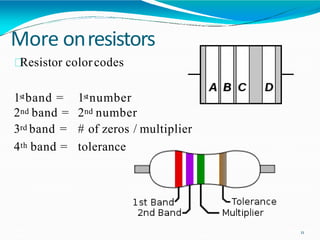
More onresistors
Resistor colorcodes
11
1stband =
2nd band =
3rd band =
4th band =
1stnumber
2nd number
# of zeros / multiplier
tolerance
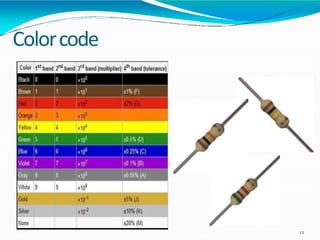
Colorcode
12
Variableresistor/ Potentiometer
Apotentiometer is avariable resistor. As you manually
turn a dial, the resistance changes.
13
Units
14
Knowing your unitsis important!
Kilo and Mega are common in resistors
Milli, micro, nano and pico can be used in other
components
K(kilo) =1,000
M (mega) = 1,000,000
M (milli) = 1/1,000
u (micro) =1/1,000,000
n (nano) = 1/1,000,000,000 (one trillionth)
p (pico) = 1/ 1,000,000,000,000 (one quadrillionth)
Ohm’s Law:
• The amount of current in a circuit is dependent on its resistance and the
applied voltage. Specifically I = V/R
• If you know any two of the factors V, I, and R you can calculate the third.
•
Current I = V/R Voltage V = IR Resistance R = V/I
Capacitors
16
Acapacitor stores electricalenergy.
Capacitance is measured in Farads. The small capacitors usually used in
electronics are often measured in microfarads and nanofarads.
Some capacitors are polarized. Note the
different length terminals on one of the capacitors.
17
Capacitor working:
Diode
Adiode is a one way valve (or gate) for electricity. It is a
component with an asymmetrical transfer characteristic. A
diode has low (ideally zero) resistance in one direction, and
high (ideally infinite) resistance in the other direction.
18
Diodes will protect your electronics.
P-N JUNCTION DIODE:
Diodecircuitprotection
In an electronic circuit, if the polarity is wrong, you can fry
your components.
20
Diodes have abar
on the cathode
(negative) side.
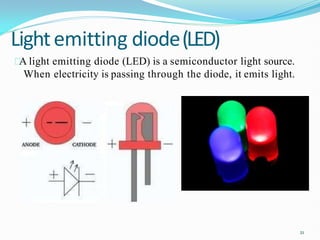
Lightemitting diode(LED)
A light emitting diode (LED) is a semiconductor light source.
When electricity is passing through the diode, it emits light.
21
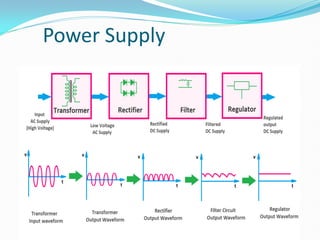
Power Supply
TRANSFORMER
REctification
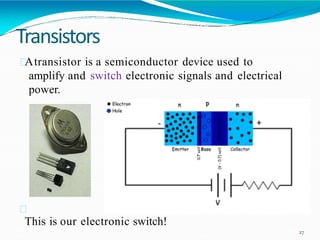
Transistors
Atransistor is a semiconductor device used to
amplify and switch electronic signals and electrical
power.
27
This is our electronic switch!
Transistor water analogy:
Howatransistorworks
29
Avoltage or current applied to one pair of the transistor’s
terminals changes the current through another pairof
terminals.
Atransistor is composed of semiconductor material with at
least three terminals
for connection to an external
circuit.
Transistors have 3pins.
For these transistors:
Collector
Emitter
Base
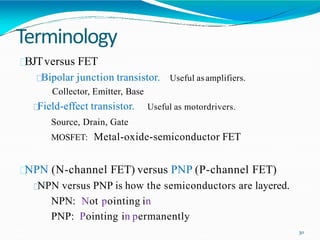
Terminology
30
Useful asamplifiers.
BJTversus FET
Bipolar junction transistor.
Collector, Emitter, Base
Useful as motordrivers.
Field-effect transistor.
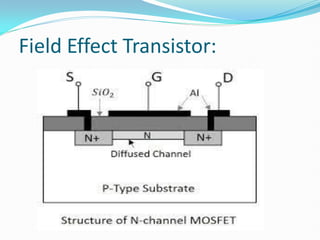
Source, Drain, Gate
MOSFET: Metal-oxide-semiconductor FET
NPN (N-channel FET) versus PNP (P-channel FET)
NPN versus PNP is how the semiconductors are layered.
NPN: Not pointing in
PNP: Pointing in permanently
Field Effect Transistor:
Schematicsymbols
BJTPNP BJTNPN
P-channel FET N-channel FET
17
Integratedcircuit
An integrated circuit (IC) is a set of transistors that is
the controller or ‘brain’of an electronic circuit.
An input is received, an output is sent out.
Modern microprocessor ICs can have billions of
transistors per square inch!
33
Logic Gates
Internal Structure of ICs.
Printed CircuitBoard
Components are attached to a printed
circuit board.
The ‘front’ side of the board will have
printed component information, such
as resistor # and resistance, diode type
and polarity,etc.
Holes go all the way through the board
from one side to the other. Through-
hole soldering is needed to connect
components to the board.
36
Backof CircuitBoard
 The ‘back’ side of the board will have lines indicating
connections between components. The lines on the
back are similar to wires.
 Thicker lines denote more current (electrons) moving
through.
 Components connect the lines.
37

basic eletronics components introduction

  • 2.
  • 3.
    Voltage: • Potential refersto the the possibility of doing work. • The symbol for potential difference is E (for electromotive force) • The practical unit of potential difference is the volt (V) • 1 volt is a measure of the amount of work required to move 1C of charge
  • 4.
    Current: • When acharge is forced to move because of a potential difference (voltage) current is produced. • In conductors - free electrons can be forced to move with relative ease, since they require little work to be moved. • So current is charge in motion. • The more electrons in motion the greater the current. • Current indicates the intensity of the electricity in motion. The symbol for current is I (for intensity) and is measured in amperes.
  • 5.
    Direction of ElectronFlow • The direction of electron flow in our circuit is from the negative side of the battery, through the load resistance, back to the positive side of the battery. Direction of conventional current • The direction of conventional current in our circuit is from the positive side of the battery, through the load resistance, back to the negativeside of the battery.
  • 7.
    Direct Current: • Circuitsthat are powered by battery sources are termed direct current circuits. • It is the flow of charges in just one direction Alternating Current: • An alternating voltage source periodically alternates or reverses in polarity. • The resulting current, therefore, periodically reverses in direction.
  • 9.
    Resistance: • Opposition tothe flow of current is termed resistance. • The fact that a wire can become hot from the flow of current is evidence of resistance. • Conductors have very little resistance. • Insulators have large amounts of resistance.
  • 10.
    Resistors 10 Aresistor impedes theflow of electricity through a circuit. Resistors have a set value. Since voltage, current and resistance are related through Ohm’s law, resistors are a good way to control voltage and current in your circuit.
  • 11.
    More onresistors Resistor colorcodes 11 1stband= 2nd band = 3rd band = 4th band = 1stnumber 2nd number # of zeros / multiplier tolerance
  • 12.
  • 13.
    Variableresistor/ Potentiometer Apotentiometer isavariable resistor. As you manually turn a dial, the resistance changes. 13
  • 14.
    Units 14 Knowing your unitsisimportant! Kilo and Mega are common in resistors Milli, micro, nano and pico can be used in other components K(kilo) =1,000 M (mega) = 1,000,000 M (milli) = 1/1,000 u (micro) =1/1,000,000 n (nano) = 1/1,000,000,000 (one trillionth) p (pico) = 1/ 1,000,000,000,000 (one quadrillionth)
  • 15.
    Ohm’s Law: • Theamount of current in a circuit is dependent on its resistance and the applied voltage. Specifically I = V/R • If you know any two of the factors V, I, and R you can calculate the third. • Current I = V/R Voltage V = IR Resistance R = V/I
  • 16.
    Capacitors 16 Acapacitor stores electricalenergy. Capacitanceis measured in Farads. The small capacitors usually used in electronics are often measured in microfarads and nanofarads. Some capacitors are polarized. Note the different length terminals on one of the capacitors.
  • 17.
  • 18.
    Diode Adiode is aone way valve (or gate) for electricity. It is a component with an asymmetrical transfer characteristic. A diode has low (ideally zero) resistance in one direction, and high (ideally infinite) resistance in the other direction. 18 Diodes will protect your electronics.
  • 19.
  • 20.
    Diodecircuitprotection In an electroniccircuit, if the polarity is wrong, you can fry your components. 20 Diodes have abar on the cathode (negative) side.
  • 21.
    Lightemitting diode(LED) A lightemitting diode (LED) is a semiconductor light source. When electricity is passing through the diode, it emits light. 21
  • 22.
  • 23.
  • 25.
  • 27.
    Transistors Atransistor is asemiconductor device used to amplify and switch electronic signals and electrical power. 27 This is our electronic switch!
  • 28.
  • 29.
    Howatransistorworks 29 Avoltage or currentapplied to one pair of the transistor’s terminals changes the current through another pairof terminals. Atransistor is composed of semiconductor material with at least three terminals for connection to an external circuit. Transistors have 3pins. For these transistors: Collector Emitter Base
  • 30.
    Terminology 30 Useful asamplifiers. BJTversus FET Bipolarjunction transistor. Collector, Emitter, Base Useful as motordrivers. Field-effect transistor. Source, Drain, Gate MOSFET: Metal-oxide-semiconductor FET NPN (N-channel FET) versus PNP (P-channel FET) NPN versus PNP is how the semiconductors are layered. NPN: Not pointing in PNP: Pointing in permanently
  • 31.
  • 32.
  • 33.
    Integratedcircuit An integrated circuit(IC) is a set of transistors that is the controller or ‘brain’of an electronic circuit. An input is received, an output is sent out. Modern microprocessor ICs can have billions of transistors per square inch! 33
  • 34.
  • 35.
  • 36.
    Printed CircuitBoard Components areattached to a printed circuit board. The ‘front’ side of the board will have printed component information, such as resistor # and resistance, diode type and polarity,etc. Holes go all the way through the board from one side to the other. Through- hole soldering is needed to connect components to the board. 36
  • 37.
    Backof CircuitBoard  The‘back’ side of the board will have lines indicating connections between components. The lines on the back are similar to wires.  Thicker lines denote more current (electrons) moving through.  Components connect the lines. 37