INSTRUMENTATION:
Two basic types of Instruments
exists
1.FILTER FLOUROMETRES
2.SPECTRO
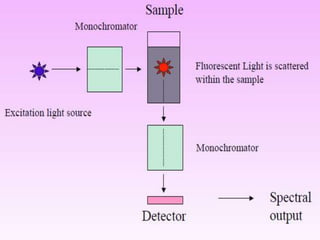
1) SOURCE OF LIGHT
2) FILTERS AND
MONOCHROMATORS
3) SAMPLE CELLS
4) DETECTORS
I. LASERS.
II. MERCURY ARC LAMP
III. XENON ARC LAMP
IV. TUNGSTEN LAMP.
 Laser can only limit light of high
irradiance
 Narrow wavelength
thus. makes excitation unnecessary.
Disadvantage:
wavelength can not vary much
A. Excitation monochromators
B. Emission monochromators
• Filters or monochromator may be used in
fluorimeter
• A monochromator transmits light with
adjustable wavelength
• Ideal monochromator transmit light in the
specified range and high wavelength
• No monochromator is perfect ___transmit
some stray light
 Single channel ;
Detect the intensity of one wavelength at a
time
 Multi channel;
Detects intensity of all wavelengths
simultaneously, making the emission
monochromator or filter unnecessary.
Flouresence Spectroscopy

Flouresence Spectroscopy

  • 1.
    INSTRUMENTATION: Two basic typesof Instruments exists 1.FILTER FLOUROMETRES 2.SPECTRO
  • 4.
    1) SOURCE OFLIGHT 2) FILTERS AND MONOCHROMATORS 3) SAMPLE CELLS 4) DETECTORS
  • 6.
    I. LASERS. II. MERCURYARC LAMP III. XENON ARC LAMP IV. TUNGSTEN LAMP.
  • 7.
     Laser canonly limit light of high irradiance  Narrow wavelength thus. makes excitation unnecessary. Disadvantage: wavelength can not vary much
  • 9.
    A. Excitation monochromators B.Emission monochromators • Filters or monochromator may be used in fluorimeter • A monochromator transmits light with adjustable wavelength • Ideal monochromator transmit light in the specified range and high wavelength • No monochromator is perfect ___transmit some stray light
  • 10.
     Single channel; Detect the intensity of one wavelength at a time  Multi channel; Detects intensity of all wavelengths simultaneously, making the emission monochromator or filter unnecessary.