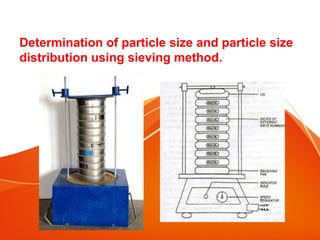
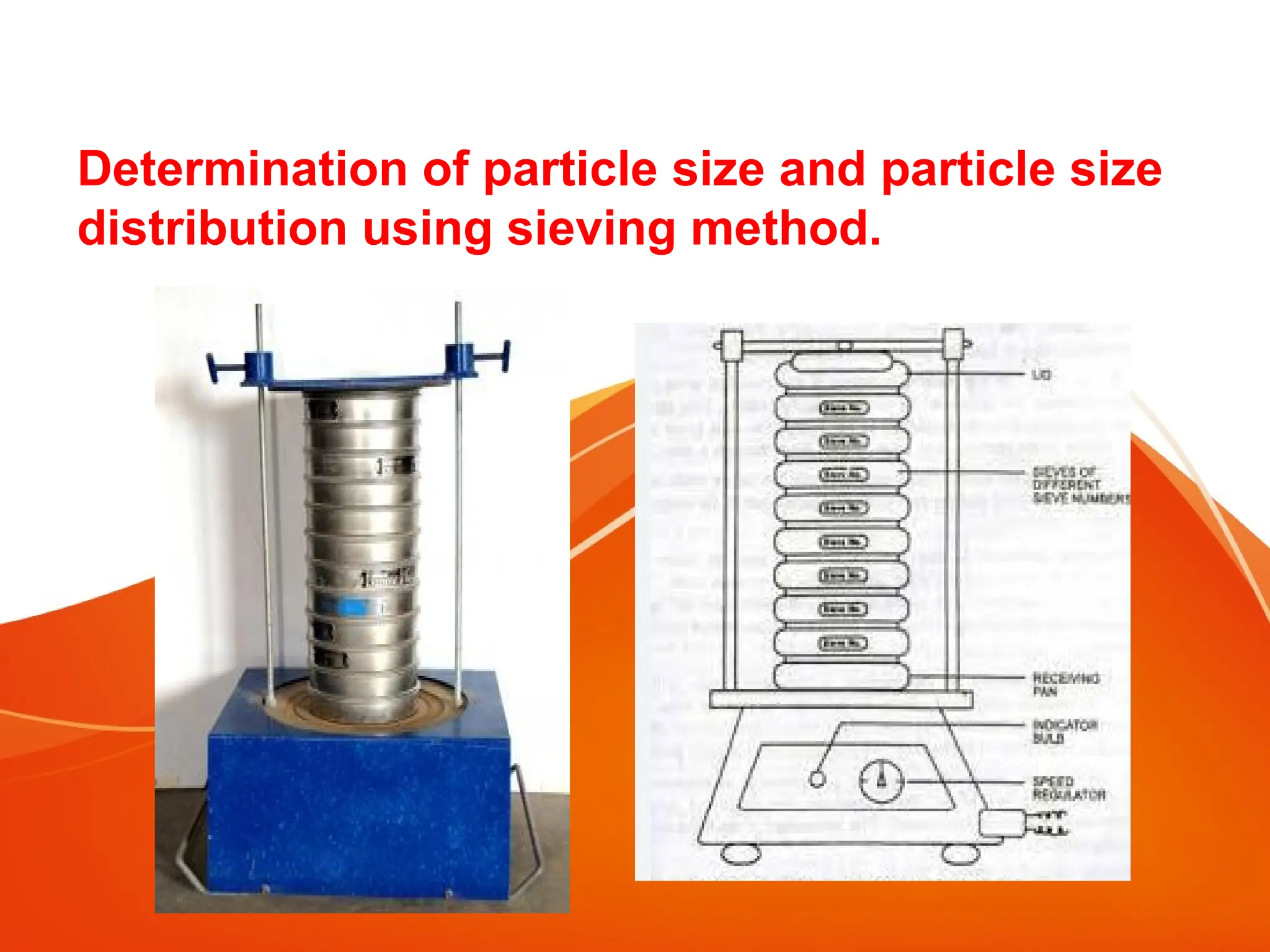
Determination of particle size and particle size
distribution using sieving method.
Requirements:
• Chemicals: A sample of any granules or
powder.
• Glassware and apparatus: Sieve set,
mechanical sieve shaker, weighing
balance etc.
References:
 Subrahmanyam CVS, Setty JT, Suresh S. Laboratory
manual of pharmaceutical engineering (Unit operations).
Delhi Vallabh Publications.
 Pharmaceutical Engineering by Sanbamurty K. (New
Age International, New Delhi)Cooper and Gunn’s Tutorial
Pharmacy Edited by Carter SJ. (CBS Publishers, Delhi)
 Pharmaceutical Dosage forms by Aulton. (Churchill
Livingstone, Edinburg).
Micromeritics
• Science and technology of small particles.
• The particle size of a drug can affect its release from
dosage forms that are administered orally, parenterally,
rectally and topically.
• Polydisperse.
• It is therefore necessary to know not only the size of a
certain particle, but also how many particles of the same
size exist in the sample.
• Thus, we need an estimate of the size range present and
the number or weight fraction of each particle size.
• This is the particle-size distribution and from it we can
calculate an average particle size for the sample.
• When the number or weight of particles lying within a
certain size range is plotted against the size range or
mean particle size, a so-called frequency distribution
curve is obtained.
• This is important because it is possible to have two
samples with the same average diameter but different
distributions.
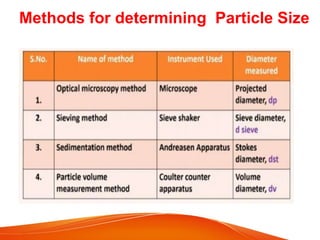
Methods for determining Particle Size
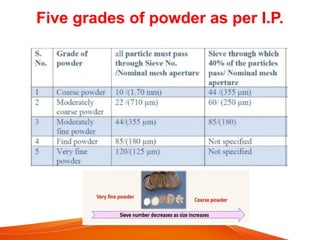
Five grades of powder as per I.P.
Sieve number:
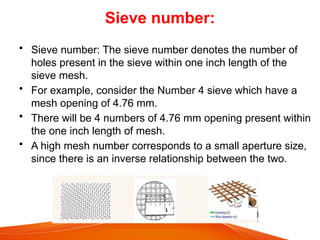
• Sieve number: The sieve number denotes the number of
holes present in the sieve within one inch length of the
sieve mesh.
• For example, consider the Number 4 sieve which have a
mesh opening of 4.76 mm.
• There will be 4 numbers of 4.76 mm opening present within
the one inch length of mesh.
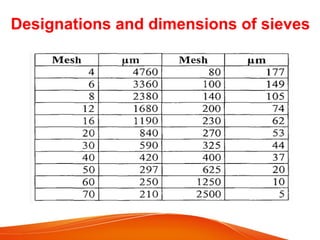
• A high mesh number corresponds to a small aperture size,
since there is an inverse relationship between the two.
Designations and dimensions of sieves
Sieving Method
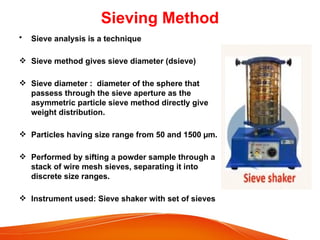
• Sieve analysis is a technique
 Sieve method gives sieve diameter (dsieve)
 Sieve diameter : diameter of the sphere that
passess through the sieve aperture as the
asymmetric particle sieve method directly give
weight distribution.
 Particles having size range from 50 and 1500 µm.
 Performed by sifting a powder sample through a
stack of wire mesh sieves, separating it into
discrete size ranges.
 Instrument used: Sieve shaker with set of sieves
Sieving Method
 Standard size sieves are available to cover a wide range of
size.
 Sieves are designed to sit in a stack so that material falls
through smaller and smaller meshes until it reaches a mesh
which is too fine for it to pass through.
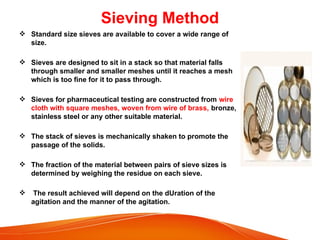
 Sieves for pharmaceutical testing are constructed from wire
cloth with square meshes, woven from wire of brass, bronze,
stainless steel or any other suitable material.
 The stack of sieves is mechanically shaken to promote the
passage of the solids.
 The fraction of the material between pairs of sieve sizes is
determined by weighing the residue on each sieve.
 The result achieved will depend on the dUration of the
agitation and the manner of the agitation.
Sieving Method Applications
 The sieving method finds application in dosage and
development of tablets and capsules.
 Normally 15 percent of fine powder (passed through mesh 100)
should be present in granulated material to get a proper flow of
material and achieve good compaction in tableting.
 Thus percent of coarse, moderate, fine powder is estimated by
this method.
 A sieve analysis can be performed on any type of non-organic
or organic granular materials including sands, crushed rock,
clays, granite, feldspars, coal, soil, a wide range of
manufactured powders, grain and seeds.
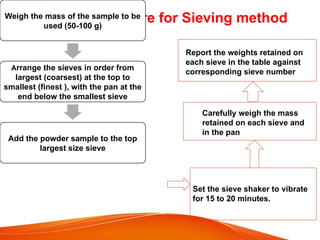
Stepwise Procedure for Sieving method
Weigh the mass of the sample to be
used (50-100 g)
Arrange the sieves in order from
largest (coarsest) at the top to
smallest (finest ), with the pan at the
end below the smallest sieve
Add the powder sample to the top
largest size sieve
Set the sieve shaker to vibrate
for 15 to 20 minutes.
Carefully weigh the mass
retained on each sieve and
in the pan
Report the weights retained on
each sieve in the table against
corresponding sieve number
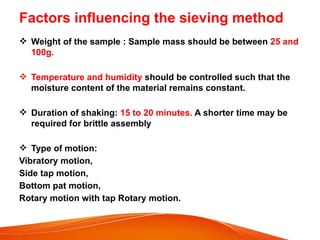
Factors influencing the sieving method
 Weight of the sample : Sample mass should be between 25 and
100g.
 Temperature and humidity should be controlled such that the
moisture content of the material remains constant.
 Duration of shaking: 15 to 20 minutes. A shorter time may be
required for brittle assembly
 Type of motion:
Vibratory motion,
Side tap motion,
Bottom pat motion,
Rotary motion with tap Rotary motion.
Observation table:
Sr.
No.
Sieve
no.
Sieve
size
(μm)
Sieve
No.Passed /
retained
Sieve
size.Passed
/retained
Weight
retained
(gm)
% Weight
retained
Cumulative %
weight
retained
01 10 2000
02 20 840
03 40 420
04 60 250
05 80 177
06 100 149
07 120 125
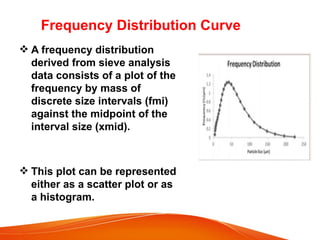
 A frequency distribution
derived from sieve analysis
data consists of a plot of the
frequency by mass of
discrete size intervals (fmi)
against the midpoint of the
interval size (xmid).
 This plot can be represented
either as a scatter plot or as
a histogram.
Frequency Distribution Curve
Calculations
% Retained = W Sieve / W total *100%
 The next step is to find the cumulative percent of aggregate
retained in each sieve.
 To do so, add up the total amount of aggregate that is retained
in each sieve and the amount in the previous sieves.
 The cumulative percent passing of the aggregate is found by
subtracting the percent retained from 100%.
%Cumulative Passing = 100% - % Cumulative Retained.
 The values are then plotted on a graph with cumulative percent
passing on the y axis and logarithmic sieve size on the x axis.
Advantages and Disadvantages
Advantages:
1. It is in expensive method
2. Simple to use
3. Rapid with reproducible results.
4. Sieving method is useful when particles are having
size range between 50 and 1500μm.
Disadvantages:
5. Lower limit of the particle size is 50μm.
6. If the powder is not dry apertures become clogged
with particles leading to improper sieving.
7. During shaking, attrition occurs causing size reduction
01 particles.

sieving analysis and results interpretation

  • 1.
    Determination of particlesize and particle size distribution using sieving method.
  • 2.
    Requirements: • Chemicals: Asample of any granules or powder. • Glassware and apparatus: Sieve set, mechanical sieve shaker, weighing balance etc.
  • 3.
    References:  Subrahmanyam CVS,Setty JT, Suresh S. Laboratory manual of pharmaceutical engineering (Unit operations). Delhi Vallabh Publications.  Pharmaceutical Engineering by Sanbamurty K. (New Age International, New Delhi)Cooper and Gunn’s Tutorial Pharmacy Edited by Carter SJ. (CBS Publishers, Delhi)  Pharmaceutical Dosage forms by Aulton. (Churchill Livingstone, Edinburg).
  • 4.
    Micromeritics • Science andtechnology of small particles. • The particle size of a drug can affect its release from dosage forms that are administered orally, parenterally, rectally and topically. • Polydisperse. • It is therefore necessary to know not only the size of a certain particle, but also how many particles of the same size exist in the sample.
  • 5.
    • Thus, weneed an estimate of the size range present and the number or weight fraction of each particle size. • This is the particle-size distribution and from it we can calculate an average particle size for the sample. • When the number or weight of particles lying within a certain size range is plotted against the size range or mean particle size, a so-called frequency distribution curve is obtained. • This is important because it is possible to have two samples with the same average diameter but different distributions.
  • 6.
  • 7.
    Five grades ofpowder as per I.P.
  • 8.
    Sieve number: • Sievenumber: The sieve number denotes the number of holes present in the sieve within one inch length of the sieve mesh. • For example, consider the Number 4 sieve which have a mesh opening of 4.76 mm. • There will be 4 numbers of 4.76 mm opening present within the one inch length of mesh. • A high mesh number corresponds to a small aperture size, since there is an inverse relationship between the two.
  • 9.
  • 10.
    Sieving Method • Sieveanalysis is a technique  Sieve method gives sieve diameter (dsieve)  Sieve diameter : diameter of the sphere that passess through the sieve aperture as the asymmetric particle sieve method directly give weight distribution.  Particles having size range from 50 and 1500 µm.  Performed by sifting a powder sample through a stack of wire mesh sieves, separating it into discrete size ranges.  Instrument used: Sieve shaker with set of sieves
  • 11.
    Sieving Method  Standardsize sieves are available to cover a wide range of size.  Sieves are designed to sit in a stack so that material falls through smaller and smaller meshes until it reaches a mesh which is too fine for it to pass through.  Sieves for pharmaceutical testing are constructed from wire cloth with square meshes, woven from wire of brass, bronze, stainless steel or any other suitable material.  The stack of sieves is mechanically shaken to promote the passage of the solids.  The fraction of the material between pairs of sieve sizes is determined by weighing the residue on each sieve.  The result achieved will depend on the dUration of the agitation and the manner of the agitation.
  • 12.
    Sieving Method Applications The sieving method finds application in dosage and development of tablets and capsules.  Normally 15 percent of fine powder (passed through mesh 100) should be present in granulated material to get a proper flow of material and achieve good compaction in tableting.  Thus percent of coarse, moderate, fine powder is estimated by this method.  A sieve analysis can be performed on any type of non-organic or organic granular materials including sands, crushed rock, clays, granite, feldspars, coal, soil, a wide range of manufactured powders, grain and seeds.
  • 13.
    Stepwise Procedure forSieving method Weigh the mass of the sample to be used (50-100 g) Arrange the sieves in order from largest (coarsest) at the top to smallest (finest ), with the pan at the end below the smallest sieve Add the powder sample to the top largest size sieve Set the sieve shaker to vibrate for 15 to 20 minutes. Carefully weigh the mass retained on each sieve and in the pan Report the weights retained on each sieve in the table against corresponding sieve number
  • 14.
    Factors influencing thesieving method  Weight of the sample : Sample mass should be between 25 and 100g.  Temperature and humidity should be controlled such that the moisture content of the material remains constant.  Duration of shaking: 15 to 20 minutes. A shorter time may be required for brittle assembly  Type of motion: Vibratory motion, Side tap motion, Bottom pat motion, Rotary motion with tap Rotary motion.
  • 15.
    Observation table: Sr. No. Sieve no. Sieve size (μm) Sieve No.Passed / retained Sieve size.Passed /retained Weight retained (gm) %Weight retained Cumulative % weight retained 01 10 2000 02 20 840 03 40 420 04 60 250 05 80 177 06 100 149 07 120 125
  • 16.
     A frequencydistribution derived from sieve analysis data consists of a plot of the frequency by mass of discrete size intervals (fmi) against the midpoint of the interval size (xmid).  This plot can be represented either as a scatter plot or as a histogram. Frequency Distribution Curve
  • 17.
    Calculations % Retained =W Sieve / W total *100%  The next step is to find the cumulative percent of aggregate retained in each sieve.  To do so, add up the total amount of aggregate that is retained in each sieve and the amount in the previous sieves.  The cumulative percent passing of the aggregate is found by subtracting the percent retained from 100%. %Cumulative Passing = 100% - % Cumulative Retained.  The values are then plotted on a graph with cumulative percent passing on the y axis and logarithmic sieve size on the x axis.
  • 18.
    Advantages and Disadvantages Advantages: 1.It is in expensive method 2. Simple to use 3. Rapid with reproducible results. 4. Sieving method is useful when particles are having size range between 50 and 1500μm. Disadvantages: 5. Lower limit of the particle size is 50μm. 6. If the powder is not dry apertures become clogged with particles leading to improper sieving. 7. During shaking, attrition occurs causing size reduction 01 particles.