Welcome
4/5/2017 1
A Presentation on Ram
Presented by
 Tipu Sultan
 Roll:04
 Batch: 17th
 Md Shakhawat Hossain Sujon
 Roll: 02
 Batch: 17th
Presented to
 TAFSIR AHMED KHAN
 LECTURER
 DEPARTMENT OF EETE
 DHAKA INTERNATIONAL UNIVERSITY
4/5/2017 2
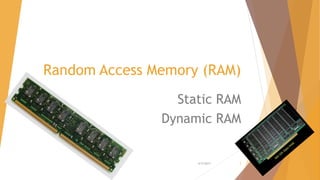
Random Access Memory (RAM)
Static RAM
Dynamic RAM
4/5/2017 3
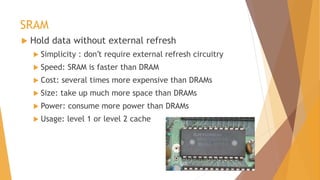
SRAM
 Hold data without external refresh
 Simplicity : don’t require external refresh circuitry
 Speed: SRAM is faster than DRAM
 Cost: several times more expensive than DRAMs
 Size: take up much more space than DRAMs
 Power: consume more power than DRAMs
 Usage: level 1 or level 2 cache
4/5/2017 4
Design Of SRAM
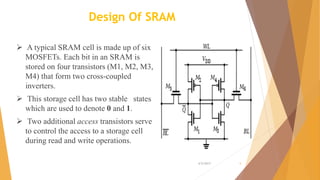
 A typical SRAM cell is made up of six
MOSFETs. Each bit in an SRAM is
stored on four transistors (M1, M2, M3,
M4) that form two cross-coupled
inverters.
 This storage cell has two stable states
which are used to denote 0 and 1.
 Two additional access transistors serve
to control the access to a storage cell
during read and write operations.
4/5/2017 5
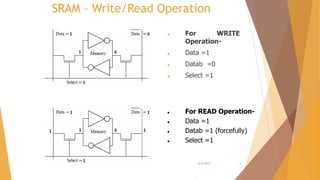
SRAM – Write/Read Operation
 For WRITE
Operation-
 Data =1
 Datab =0
 Select =1
 For READ Operation-
 Data =1
 Datab =1 (forcefully)
 Select =1
4/5/2017 6
Reading operation
 Assume that the content of memory is 1 stored at Q. The read cycle
is started by precharging both the bit lines to a logic 1,
 The word line WL, enabling M5 AND M6 .
 The second step occurs when the value stored in Q & Q’ are
transferred to the bit line by leaving BL at its precharged value and
discharging BL’ through M1 and M5 to a logical 0
 On the BL side, the transistors M4 and M6 pull the bit line toward VDD,
a logical 1 (M4 as it is turned on because Q’ is logically set to 0).
 Bit lines reach a sense amplifier, which will sense which line has
higher voltage and thus will tell whether there was 1 stored or 0. The
higher the sensitivity of sense amplifier, the faster the speed of read
operation is.
4/5/2017 7
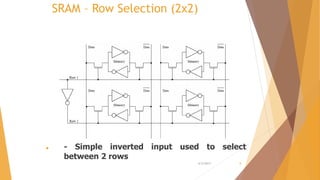
SRAM – Row Selection (2x2)
 - Simple inverted input used to select
between 2 rows
4/5/2017 8
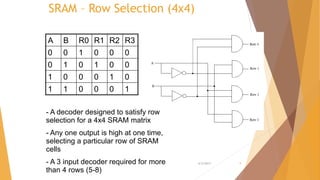
SRAM – Row Selection (4x4)
A B R0 R1 R2 R3
0 0 1 0 0 0
0 1 0 1 0 0
1 0 0 0 1 0
1 1 0 0 0 1
- A decoder designed to satisfy row
selection for a 4x4 SRAM matrix
- Any one output is high at one time,
selecting a particular row of SRAM
cells
- A 3 input decoder required for more
than 4 rows (5-8)
4/5/2017 9
Timing Diagram
4/5/2017 10
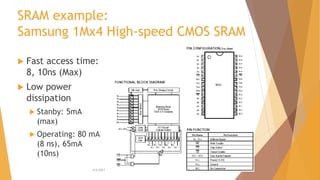
SRAM example:
Samsung 1Mx4 High-speed CMOS SRAM
 Fast access time:
8, 10ns (Max)
 Low power
dissipation
 Stanby: 5mA
(max)
 Operating: 80 mA
(8 ns), 65mA
(10ns)
4/5/2017 11
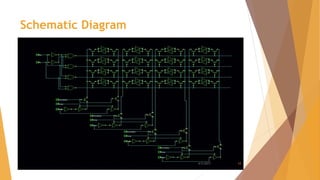
Schematic Diagram
4/5/2017 12
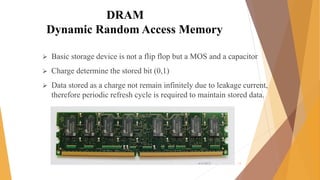
DRAM
Dynamic Random Access Memory
 Basic storage device is not a flip flop but a MOS and a capacitor
 Charge determine the stored bit (0,1)
 Data stored as a charge not remain infinitely due to leakage current,
therefore periodic refresh cycle is required to maintain stored data.
4/5/2017 13
OPERATION
VDD
O/P
CT1
T3
I/P
A
 When A= 1 T1 will be ON then
capacitor charges to I/P value during
interval A=1
When T1 is OFF the invertor will
remember the sample data because of
stored charge on capacitor.
Charge on capacitor eventually leak
OFF. Because of leakage through
insulation which supports the gate on
T2.
 To larger extent it is due to leakage
through reverse biased junction formed
b/w sub. And drain of T1. 4/5/2017 14
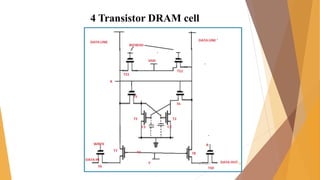
4 Transistor DRAM cell
4/5/2017 15
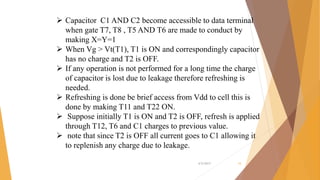
 Capacitor C1 AND C2 become accessible to data terminal
when gate T7, T8 , T5 AND T6 are made to conduct by
making X=Y=1
 When Vg > Vt(T1), T1 is ON and correspondingly capacitor
has no charge and T2 is OFF.
 If any operation is not performed for a long time the charge
of capacitor is lost due to leakage therefore refreshing is
needed.
 Refreshing is done be brief access from Vdd to cell this is
done by making T11 and T22 ON.
 Suppose initially T1 is ON and T2 is OFF, refresh is applied
through T12, T6 and C1 charges to previous value.
 note that since T2 is OFF all current goes to C1 allowing it
to replenish any charge due to leakage.
4/5/2017 16
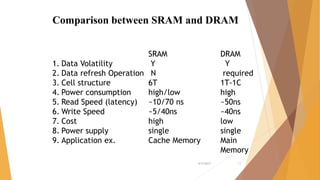
SRAM DRAM
1. Data Volatility Y Y
2. Data refresh Operation N required
3. Cell structure 6T 1T-1C
4. Power consumption high/low high
5. Read Speed (latency) ~10/70 ns ~50ns
6. Write Speed ~5/40ns ~40ns
7. Cost high low
8. Power supply single single
9. Application ex. Cache Memory Main
Memory
Comparison between SRAM and DRAM
4/5/2017 17
Thank you
4/5/2017 18

SRAM DRAM

  • 1.
  • 2.
    A Presentation onRam Presented by  Tipu Sultan  Roll:04  Batch: 17th  Md Shakhawat Hossain Sujon  Roll: 02  Batch: 17th Presented to  TAFSIR AHMED KHAN  LECTURER  DEPARTMENT OF EETE  DHAKA INTERNATIONAL UNIVERSITY 4/5/2017 2
  • 3.
    Random Access Memory(RAM) Static RAM Dynamic RAM 4/5/2017 3
  • 4.
    SRAM  Hold datawithout external refresh  Simplicity : don’t require external refresh circuitry  Speed: SRAM is faster than DRAM  Cost: several times more expensive than DRAMs  Size: take up much more space than DRAMs  Power: consume more power than DRAMs  Usage: level 1 or level 2 cache 4/5/2017 4
  • 5.
    Design Of SRAM A typical SRAM cell is made up of six MOSFETs. Each bit in an SRAM is stored on four transistors (M1, M2, M3, M4) that form two cross-coupled inverters.  This storage cell has two stable states which are used to denote 0 and 1.  Two additional access transistors serve to control the access to a storage cell during read and write operations. 4/5/2017 5
  • 6.
    SRAM – Write/ReadOperation  For WRITE Operation-  Data =1  Datab =0  Select =1  For READ Operation-  Data =1  Datab =1 (forcefully)  Select =1 4/5/2017 6
  • 7.
    Reading operation  Assumethat the content of memory is 1 stored at Q. The read cycle is started by precharging both the bit lines to a logic 1,  The word line WL, enabling M5 AND M6 .  The second step occurs when the value stored in Q & Q’ are transferred to the bit line by leaving BL at its precharged value and discharging BL’ through M1 and M5 to a logical 0  On the BL side, the transistors M4 and M6 pull the bit line toward VDD, a logical 1 (M4 as it is turned on because Q’ is logically set to 0).  Bit lines reach a sense amplifier, which will sense which line has higher voltage and thus will tell whether there was 1 stored or 0. The higher the sensitivity of sense amplifier, the faster the speed of read operation is. 4/5/2017 7
  • 8.
    SRAM – RowSelection (2x2)  - Simple inverted input used to select between 2 rows 4/5/2017 8
  • 9.
    SRAM – RowSelection (4x4) A B R0 R1 R2 R3 0 0 1 0 0 0 0 1 0 1 0 0 1 0 0 0 1 0 1 1 0 0 0 1 - A decoder designed to satisfy row selection for a 4x4 SRAM matrix - Any one output is high at one time, selecting a particular row of SRAM cells - A 3 input decoder required for more than 4 rows (5-8) 4/5/2017 9
  • 10.
  • 11.
    SRAM example: Samsung 1Mx4High-speed CMOS SRAM  Fast access time: 8, 10ns (Max)  Low power dissipation  Stanby: 5mA (max)  Operating: 80 mA (8 ns), 65mA (10ns) 4/5/2017 11
  • 12.
  • 13.
    DRAM Dynamic Random AccessMemory  Basic storage device is not a flip flop but a MOS and a capacitor  Charge determine the stored bit (0,1)  Data stored as a charge not remain infinitely due to leakage current, therefore periodic refresh cycle is required to maintain stored data. 4/5/2017 13
  • 14.
    OPERATION VDD O/P CT1 T3 I/P A  When A=1 T1 will be ON then capacitor charges to I/P value during interval A=1 When T1 is OFF the invertor will remember the sample data because of stored charge on capacitor. Charge on capacitor eventually leak OFF. Because of leakage through insulation which supports the gate on T2.  To larger extent it is due to leakage through reverse biased junction formed b/w sub. And drain of T1. 4/5/2017 14
  • 15.
    4 Transistor DRAMcell 4/5/2017 15
  • 16.
     Capacitor C1AND C2 become accessible to data terminal when gate T7, T8 , T5 AND T6 are made to conduct by making X=Y=1  When Vg > Vt(T1), T1 is ON and correspondingly capacitor has no charge and T2 is OFF.  If any operation is not performed for a long time the charge of capacitor is lost due to leakage therefore refreshing is needed.  Refreshing is done be brief access from Vdd to cell this is done by making T11 and T22 ON.  Suppose initially T1 is ON and T2 is OFF, refresh is applied through T12, T6 and C1 charges to previous value.  note that since T2 is OFF all current goes to C1 allowing it to replenish any charge due to leakage. 4/5/2017 16
  • 17.
    SRAM DRAM 1. DataVolatility Y Y 2. Data refresh Operation N required 3. Cell structure 6T 1T-1C 4. Power consumption high/low high 5. Read Speed (latency) ~10/70 ns ~50ns 6. Write Speed ~5/40ns ~40ns 7. Cost high low 8. Power supply single single 9. Application ex. Cache Memory Main Memory Comparison between SRAM and DRAM 4/5/2017 17
  • 18.