EET 3350 Digital Systems Design

    Textbook: John Wakerly
       Chapter 9: 9.2-9.4


     Static read/write memories
    Dynamic read/write memories


                                  1
Random Access Memory (RAM)
• For most applications, main memory is a
  collection of RAM chips
  – These are volatile, switch the machine off and the
    contents in this form of memory are lost


• There are three basic types of RAM
  – Dynamic RAM (DRAM)
  – Static RAM (SRAM)
  – Non-volatile RAM (NVRAM = RAM + battery)


                                                         2
Random Access Memory (RAM)
• Read/Write Memory
 – Access time is independent of bit’s location
 – Volatile: lose their content when power is removed
• Static RAM (SRAM)
 – Memory behaves like Latches or Flip-Flops
 – Data remains stored as long as power applied
• Dynamic RAM (DRAM)
 – Charged or discharged capacitor
 – Memory lasts only for a few milliseconds
 – Data must be refreshed periodically by reading and
   rewriting

                                                        3
Static RAM (SRAM)
• Each bit (or the cell that stores the bit) is
  represented by a Flip-Flop (or, more
  accurately, a Latch)

• The cell's output is maintained until either
  altered to a new value or the power is turned
  off

• When compared to Dynamic RAM (DRAM)
  – More complex
  – More expensive

                                                  4
Static RAM (SRAM)
• Since storage cells in SRAM are made of
  Latches they do not require refreshing in order
  to keep their data
• The problem is that each cell requires at least
  six transistors to build and the cell holds only
  one bit data
• The capacity of SRAM is far below DRAM
• SRAM is widely used for cache memory


                                                     5
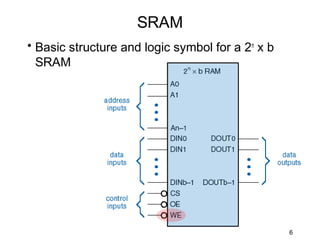
SRAM
• Basic structure and logic symbol for a 2n x b
  SRAM


                                                  6
SRAM Operation
• Individual bits are D latches, not edge-triggered
  D flip-flops
  – Fewer transistors per cell
• Implications for write operations:
  – Address must be stable before writing cell
  – Data must be stable before ending a write


                                         ≡


                                                 7
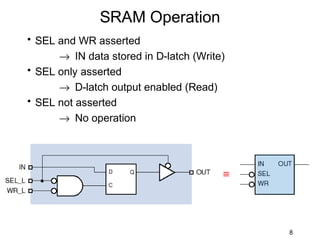
SRAM Operation
• SEL and WR asserted
      → IN data stored in D-latch (Write)
• SEL only asserted
      → D-latch output enabled (Read)
• SEL not asserted
      → No operation


                                        ≡


                                            8
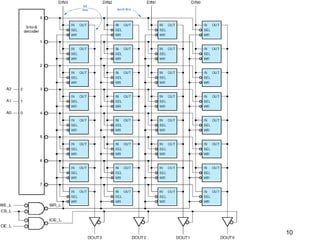
SRAM Array
• Internal structure of an 8 x 4 static RAM
• As with ROM, the decoder selects a particular
  row
• Outputs are tri-state buffered and controlled by
  an enable input


                                                     9
10
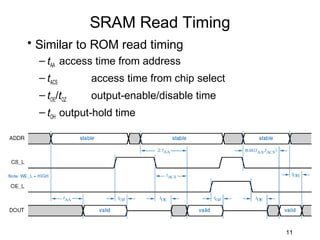
SRAM Read Timing
• Similar to ROM read timing
  – tAA access time from address
  – tACS      access time from chip select
  – tOE/tOZ   output-enable/disable time
  – tOH output-hold time


                                             11
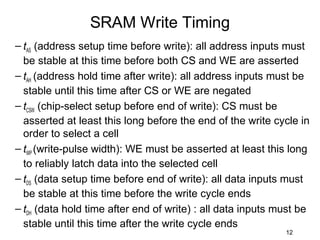
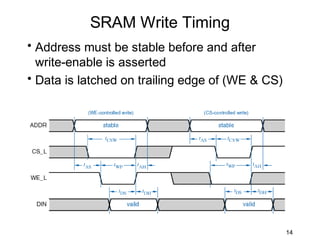
SRAM Write Timing
– tAS (address setup time before write): all address inputs must
  be stable at this time before both CS and WE are asserted
– tAH (address hold time after write): all address inputs must be
  stable until this time after CS or WE are negated
– tCSW (chip-select setup before end of write): CS must be
  asserted at least this long before the end of the write cycle in
  order to select a cell
– tWP (write-pulse width): WE must be asserted at least this long
  to reliably latch data into the selected cell
– tDS (data setup time before end of write): all data inputs must
  be stable at this time before the write cycle ends
– tDH (data hold time after end of write) : all data inputs must be
  stable until this time after the write cycle ends
                                                             12
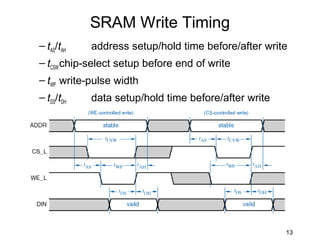
SRAM Write Timing
– tAS/tAH   address setup/hold time before/after write
– tCSW chip-select setup before end of write
– tWP write-pulse width
– tDS/tDH   data setup/hold time before/after write


                                                      13
SRAM Write Timing
• Address must be stable before and after
  write-enable is asserted
• Data is latched on trailing edge of (WE & CS)


                                                  14
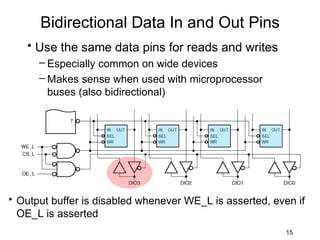
Bidirectional Data In and Out Pins
   • Use the same data pins for reads and writes
      – Especially common on wide devices
      – Makes sense when used with microprocessor
        buses (also bidirectional)


• Output buffer is disabled whenever WE_L is asserted, even if
  OE_L is asserted
                                                          15
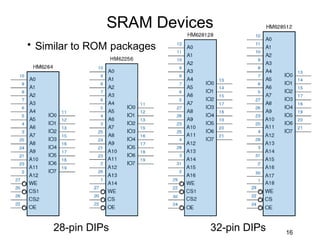
SRAM Devices
• Similar to ROM packages


     28-pin DIPs            32-pin DIPs   16
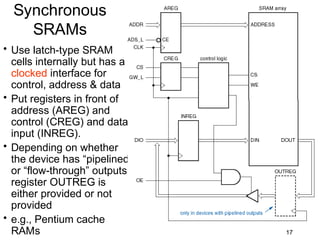
Synchronous
    SRAMs
• Use latch-type SRAM
  cells internally but has a
  clocked interface for
  control, address & data
• Put registers in front of
  address (AREG) and
  control (CREG) and data
  input (INREG).
• Depending on whether
  the device has “pipelined”
  or “flow-through” outputs
  register OUTREG is
  either provided or not
  provided
• e.g., Pentium cache
  RAMs                         17
Dynamic RAM (DRAM)
• Commonly used in main memory.
  – A logical '1' is used to charge a capacitor, and this
    holds the device in its switched on (or positive
    state).
  – The capacitor will lose it's charge with time so the
    capacitor has to constantly refreshed to keep the
    switched on state.


• If a logical '0' is to be stored the capacitor is
  discharged.


                                                            18
Dynamic RAM (DRAM)
• The use of a capacitor as a means to store data
• Cuts down the number of transistors needed to build
  cell
• However, it requires constant refreshing due to
  leakage
• Advantage:
  – High density (capacity)
  – Cheaper cost per bit
  – Lower power consumption per bit
• Disadvantage:
  – Must be refreshed periodically
  – While it is being refreshed, the data can not be accessed


                                                                19
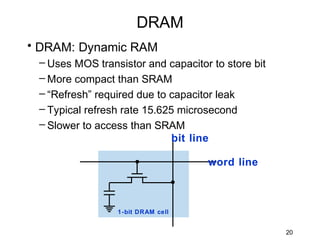
DRAM
• DRAM: Dynamic RAM
 – Uses MOS transistor and capacitor to store bit
 – More compact than SRAM
 – “Refresh” required due to capacitor leak
 – Typical refresh rate 15.625 microsecond
 – Slower to access than SRAM
                              bit line

                                    word line


                 1-bit DRAM cell


                                                    20
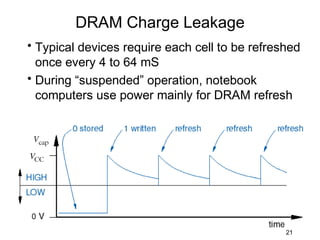
DRAM Charge Leakage
• Typical devices require each cell to be refreshed
  once every 4 to 64 mS
• During “suspended” operation, notebook
  computers use power mainly for DRAM refresh


                                                21
DRAM Packaging
• Packaging in DRAM
 – To reduce the number of pins needed for address,
   multiplex / demultiplexing is used
 – Method is to split the address into half and send in
   each half of the address through the same pins
   requires fewer pins
 – Internally, DRAM is divided into a square of rows
   and columns, the first half of the address is called
   the row and the second half is called the column
• Organization of DRAM
 – Most DRAM are x 1 and x 4


                                                          22
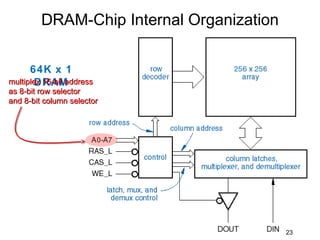
DRAM-Chip Internal Organization

      64K x 1
        DRAM
multiplex 16-bit address
as 8-bit row selector
and 8-bit column selector


                                           23
DRAM Timing
• No clock
• DRAM operations are initiated and completed on both
  the rising and falling edges of RAS_L and CAS_L
• The timing for RAS-only refresh cycle is shown on next
  slide
• This cycle is used to refresh a row of memory without
  actually reading or writing any data at the external pins
  of the DRAM chip
• The cycle begins when a row address is applied to the
  multiplexed address inputs & RAS_L is asserted


                                                     24
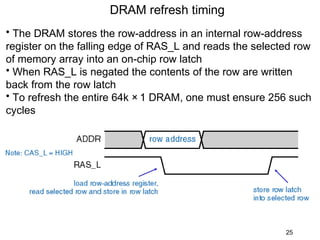
DRAM refresh timing
• The DRAM stores the row-address in an internal row-address
register on the falling edge of RAS_L and reads the selected row
of memory array into an on-chip row latch
• When RAS_L is negated the contents of the row are written
back from the row latch
• To refresh the entire 64k × 1 DRAM, one must ensure 256 such
cycles


                                                          25
DRAM read timing
• Begins like a refresh cycle, selected row is read into the row
latch
• Next a column address is applied to the multiplexed address
inputs & is stored in an on-chip column address register on the
falling edge of CAS_L
• It selects one bit of the just read row which is made available on
the DRAM’s DOUT pin which is enabled as long as CAS_L is
asserted


                                                              26
DRAM write timing
• Begins like a refresh or read cycle, WE_L must be asserted
before CAS_L is asserted, this disables DOUT for the rest of the
cycle, even though CAS_L will be asserted subsequently
• Once the selected row is read into the row latch, WE_L forces
the input bit on DIN to be merged into the row latch in the bit
position selected by the column address


                                                           27
RAS/CAS Operation
• Row Address Strobe, Column Address Strobe
 – n address bits are provided in two steps using n/2
   pins, referenced to the falling edges of RAS_L and
   CAS_L
 – Traditional method of DRAM operation for 20 years
 – Now being supplemented by synchronous, clocked
   interfaces in SDRAM (synchronous DRAM)


                                                    28
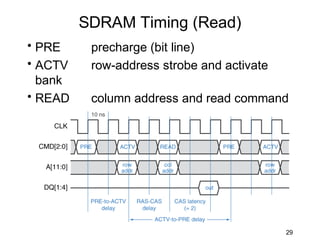
SDRAM Timing (Read)
• PRE     precharge (bit line)
• ACTV    row-address strobe and activate
  bank
• READ    column address and read command


                                            29
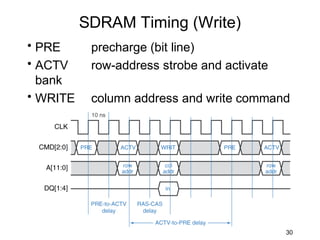
SDRAM Timing (Write)
• PRE      precharge (bit line)
• ACTV     row-address strobe and activate
  bank
• WRITE    column address and write command


                                             30
Types of RAM
• Synchronous DRAM (SDRAM)
 – SDRAM has a synchronous interface
 – SDRAM replaced DRAM, FPM, and EDO
 – SDRAM is an improvement because it synchronizes
   data transfer between the CPU and memory.
 – It waits for a clock pulse before transferring data
   and is therefore synchronous with the computer
   system bus and processor.
 – This greatly improves performance over
   asynchronous DRAM.


                                                    31
Types of RAM
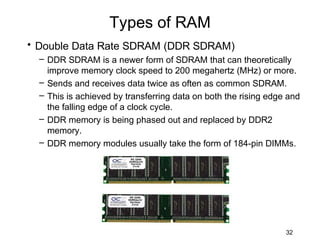
• Double Data Rate SDRAM (DDR SDRAM)
  – DDR SDRAM is a newer form of SDRAM that can theoretically
    improve memory clock speed to 200 megahertz (MHz) or more.
  – Sends and receives data twice as often as common SDRAM.
  – This is achieved by transferring data on both the rising edge and
    the falling edge of a clock cycle.
  – DDR memory is being phased out and replaced by DDR2
    memory.
  – DDR memory modules usually take the form of 184-pin DIMMs.


                                                                 32

Static and Dynamic Read/Write memories

  • 1.
    EET 3350 DigitalSystems Design Textbook: John Wakerly Chapter 9: 9.2-9.4 Static read/write memories Dynamic read/write memories 1
  • 2.
    Random Access Memory(RAM) • For most applications, main memory is a collection of RAM chips – These are volatile, switch the machine off and the contents in this form of memory are lost • There are three basic types of RAM – Dynamic RAM (DRAM) – Static RAM (SRAM) – Non-volatile RAM (NVRAM = RAM + battery) 2
  • 3.
    Random Access Memory(RAM) • Read/Write Memory – Access time is independent of bit’s location – Volatile: lose their content when power is removed • Static RAM (SRAM) – Memory behaves like Latches or Flip-Flops – Data remains stored as long as power applied • Dynamic RAM (DRAM) – Charged or discharged capacitor – Memory lasts only for a few milliseconds – Data must be refreshed periodically by reading and rewriting 3
  • 4.
    Static RAM (SRAM) •Each bit (or the cell that stores the bit) is represented by a Flip-Flop (or, more accurately, a Latch) • The cell's output is maintained until either altered to a new value or the power is turned off • When compared to Dynamic RAM (DRAM) – More complex – More expensive 4
  • 5.
    Static RAM (SRAM) •Since storage cells in SRAM are made of Latches they do not require refreshing in order to keep their data • The problem is that each cell requires at least six transistors to build and the cell holds only one bit data • The capacity of SRAM is far below DRAM • SRAM is widely used for cache memory 5
  • 6.
    SRAM • Basic structureand logic symbol for a 2n x b SRAM 6
  • 7.
    SRAM Operation • Individualbits are D latches, not edge-triggered D flip-flops – Fewer transistors per cell • Implications for write operations: – Address must be stable before writing cell – Data must be stable before ending a write ≡ 7
  • 8.
    SRAM Operation • SELand WR asserted → IN data stored in D-latch (Write) • SEL only asserted → D-latch output enabled (Read) • SEL not asserted → No operation ≡ 8
  • 9.
    SRAM Array • Internalstructure of an 8 x 4 static RAM • As with ROM, the decoder selects a particular row • Outputs are tri-state buffered and controlled by an enable input 9
  • 10.
  • 11.
    SRAM Read Timing •Similar to ROM read timing – tAA access time from address – tACS access time from chip select – tOE/tOZ output-enable/disable time – tOH output-hold time 11
  • 12.
    SRAM Write Timing –tAS (address setup time before write): all address inputs must be stable at this time before both CS and WE are asserted – tAH (address hold time after write): all address inputs must be stable until this time after CS or WE are negated – tCSW (chip-select setup before end of write): CS must be asserted at least this long before the end of the write cycle in order to select a cell – tWP (write-pulse width): WE must be asserted at least this long to reliably latch data into the selected cell – tDS (data setup time before end of write): all data inputs must be stable at this time before the write cycle ends – tDH (data hold time after end of write) : all data inputs must be stable until this time after the write cycle ends 12
  • 13.
    SRAM Write Timing –tAS/tAH address setup/hold time before/after write – tCSW chip-select setup before end of write – tWP write-pulse width – tDS/tDH data setup/hold time before/after write 13
  • 14.
    SRAM Write Timing •Address must be stable before and after write-enable is asserted • Data is latched on trailing edge of (WE & CS) 14
  • 15.
    Bidirectional Data Inand Out Pins • Use the same data pins for reads and writes – Especially common on wide devices – Makes sense when used with microprocessor buses (also bidirectional) • Output buffer is disabled whenever WE_L is asserted, even if OE_L is asserted 15
  • 16.
    SRAM Devices • Similarto ROM packages 28-pin DIPs 32-pin DIPs 16
  • 17.
    Synchronous SRAMs • Use latch-type SRAM cells internally but has a clocked interface for control, address & data • Put registers in front of address (AREG) and control (CREG) and data input (INREG). • Depending on whether the device has “pipelined” or “flow-through” outputs register OUTREG is either provided or not provided • e.g., Pentium cache RAMs 17
  • 18.
    Dynamic RAM (DRAM) •Commonly used in main memory. – A logical '1' is used to charge a capacitor, and this holds the device in its switched on (or positive state). – The capacitor will lose it's charge with time so the capacitor has to constantly refreshed to keep the switched on state. • If a logical '0' is to be stored the capacitor is discharged. 18
  • 19.
    Dynamic RAM (DRAM) •The use of a capacitor as a means to store data • Cuts down the number of transistors needed to build cell • However, it requires constant refreshing due to leakage • Advantage: – High density (capacity) – Cheaper cost per bit – Lower power consumption per bit • Disadvantage: – Must be refreshed periodically – While it is being refreshed, the data can not be accessed 19
  • 20.
    DRAM • DRAM: DynamicRAM – Uses MOS transistor and capacitor to store bit – More compact than SRAM – “Refresh” required due to capacitor leak – Typical refresh rate 15.625 microsecond – Slower to access than SRAM bit line word line 1-bit DRAM cell 20
  • 21.
    DRAM Charge Leakage •Typical devices require each cell to be refreshed once every 4 to 64 mS • During “suspended” operation, notebook computers use power mainly for DRAM refresh 21
  • 22.
    DRAM Packaging • Packagingin DRAM – To reduce the number of pins needed for address, multiplex / demultiplexing is used – Method is to split the address into half and send in each half of the address through the same pins requires fewer pins – Internally, DRAM is divided into a square of rows and columns, the first half of the address is called the row and the second half is called the column • Organization of DRAM – Most DRAM are x 1 and x 4 22
  • 23.
    DRAM-Chip Internal Organization 64K x 1 DRAM multiplex 16-bit address as 8-bit row selector and 8-bit column selector 23
  • 24.
    DRAM Timing • Noclock • DRAM operations are initiated and completed on both the rising and falling edges of RAS_L and CAS_L • The timing for RAS-only refresh cycle is shown on next slide • This cycle is used to refresh a row of memory without actually reading or writing any data at the external pins of the DRAM chip • The cycle begins when a row address is applied to the multiplexed address inputs & RAS_L is asserted 24
  • 25.
    DRAM refresh timing •The DRAM stores the row-address in an internal row-address register on the falling edge of RAS_L and reads the selected row of memory array into an on-chip row latch • When RAS_L is negated the contents of the row are written back from the row latch • To refresh the entire 64k × 1 DRAM, one must ensure 256 such cycles 25
  • 26.
    DRAM read timing •Begins like a refresh cycle, selected row is read into the row latch • Next a column address is applied to the multiplexed address inputs & is stored in an on-chip column address register on the falling edge of CAS_L • It selects one bit of the just read row which is made available on the DRAM’s DOUT pin which is enabled as long as CAS_L is asserted 26
  • 27.
    DRAM write timing •Begins like a refresh or read cycle, WE_L must be asserted before CAS_L is asserted, this disables DOUT for the rest of the cycle, even though CAS_L will be asserted subsequently • Once the selected row is read into the row latch, WE_L forces the input bit on DIN to be merged into the row latch in the bit position selected by the column address 27
  • 28.
    RAS/CAS Operation • RowAddress Strobe, Column Address Strobe – n address bits are provided in two steps using n/2 pins, referenced to the falling edges of RAS_L and CAS_L – Traditional method of DRAM operation for 20 years – Now being supplemented by synchronous, clocked interfaces in SDRAM (synchronous DRAM) 28
  • 29.
    SDRAM Timing (Read) •PRE precharge (bit line) • ACTV row-address strobe and activate bank • READ column address and read command 29
  • 30.
    SDRAM Timing (Write) •PRE precharge (bit line) • ACTV row-address strobe and activate bank • WRITE column address and write command 30
  • 31.
    Types of RAM •Synchronous DRAM (SDRAM) – SDRAM has a synchronous interface – SDRAM replaced DRAM, FPM, and EDO – SDRAM is an improvement because it synchronizes data transfer between the CPU and memory. – It waits for a clock pulse before transferring data and is therefore synchronous with the computer system bus and processor. – This greatly improves performance over asynchronous DRAM. 31
  • 32.
    Types of RAM •Double Data Rate SDRAM (DDR SDRAM) – DDR SDRAM is a newer form of SDRAM that can theoretically improve memory clock speed to 200 megahertz (MHz) or more. – Sends and receives data twice as often as common SDRAM. – This is achieved by transferring data on both the rising edge and the falling edge of a clock cycle. – DDR memory is being phased out and replaced by DDR2 memory. – DDR memory modules usually take the form of 184-pin DIMMs. 32