RAMRANDOM ACCESS MEMORY
1
WHAT IS RAM?
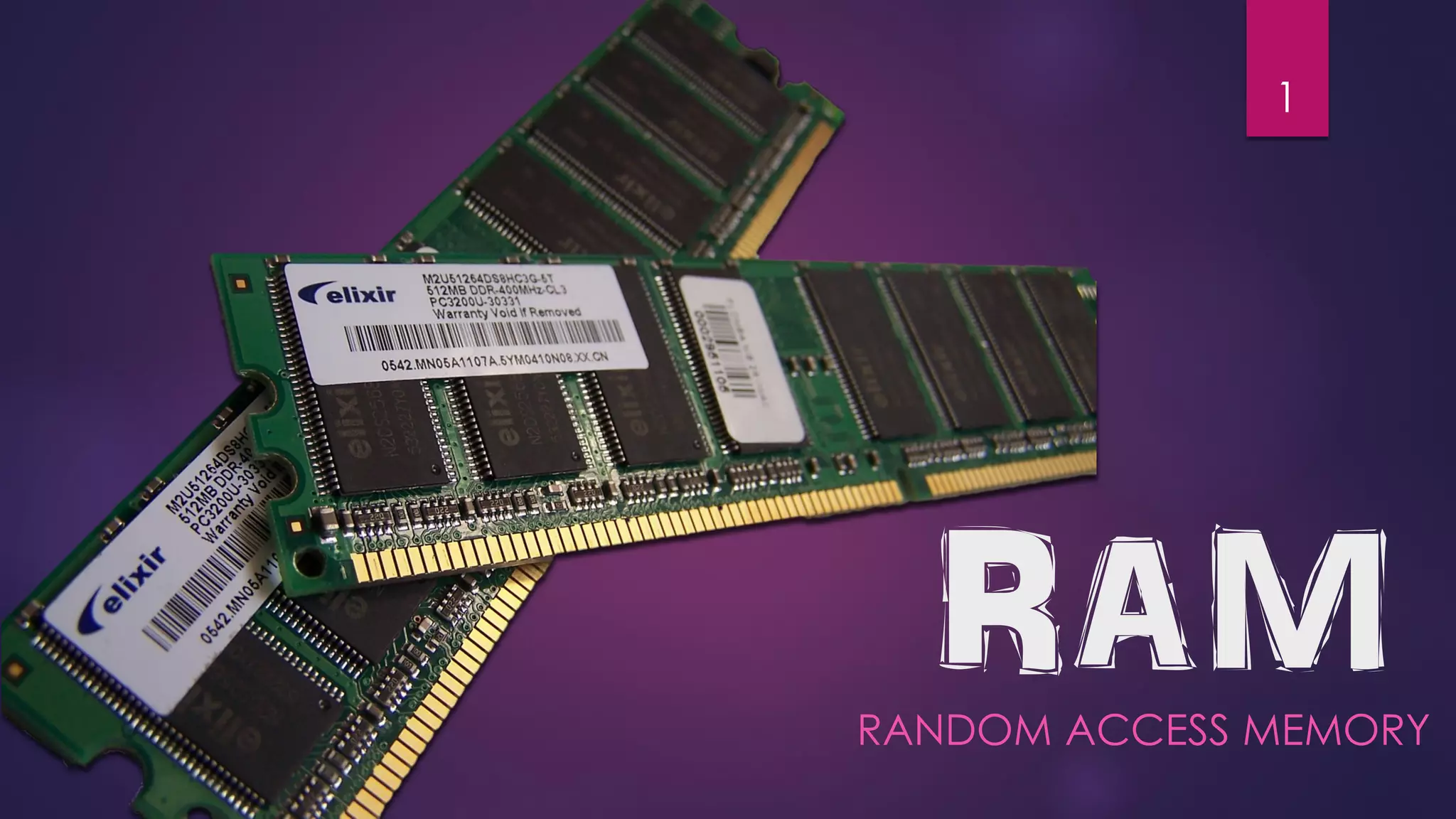
 Alternatively referred to as main memory, primary memory, or
system memory, Random Access Memory (RAM) is a hardware
device that allows information to be stored and retrieved on a
computer.
 Ram is volatile memory, meaning it does not retain data, when the
electric power is turned off or fails, so if you turn off your computer,
all memory stored in RAM is lost.
 When your computer is turned on again, the BIOS reads your
operating system and related files from the hard disk and loads
them back into RAM.
 RAM stores its data in a series of memory cells that can be accessed
in any order, that is why it is called Random.
 SAM (Sequential Access Memory) is almost same as RAM, but can only
access its memory cells in a specific order/sequence.
2
TYPES OF RAM
STATIC RAM (SRAM)
 In SRAM, a bit of data is stored
using the state of a six
transistor memory cell.
 This form of RAM is more expensive
to produce, but is generally faster
and requires less power than
DRAM and, in modern computers,
is often used as cache memory for
the CPU.
DYNAMIC RAM (DRAM)
 DRAM stores a bit of data using a
transistor and capacitor pair,
which together comprise a
DRAM memory cell.
 As this form of memory is less
expensive to produce than static
RAM, it is the predominant form of
computer memory used in
modern computers.
 Both static and dynamic RAM are considered volatile, as their state is lost or
reset when power is removed from the system.
 In general, the term RAM refers solely to solid-state memory devices (either
DRAM or SRAM), and more specifically the main memory in most computers.
3
OTHER USES OF RAM
VIRTUAL MEMORY
Most modern operating systems
employ a method of extending
RAM capacity, known as
"virtual memory".
A portion of the
computer's hard drive is set
aside for a paging file or
a scratch partition, and the
combination of physical RAM
and the paging file form the
system's total memory.
(For example, if a computer
has 2 GB of RAM and a 1 GB
page file, the operating system
has 3 GB total memory
available to it.)
RAM DISK
Software can "partition" a
portion of a computer's RAM,
allowing it to act as a much
faster hard drive that is called
a RAM disk.
A RAM disk loses the stored
data when the computer is shut
down, unless memory is
arranged to have a standby
battery source.
SHADOW RAM
Sometimes, the contents of a
relatively slow ROM chip are
copied to read/write memory
to allow for shorter access
times.
The ROM chip is then disabled
while the initialized memory
locations are switched in on the
same block of addresses (often
write-protected).
This process, sometimes
called shadowing, is fairly
common in both computers
and embedded systems.
 In addition to serving as temporary storage and working space for the operating
system and applications, RAM is used in numerous other ways.
4
RECENT DEVELOPMENTS
 Several new types of non-volatile RAM, which will preserve data
while powered down, are under development.
 The technologies used include carbon nanotubes and approaches
utilizing Tunnel magneto resistance.
 Some kinds of random-access memory, such as "EcoRAM", are
specifically designed for server farms, where low power
consumption is more important than speed.
5
“
”
If your advertising goes
unnoticed, everything
else is academic.
WILLIAM BERNBACH
DIVYANSH BATHAM
6
THANKYOU :)
7

RAM (Random Access Memory)

  • 1.
  • 2.
    WHAT IS RAM? Alternatively referred to as main memory, primary memory, or system memory, Random Access Memory (RAM) is a hardware device that allows information to be stored and retrieved on a computer.  Ram is volatile memory, meaning it does not retain data, when the electric power is turned off or fails, so if you turn off your computer, all memory stored in RAM is lost.  When your computer is turned on again, the BIOS reads your operating system and related files from the hard disk and loads them back into RAM.  RAM stores its data in a series of memory cells that can be accessed in any order, that is why it is called Random.  SAM (Sequential Access Memory) is almost same as RAM, but can only access its memory cells in a specific order/sequence. 2
  • 3.
    TYPES OF RAM STATICRAM (SRAM)  In SRAM, a bit of data is stored using the state of a six transistor memory cell.  This form of RAM is more expensive to produce, but is generally faster and requires less power than DRAM and, in modern computers, is often used as cache memory for the CPU. DYNAMIC RAM (DRAM)  DRAM stores a bit of data using a transistor and capacitor pair, which together comprise a DRAM memory cell.  As this form of memory is less expensive to produce than static RAM, it is the predominant form of computer memory used in modern computers.  Both static and dynamic RAM are considered volatile, as their state is lost or reset when power is removed from the system.  In general, the term RAM refers solely to solid-state memory devices (either DRAM or SRAM), and more specifically the main memory in most computers. 3
  • 4.
    OTHER USES OFRAM VIRTUAL MEMORY Most modern operating systems employ a method of extending RAM capacity, known as "virtual memory". A portion of the computer's hard drive is set aside for a paging file or a scratch partition, and the combination of physical RAM and the paging file form the system's total memory. (For example, if a computer has 2 GB of RAM and a 1 GB page file, the operating system has 3 GB total memory available to it.) RAM DISK Software can "partition" a portion of a computer's RAM, allowing it to act as a much faster hard drive that is called a RAM disk. A RAM disk loses the stored data when the computer is shut down, unless memory is arranged to have a standby battery source. SHADOW RAM Sometimes, the contents of a relatively slow ROM chip are copied to read/write memory to allow for shorter access times. The ROM chip is then disabled while the initialized memory locations are switched in on the same block of addresses (often write-protected). This process, sometimes called shadowing, is fairly common in both computers and embedded systems.  In addition to serving as temporary storage and working space for the operating system and applications, RAM is used in numerous other ways. 4
  • 5.
    RECENT DEVELOPMENTS  Severalnew types of non-volatile RAM, which will preserve data while powered down, are under development.  The technologies used include carbon nanotubes and approaches utilizing Tunnel magneto resistance.  Some kinds of random-access memory, such as "EcoRAM", are specifically designed for server farms, where low power consumption is more important than speed. 5
  • 6.
    “ ” If your advertisinggoes unnoticed, everything else is academic. WILLIAM BERNBACH DIVYANSH BATHAM 6
  • 7.