NOSOCOMIAL INFECTION Presented by, Saima fazal B.S(3 rd  year)
INTRODUCTION Nosocomial infection comes from Greek words   “ nosus ”   meaning   disease  and  “   komeion ”  meaning   to take care of Also called as   HOSPITAL ACQUIRED INFECTION Infections are considered nosocomial if they first appear 48hrs or more after hospital admission or within 30 days after discharge.
Crowded hospital conditions New microorganism Increasing number of people with compromised immune system Increasing Bacterial resistance Rise in nosocomial infection as a result of four factor
EPIDEMIOLOGY Nosocomial infections can be exogenous (external organism) and endogenous (opportunist normal flora) Host susceptibility Is an important factor in the development of nosocomial infection. Medical equipments and procedures (surgery) are often responsible for infections
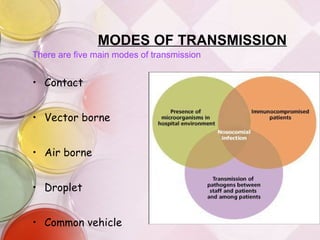
MODES OF TRANSMISSION There are five main modes of transmission Contact Vector borne Air borne Droplet Common vehicle
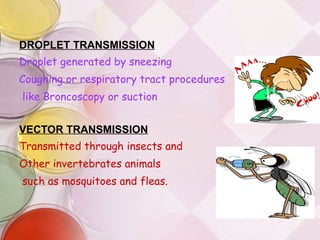
DROPLET TRANSMISSION Droplet generated by sneezing Coughing or respiratory tract procedures like Broncoscopy or suction VECTOR TRANSMISSION Transmitted through insects and Other invertebrates animals such as mosquitoes and fleas.
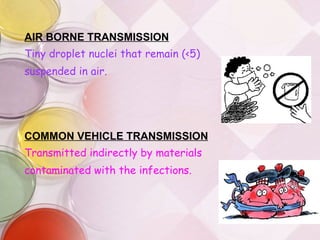
AIR BORNE TRANSMISSION Tiny droplet nuclei that remain (<5) suspended in air. COMMON VEHICLE TRANSMISSION Transmitted indirectly by materials  contaminated with the infections.
CONTACT TRANSMISSION Most important and frequent mode of transmission of nosocomial infections, is divided into two subgroups :  Direct-contact transmission  Indirect-contact transmission.  Direct-contact transmission  Involves a direct body surface-to-body surface contact and physical transfer of microorganisms between a susceptible host and an infected or colonized person, such as occurs when a person turns a patient, gives a patient a bath
Indirect-contact transmission   Involves contact of a susceptible host with a contaminated intermediate object, usually inanimate, such as contaminated instruments,  needles , or dressings, or contaminated gloves that are not changed between patients
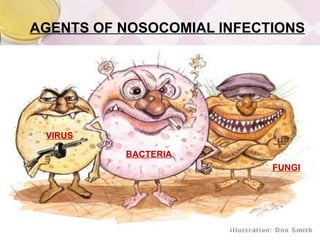
AGENTS OF NOSOCOMIAL INFECTIONS VIRUS BACTERIA FUNGI
 
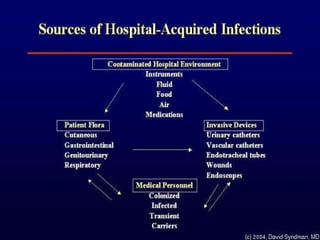
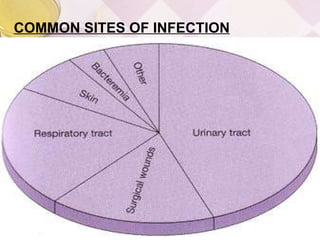
COMMON SITES OF INFECTION
COMMON INFECTIONS Following are the most common nosocomial infections: Urinary tract infection Catheter associated infection Pneumonia Blood stream infections
PROBLEMS OF NOSOCOMIAL INFECTIONS Nosocomial infections will become more important as public health problems as it causes, Nosocomial suffering Prolonged hospital stay Increase the cost of care significantly
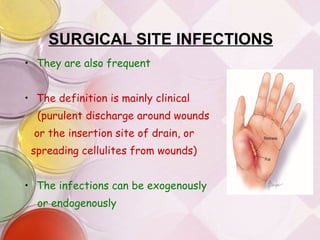
SURGICAL SITE INFECTIONS They are also frequent The definition is mainly clinical (purulent discharge around wounds or the insertion site of drain, or spreading cellulites from wounds) The infections can be exogenously  or endogenously
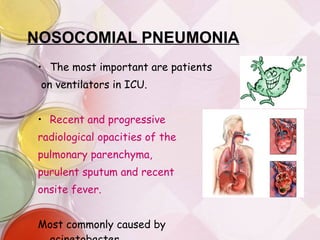
NOSOCOMIAL PNEUMONIA The most important are patients  on ventilators in ICU. Recent and progressive radiological opacities of the pulmonary parenchyma,  purulent sputum and recent  onsite fever.  Most commonly caused by acinetobacter.
NOSOCOMIAL BACTERAEMIA The incidence is increasing particularly for certain organisms such as multi resistance coagulase negative staphylococcus and candida. Infections may occurs at the skin entry site of the IV device or in the sub cutaneous path of catheter.
 
URINARY TRACT INFECTIONS It is the most common cause of nosocomial infections 80% of the infections are associated with indwelling catheters.
PREVENTION AND CONTROL Prevention and control of nosocomial infections can be done by the following ways, ISOLATION Designed to prevent transmission of microorganisms by common routes in hospitals. Because agent and host factors are more difficult to control, interruption of transfer of microorganisms is directed primarily at transmission.
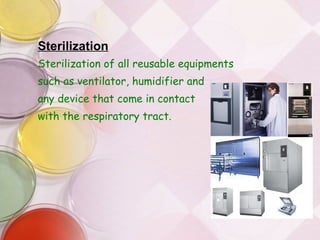
Sterilization Sterilization of all reusable equipments  such as ventilator, humidifier and  any device that come in contact  with the respiratory tract.
 
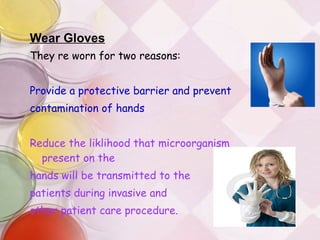
Wear Gloves They re worn for two reasons: Provide a protective barrier and prevent  contamination of hands Reduce the liklihood that microorganism present on the  hands will be transmitted to the  patients during invasive and  other patient care procedure.
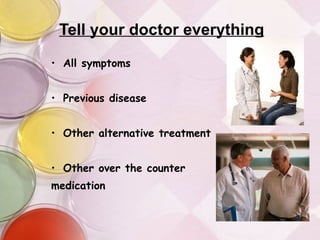
Tell your doctor everything All symptoms Previous disease Other alternative treatment Other over the counter  medication
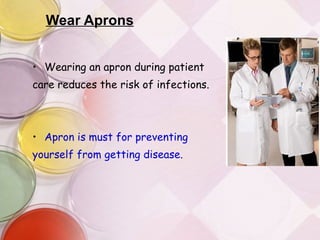
Wear Aprons Wearing an apron during patient  care reduces the risk of infections. Apron is must for preventing  yourself from getting disease.
Get educated Learn about your conditions and  treatment is the best way to prevent an error. Get involved Be assertive about your rights To be a part of the decision Process for your medical care
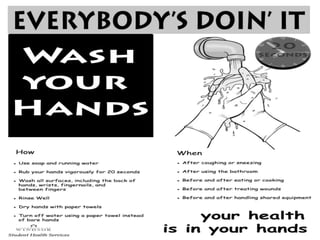
There is no official national approach and no real managerial support from authorities for nosocomial infection Only thing is proper asepsis, proper hand washing and sterilization. CONCLUSION
Thank you

Nosocomial Infection

  • 1.
    NOSOCOMIAL INFECTION Presentedby, Saima fazal B.S(3 rd year)
  • 2.
    INTRODUCTION Nosocomial infectioncomes from Greek words “ nosus ” meaning disease and “ komeion ” meaning to take care of Also called as HOSPITAL ACQUIRED INFECTION Infections are considered nosocomial if they first appear 48hrs or more after hospital admission or within 30 days after discharge.
  • 3.
    Crowded hospital conditionsNew microorganism Increasing number of people with compromised immune system Increasing Bacterial resistance Rise in nosocomial infection as a result of four factor
  • 4.
    EPIDEMIOLOGY Nosocomial infectionscan be exogenous (external organism) and endogenous (opportunist normal flora) Host susceptibility Is an important factor in the development of nosocomial infection. Medical equipments and procedures (surgery) are often responsible for infections
  • 5.
    MODES OF TRANSMISSIONThere are five main modes of transmission Contact Vector borne Air borne Droplet Common vehicle
  • 6.
    DROPLET TRANSMISSION Dropletgenerated by sneezing Coughing or respiratory tract procedures like Broncoscopy or suction VECTOR TRANSMISSION Transmitted through insects and Other invertebrates animals such as mosquitoes and fleas.
  • 7.
    AIR BORNE TRANSMISSIONTiny droplet nuclei that remain (<5) suspended in air. COMMON VEHICLE TRANSMISSION Transmitted indirectly by materials contaminated with the infections.
  • 8.
    CONTACT TRANSMISSION Mostimportant and frequent mode of transmission of nosocomial infections, is divided into two subgroups : Direct-contact transmission Indirect-contact transmission. Direct-contact transmission Involves a direct body surface-to-body surface contact and physical transfer of microorganisms between a susceptible host and an infected or colonized person, such as occurs when a person turns a patient, gives a patient a bath
  • 9.
    Indirect-contact transmission Involves contact of a susceptible host with a contaminated intermediate object, usually inanimate, such as contaminated instruments, needles , or dressings, or contaminated gloves that are not changed between patients
  • 10.
    AGENTS OF NOSOCOMIALINFECTIONS VIRUS BACTERIA FUNGI
  • 11.
  • 12.
    COMMON SITES OFINFECTION
  • 13.
    COMMON INFECTIONS Followingare the most common nosocomial infections: Urinary tract infection Catheter associated infection Pneumonia Blood stream infections
  • 14.
    PROBLEMS OF NOSOCOMIALINFECTIONS Nosocomial infections will become more important as public health problems as it causes, Nosocomial suffering Prolonged hospital stay Increase the cost of care significantly
  • 15.
    SURGICAL SITE INFECTIONSThey are also frequent The definition is mainly clinical (purulent discharge around wounds or the insertion site of drain, or spreading cellulites from wounds) The infections can be exogenously or endogenously
  • 16.
    NOSOCOMIAL PNEUMONIA Themost important are patients on ventilators in ICU. Recent and progressive radiological opacities of the pulmonary parenchyma, purulent sputum and recent onsite fever. Most commonly caused by acinetobacter.
  • 17.
    NOSOCOMIAL BACTERAEMIA Theincidence is increasing particularly for certain organisms such as multi resistance coagulase negative staphylococcus and candida. Infections may occurs at the skin entry site of the IV device or in the sub cutaneous path of catheter.
  • 18.
  • 19.
    URINARY TRACT INFECTIONSIt is the most common cause of nosocomial infections 80% of the infections are associated with indwelling catheters.
  • 20.
    PREVENTION AND CONTROLPrevention and control of nosocomial infections can be done by the following ways, ISOLATION Designed to prevent transmission of microorganisms by common routes in hospitals. Because agent and host factors are more difficult to control, interruption of transfer of microorganisms is directed primarily at transmission.
  • 21.
    Sterilization Sterilization ofall reusable equipments such as ventilator, humidifier and any device that come in contact with the respiratory tract.
  • 22.
  • 23.
    Wear Gloves Theyre worn for two reasons: Provide a protective barrier and prevent contamination of hands Reduce the liklihood that microorganism present on the hands will be transmitted to the patients during invasive and other patient care procedure.
  • 24.
    Tell your doctoreverything All symptoms Previous disease Other alternative treatment Other over the counter medication
  • 25.
    Wear Aprons Wearingan apron during patient care reduces the risk of infections. Apron is must for preventing yourself from getting disease.
  • 26.
    Get educated Learnabout your conditions and treatment is the best way to prevent an error. Get involved Be assertive about your rights To be a part of the decision Process for your medical care
  • 27.
    There is noofficial national approach and no real managerial support from authorities for nosocomial infection Only thing is proper asepsis, proper hand washing and sterilization. CONCLUSION
  • 28.