
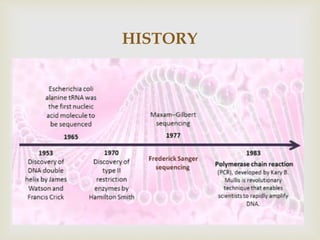
 HISTORY OF DNA SEQUENCING
 INTRODUCTION
 WHAT EXACTLY IS DNA SEQUENCING….??
 DNA STRUCTURE
 IN THE BEGINNING
 HOW IS DNA SEQUENCING PERFORMED..??
 DIFFERENT METHODS FOR DNA SEQUENCING
 SANGER SEQUENCING
 MAX-GILBERT SEQUENCING
 APPLICATION
 ADVANTAGES
 DISADVANTAGES
 CONCLUSION
LIST OF CONTENTS

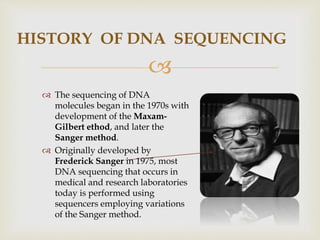
HISTORY OF DNA SEQUENCING
 The sequencing of DNA
molecules began in the 1970s with
development of the Maxam-
Gilbert ethod, and later the
Sanger method.
 Originally developed by
Frederick Sanger in 1975, most
DNA sequencing that occurs in
medical and research laboratories
today is performed using
sequencers employing variations
of the Sanger method.

HISTORY

INTRODUCTION
 The term DNA sequencing refers to sequencing methods for
determining the order of the nucleotide bases - adenine,
guanine, cytosine, and thymine - in a molecule of DNA.
Knowledge of DNA sequences has become indispensable for
basic biological research, other research branches utilizing
DNA sequencing, and in numerous applied fields such as:
 Diagnostic,
 Biotechnology,
 Forensic Biology And
 Biological Systematics.

WHAT EXACTLY IS DNA
SEQUENCING….??
 The very basic unit of the human genome is a single
DNA nucleotide. This nucleotide is extremely small and
is made up of minuscule atoms, which creates a challenge
for even an advanced microscope to be used for
detection.
 Researchers still, however, need to be able to determine
the sequence of bases in DNA that make up the human
genome. As such, DNA sequencing has been developed
but the process itself is a seemingly complex one.
 DNA sequencing involves the determination of the order
of DNA bases.

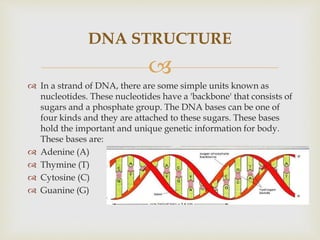
 In a strand of DNA, there are some simple units known as
nucleotides. These nucleotides have a 'backbone' that consists of
sugars and a phosphate group. The DNA bases can be one of
four kinds and they are attached to these sugars. These bases
hold the important and unique genetic information for body.
These bases are:
 Adenine (A)
 Thymine (T)
 Cytosine (C)
 Guanine (G)
DNA STRUCTURE

IN THE BEGINNING
 The very first methods used for DNA sequencing were created
in the 1970s.
 During this decade, researchers were only able to sequence a
small number of base pairs, .
 By 1990, things had improved somewhat but the number of
laboratories able to sequence a hundred thousand bases was
still few.
 Not only that, but the cost of sequencing itself was extremely
high and impractical.
 Fortunately, there have been vast improvements since then,
particularly in terms of technological advancement.

 Better still, automation has made the process much faster and a
great deal more practical.
 Now, individual genes are sequenced on a regular basis and
can be done quickly and affordably for laboratories.
 In fact, some laboratories are sequencing more than a hundred
million bases in a given year

HOW IS DNA SEQUENCING
PERFORMED..??
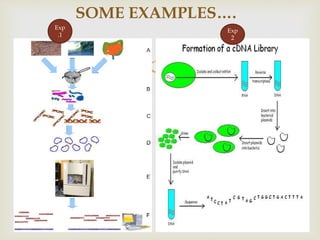
 DNA sequencing involves the process of figuring out the
precise order of the four bases found in one piece of DNA.
 The DNA is really just a template that is used to create a series
of fragments.
 The fragments differ in length by one base and they are
separated by size before the bases are identified, which then
effectively recreates the original DNA sequence.
 Each person has twenty-three pairs of chromosomes - one copy
of the human genome.
 Because technology has limitations, we are limited in how
many bases can be read at one time.
 Therefore, we can't just read each base from one end of a
chromosome to the other. To make it feasible, the chromosome
is cut down into smaller fragments.

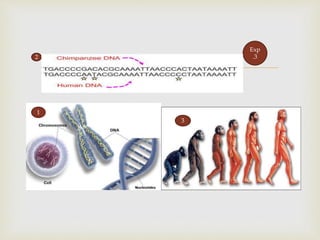
SOME EXAMPLES….
Exp
.1
Exp
2

1
2
3
Exp
.3

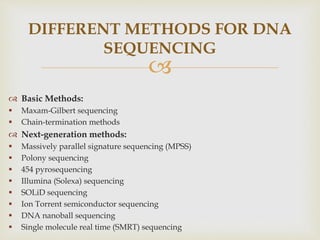
 Basic Methods:
 Maxam-Gilbert sequencing
 Chain-termination methods
 Next-generation methods:
 Massively parallel signature sequencing (MPSS)
 Polony sequencing
 454 pyrosequencing
 Illumina (Solexa) sequencing
 SOLiD sequencing
 Ion Torrent semiconductor sequencing
 DNA nanoball sequencing
 Single molecule real time (SMRT) sequencing
DIFFERENT METHODS FOR DNA
SEQUENCING

SANGER SEQUENCING
OR
CHAIN TERMINATION
METHOD

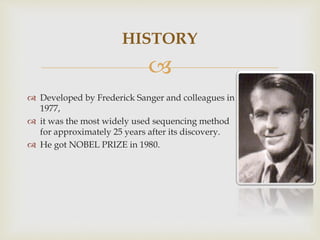
 Developed by Frederick Sanger and colleagues in
1977,
 it was the most widely used sequencing method
for approximately 25 years after its discovery.
 He got NOBEL PRIZE in 1980.
HISTORY

 It is method to find out the nucleotides Sequence of unknown
DNA strand.
 More recently, Sanger sequencing has been upgraded as "Next-
Generation“ sequencing methods, especially for large scale
genome analyses and for obtaining especially long DNA
sequence reads (>500 nucleotides).
INTRODUCTION
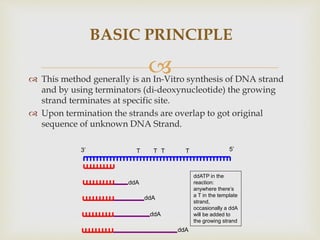
 This method generally is an In-Vitro synthesis of DNA strand
and by using terminators (di-deoxynucleotide) the growing
strand terminates at specific site.
 Upon termination the strands are overlap to got original
sequence of unknown DNA Strand.
BASIC PRINCIPLE
ddA
ddA
ddA
ddA
ddATP in the
reaction:
anywhere there’s
a T in the template
strand,
occasionally a ddA
will be added to
the growing strand
5’3’ T T TT


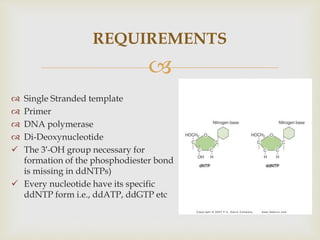
 Single Stranded template
 Primer
 DNA polymerase
 Di-Deoxynucleotide
 The 3′-OH group necessary for
formation of the phosphodiester bond
is missing in ddNTPs)
 Every nucleotide have its specific
ddNTP form i.e., ddATP, ddGTP etc
REQUIREMENTS

 Steps:
1. Denaturation
2. Primer attachment and extension of bases
3. Termination
4. Gel electrophoresis
PROCEDURE

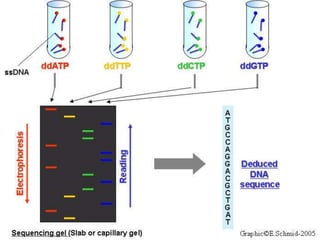
 The DNA template is treated with heat so that it becomes single
stranded
 A short, single-stranded primer which is radioactively labelled
is added to the end of the DNA template
 Add template DNA and primer in 4 Tubes.
 Now add ddNTPs In tubes in the way that single tube contain
one type of ddNTP.
 Extension is start and band formed of various sizes.
 The fragments of DNA are separated by electrophoresis
 Overlap these sequences to find out sequence of Target DNA.
Cont….


MAXAM-GILBERT
SEQUENCING
METHOD

 Maxam–Gilbert sequencing is a method of DNA sequencing
developed by Allan Maxam and Walter Gilbert in 1976–1977.
 Maxam–Gilbert sequencing was the first widely adopted
method for DNA sequencing, and, along with the Sanger
dideoxy method.
 method based on chemical modification of DNA and
subsequent cleavage at specific nitrogenous bases.
INTRODUCTION

PRINCIPLE
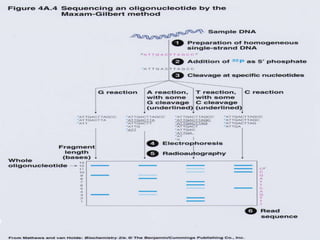
 purification of the DNA fragment that to be sequenced and
labeled with radioactive material.
 Chemical treatment generates breaks at a specific nitrogenous
bases and thus a series of labelled fragments is generated. The
fragments in the four reactions are arranged side by side in gel
electrophoresis for size separation.
 The fragments visualize in X-ray for autoradiography.
 To visualize the fragments,the gel is exposed to X-ray film for
autoradiography,yielding a series of dark bands each
corresponding to a radiolabelled DNA fragment,from which
the sequence may be inferred.


 Maxam–Gilbert sequencing requires radioactive labeling at one 5′ end of
the DNA fragment to be sequenced (gamma-32P).
 Chemical treatment generates breaks at a small proportion of one or two of
the four nucleotide bases in each of four reactions (G, A+G, C, C+T). For
example,
1. the purines (A+G) by using formic acid,
2. the guanines (and to some extent the adenines) by dimethyl sulfate,
3. the pyrimidines (C+T) by using hydrazine.
4. NaCl add to hydrazine for Cytosine.
 Add each chemical in separate tube.
 Thus a series of labeled fragments is generated.
 The fragments in the four reactions are electrophoresed side by side for
size separation.
 To visualize the fragments, the gel is exposed to X-ray film for
autoradiography, yielding a series of dark bands each showing the location
of identical radiolabeled DNA molecules.
Procedure
APPLICATIONS:
 With its study we can understand the function of a specific sequence
and the sequence responsible for any disease.
 With the help of comparative DNA sequence study we can detect any
mutation.
 DNA fingerprinting.
 By knowing the whole genome sequence, Human genome project get
completed.
 Forensics:-
DNA sequencing has been applied in forensics science to identify
particular individual because every individual has unique sequence
of his/her DNA. It is particularly ed to identify the criminals by
finding some proof from the crime scene in the form of hair, nail, skin
or blood samples.

 Agriculture:-
DNA sequencing has played vital role in the field of agriculture.
The mapping and sequencing of the whole genome of
microorganisms has allowed the agriculturists to make them
useful for the crops and food plants.
 Medicine:-
In medical research, DNA sequencing can be used to detect the
genes which are associated with some heredity or acquired
diseases. Scientists use different techniques of genetic
engineering like gene therapy to identify the defected genes and
replace them with the healthy ones.
ADVANTAGES
 One major application of DNA testing is in forensic
identification;
 DNA test results are much clearer than fingerprints and it is
with these results and proof that it is possible to find criminals;
 DNA evidence from blood, skin or hair can be matched to the
DNA of a suspect to determine information about where an
individual was and who they may have come in contact with;
 DNA analysis is especially important in cases of rape, where
doctors can often examine a victim and find traces of the
rapist's DNA.
More and more old crimes are being
solved by resubmitting evidence for
enhanced DNA testing.
Another major advantage of DNA
analysis is the ability to screen for certain
genetic diseases or risk factors.
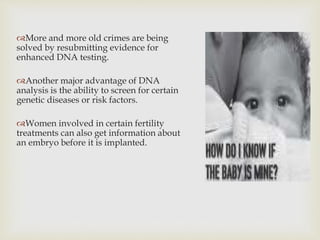
Women involved in certain fertility
treatments can also get information about
an embryo before it is implanted.
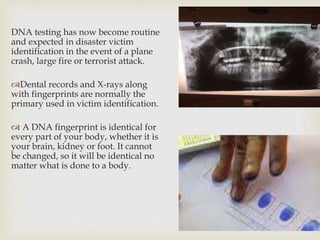
DNA testing has now become routine
and expected in disaster victim
identification in the event of a plane
crash, large fire or terrorist attack.
Dental records and X-rays along
with fingerprints are normally the
primary used in victim identification.
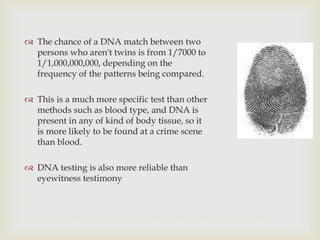
 A DNA fingerprint is identical for
every part of your body, whether it is
your brain, kidney or foot. It cannot
be changed, so it will be identical no
matter what is done to a body.
 The chance of a DNA match between two
persons who aren't twins is from 1/7000 to
1/1,000,000,000, depending on the
frequency of the patterns being compared.
 This is a much more specific test than other
methods such as blood type, and DNA is
present in any of kind of body tissue, so it
is more likely to be found at a crime scene
than blood.
 DNA testing is also more reliable than
eyewitness testimony

DISADVANTAGES
 One key disadvantage of DNA analysis is the potential for invasion of
individual privacy;
 Because a person's DNA reveals so much information about their
physical state, it is sensitive information that must be carefully
guarded;
 Information about an individual's ethnic background and parentage
could become cause for discrimination;
 Disadvantages include incomplete coverage, which can lead to false
normal results, and the ability to test only for unbalanced
rearrangements (duplications and deletions), and not balanced
translocations or inversions

CONCLUSIONS
 DNA is present in each of our cells and contains the
instructions that allow our bodies to function.
 Each of our DNA patterns are different, just as our bodies
differ. The only exception to this rule is identical twins.
 Criminologists can use DNA present at a crime scene to
determine who was present when the crime was committed by
comparing these patterns.
 While there are several benefits in using DNA analysis to solve
crimes, there are still some drawbacks that must be considered.

DNA Sequencing

  • 2.
      HISTORY OFDNA SEQUENCING  INTRODUCTION  WHAT EXACTLY IS DNA SEQUENCING….??  DNA STRUCTURE  IN THE BEGINNING  HOW IS DNA SEQUENCING PERFORMED..??  DIFFERENT METHODS FOR DNA SEQUENCING  SANGER SEQUENCING  MAX-GILBERT SEQUENCING  APPLICATION  ADVANTAGES  DISADVANTAGES  CONCLUSION LIST OF CONTENTS
  • 3.
     HISTORY OF DNASEQUENCING  The sequencing of DNA molecules began in the 1970s with development of the Maxam- Gilbert ethod, and later the Sanger method.  Originally developed by Frederick Sanger in 1975, most DNA sequencing that occurs in medical and research laboratories today is performed using sequencers employing variations of the Sanger method.
  • 4.
  • 5.
     INTRODUCTION  The termDNA sequencing refers to sequencing methods for determining the order of the nucleotide bases - adenine, guanine, cytosine, and thymine - in a molecule of DNA. Knowledge of DNA sequences has become indispensable for basic biological research, other research branches utilizing DNA sequencing, and in numerous applied fields such as:  Diagnostic,  Biotechnology,  Forensic Biology And  Biological Systematics.
  • 6.
     WHAT EXACTLY ISDNA SEQUENCING….??  The very basic unit of the human genome is a single DNA nucleotide. This nucleotide is extremely small and is made up of minuscule atoms, which creates a challenge for even an advanced microscope to be used for detection.  Researchers still, however, need to be able to determine the sequence of bases in DNA that make up the human genome. As such, DNA sequencing has been developed but the process itself is a seemingly complex one.  DNA sequencing involves the determination of the order of DNA bases.
  • 7.
      In astrand of DNA, there are some simple units known as nucleotides. These nucleotides have a 'backbone' that consists of sugars and a phosphate group. The DNA bases can be one of four kinds and they are attached to these sugars. These bases hold the important and unique genetic information for body. These bases are:  Adenine (A)  Thymine (T)  Cytosine (C)  Guanine (G) DNA STRUCTURE
  • 8.
     IN THE BEGINNING The very first methods used for DNA sequencing were created in the 1970s.  During this decade, researchers were only able to sequence a small number of base pairs, .  By 1990, things had improved somewhat but the number of laboratories able to sequence a hundred thousand bases was still few.  Not only that, but the cost of sequencing itself was extremely high and impractical.  Fortunately, there have been vast improvements since then, particularly in terms of technological advancement.
  • 9.
      Better still,automation has made the process much faster and a great deal more practical.  Now, individual genes are sequenced on a regular basis and can be done quickly and affordably for laboratories.  In fact, some laboratories are sequencing more than a hundred million bases in a given year
  • 10.
     HOW IS DNASEQUENCING PERFORMED..??  DNA sequencing involves the process of figuring out the precise order of the four bases found in one piece of DNA.  The DNA is really just a template that is used to create a series of fragments.  The fragments differ in length by one base and they are separated by size before the bases are identified, which then effectively recreates the original DNA sequence.  Each person has twenty-three pairs of chromosomes - one copy of the human genome.  Because technology has limitations, we are limited in how many bases can be read at one time.  Therefore, we can't just read each base from one end of a chromosome to the other. To make it feasible, the chromosome is cut down into smaller fragments.
  • 11.
  • 12.
  • 13.
      Basic Methods: Maxam-Gilbert sequencing  Chain-termination methods  Next-generation methods:  Massively parallel signature sequencing (MPSS)  Polony sequencing  454 pyrosequencing  Illumina (Solexa) sequencing  SOLiD sequencing  Ion Torrent semiconductor sequencing  DNA nanoball sequencing  Single molecule real time (SMRT) sequencing DIFFERENT METHODS FOR DNA SEQUENCING
  • 14.
  • 15.
      Developed byFrederick Sanger and colleagues in 1977,  it was the most widely used sequencing method for approximately 25 years after its discovery.  He got NOBEL PRIZE in 1980. HISTORY
  • 16.
      It ismethod to find out the nucleotides Sequence of unknown DNA strand.  More recently, Sanger sequencing has been upgraded as "Next- Generation“ sequencing methods, especially for large scale genome analyses and for obtaining especially long DNA sequence reads (>500 nucleotides). INTRODUCTION
  • 17.
     This methodgenerally is an In-Vitro synthesis of DNA strand and by using terminators (di-deoxynucleotide) the growing strand terminates at specific site.  Upon termination the strands are overlap to got original sequence of unknown DNA Strand. BASIC PRINCIPLE ddA ddA ddA ddA ddATP in the reaction: anywhere there’s a T in the template strand, occasionally a ddA will be added to the growing strand 5’3’ T T TT
  • 18.
  • 19.
      Single Strandedtemplate  Primer  DNA polymerase  Di-Deoxynucleotide  The 3′-OH group necessary for formation of the phosphodiester bond is missing in ddNTPs)  Every nucleotide have its specific ddNTP form i.e., ddATP, ddGTP etc REQUIREMENTS
  • 20.
      Steps: 1. Denaturation 2.Primer attachment and extension of bases 3. Termination 4. Gel electrophoresis PROCEDURE
  • 21.
      The DNAtemplate is treated with heat so that it becomes single stranded  A short, single-stranded primer which is radioactively labelled is added to the end of the DNA template  Add template DNA and primer in 4 Tubes.  Now add ddNTPs In tubes in the way that single tube contain one type of ddNTP.  Extension is start and band formed of various sizes.  The fragments of DNA are separated by electrophoresis  Overlap these sequences to find out sequence of Target DNA. Cont….
  • 22.
  • 23.
  • 24.
      Maxam–Gilbert sequencingis a method of DNA sequencing developed by Allan Maxam and Walter Gilbert in 1976–1977.  Maxam–Gilbert sequencing was the first widely adopted method for DNA sequencing, and, along with the Sanger dideoxy method.  method based on chemical modification of DNA and subsequent cleavage at specific nitrogenous bases. INTRODUCTION
  • 25.
     PRINCIPLE  purification ofthe DNA fragment that to be sequenced and labeled with radioactive material.  Chemical treatment generates breaks at a specific nitrogenous bases and thus a series of labelled fragments is generated. The fragments in the four reactions are arranged side by side in gel electrophoresis for size separation.  The fragments visualize in X-ray for autoradiography.  To visualize the fragments,the gel is exposed to X-ray film for autoradiography,yielding a series of dark bands each corresponding to a radiolabelled DNA fragment,from which the sequence may be inferred.
  • 26.
  • 27.
      Maxam–Gilbert sequencingrequires radioactive labeling at one 5′ end of the DNA fragment to be sequenced (gamma-32P).  Chemical treatment generates breaks at a small proportion of one or two of the four nucleotide bases in each of four reactions (G, A+G, C, C+T). For example, 1. the purines (A+G) by using formic acid, 2. the guanines (and to some extent the adenines) by dimethyl sulfate, 3. the pyrimidines (C+T) by using hydrazine. 4. NaCl add to hydrazine for Cytosine.  Add each chemical in separate tube.  Thus a series of labeled fragments is generated.  The fragments in the four reactions are electrophoresed side by side for size separation.  To visualize the fragments, the gel is exposed to X-ray film for autoradiography, yielding a series of dark bands each showing the location of identical radiolabeled DNA molecules. Procedure
  • 28.
    APPLICATIONS:  With itsstudy we can understand the function of a specific sequence and the sequence responsible for any disease.  With the help of comparative DNA sequence study we can detect any mutation.  DNA fingerprinting.  By knowing the whole genome sequence, Human genome project get completed.  Forensics:- DNA sequencing has been applied in forensics science to identify particular individual because every individual has unique sequence of his/her DNA. It is particularly ed to identify the criminals by finding some proof from the crime scene in the form of hair, nail, skin or blood samples.
  • 29.
      Agriculture:- DNA sequencinghas played vital role in the field of agriculture. The mapping and sequencing of the whole genome of microorganisms has allowed the agriculturists to make them useful for the crops and food plants.  Medicine:- In medical research, DNA sequencing can be used to detect the genes which are associated with some heredity or acquired diseases. Scientists use different techniques of genetic engineering like gene therapy to identify the defected genes and replace them with the healthy ones.
  • 30.
    ADVANTAGES  One majorapplication of DNA testing is in forensic identification;  DNA test results are much clearer than fingerprints and it is with these results and proof that it is possible to find criminals;  DNA evidence from blood, skin or hair can be matched to the DNA of a suspect to determine information about where an individual was and who they may have come in contact with;  DNA analysis is especially important in cases of rape, where doctors can often examine a victim and find traces of the rapist's DNA.
  • 31.
    More and moreold crimes are being solved by resubmitting evidence for enhanced DNA testing. Another major advantage of DNA analysis is the ability to screen for certain genetic diseases or risk factors. Women involved in certain fertility treatments can also get information about an embryo before it is implanted.
  • 32.
    DNA testing hasnow become routine and expected in disaster victim identification in the event of a plane crash, large fire or terrorist attack. Dental records and X-rays along with fingerprints are normally the primary used in victim identification.  A DNA fingerprint is identical for every part of your body, whether it is your brain, kidney or foot. It cannot be changed, so it will be identical no matter what is done to a body.
  • 33.
     The chanceof a DNA match between two persons who aren't twins is from 1/7000 to 1/1,000,000,000, depending on the frequency of the patterns being compared.  This is a much more specific test than other methods such as blood type, and DNA is present in any of kind of body tissue, so it is more likely to be found at a crime scene than blood.  DNA testing is also more reliable than eyewitness testimony
  • 34.
     DISADVANTAGES  One keydisadvantage of DNA analysis is the potential for invasion of individual privacy;  Because a person's DNA reveals so much information about their physical state, it is sensitive information that must be carefully guarded;  Information about an individual's ethnic background and parentage could become cause for discrimination;  Disadvantages include incomplete coverage, which can lead to false normal results, and the ability to test only for unbalanced rearrangements (duplications and deletions), and not balanced translocations or inversions
  • 35.
     CONCLUSIONS  DNA ispresent in each of our cells and contains the instructions that allow our bodies to function.  Each of our DNA patterns are different, just as our bodies differ. The only exception to this rule is identical twins.  Criminologists can use DNA present at a crime scene to determine who was present when the crime was committed by comparing these patterns.  While there are several benefits in using DNA analysis to solve crimes, there are still some drawbacks that must be considered.