MASSONS TRICHROME STAIN PRESENTED BY: MEHTAB SHAH  B.S MT 3 Rd  year  (SDLS(LNH) HISTOPATHOLOGY
SPECIAL STAINING Special stains are used to identify certain normal and abnormal substance present in the cells an tissue, which cannot be differentiated by routine haemotoxylin and eosin staining.
INTRODUCTION Masson's trichrome stain is modified from Masson in (1929). Masson's trichrome  is a three-colour  staining  protocol used in  histology .  This stainis used to distinguishes between collagen and smooth muscle in tumours.
Muscle Muscle cells are specialized for contractility, and they can be classified according to their microscopic appearance into 3 categories:  Smooth muscle  which is found primarily in tubular organs.  Skeletal muscle  which is generally attached to bones.  Cardiac muscle  which is found in the wall of the heart.
SMOOTH MUSCLE (involuntary) Is developed from mesenchymal cells. cell is spindle-shaped with an elongated centrally located nucleus. Microscopically; cells appear eosinophillic the presence of glycogen. The cytoplasm contains bundles of myofilaments called myofibrils. Surrounded by the sarcoplasm. The centrally situated nuclei with their fine chromatin pattern stain with hemotoxylin and have elongated appearance: they may contain one or two nucleoli.
COLLAGEN These connective tissue protein provide tensile strength. There are at least 27 types of collagen. Type 1,2,3.4 and 11 are the fibrillar collagens and most abundant. The collagen of skin and bone is mostly type 1,while cartilage collagen is mostly type 2. Type 4 forms sheets instead of fibrils and is major collagen found basement membrane.
Contd …………….. Other collagen may form extra cellular matrix meshwork, participate in cellular anchorage.
PRINCIPLE Trichrome procedure are three dyes Sections are first stained with an acid dye such as Biebrich scarlet. All acidophilic tissue elements such as cytoplasm. muscle and collagen will bind with the acid dyes. The section are then treated with phosphotungstic and phosphomolydic acid.
Contd……………………. Because cytoplasm is much less permeable than collagen the phosphotigstic and phophomolydic acids cause the Biebrich scarlet to diffuse out of the collagen but not out of the cytoplasm. Phosphotigstic and phosphomolydic have numerous acidic groups. Finally a dye of large particle size such as light green is used that is able to enter collagen.
FIXATIVE   Bouin’s solution is preferred 10% neutral buffered formalin may be used TECHNIQUE Cut paraffin section at 4 microns
REAGENT REQUIRMENT Weigerts iron haematoxylin 5% phosphomolydic acid 5% phosphotungstic acid 2% light green Biebrich scarlet acid fushin solution
PROCEDURE Depparaffinize section in xylene Clean xylene by alcohol Rinse with distilled water weigerts iron hemotoxylin  5-10 mint;
Contd……………………… Rinse well in d/w Biebrich scarlet acid fuchin 5-10 mint; Rinse in d/w Phosphotungstic – phosphomolydic acid solution 10-15 mint;
Light green solution 2-5mint; Dehydrate in absolute alcohol Clear in xylene Mount in synthetic resin Microscopy
Quality control and safety Practically every tissue has an internal control so no other control are needed, if  a control is desired ,uterus, small intestine, appendix or fallopian tube will provide good material. Wear gloves, lab coat. avoid contact and inhalation
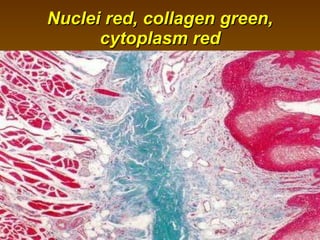
Results Nuclei…………………………….black, blue Muscle.cytoplasm,fibrin………..red Collagen………………………...green
 
Nuclei red, collagen green, cytoplasm red
Infracted rat heart showing damaged cardiac tissue in blue.
Terminal ileum with increase in subepithelial collagen table in a patient with collagenous colitis
 

Massons Trichrome Stain

  • 1.
  • 2.
    MASSONS TRICHROME STAINPRESENTED BY: MEHTAB SHAH B.S MT 3 Rd year (SDLS(LNH) HISTOPATHOLOGY
  • 3.
    SPECIAL STAINING Specialstains are used to identify certain normal and abnormal substance present in the cells an tissue, which cannot be differentiated by routine haemotoxylin and eosin staining.
  • 4.
    INTRODUCTION Masson's trichromestain is modified from Masson in (1929). Masson's trichrome is a three-colour staining protocol used in histology . This stainis used to distinguishes between collagen and smooth muscle in tumours.
  • 5.
    Muscle Muscle cellsare specialized for contractility, and they can be classified according to their microscopic appearance into 3 categories: Smooth muscle which is found primarily in tubular organs. Skeletal muscle which is generally attached to bones. Cardiac muscle which is found in the wall of the heart.
  • 6.
    SMOOTH MUSCLE (involuntary)Is developed from mesenchymal cells. cell is spindle-shaped with an elongated centrally located nucleus. Microscopically; cells appear eosinophillic the presence of glycogen. The cytoplasm contains bundles of myofilaments called myofibrils. Surrounded by the sarcoplasm. The centrally situated nuclei with their fine chromatin pattern stain with hemotoxylin and have elongated appearance: they may contain one or two nucleoli.
  • 7.
    COLLAGEN These connectivetissue protein provide tensile strength. There are at least 27 types of collagen. Type 1,2,3.4 and 11 are the fibrillar collagens and most abundant. The collagen of skin and bone is mostly type 1,while cartilage collagen is mostly type 2. Type 4 forms sheets instead of fibrils and is major collagen found basement membrane.
  • 8.
    Contd …………….. Othercollagen may form extra cellular matrix meshwork, participate in cellular anchorage.
  • 9.
    PRINCIPLE Trichrome procedureare three dyes Sections are first stained with an acid dye such as Biebrich scarlet. All acidophilic tissue elements such as cytoplasm. muscle and collagen will bind with the acid dyes. The section are then treated with phosphotungstic and phosphomolydic acid.
  • 10.
    Contd……………………. Because cytoplasmis much less permeable than collagen the phosphotigstic and phophomolydic acids cause the Biebrich scarlet to diffuse out of the collagen but not out of the cytoplasm. Phosphotigstic and phosphomolydic have numerous acidic groups. Finally a dye of large particle size such as light green is used that is able to enter collagen.
  • 11.
    FIXATIVE Bouin’s solution is preferred 10% neutral buffered formalin may be used TECHNIQUE Cut paraffin section at 4 microns
  • 12.
    REAGENT REQUIRMENT Weigertsiron haematoxylin 5% phosphomolydic acid 5% phosphotungstic acid 2% light green Biebrich scarlet acid fushin solution
  • 13.
    PROCEDURE Depparaffinize sectionin xylene Clean xylene by alcohol Rinse with distilled water weigerts iron hemotoxylin 5-10 mint;
  • 14.
    Contd……………………… Rinse wellin d/w Biebrich scarlet acid fuchin 5-10 mint; Rinse in d/w Phosphotungstic – phosphomolydic acid solution 10-15 mint;
  • 15.
    Light green solution2-5mint; Dehydrate in absolute alcohol Clear in xylene Mount in synthetic resin Microscopy
  • 16.
    Quality control andsafety Practically every tissue has an internal control so no other control are needed, if a control is desired ,uterus, small intestine, appendix or fallopian tube will provide good material. Wear gloves, lab coat. avoid contact and inhalation
  • 17.
    Results Nuclei…………………………….black, blueMuscle.cytoplasm,fibrin………..red Collagen………………………...green
  • 18.
  • 19.
    Nuclei red, collagengreen, cytoplasm red
  • 20.
    Infracted rat heartshowing damaged cardiac tissue in blue.
  • 21.
    Terminal ileum withincrease in subepithelial collagen table in a patient with collagenous colitis
  • 22.