Malarial parasite Presented by : MARIAM RAZI B.S Medical Technology 5 th  semester
MALARIA Italian ,  Mala “bad” aria “air” Malaria is a mosquito borne parasitic disease Caused by plasmodium parasites Transmitted by the sting of the Anopheles mosquito or by a contaminated needle or transfusion Tropical and subtropical regions 300 to 500 million cases annually Mortality rate is 1.1-2.7 million / year One death every 20 to 30 seconds, somewhere in the world
HISTORY OF MALARIA   The first evidence of malaria  parasites had been found in mosquitoes preserved in amber from the Paleogene period that are approximately 30 million years old
500 B.C_ Hippocrates   Classified the fever types  Noted relation ship b/w enlarged spleen and  marshes  First Century AD_ Roman writers Attributed malarial diseases to the swamps
1880-laveran_   discovered plasmodium in human blood 1885- Golgi_   erythrocytic schizogony in man   1894 – Manson_   role of mosquito in malaria 1857-Ronald Ross _   sexual cycle in mosquito 1948-Short and Graham   _   pre erythrocytic schizogony 1969 – Rudzinska –   fine structure of plasmodium
Malarial parasite There are four species of Plasmodium that cause Malaria in man : P. falciparum (malignant, TERTIAN) P. vivax (benign, TERTIAN) P. ovale (TERTIAN) P. malariae (QUARTAN)
Life cycle of malarial parasite
Lab Diagnosis Method used to diagnose: Microscopy Serology – Rapid Diagnostic Tests Molecular biology method (PCR)
Microscopy Gold standard  Highly sensitive, specific  Laboratory diagnosis of malaria can by made through microscopic examination of thick or thin blood smear Thick smears are used for screening purposes Thin smears are for morphological detail and species identification
Appearance of thick and thin smear
Staining methods Giemsa staining Lieshman's stain Field’s stain
Microscopic Findings The four Plasmodium species that cause human malaria can be distinguished most of the time (but not always) based on the morphology of their blood stages The distinguishable stages: Ring form trophozoite Trophozoite Shizont  Gametocyte
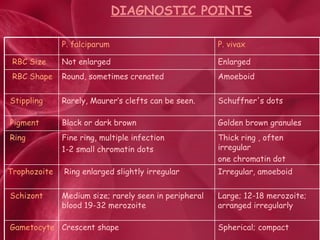
DIAGNOSTIC POINTS Golden brown granules  Black or dark brown  Pigment P. vivax P. falciparum Spherical; compact  Large; 12-18 merozoite; arranged irregularly  Irregular, amoeboid Thick ring , often irregular one chromatin dot Schuffner's dots Amoeboid  Enlarged  Gametocyte Schizont Trophozoite Ring Stippling  RBC Shape  RBC Size  Crescent shape Medium size; rarely seen in peripheral blood 19-32 merozoite Ring enlarged slightly irregular Fine ring, multiple infection 1-2 small chromatin dots Rarely, Maurer’s clefts can be seen.  Round, sometimes crenated  Not enlarged
Trophozoite Shizont Gametocyte Maurer's clefts .  Ring   P. falciparum
Trophozoite Gametocyte Shizont Rings P. vivax
DIAGNOSTIC POINTS P.OVALE P.MALRIAE Like  P. vivax , but smaller  Medium size; 8-14 merozoite arranged irregularly Round , compact Rings large and coarse, one chromatin dot. Black to brownish-black.  Schuffner's dots Fimbriation Enlarged  Similar to  P. vivax , but smaller  Small; 9-10 merozoite arranged as rosette Band forms are a characteristic of this species. Thick ring; one chromatin dot Dark black.  Ziemann's dots,  Elongation Not enlarged  Gametocyte Schizont Trophozoite Ring Pigment  Stippling  RBC Shape  RBC Size
Rings Trophozoite Shizont Gametocyte P.MALRIAE
Rings Trophozoite Shizont Gametocyte P.OVALE
Reporting of blood film 1-10 per 100 high power fields ….........................+ 11-100 per 100 high power fields …………………+ + 1-10 in every high power fields ……………………. + + + More than 10 in every high power fields ………….. + + + +
Other findings : Normocytic and normchromic Hemoglobin :   Anemia is common in malaria. Reticulocytes count :   Reticulocytosis  Total leukocyte count :   Leukopenia is seen   Platelet count :   Thrombocytopenia Prothrombin time :   Rises
MALARIAL PARASITE REPORTED IN  LNH 2008
COMPLICATIONS  Cerebral malaria  Adult respiratory distress syndrome (ARDS) Black water fever (severe hemolysis)   Renal failure Tropical splenomegaly syndrome (TSS) Bone Marrow Depression  Hypoglycemia  Anemia
Malaria control Spry insecticides :(e.g. DDT ) Use mosquito nets, screen, or mosquito repellents to protect the person from mosquito bites. Reconstruction of environment: eradicate the breeding places of mosquitoes.
THANK YOU

Malaria Parasite

  • 1.
    Malarial parasite Presentedby : MARIAM RAZI B.S Medical Technology 5 th semester
  • 2.
    MALARIA Italian , Mala “bad” aria “air” Malaria is a mosquito borne parasitic disease Caused by plasmodium parasites Transmitted by the sting of the Anopheles mosquito or by a contaminated needle or transfusion Tropical and subtropical regions 300 to 500 million cases annually Mortality rate is 1.1-2.7 million / year One death every 20 to 30 seconds, somewhere in the world
  • 3.
    HISTORY OF MALARIA The first evidence of malaria parasites had been found in mosquitoes preserved in amber from the Paleogene period that are approximately 30 million years old
  • 4.
    500 B.C_ Hippocrates Classified the fever types Noted relation ship b/w enlarged spleen and marshes First Century AD_ Roman writers Attributed malarial diseases to the swamps
  • 5.
    1880-laveran_ discovered plasmodium in human blood 1885- Golgi_ erythrocytic schizogony in man 1894 – Manson_ role of mosquito in malaria 1857-Ronald Ross _ sexual cycle in mosquito 1948-Short and Graham _ pre erythrocytic schizogony 1969 – Rudzinska – fine structure of plasmodium
  • 6.
    Malarial parasite Thereare four species of Plasmodium that cause Malaria in man : P. falciparum (malignant, TERTIAN) P. vivax (benign, TERTIAN) P. ovale (TERTIAN) P. malariae (QUARTAN)
  • 7.
    Life cycle ofmalarial parasite
  • 8.
    Lab Diagnosis Methodused to diagnose: Microscopy Serology – Rapid Diagnostic Tests Molecular biology method (PCR)
  • 9.
    Microscopy Gold standard Highly sensitive, specific Laboratory diagnosis of malaria can by made through microscopic examination of thick or thin blood smear Thick smears are used for screening purposes Thin smears are for morphological detail and species identification
  • 10.
    Appearance of thickand thin smear
  • 11.
    Staining methods Giemsastaining Lieshman's stain Field’s stain
  • 12.
    Microscopic Findings Thefour Plasmodium species that cause human malaria can be distinguished most of the time (but not always) based on the morphology of their blood stages The distinguishable stages: Ring form trophozoite Trophozoite Shizont Gametocyte
  • 13.
    DIAGNOSTIC POINTS Goldenbrown granules Black or dark brown Pigment P. vivax P. falciparum Spherical; compact Large; 12-18 merozoite; arranged irregularly Irregular, amoeboid Thick ring , often irregular one chromatin dot Schuffner's dots Amoeboid Enlarged Gametocyte Schizont Trophozoite Ring Stippling RBC Shape RBC Size Crescent shape Medium size; rarely seen in peripheral blood 19-32 merozoite Ring enlarged slightly irregular Fine ring, multiple infection 1-2 small chromatin dots Rarely, Maurer’s clefts can be seen. Round, sometimes crenated Not enlarged
  • 14.
    Trophozoite Shizont GametocyteMaurer's clefts . Ring P. falciparum
  • 15.
  • 16.
    DIAGNOSTIC POINTS P.OVALEP.MALRIAE Like P. vivax , but smaller Medium size; 8-14 merozoite arranged irregularly Round , compact Rings large and coarse, one chromatin dot. Black to brownish-black. Schuffner's dots Fimbriation Enlarged Similar to P. vivax , but smaller Small; 9-10 merozoite arranged as rosette Band forms are a characteristic of this species. Thick ring; one chromatin dot Dark black. Ziemann's dots, Elongation Not enlarged Gametocyte Schizont Trophozoite Ring Pigment Stippling RBC Shape RBC Size
  • 17.
    Rings Trophozoite ShizontGametocyte P.MALRIAE
  • 18.
    Rings Trophozoite ShizontGametocyte P.OVALE
  • 19.
    Reporting of bloodfilm 1-10 per 100 high power fields ….........................+ 11-100 per 100 high power fields …………………+ + 1-10 in every high power fields ……………………. + + + More than 10 in every high power fields ………….. + + + +
  • 20.
    Other findings :Normocytic and normchromic Hemoglobin : Anemia is common in malaria. Reticulocytes count : Reticulocytosis Total leukocyte count : Leukopenia is seen Platelet count : Thrombocytopenia Prothrombin time : Rises
  • 21.
  • 22.
    COMPLICATIONS Cerebralmalaria Adult respiratory distress syndrome (ARDS) Black water fever (severe hemolysis)   Renal failure Tropical splenomegaly syndrome (TSS) Bone Marrow Depression Hypoglycemia Anemia
  • 23.
    Malaria control Spryinsecticides :(e.g. DDT ) Use mosquito nets, screen, or mosquito repellents to protect the person from mosquito bites. Reconstruction of environment: eradicate the breeding places of mosquitoes.
  • 24.