The derivative
A derivative of a function is a representation of the rate of change of one variable in relation
to another at a given point on a function.
The derivative measures the steepness of the graph of a function at some particular point on
the graph.
Thus, the derivative is a slope.
(That means that it is a ratio of change in the value of the function to change in the
independent variable.)
The derivative is also, itself, a function: it varies from place to place.
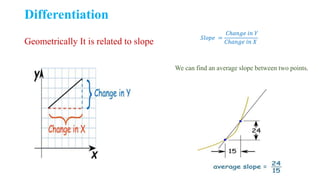
Differentiation
Geometrically It is related to slope 𝑆𝑙𝑜𝑝𝑒 =
𝐶ℎ𝑎𝑛𝑔𝑒 𝑖𝑛 𝑌
𝐶ℎ𝑎𝑛𝑔𝑒 𝑖𝑛 𝑋
We can find an average slope between two points.
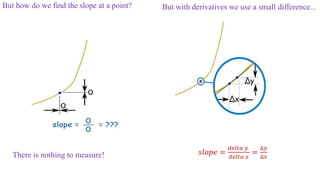
But how do we find the slope at a point?
There is nothing to measure!
But with derivatives we use a small difference...
𝑠𝑙𝑜𝑝𝑒 =
𝑑𝑒𝑙𝑡𝑎 𝑦
𝑑𝑒𝑙𝑡𝑎 𝑥
=
∆𝑦
∆𝑥
For example
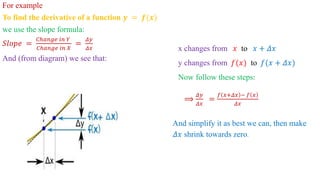
To find the derivative of a function 𝒚 = 𝒇(𝒙)
we use the slope formula:
𝑆𝑙𝑜𝑝𝑒 =
𝐶ℎ𝑎𝑛𝑔𝑒 𝑖𝑛 𝑌
𝐶ℎ𝑎𝑛𝑔𝑒 𝑖𝑛 𝑋
=
𝛥𝑦
𝛥𝑥
And (from diagram) we see that:
x changes from 𝑥 to 𝑥 + 𝛥𝑥
y changes from 𝑓(𝑥) to 𝑓(𝑥 + 𝛥𝑥)
Now follow these steps:
⟹
𝛥𝑦
𝛥𝑥
=
𝑓 𝑥+𝛥𝑥 − 𝑓 𝑥
𝛥𝑥
And simplify it as best we can, then make
𝛥𝑥 shrink towards zero.
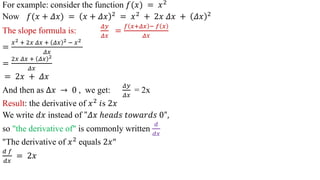
For example: consider the function 𝑓(𝑥) = 𝑥2
Now 𝑓(𝑥 + 𝛥𝑥) = 𝑥 + 𝛥𝑥 2
= 𝑥2
+ 2𝑥 𝛥𝑥 + 𝛥𝑥 2
The slope formula is:
𝛥𝑦
𝛥𝑥
=
𝑓 𝑥+𝛥𝑥 − 𝑓 𝑥
𝛥𝑥
=
𝑥2 + 2𝑥 𝛥𝑥 + 𝛥𝑥 2 − 𝑥2
𝛥𝑥
=
2𝑥 𝛥𝑥 + 𝛥𝑥 2
𝛥𝑥
= 2𝑥 + 𝛥𝑥
And then as Δ𝑥 → 0 , we get:
𝛥𝑦
𝛥𝑥
= 2x
Result: the derivative of 𝑥2 𝑖s 2𝑥
We write 𝑑𝑥 instead of "𝛥𝑥 ℎ𝑒𝑎𝑑𝑠 𝑡𝑜𝑤𝑎𝑟𝑑𝑠 0",
so "the derivative of" is commonly written
𝑑
𝑑𝑥
"The derivative of 𝑥2
equals 2𝑥"
𝑑 𝑓
𝑑𝑥
= 2𝑥
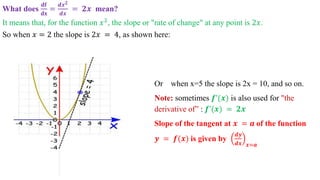
What does
𝐝𝐟
𝐝𝐱
=
𝒅𝒙 𝟐
𝒅𝒙
= 𝟐𝒙 mean?
It means that, for the function 𝑥2, the slope or "rate of change" at any point is 2𝑥.
So when 𝑥 = 2 the slope is 2𝑥 = 4, as shown here:
Or when x=5 the slope is 2x = 10, and so on.
Note: sometimes 𝒇’(𝒙) is also used for "the
derivative of” : 𝒇’(𝒙) = 𝟐𝒙
Slope of the tangent at 𝒙 = 𝒂 of the function
𝒚 = 𝒇(𝒙) is given by
𝒅𝒚
𝒅𝒙 𝒙=𝒂
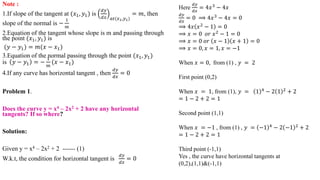
Note :
1.If slope of the tangent at (𝑥1, 𝑦1) is
𝑑𝑦
𝑑𝑥 𝑎𝑡(𝑥1,𝑦1)
= 𝑚, then
slope of the normal is −
1
𝑚
2.Equation of the tangent whose slope is m and passing through
the point (𝑥1, 𝑦1) is
(𝑦 − 𝑦1) = 𝑚(𝑥 − 𝑥1)
3.Equation of the normal passing through the point (𝑥1, 𝑦1)
is 𝑦 − 𝑦1 = −
1
𝑚
(𝑥 − 𝑥1)
4.If any curve has horizontal tangent , then
𝑑𝑦
𝑑𝑥
= 0
Problem 1.
Does the curve y = x4 – 2x2 + 2 have any horizontal
tangents? If so where?
Solution:
Given y = x4 – 2x2 + 2 ------ (1)
W.k.t, the condition for horizontal tangent is
𝑑𝑦
𝑑𝑥
= 0
Here
𝑑𝑦
𝑑𝑥
= 4𝑥3
− 4𝑥
𝑑𝑦
𝑑𝑥
= 0 ⟹ 4𝑥3
− 4𝑥 = 0
⟹ 4𝑥 𝑥2 − 1 = 0
⟹ 𝑥 = 0 𝑜𝑟 𝑥2
− 1 = 0
⟹ 𝑥 = 0 𝑜𝑟 𝑥 − 1 𝑥 + 1 = 0
⟹ 𝑥 = 0, 𝑥 = 1, 𝑥 = −1
When 𝑥 = 0, from (1) , 𝑦 = 2
First point (0,2)
When 𝑥 = 1, from (1), 𝑦 = 1 4
− 2 1 2
+ 2
= 1 − 2 + 2 = 1
Second point (1,1)
When 𝑥 = −1 , from (1) , 𝑦 = −1 4 − 2 −1 2 + 2
= 1 − 2 + 2 = 1
Third point (-1,1)
Yes , the curve have horizontal tangents at
(0,2),(1,1)&(-1,1)
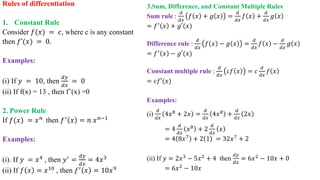
Rules of differentiation
1. Constant Rule
Consider 𝑓(𝑥) = 𝑐, where c is any constant
then 𝑓’(𝑥) = 0.
Examples:
(i) If 𝑦 = 10, then
𝑑𝑦
𝑑𝑥
= 0
(ii) If f(x) = 13 , then f’(x) =0
2. Power Rule
If 𝑓(𝑥) = 𝑥 𝑛 then 𝑓′ 𝑥 = 𝑛 𝑥 𝑛−1
Examples:
(i). If 𝑦 = 𝑥4 , then 𝑦′ =
𝑑𝑦
𝑑𝑥
= 4𝑥3
(ii) If 𝑓 𝑥 = 𝑥10 , then 𝑓′ 𝑥 = 10𝑥9
3.Sum, Difference, and Constant Multiple Rules
Sum rule :
𝑑
𝑑𝑥
𝑓 𝑥 + 𝑔 𝑥 =
𝑑
𝑑𝑥
𝑓 𝑥 +
𝑑
𝑑𝑥
𝑔 𝑥
= 𝑓′
𝑥 + 𝑔′(𝑥)
Difference rule :
𝑑
𝑑𝑥
𝑓 𝑥 − 𝑔 𝑥 =
𝑑
𝑑𝑥
𝑓 𝑥 −
𝑑
𝑑𝑥
𝑔 𝑥
= 𝑓′ 𝑥 − 𝑔′(𝑥)
Constant multiple rule :
𝑑
𝑑𝑥
𝑐𝑓 𝑥 = 𝑐
𝑑
𝑑𝑥
𝑓 𝑥
= 𝑐𝑓′(𝑥)
Examples:
(i)
𝑑
𝑑𝑥
4𝑥8 + 2𝑥 =
𝑑
𝑑𝑥
4𝑥8 +
𝑑
𝑑𝑥
2𝑥
= 4
𝑑
𝑑𝑥
𝑥8 + 2
𝑑
𝑑𝑥
𝑥
= 4 8𝑥7 + 2 1 = 32𝑥7 + 2
(ii) If 𝑦 = 2𝑥3 − 5𝑥2 + 4 then
𝑑𝑦
𝑑𝑥
= 6𝑥2 − 10𝑥 + 0
= 6𝑥2 − 10𝑥
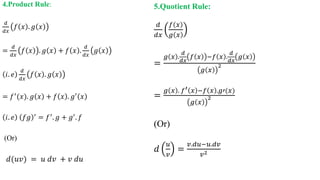
4.Product Rule:
𝑑
𝑑𝑥
𝑓 𝑥 . 𝑔 𝑥
=
𝑑
𝑑𝑥
𝑓 𝑥 . 𝑔 𝑥 + 𝑓 𝑥 .
𝑑
𝑑𝑥
𝑔 𝑥
𝑖. 𝑒
𝑑
𝑑𝑥
𝑓 𝑥 . 𝑔 𝑥
= 𝑓′(𝑥). 𝑔 𝑥 + 𝑓 𝑥 . 𝑔′ 𝑥
𝑖. 𝑒 𝑓𝑔 ′ = 𝑓′. 𝑔 + 𝑔′. 𝑓
(Or)
𝑑(𝑢𝑣) = 𝑢 𝑑𝑣 + 𝑣 𝑑𝑢
5.Quotient Rule:
𝑑
𝑑𝑥
𝑓 𝑥
𝑔 𝑥
=
𝑔 𝑥 .
𝑑
𝑑𝑥
𝑓 𝑥 −𝑓 𝑥 .
𝑑
𝑑𝑥
𝑔 𝑥
𝑔 𝑥
2
=
𝑔 𝑥 . 𝑓′ 𝑥 −𝑓 𝑥 .𝑔′(𝑥)
𝑔 𝑥
2
(Or)
𝑑
𝑢
𝑣
=
𝑣.𝑑𝑢−𝑢.𝑑𝑣
𝑣2
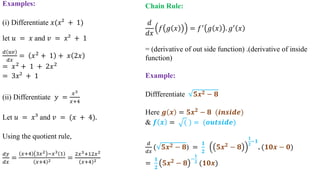
Examples:
(i) Differentiate 𝑥(𝑥² + 1)
let 𝑢 = 𝑥 and 𝑣 = 𝑥² + 1
𝑑 𝑢𝑣
𝑑𝑥
= 𝑥2 + 1 + 𝑥 2𝑥
= 𝑥2
+ 1 + 2𝑥2
= 3𝑥² + 1
(ii) Differentiate 𝑦 =
𝑥3
𝑥+4
Let 𝑢 = 𝑥³ and 𝑣 = (𝑥 + 4).
Using the quotient rule,
𝑑𝑦
𝑑𝑥
=
𝑥+4 3𝑥2 −𝑥3 1
𝑥+4 2 =
2𝑥3+12𝑥2
𝑥+4 2
Chain Rule:
𝑑
𝑑𝑥
𝑓 𝑔 𝑥 = 𝑓′
𝑔 𝑥 . 𝑔′
𝑥
= (derivative of out side function) .(derivative of inside
function)
Example:
Diffferentiate 𝟓𝒙 𝟐 − 𝟖
Here 𝒈 𝒙 = 𝟓𝒙 𝟐 − 𝟖 (𝒊𝒏𝒔𝒊𝒅𝒆)
& 𝒇 𝒙 = ( ) = (𝒐𝒖𝒕𝒔𝒊𝒅𝒆)
𝑑
𝑑𝑥
( 𝟓𝒙 𝟐 − 𝟖) =
𝟏
𝟐
𝟓𝒙 𝟐
− 𝟖
𝟏
𝟐
−𝟏
. (𝟏𝟎𝒙 − 𝟎)
=
𝟏
𝟐
𝟓𝒙 𝟐 − 𝟖
−
𝟏
𝟐 (𝟏𝟎𝒙)

Differential Calculus- differentiation

  • 1.
    The derivative A derivativeof a function is a representation of the rate of change of one variable in relation to another at a given point on a function. The derivative measures the steepness of the graph of a function at some particular point on the graph. Thus, the derivative is a slope. (That means that it is a ratio of change in the value of the function to change in the independent variable.) The derivative is also, itself, a function: it varies from place to place.
  • 2.
    Differentiation Geometrically It isrelated to slope 𝑆𝑙𝑜𝑝𝑒 = 𝐶ℎ𝑎𝑛𝑔𝑒 𝑖𝑛 𝑌 𝐶ℎ𝑎𝑛𝑔𝑒 𝑖𝑛 𝑋 We can find an average slope between two points.
  • 3.
    But how dowe find the slope at a point? There is nothing to measure! But with derivatives we use a small difference... 𝑠𝑙𝑜𝑝𝑒 = 𝑑𝑒𝑙𝑡𝑎 𝑦 𝑑𝑒𝑙𝑡𝑎 𝑥 = ∆𝑦 ∆𝑥
  • 4.
    For example To findthe derivative of a function 𝒚 = 𝒇(𝒙) we use the slope formula: 𝑆𝑙𝑜𝑝𝑒 = 𝐶ℎ𝑎𝑛𝑔𝑒 𝑖𝑛 𝑌 𝐶ℎ𝑎𝑛𝑔𝑒 𝑖𝑛 𝑋 = 𝛥𝑦 𝛥𝑥 And (from diagram) we see that: x changes from 𝑥 to 𝑥 + 𝛥𝑥 y changes from 𝑓(𝑥) to 𝑓(𝑥 + 𝛥𝑥) Now follow these steps: ⟹ 𝛥𝑦 𝛥𝑥 = 𝑓 𝑥+𝛥𝑥 − 𝑓 𝑥 𝛥𝑥 And simplify it as best we can, then make 𝛥𝑥 shrink towards zero.
  • 5.
    For example: considerthe function 𝑓(𝑥) = 𝑥2 Now 𝑓(𝑥 + 𝛥𝑥) = 𝑥 + 𝛥𝑥 2 = 𝑥2 + 2𝑥 𝛥𝑥 + 𝛥𝑥 2 The slope formula is: 𝛥𝑦 𝛥𝑥 = 𝑓 𝑥+𝛥𝑥 − 𝑓 𝑥 𝛥𝑥 = 𝑥2 + 2𝑥 𝛥𝑥 + 𝛥𝑥 2 − 𝑥2 𝛥𝑥 = 2𝑥 𝛥𝑥 + 𝛥𝑥 2 𝛥𝑥 = 2𝑥 + 𝛥𝑥 And then as Δ𝑥 → 0 , we get: 𝛥𝑦 𝛥𝑥 = 2x Result: the derivative of 𝑥2 𝑖s 2𝑥 We write 𝑑𝑥 instead of "𝛥𝑥 ℎ𝑒𝑎𝑑𝑠 𝑡𝑜𝑤𝑎𝑟𝑑𝑠 0", so "the derivative of" is commonly written 𝑑 𝑑𝑥 "The derivative of 𝑥2 equals 2𝑥" 𝑑 𝑓 𝑑𝑥 = 2𝑥
  • 6.
    What does 𝐝𝐟 𝐝𝐱 = 𝒅𝒙 𝟐 𝒅𝒙 =𝟐𝒙 mean? It means that, for the function 𝑥2, the slope or "rate of change" at any point is 2𝑥. So when 𝑥 = 2 the slope is 2𝑥 = 4, as shown here: Or when x=5 the slope is 2x = 10, and so on. Note: sometimes 𝒇’(𝒙) is also used for "the derivative of” : 𝒇’(𝒙) = 𝟐𝒙 Slope of the tangent at 𝒙 = 𝒂 of the function 𝒚 = 𝒇(𝒙) is given by 𝒅𝒚 𝒅𝒙 𝒙=𝒂
  • 7.
    Note : 1.If slopeof the tangent at (𝑥1, 𝑦1) is 𝑑𝑦 𝑑𝑥 𝑎𝑡(𝑥1,𝑦1) = 𝑚, then slope of the normal is − 1 𝑚 2.Equation of the tangent whose slope is m and passing through the point (𝑥1, 𝑦1) is (𝑦 − 𝑦1) = 𝑚(𝑥 − 𝑥1) 3.Equation of the normal passing through the point (𝑥1, 𝑦1) is 𝑦 − 𝑦1 = − 1 𝑚 (𝑥 − 𝑥1) 4.If any curve has horizontal tangent , then 𝑑𝑦 𝑑𝑥 = 0 Problem 1. Does the curve y = x4 – 2x2 + 2 have any horizontal tangents? If so where? Solution: Given y = x4 – 2x2 + 2 ------ (1) W.k.t, the condition for horizontal tangent is 𝑑𝑦 𝑑𝑥 = 0 Here 𝑑𝑦 𝑑𝑥 = 4𝑥3 − 4𝑥 𝑑𝑦 𝑑𝑥 = 0 ⟹ 4𝑥3 − 4𝑥 = 0 ⟹ 4𝑥 𝑥2 − 1 = 0 ⟹ 𝑥 = 0 𝑜𝑟 𝑥2 − 1 = 0 ⟹ 𝑥 = 0 𝑜𝑟 𝑥 − 1 𝑥 + 1 = 0 ⟹ 𝑥 = 0, 𝑥 = 1, 𝑥 = −1 When 𝑥 = 0, from (1) , 𝑦 = 2 First point (0,2) When 𝑥 = 1, from (1), 𝑦 = 1 4 − 2 1 2 + 2 = 1 − 2 + 2 = 1 Second point (1,1) When 𝑥 = −1 , from (1) , 𝑦 = −1 4 − 2 −1 2 + 2 = 1 − 2 + 2 = 1 Third point (-1,1) Yes , the curve have horizontal tangents at (0,2),(1,1)&(-1,1)
  • 8.
    Rules of differentiation 1.Constant Rule Consider 𝑓(𝑥) = 𝑐, where c is any constant then 𝑓’(𝑥) = 0. Examples: (i) If 𝑦 = 10, then 𝑑𝑦 𝑑𝑥 = 0 (ii) If f(x) = 13 , then f’(x) =0 2. Power Rule If 𝑓(𝑥) = 𝑥 𝑛 then 𝑓′ 𝑥 = 𝑛 𝑥 𝑛−1 Examples: (i). If 𝑦 = 𝑥4 , then 𝑦′ = 𝑑𝑦 𝑑𝑥 = 4𝑥3 (ii) If 𝑓 𝑥 = 𝑥10 , then 𝑓′ 𝑥 = 10𝑥9 3.Sum, Difference, and Constant Multiple Rules Sum rule : 𝑑 𝑑𝑥 𝑓 𝑥 + 𝑔 𝑥 = 𝑑 𝑑𝑥 𝑓 𝑥 + 𝑑 𝑑𝑥 𝑔 𝑥 = 𝑓′ 𝑥 + 𝑔′(𝑥) Difference rule : 𝑑 𝑑𝑥 𝑓 𝑥 − 𝑔 𝑥 = 𝑑 𝑑𝑥 𝑓 𝑥 − 𝑑 𝑑𝑥 𝑔 𝑥 = 𝑓′ 𝑥 − 𝑔′(𝑥) Constant multiple rule : 𝑑 𝑑𝑥 𝑐𝑓 𝑥 = 𝑐 𝑑 𝑑𝑥 𝑓 𝑥 = 𝑐𝑓′(𝑥) Examples: (i) 𝑑 𝑑𝑥 4𝑥8 + 2𝑥 = 𝑑 𝑑𝑥 4𝑥8 + 𝑑 𝑑𝑥 2𝑥 = 4 𝑑 𝑑𝑥 𝑥8 + 2 𝑑 𝑑𝑥 𝑥 = 4 8𝑥7 + 2 1 = 32𝑥7 + 2 (ii) If 𝑦 = 2𝑥3 − 5𝑥2 + 4 then 𝑑𝑦 𝑑𝑥 = 6𝑥2 − 10𝑥 + 0 = 6𝑥2 − 10𝑥
  • 9.
    4.Product Rule: 𝑑 𝑑𝑥 𝑓 𝑥. 𝑔 𝑥 = 𝑑 𝑑𝑥 𝑓 𝑥 . 𝑔 𝑥 + 𝑓 𝑥 . 𝑑 𝑑𝑥 𝑔 𝑥 𝑖. 𝑒 𝑑 𝑑𝑥 𝑓 𝑥 . 𝑔 𝑥 = 𝑓′(𝑥). 𝑔 𝑥 + 𝑓 𝑥 . 𝑔′ 𝑥 𝑖. 𝑒 𝑓𝑔 ′ = 𝑓′. 𝑔 + 𝑔′. 𝑓 (Or) 𝑑(𝑢𝑣) = 𝑢 𝑑𝑣 + 𝑣 𝑑𝑢 5.Quotient Rule: 𝑑 𝑑𝑥 𝑓 𝑥 𝑔 𝑥 = 𝑔 𝑥 . 𝑑 𝑑𝑥 𝑓 𝑥 −𝑓 𝑥 . 𝑑 𝑑𝑥 𝑔 𝑥 𝑔 𝑥 2 = 𝑔 𝑥 . 𝑓′ 𝑥 −𝑓 𝑥 .𝑔′(𝑥) 𝑔 𝑥 2 (Or) 𝑑 𝑢 𝑣 = 𝑣.𝑑𝑢−𝑢.𝑑𝑣 𝑣2
  • 10.
    Examples: (i) Differentiate 𝑥(𝑥²+ 1) let 𝑢 = 𝑥 and 𝑣 = 𝑥² + 1 𝑑 𝑢𝑣 𝑑𝑥 = 𝑥2 + 1 + 𝑥 2𝑥 = 𝑥2 + 1 + 2𝑥2 = 3𝑥² + 1 (ii) Differentiate 𝑦 = 𝑥3 𝑥+4 Let 𝑢 = 𝑥³ and 𝑣 = (𝑥 + 4). Using the quotient rule, 𝑑𝑦 𝑑𝑥 = 𝑥+4 3𝑥2 −𝑥3 1 𝑥+4 2 = 2𝑥3+12𝑥2 𝑥+4 2 Chain Rule: 𝑑 𝑑𝑥 𝑓 𝑔 𝑥 = 𝑓′ 𝑔 𝑥 . 𝑔′ 𝑥 = (derivative of out side function) .(derivative of inside function) Example: Diffferentiate 𝟓𝒙 𝟐 − 𝟖 Here 𝒈 𝒙 = 𝟓𝒙 𝟐 − 𝟖 (𝒊𝒏𝒔𝒊𝒅𝒆) & 𝒇 𝒙 = ( ) = (𝒐𝒖𝒕𝒔𝒊𝒅𝒆) 𝑑 𝑑𝑥 ( 𝟓𝒙 𝟐 − 𝟖) = 𝟏 𝟐 𝟓𝒙 𝟐 − 𝟖 𝟏 𝟐 −𝟏 . (𝟏𝟎𝒙 − 𝟎) = 𝟏 𝟐 𝟓𝒙 𝟐 − 𝟖 − 𝟏 𝟐 (𝟏𝟎𝒙)