How are graphs
transformed by
f(x)+a and
f(x+a)?
Use function
notation to
describe a
curve
Recognise
translations
of quadratic
functions.
Function notation
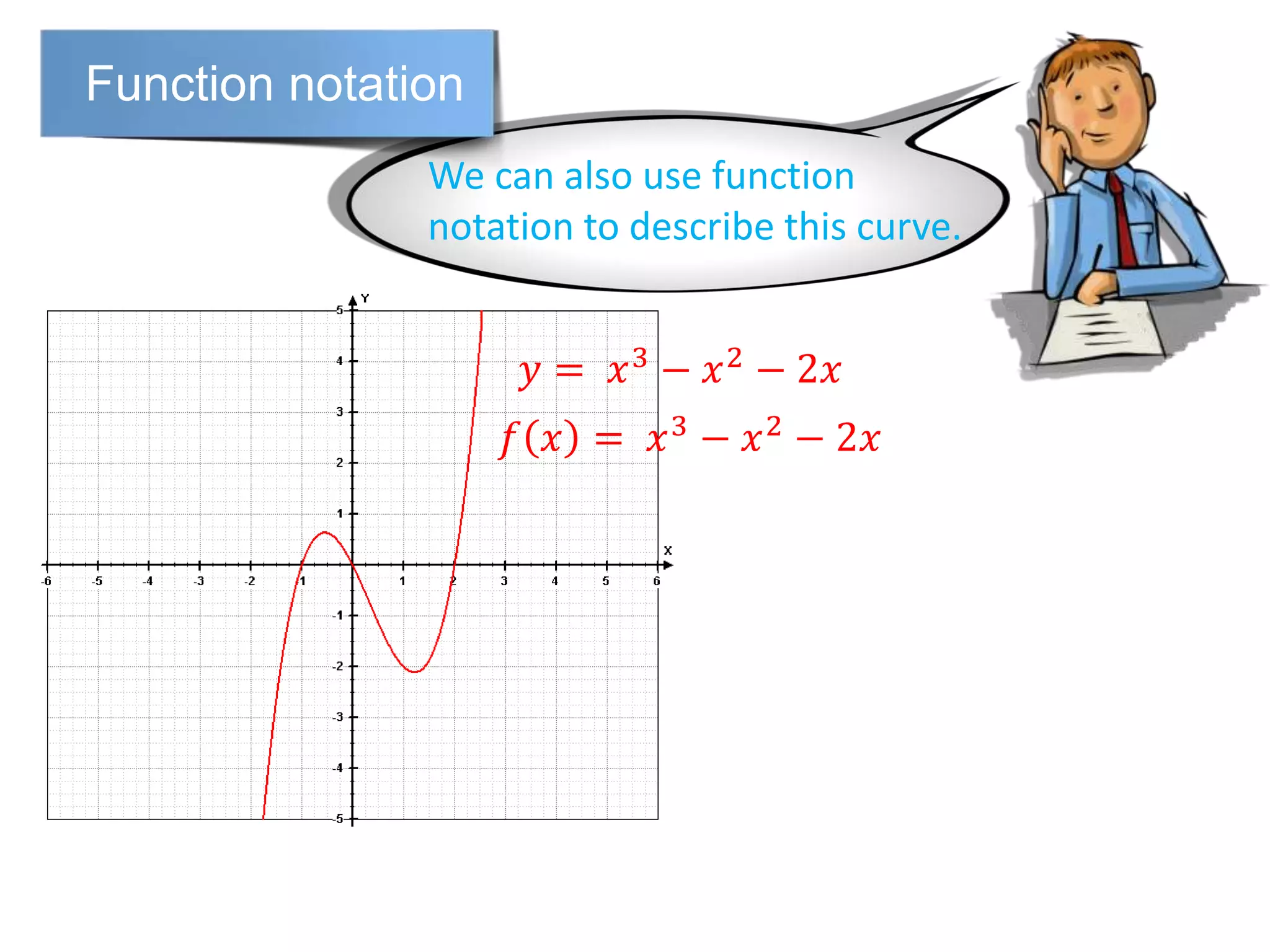
This is the graph of a cubic.
𝑦 = 𝑥3 − 𝑥2 − 2𝑥
Function notation
We can also use function
notation to describe this curve.
𝑦 = 𝑥3 − 𝑥2 − 2𝑥
𝑓 𝑥 = 𝑥3 − 𝑥2 − 2𝑥
Function notation
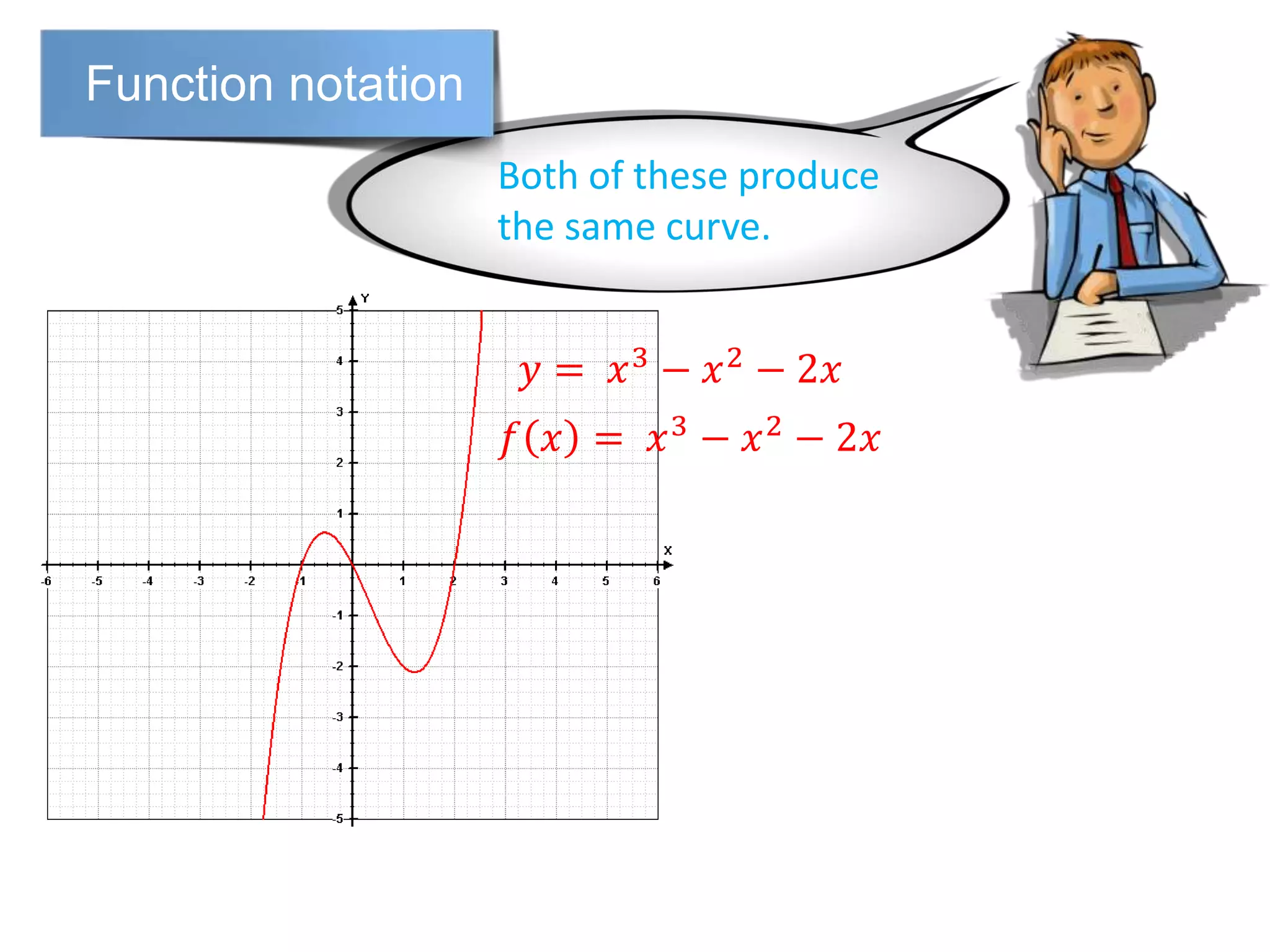
Both of these produce
the same curve.
𝑦 = 𝑥3 − 𝑥2 − 2𝑥
𝑓 𝑥 = 𝑥3 − 𝑥2 − 2𝑥
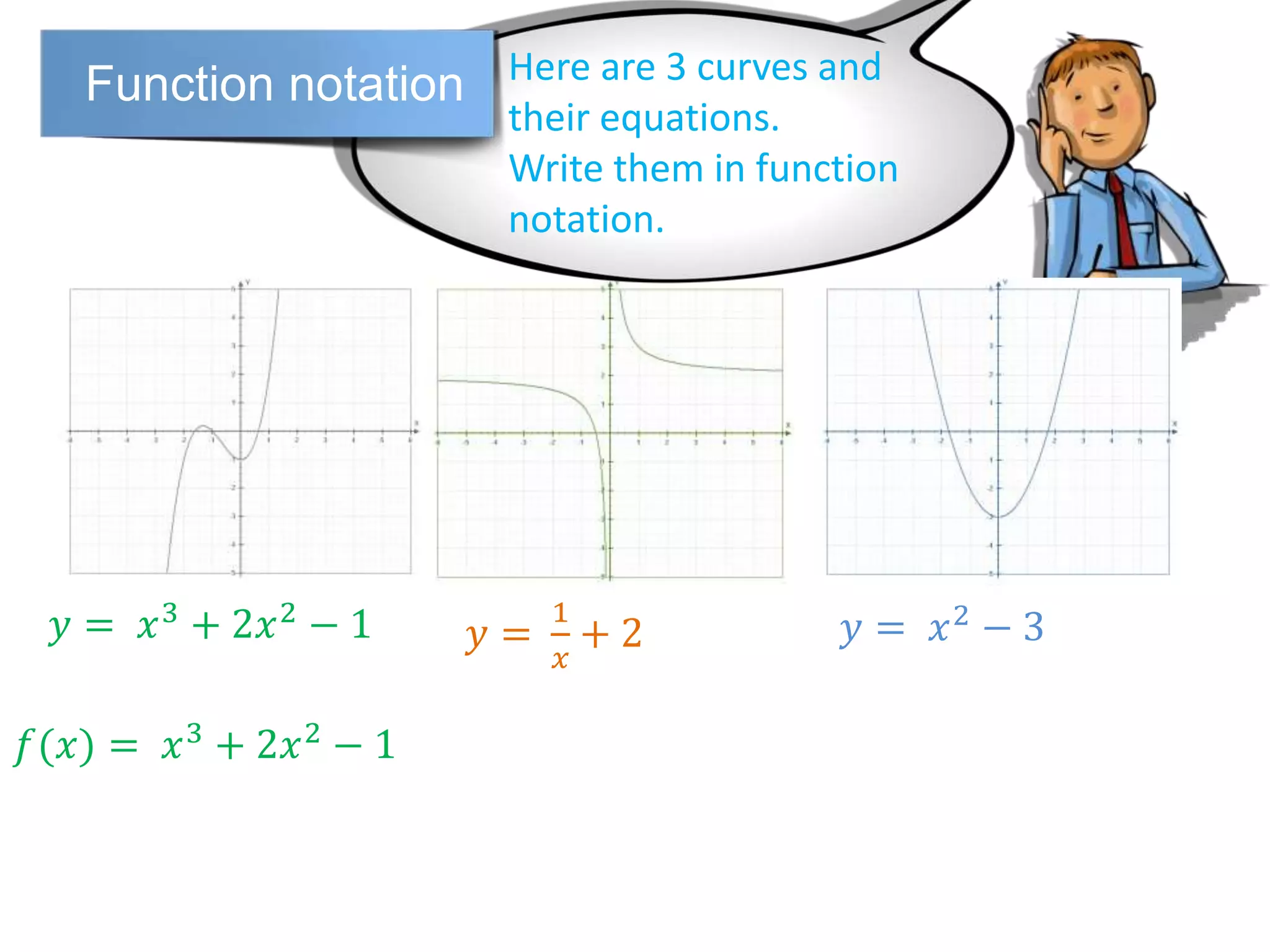
Function notation Here are 3 curves and
their equations.
Write them in function
notation.
𝑦 = 𝑥3 + 2𝑥2 − 1 𝑦 = 𝑥2 − 3
𝑦 =
1
𝑥
+ 2
Function notation Here are 3 curves and
their equations.
Write them in function
notation.
𝑦 = 𝑥3 + 2𝑥2 − 1 𝑦 = 𝑥2 − 3
𝑦 =
1
𝑥
+ 2
𝑓(𝑥) = 𝑥3
+ 2𝑥2
− 1
Function notation Here are 3 curves and
their equations.
Write them in function
notation.
𝑦 = 𝑥3 + 2𝑥2 − 1 𝑦 = 𝑥2 − 3
𝑦 =
1
𝑥
+ 2
𝑓(𝑥) = 𝑥3
+ 2𝑥2
− 1 𝑓(𝑥) =
1
𝑥
+ 2
Function notation Here are 3 curves and
their equations.
Write them in function
notation.
𝑦 = 𝑥3 + 2𝑥2 − 1 𝑦 = 𝑥2 − 3
𝑦 =
1
𝑥
+ 2
𝑓(𝑥) = 𝑥3
+ 2𝑥2
− 1 𝑓(𝑥) =
1
𝑥
+ 2 𝑓 𝑥 = 𝑥2 − 3
Function notation
We can also describe
function in words:
𝑓 𝑥 = 𝑥2
− 3 “f of 𝑥 is 𝑥 squared subtract 3.”
Function notation
𝑓 𝑥 = 𝑥2
− 3
𝑓 2 = (2)2− 3 = 1
“f of 𝑥 is square and subtract 3.”
Function notation
makes it clear what we
are substituting :
Function notation
𝑓 𝑥 = 𝑥2
− 3
𝑓 1 = (1)2− 3 = -2
𝑓 2 = (2)2− 3 = 1
“f of 𝑥 is square and subtract 3.”
Function notation
makes it clear what we
are substituting :
Function notation
𝑓 𝑥 = 𝑥2
− 3
𝑓 1 = (1)2− 3 = -2
𝑓 2 = (2)2− 3 = 1
“f of 𝑥 is square and subtract 3.”
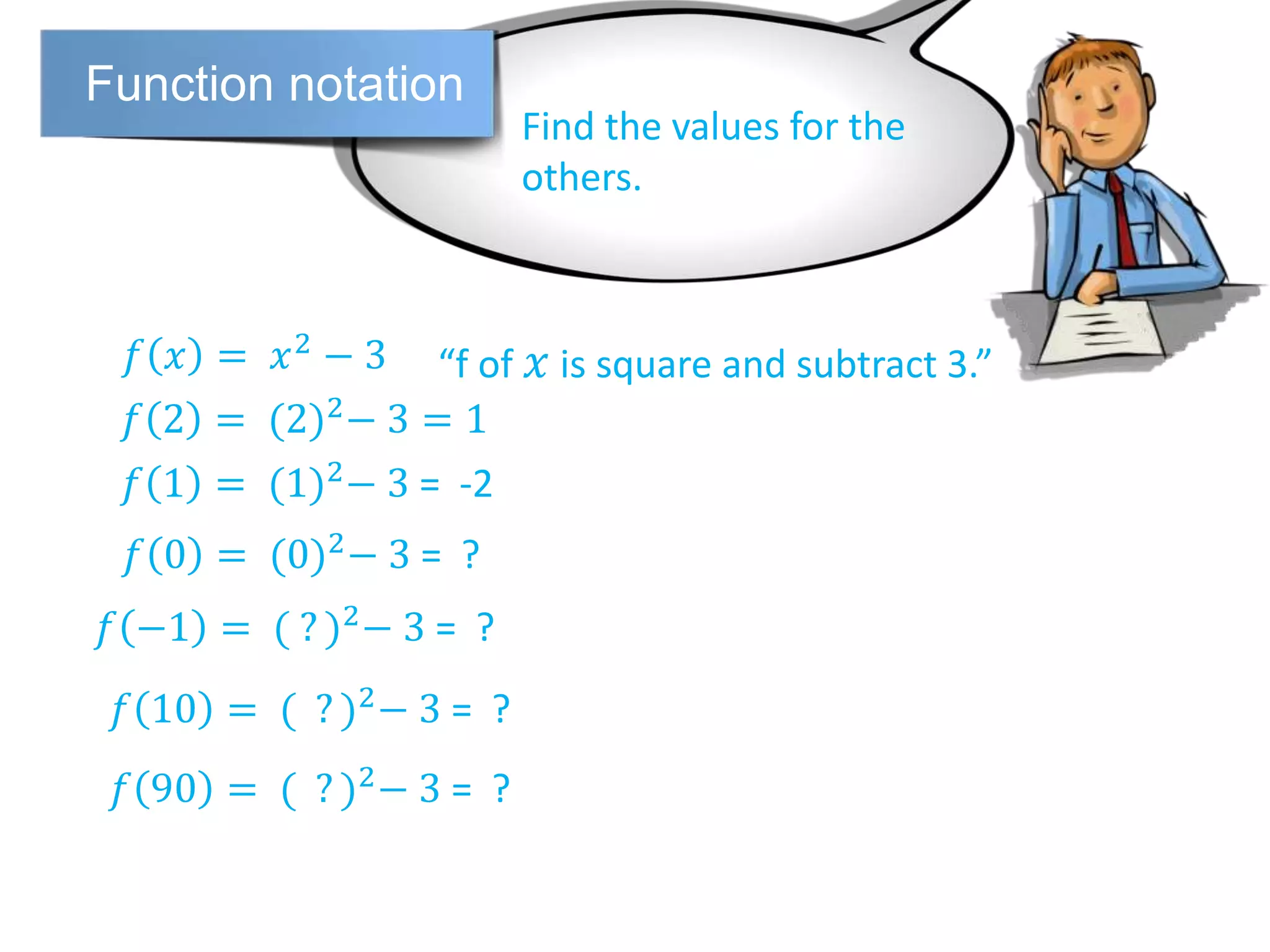
Find the values for the
others.
𝑓 0 = (0)2− 3 = ?
𝑓 −1 = ( ? )2
− 3 = ?
𝑓 10 = ( ? )2− 3 = ?
𝑓 90 = ( ? )2
− 3 = ?
Function notation
𝑓 𝑥 = 𝑥2
− 3
𝑓 1 = (1)2− 3 = -2
𝑓 2 = (2)2− 3 = 1
“f of 𝑥 is square and subtract 3.”
Find the values for the
others.
𝑓 0 = (0)2− 3 = -3
𝑓 −1 = ( ? )2
− 3 = ?
𝑓 10 = ( ? )2− 3 = ?
𝑓 90 = ( ? )2
− 3 = ?
Function notation
𝑓 𝑥 = 𝑥2
− 3
𝑓 1 = (1)2− 3 = -2
𝑓 2 = (2)2− 3 = 1
“f of 𝑥 is square and subtract 3.”
Find the values for the
others.
𝑓 0 = (0)2− 3 = -3
𝑓 −1 = (−1)2
− 3 = -2
𝑓 10 = ( ? )2− 3 = ?
𝑓 90 = ( ? )2
− 3 = ?
Function notation
𝑓 𝑥 = 𝑥2
− 3
𝑓 1 = (1)2− 3 = -2
𝑓 2 = (2)2− 3 = 1
“f of 𝑥 is square and subtract 3.”
Find the values for the
others.
𝑓 0 = (0)2− 3 = -3
𝑓 −1 = (−1)2
− 3 = -2
𝑓 10 = (10)2− 3 = 97
𝑓 90 = ( ? )2
− 3 = ?
Function notation
𝑓 𝑥 = 𝑥2
− 3
𝑓 1 = (1)2− 3 = -2
𝑓 2 = (2)2− 3 = 1
“f of 𝑥 is square and subtract 3.”
Find the values for the
others.
𝑓 0 = (0)2− 3 = -3
𝑓 −1 = (−1)2
− 3 = -2
𝑓 10 = (10)2− 3 = 97
𝑓 90 = ( 90)2
− 3 = 8097
Function notation
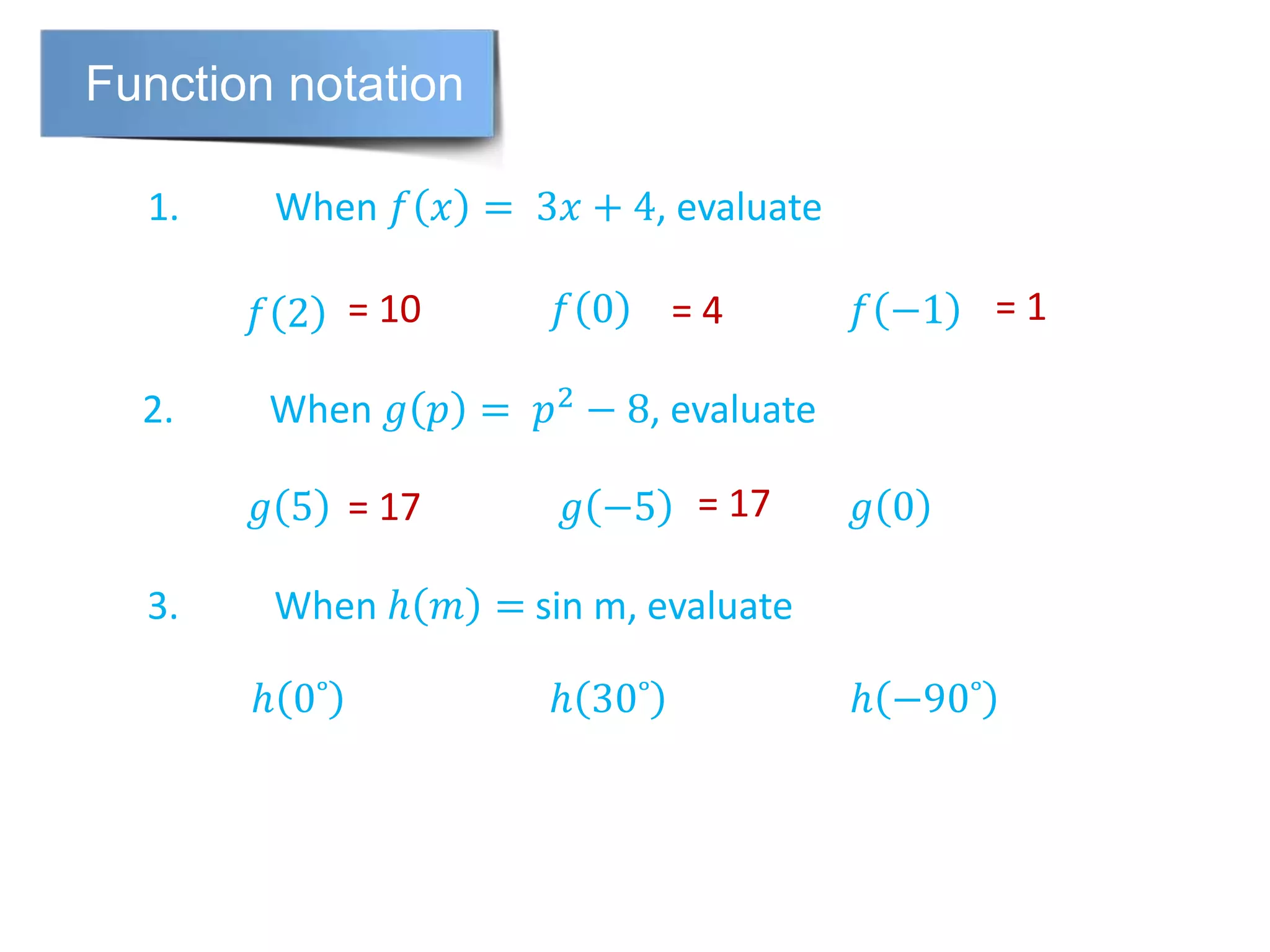
1. When 𝑓 𝑥 = 3𝑥 + 4, evaluate
𝑓 2 𝑓 0 𝑓 −1
2. When 𝑔 𝑝 = 𝑝2
− 8, evaluate
𝑔 5 𝑔 −5 𝑔 0
3. When ℎ 𝑚 = sin m, evaluate
ℎ 0˚ ℎ 30˚ ℎ −90˚
Function notation
1. When 𝑓 𝑥 = 3𝑥 + 4, evaluate
𝑓 2 𝑓 0 𝑓 −1
2. When 𝑔 𝑝 = 𝑝2
− 8, evaluate
𝑔 5 𝑔 −5 𝑔 0
3. When ℎ 𝑚 = sin m, evaluate
ℎ 0˚ ℎ 30˚ ℎ −90˚
= 10
Function notation
1. When 𝑓 𝑥 = 3𝑥 + 4, evaluate
𝑓 2 𝑓 0 𝑓 −1
2. When 𝑔 𝑝 = 𝑝2
− 8, evaluate
𝑔 5 𝑔 −5 𝑔 0
3. When ℎ 𝑚 = sin m, evaluate
ℎ 0˚ ℎ 30˚ ℎ −90˚
= 10 = 4
Function notation
1. When 𝑓 𝑥 = 3𝑥 + 4, evaluate
𝑓 2 𝑓 0 𝑓 −1
2. When 𝑔 𝑝 = 𝑝2
− 8, evaluate
𝑔 5 𝑔 −5 𝑔 0
3. When ℎ 𝑚 = sin m, evaluate
ℎ 0˚ ℎ 30˚ ℎ −90˚
= 10 = 4 = 1
Function notation
1. When 𝑓 𝑥 = 3𝑥 + 4, evaluate
𝑓 2 𝑓 0 𝑓 −1
2. When 𝑔 𝑝 = 𝑝2
− 8, evaluate
𝑔 5 𝑔 −5 𝑔 0
3. When ℎ 𝑚 = sin m, evaluate
ℎ 0˚ ℎ 30˚ ℎ −90˚
= 10 = 4 = 1
= 17
Function notation
1. When 𝑓 𝑥 = 3𝑥 + 4, evaluate
𝑓 2 𝑓 0 𝑓 −1
2. When 𝑔 𝑝 = 𝑝2
− 8, evaluate
𝑔 5 𝑔 −5 𝑔 0
3. When ℎ 𝑚 = sin m, evaluate
ℎ 0˚ ℎ 30˚ ℎ −90˚
= 10 = 4 = 1
= 17 = 17
Function notation
1. When 𝑓 𝑥 = 3𝑥 + 4, evaluate
𝑓 2 𝑓 0 𝑓 −1
2. When 𝑔 𝑝 = 𝑝2
− 8, evaluate
𝑔 5 𝑔 −5 𝑔 0
3. When ℎ 𝑚 = sin m, evaluate
ℎ 0˚ ℎ 30˚ ℎ −90˚
= 10 = 4 = 1
= 17 = 17 = -8
Function notation
1. When 𝑓 𝑥 = 3𝑥 + 4, evaluate
𝑓 2 𝑓 0 𝑓 −1
2. When 𝑔 𝑝 = 𝑝2
− 8, evaluate
𝑔 5 𝑔 −5 𝑔 0
3. When ℎ 𝑚 = sin m, evaluate
ℎ 0˚ ℎ 30˚ ℎ −90˚
= 10 = 4 = 1
= 17 = 17 = -8
= 0
Function notation
1. When 𝑓 𝑥 = 3𝑥 + 4, evaluate
𝑓 2 𝑓 0 𝑓 −1
2. When 𝑔 𝑝 = 𝑝2
− 8, evaluate
𝑔 5 𝑔 −5 𝑔 0
3. When ℎ 𝑚 = sin m, evaluate
ℎ 0˚ ℎ 30˚ ℎ −90˚
= 10 = 4 = 1
= 17 = 17 = -8
= 0 = 0.5
Function notation
1. When 𝑓 𝑥 = 3𝑥 + 4, evaluate
𝑓 2 𝑓 0 𝑓 −1
2. When 𝑔 𝑝 = 𝑝2
− 8, evaluate
𝑔 5 𝑔 −5 𝑔 0
3. When ℎ 𝑚 = sin m, evaluate
ℎ 0˚ ℎ 30˚ ℎ −90˚
= 10 = 4 = 1
= 17 = 17 = -8
= 0 = 0.5 = -1
Combining functions
Given that f(𝒙) = 𝒙𝟐
Let 𝒚 = f(𝒙) + 2
What is 𝒚 if 𝒙 = 4?
Function notation
Translating functions
Given that f(𝒙) = 𝒙𝟐
𝒚 = f(𝟒) + 2 = (𝟒)𝟐 + 2 = 18
Let 𝒚 = f(𝒙) + 2
What is 𝒚 if 𝒙 = 4?
Function notation
Translating functions
Given that f(𝒙) = 𝒙𝟐
𝒚 = f(𝟒) + 2 = (𝟒)𝟐 + 2 = 18
Let 𝒚 = f(𝒙) + 2
What is 𝒚 if 𝒙 = 4?
Now let 𝒚 = f(𝒙 + 𝟐)
What is 𝒚 if 𝒙 = 4?
Function notation
Translating functions
Given that f(𝒙) = 𝒙𝟐
𝒚 = f(𝟒) + 2 = (𝟒)𝟐 + 2 = 18
Let 𝒚 = f(𝒙) + 2
What is 𝒚 if 𝒙 = 4?
Now let 𝒚 = f(𝒙 + 𝟐)
What is 𝒚 if 𝒙 = 4?
𝒚 = f(𝟒 + 𝟐) = (𝟔)𝟐 = 36
Function notation
Translating functions
Given that f(𝒙) = 𝒙𝟐
𝒚 = f(𝟒) + 2 = (𝟒)𝟐 + 2 = 18
Let 𝒚 = f(𝒙) + 2
What is 𝒚 if 𝒙 = 4?
Now let 𝒚 = f(𝒙 + 𝟐)
What is 𝒚 if 𝒙 = 4?
𝒚 = f(𝟒 + 𝟐) = (𝟔)𝟐 = 36
So, 𝑦 = f(𝒙 + 𝟐) ⇒ 𝑦 = (𝒙 + 𝟐)𝟐
Function notation
Use function
notation to
describe a
curve
Recognise
translations
of quadratic
functions.
Use function
notation to
describe a
curve
Recognise
translations
of quadratic
functions.
Quadratic functions
Here is y = 𝑥2
Quadratic functions
Which
transformation
would map the red
curve on to the blue
one?
Quadratic functions
Translation
up 3 units
or by 0
3
Translation by 0
3
6
5
4
3
2
1
-1
-2
-3
-4
-5
-6
5
4
3
2
1
-1
-2
-3
-4
-5
X
Y
Quadratic functions
Which
transformation
would map the red
curve on to the
green one?
Translation by 0
3
6
5
4
3
2
1
-1
-2
-3
-4
-5
-6
5
4
3
2
1
-1
-2
-3
-4
-5
X
Y
Quadratic functions
Translation
down 2 units
or by 0
−2
Translation by 0
−2
Translation by 0
3
6
5
4
3
2
1
-1
-2
-3
-4
-5
-6
5
4
3
2
1
-1
-2
-3
-4
-5
X
Y
Quadratic functions
Now look at the
function statement
for each curve.
What do you notice?
y = 𝒙𝟐
y = 𝑥2 + 3
y = 𝑥2 - 2
Translation by 0
3
Translation by 0
−2
6
5
4
3
2
1
-1
-2
-3
-4
-5
-6
5
4
3
2
1
-1
-2
-3
-4
-5
X
Y
Quadratic functions
Adding or
subtracting a number
translates the quadratic
curve up or down
by that number
of units.
Translation by 0
3
Translation by 0
−2
y = 𝑥2 + 3
y = 𝒙𝟐
y = 𝑥2 - 2
Quadratic functions
This is y = −𝑥2
y = −𝒙𝟐
Quadratic functions
This is y = −𝑥2
y = −𝒙𝟐
It cuts the y axis at (0,0).
What would y = −𝑥2+ 2
look like and where
would it cut
the y axis?
Quadratic functions
It cuts the y axis
at (0,2).
It is a translation by 0
2
y = −𝒙𝟐
y = −𝒙𝟐 + 2
Quadratic functions
It cuts the y axis
at (0,2).
It is a translation by 0
2
What would produce a
translation by 0
−3
y = −𝒙𝟐 + 2
y = −𝒙𝟐
Quadratic functions
What would produce a
translation by 0
−3
y = −𝒙𝟐 - 3
y = −𝒙𝟐
y = −𝒙𝟐 - 3
Quadratic functions
How would you
describe these
transformations
of the red curve?
Quadratic functions
Translations by:
2
0
−3
0
4
0
−5
0
Quadratic functions
Now compare with
the equations.
2
0
−3
0
4
0
−5
0
y = 𝒙𝟐
y = (𝒙 − 𝟐)𝟐
y = (𝒙 − 𝟒)𝟐
y = (𝒙 + 𝟑)𝟐
y = (𝒙 + 𝟓)𝟐
What do you
notice?
Quadratic functions
Units moved is the
same as the number
in the bracket
but the sign is
opposite.
2
0
−3
0
4
0
−5
0
y = 𝒙𝟐
y = (𝒙 − 𝟐)𝟐
y = (𝒙 − 𝟒)𝟐
y = (𝒙 + 𝟑)𝟐
y = (𝒙 + 𝟓)𝟐
Quadratic functions
Where would
y = (𝒙 − 𝟏)𝟐 be?
y = 𝒙𝟐
Quadratic functions
y = 𝒙𝟐
Quadratic functions
And
y = (𝒙 + 𝟏)𝟐?
y = (𝒙 − 𝟏)𝟐
y = 𝒙𝟐
Quadratic functions
y = (𝒙 − 𝟏)𝟐
y = 𝒙𝟐
y = (𝒙 + 𝟏)𝟐
Quadratic functions
Transformations of y = 𝒙𝟐
Equation Transformation Comment
y = 𝒙𝟐 + a Translation by
𝑎
0
Translate in y direction.
Up if a positive.
Down if a negative.
The same as you see.
y = (𝒙 + 𝒂)𝟐
Translation by
0
−𝑎
Translate in x direction.
Left if a positive.
Right if a negative.
The opposite to what you see.
Quadratic functions
1. 2.
3. 4.
What are the
equations of
these curves?
Quadratic functions
1. 2.
3. 4.
What are the
equations of
these curves?
y = (𝒙 − 𝟏)𝟐
Quadratic functions
1. 2.
3. 4.
What are the
equations of
these curves?
y = (𝒙 − 𝟏)𝟐 y = (𝒙 + 𝟏)𝟐
Quadratic functions
1. 2.
3. 4.
What are the
equations of
these curves?
y = (𝒙 − 𝟏)𝟐 y = (𝒙 + 𝟏)𝟐
y = 𝒙𝟐 -1
Quadratic functions
1. 2.
3. 4.
What are the
equations of
these curves?
y = (𝒙 − 𝟏)𝟐 y = (𝒙 + 𝟏)𝟐
y = 𝒙𝟐 -1 y = 𝒙𝟐
+2
Translating functions
Equation Transformation Comment
y = f(𝒙)+ a Translation by
𝑎
0
Translate in y direction.
Up if a positive.
Down if a negative.
The same as you see.
y = f(𝒙 + 𝒂) Translation by
0
−𝑎
Translate in x direction.
Left if a positive.
Right if a negative.
The opposite to what you see.
Transformations of y = f(𝒙)
Use function
notation to
describe a
curve
Recognise
translations
of quadratic
functions.
Use function
notation to
describe a
curve
Recognise
translations
of quadratic
functions.
How are graphs
transformed by
f(x)+a and f(x+a)
?
Visit: https://tute.in/

Gcse Maths Resources

  • 1.
    How are graphs transformedby f(x)+a and f(x+a)?
  • 2.
    Use function notation to describea curve Recognise translations of quadratic functions.
  • 3.
    Function notation This isthe graph of a cubic. 𝑦 = 𝑥3 − 𝑥2 − 2𝑥
  • 4.
    Function notation We canalso use function notation to describe this curve. 𝑦 = 𝑥3 − 𝑥2 − 2𝑥 𝑓 𝑥 = 𝑥3 − 𝑥2 − 2𝑥
  • 5.
    Function notation Both ofthese produce the same curve. 𝑦 = 𝑥3 − 𝑥2 − 2𝑥 𝑓 𝑥 = 𝑥3 − 𝑥2 − 2𝑥
  • 6.
    Function notation Hereare 3 curves and their equations. Write them in function notation. 𝑦 = 𝑥3 + 2𝑥2 − 1 𝑦 = 𝑥2 − 3 𝑦 = 1 𝑥 + 2
  • 7.
    Function notation Hereare 3 curves and their equations. Write them in function notation. 𝑦 = 𝑥3 + 2𝑥2 − 1 𝑦 = 𝑥2 − 3 𝑦 = 1 𝑥 + 2 𝑓(𝑥) = 𝑥3 + 2𝑥2 − 1
  • 8.
    Function notation Hereare 3 curves and their equations. Write them in function notation. 𝑦 = 𝑥3 + 2𝑥2 − 1 𝑦 = 𝑥2 − 3 𝑦 = 1 𝑥 + 2 𝑓(𝑥) = 𝑥3 + 2𝑥2 − 1 𝑓(𝑥) = 1 𝑥 + 2
  • 9.
    Function notation Hereare 3 curves and their equations. Write them in function notation. 𝑦 = 𝑥3 + 2𝑥2 − 1 𝑦 = 𝑥2 − 3 𝑦 = 1 𝑥 + 2 𝑓(𝑥) = 𝑥3 + 2𝑥2 − 1 𝑓(𝑥) = 1 𝑥 + 2 𝑓 𝑥 = 𝑥2 − 3
  • 10.
    Function notation We canalso describe function in words: 𝑓 𝑥 = 𝑥2 − 3 “f of 𝑥 is 𝑥 squared subtract 3.”
  • 11.
    Function notation 𝑓 𝑥= 𝑥2 − 3 𝑓 2 = (2)2− 3 = 1 “f of 𝑥 is square and subtract 3.” Function notation makes it clear what we are substituting :
  • 12.
    Function notation 𝑓 𝑥= 𝑥2 − 3 𝑓 1 = (1)2− 3 = -2 𝑓 2 = (2)2− 3 = 1 “f of 𝑥 is square and subtract 3.” Function notation makes it clear what we are substituting :
  • 13.
    Function notation 𝑓 𝑥= 𝑥2 − 3 𝑓 1 = (1)2− 3 = -2 𝑓 2 = (2)2− 3 = 1 “f of 𝑥 is square and subtract 3.” Find the values for the others. 𝑓 0 = (0)2− 3 = ? 𝑓 −1 = ( ? )2 − 3 = ? 𝑓 10 = ( ? )2− 3 = ? 𝑓 90 = ( ? )2 − 3 = ?
  • 14.
    Function notation 𝑓 𝑥= 𝑥2 − 3 𝑓 1 = (1)2− 3 = -2 𝑓 2 = (2)2− 3 = 1 “f of 𝑥 is square and subtract 3.” Find the values for the others. 𝑓 0 = (0)2− 3 = -3 𝑓 −1 = ( ? )2 − 3 = ? 𝑓 10 = ( ? )2− 3 = ? 𝑓 90 = ( ? )2 − 3 = ?
  • 15.
    Function notation 𝑓 𝑥= 𝑥2 − 3 𝑓 1 = (1)2− 3 = -2 𝑓 2 = (2)2− 3 = 1 “f of 𝑥 is square and subtract 3.” Find the values for the others. 𝑓 0 = (0)2− 3 = -3 𝑓 −1 = (−1)2 − 3 = -2 𝑓 10 = ( ? )2− 3 = ? 𝑓 90 = ( ? )2 − 3 = ?
  • 16.
    Function notation 𝑓 𝑥= 𝑥2 − 3 𝑓 1 = (1)2− 3 = -2 𝑓 2 = (2)2− 3 = 1 “f of 𝑥 is square and subtract 3.” Find the values for the others. 𝑓 0 = (0)2− 3 = -3 𝑓 −1 = (−1)2 − 3 = -2 𝑓 10 = (10)2− 3 = 97 𝑓 90 = ( ? )2 − 3 = ?
  • 17.
    Function notation 𝑓 𝑥= 𝑥2 − 3 𝑓 1 = (1)2− 3 = -2 𝑓 2 = (2)2− 3 = 1 “f of 𝑥 is square and subtract 3.” Find the values for the others. 𝑓 0 = (0)2− 3 = -3 𝑓 −1 = (−1)2 − 3 = -2 𝑓 10 = (10)2− 3 = 97 𝑓 90 = ( 90)2 − 3 = 8097
  • 18.
    Function notation 1. When𝑓 𝑥 = 3𝑥 + 4, evaluate 𝑓 2 𝑓 0 𝑓 −1 2. When 𝑔 𝑝 = 𝑝2 − 8, evaluate 𝑔 5 𝑔 −5 𝑔 0 3. When ℎ 𝑚 = sin m, evaluate ℎ 0˚ ℎ 30˚ ℎ −90˚
  • 19.
    Function notation 1. When𝑓 𝑥 = 3𝑥 + 4, evaluate 𝑓 2 𝑓 0 𝑓 −1 2. When 𝑔 𝑝 = 𝑝2 − 8, evaluate 𝑔 5 𝑔 −5 𝑔 0 3. When ℎ 𝑚 = sin m, evaluate ℎ 0˚ ℎ 30˚ ℎ −90˚ = 10
  • 20.
    Function notation 1. When𝑓 𝑥 = 3𝑥 + 4, evaluate 𝑓 2 𝑓 0 𝑓 −1 2. When 𝑔 𝑝 = 𝑝2 − 8, evaluate 𝑔 5 𝑔 −5 𝑔 0 3. When ℎ 𝑚 = sin m, evaluate ℎ 0˚ ℎ 30˚ ℎ −90˚ = 10 = 4
  • 21.
    Function notation 1. When𝑓 𝑥 = 3𝑥 + 4, evaluate 𝑓 2 𝑓 0 𝑓 −1 2. When 𝑔 𝑝 = 𝑝2 − 8, evaluate 𝑔 5 𝑔 −5 𝑔 0 3. When ℎ 𝑚 = sin m, evaluate ℎ 0˚ ℎ 30˚ ℎ −90˚ = 10 = 4 = 1
  • 22.
    Function notation 1. When𝑓 𝑥 = 3𝑥 + 4, evaluate 𝑓 2 𝑓 0 𝑓 −1 2. When 𝑔 𝑝 = 𝑝2 − 8, evaluate 𝑔 5 𝑔 −5 𝑔 0 3. When ℎ 𝑚 = sin m, evaluate ℎ 0˚ ℎ 30˚ ℎ −90˚ = 10 = 4 = 1 = 17
  • 23.
    Function notation 1. When𝑓 𝑥 = 3𝑥 + 4, evaluate 𝑓 2 𝑓 0 𝑓 −1 2. When 𝑔 𝑝 = 𝑝2 − 8, evaluate 𝑔 5 𝑔 −5 𝑔 0 3. When ℎ 𝑚 = sin m, evaluate ℎ 0˚ ℎ 30˚ ℎ −90˚ = 10 = 4 = 1 = 17 = 17
  • 24.
    Function notation 1. When𝑓 𝑥 = 3𝑥 + 4, evaluate 𝑓 2 𝑓 0 𝑓 −1 2. When 𝑔 𝑝 = 𝑝2 − 8, evaluate 𝑔 5 𝑔 −5 𝑔 0 3. When ℎ 𝑚 = sin m, evaluate ℎ 0˚ ℎ 30˚ ℎ −90˚ = 10 = 4 = 1 = 17 = 17 = -8
  • 25.
    Function notation 1. When𝑓 𝑥 = 3𝑥 + 4, evaluate 𝑓 2 𝑓 0 𝑓 −1 2. When 𝑔 𝑝 = 𝑝2 − 8, evaluate 𝑔 5 𝑔 −5 𝑔 0 3. When ℎ 𝑚 = sin m, evaluate ℎ 0˚ ℎ 30˚ ℎ −90˚ = 10 = 4 = 1 = 17 = 17 = -8 = 0
  • 26.
    Function notation 1. When𝑓 𝑥 = 3𝑥 + 4, evaluate 𝑓 2 𝑓 0 𝑓 −1 2. When 𝑔 𝑝 = 𝑝2 − 8, evaluate 𝑔 5 𝑔 −5 𝑔 0 3. When ℎ 𝑚 = sin m, evaluate ℎ 0˚ ℎ 30˚ ℎ −90˚ = 10 = 4 = 1 = 17 = 17 = -8 = 0 = 0.5
  • 27.
    Function notation 1. When𝑓 𝑥 = 3𝑥 + 4, evaluate 𝑓 2 𝑓 0 𝑓 −1 2. When 𝑔 𝑝 = 𝑝2 − 8, evaluate 𝑔 5 𝑔 −5 𝑔 0 3. When ℎ 𝑚 = sin m, evaluate ℎ 0˚ ℎ 30˚ ℎ −90˚ = 10 = 4 = 1 = 17 = 17 = -8 = 0 = 0.5 = -1
  • 28.
    Combining functions Given thatf(𝒙) = 𝒙𝟐 Let 𝒚 = f(𝒙) + 2 What is 𝒚 if 𝒙 = 4? Function notation
  • 29.
    Translating functions Given thatf(𝒙) = 𝒙𝟐 𝒚 = f(𝟒) + 2 = (𝟒)𝟐 + 2 = 18 Let 𝒚 = f(𝒙) + 2 What is 𝒚 if 𝒙 = 4? Function notation
  • 30.
    Translating functions Given thatf(𝒙) = 𝒙𝟐 𝒚 = f(𝟒) + 2 = (𝟒)𝟐 + 2 = 18 Let 𝒚 = f(𝒙) + 2 What is 𝒚 if 𝒙 = 4? Now let 𝒚 = f(𝒙 + 𝟐) What is 𝒚 if 𝒙 = 4? Function notation
  • 31.
    Translating functions Given thatf(𝒙) = 𝒙𝟐 𝒚 = f(𝟒) + 2 = (𝟒)𝟐 + 2 = 18 Let 𝒚 = f(𝒙) + 2 What is 𝒚 if 𝒙 = 4? Now let 𝒚 = f(𝒙 + 𝟐) What is 𝒚 if 𝒙 = 4? 𝒚 = f(𝟒 + 𝟐) = (𝟔)𝟐 = 36 Function notation
  • 32.
    Translating functions Given thatf(𝒙) = 𝒙𝟐 𝒚 = f(𝟒) + 2 = (𝟒)𝟐 + 2 = 18 Let 𝒚 = f(𝒙) + 2 What is 𝒚 if 𝒙 = 4? Now let 𝒚 = f(𝒙 + 𝟐) What is 𝒚 if 𝒙 = 4? 𝒚 = f(𝟒 + 𝟐) = (𝟔)𝟐 = 36 So, 𝑦 = f(𝒙 + 𝟐) ⇒ 𝑦 = (𝒙 + 𝟐)𝟐 Function notation
  • 33.
    Use function notation to describea curve Recognise translations of quadratic functions.
  • 34.
    Use function notation to describea curve Recognise translations of quadratic functions.
  • 35.
  • 36.
    Quadratic functions Which transformation would mapthe red curve on to the blue one?
  • 37.
    Quadratic functions Translation up 3units or by 0 3 Translation by 0 3
  • 38.
  • 39.
  • 40.
    6 5 4 3 2 1 -1 -2 -3 -4 -5 -6 5 4 3 2 1 -1 -2 -3 -4 -5 X Y Quadratic functions Now lookat the function statement for each curve. What do you notice? y = 𝒙𝟐 y = 𝑥2 + 3 y = 𝑥2 - 2 Translation by 0 3 Translation by 0 −2
  • 41.
    6 5 4 3 2 1 -1 -2 -3 -4 -5 -6 5 4 3 2 1 -1 -2 -3 -4 -5 X Y Quadratic functions Adding or subtractinga number translates the quadratic curve up or down by that number of units. Translation by 0 3 Translation by 0 −2 y = 𝑥2 + 3 y = 𝒙𝟐 y = 𝑥2 - 2
  • 42.
    Quadratic functions This isy = −𝑥2 y = −𝒙𝟐
  • 43.
    Quadratic functions This isy = −𝑥2 y = −𝒙𝟐 It cuts the y axis at (0,0). What would y = −𝑥2+ 2 look like and where would it cut the y axis?
  • 44.
    Quadratic functions It cutsthe y axis at (0,2). It is a translation by 0 2 y = −𝒙𝟐 y = −𝒙𝟐 + 2
  • 45.
    Quadratic functions It cutsthe y axis at (0,2). It is a translation by 0 2 What would produce a translation by 0 −3 y = −𝒙𝟐 + 2 y = −𝒙𝟐
  • 46.
    Quadratic functions What wouldproduce a translation by 0 −3 y = −𝒙𝟐 - 3 y = −𝒙𝟐 y = −𝒙𝟐 - 3
  • 47.
    Quadratic functions How wouldyou describe these transformations of the red curve?
  • 48.
  • 49.
    Quadratic functions Now comparewith the equations. 2 0 −3 0 4 0 −5 0 y = 𝒙𝟐 y = (𝒙 − 𝟐)𝟐 y = (𝒙 − 𝟒)𝟐 y = (𝒙 + 𝟑)𝟐 y = (𝒙 + 𝟓)𝟐 What do you notice?
  • 50.
    Quadratic functions Units movedis the same as the number in the bracket but the sign is opposite. 2 0 −3 0 4 0 −5 0 y = 𝒙𝟐 y = (𝒙 − 𝟐)𝟐 y = (𝒙 − 𝟒)𝟐 y = (𝒙 + 𝟑)𝟐 y = (𝒙 + 𝟓)𝟐
  • 51.
    Quadratic functions Where would y= (𝒙 − 𝟏)𝟐 be? y = 𝒙𝟐
  • 52.
  • 53.
    Quadratic functions And y =(𝒙 + 𝟏)𝟐? y = (𝒙 − 𝟏)𝟐 y = 𝒙𝟐
  • 54.
    Quadratic functions y =(𝒙 − 𝟏)𝟐 y = 𝒙𝟐 y = (𝒙 + 𝟏)𝟐
  • 55.
    Quadratic functions Transformations ofy = 𝒙𝟐 Equation Transformation Comment y = 𝒙𝟐 + a Translation by 𝑎 0 Translate in y direction. Up if a positive. Down if a negative. The same as you see. y = (𝒙 + 𝒂)𝟐 Translation by 0 −𝑎 Translate in x direction. Left if a positive. Right if a negative. The opposite to what you see.
  • 56.
    Quadratic functions 1. 2. 3.4. What are the equations of these curves?
  • 57.
    Quadratic functions 1. 2. 3.4. What are the equations of these curves? y = (𝒙 − 𝟏)𝟐
  • 58.
    Quadratic functions 1. 2. 3.4. What are the equations of these curves? y = (𝒙 − 𝟏)𝟐 y = (𝒙 + 𝟏)𝟐
  • 59.
    Quadratic functions 1. 2. 3.4. What are the equations of these curves? y = (𝒙 − 𝟏)𝟐 y = (𝒙 + 𝟏)𝟐 y = 𝒙𝟐 -1
  • 60.
    Quadratic functions 1. 2. 3.4. What are the equations of these curves? y = (𝒙 − 𝟏)𝟐 y = (𝒙 + 𝟏)𝟐 y = 𝒙𝟐 -1 y = 𝒙𝟐 +2
  • 61.
    Translating functions Equation TransformationComment y = f(𝒙)+ a Translation by 𝑎 0 Translate in y direction. Up if a positive. Down if a negative. The same as you see. y = f(𝒙 + 𝒂) Translation by 0 −𝑎 Translate in x direction. Left if a positive. Right if a negative. The opposite to what you see. Transformations of y = f(𝒙)
  • 62.
    Use function notation to describea curve Recognise translations of quadratic functions.
  • 63.
    Use function notation to describea curve Recognise translations of quadratic functions.
  • 64.
    How are graphs transformedby f(x)+a and f(x+a) ? Visit: https://tute.in/