


![PROPERTIES OF FOURIER
TRANSFORMS1.Linearity Property
𝐼𝑓 𝐹 𝑓 𝑥 = 𝐹 𝑠 𝑎𝑛𝑑 𝐹 𝑔 𝑥 = 𝐺 𝑠 , 𝑡ℎ𝑒𝑛 𝐹[𝑎𝑓(𝑥) + 𝑏𝑔(𝑥)] = 𝑎𝐹(𝑠) + 𝑏𝐺(𝑠)
2.Shifting Property
𝐼𝑓 𝐹 𝑓 𝑥 = 𝐹 𝑠 , 𝑡ℎ𝑒𝑛 𝐹[𝑓(𝑥 − 𝑎)] = 𝑒 𝑖𝑎𝑥
𝐹(𝑠)
3.If 𝐹 𝑠 =
1
2𝜋 −∞
∞
𝑓 𝑥 𝑒 𝑖𝑠𝑥
𝑑𝑥, then 𝐹 𝑒 𝑖𝑎𝑥
𝑓 𝑥 = 𝐹[𝑎 + 𝑠]
4.Change of scale Property
𝐼𝑓 𝐹 𝑓 𝑥 = 𝐹 𝑠 , 𝑡ℎ𝑒𝑛 𝐹 𝑓 𝑎𝑥 =
1
𝑎
𝐹(
𝑠
𝑎
), 𝑎 ≠ 0
5.𝐼𝑓 𝐹 𝑓 𝑥 = 𝐹 𝑠 , 𝑡ℎ𝑒𝑛 𝐹 𝑥 𝑛
𝑓 𝑥 = −1 𝑛 𝑑 𝑛
𝑑𝑠 𝑛 ( 𝐹 𝑠 )
6.𝐼𝑓 𝐹 𝑓 𝑥 = 𝐹 𝑠 𝑎𝑛𝑑 𝑓 𝑥 ⟶ 0 𝑎𝑠 𝑥 ⟶ ±∞, 𝑡ℎ𝑒𝑛 𝐹 𝑓′
𝑥 = −𝑖𝑠𝐹(𝑠)
7.𝐼𝑓 𝐹 𝑓 𝑥 = 𝐹 𝑠 , 𝑡ℎ𝑒𝑛 𝐹[ 𝑎
𝑥
𝑓 𝑥 𝑑𝑥] =
𝐹 𝑥
−𝑖𝑠
8.𝐼𝑓 𝐹 𝑓 𝑥 = 𝑓 𝑠 , 𝑡ℎ𝑒𝑛 𝐹 𝑓 −𝑥 = 𝐹(−𝑠)
9.𝐼𝑓 𝐹 𝑓 𝑥 = 𝐹 𝑠 , 𝑡ℎ𝑒𝑛 𝐹 𝑓 𝑥 = 𝐹(−𝑠)
10.𝐼𝑓 𝐹 𝑓 𝑥 = 𝐹 𝑠 , 𝑡ℎ𝑒𝑛 𝐹 𝑓 −𝑥 = 𝐹(𝑠)
11.Modulation Property
𝐼𝑓 𝐹 𝑓 𝑥 = 𝐹 𝑠 , 𝑡ℎ𝑒𝑛 𝐹 𝑓 𝑥 𝑐𝑜𝑠𝑎𝑥 =
1
2
[𝐹 𝑠 − 𝑎 + 𝐹 𝑠 + 𝑎 ]](https://image.slidesharecdn.com/fouriertransforms-201001161950/85/Fourier-transforms-7-320.jpg)

![PROPERTIES OF FOURIER SINE AND
COSINE TRANSFORMS
1.(i). 𝐹𝑠 𝑎𝑓 𝑥 + 𝑏𝑔 𝑥 = 𝑎𝐹𝑠 𝑓 𝑥 + 𝑏𝐹𝑠[𝑔 𝑥 ]
(ii) 𝐹𝑐 𝑎𝑓 𝑥 + 𝑏𝑔 𝑥 = 𝑎𝐹𝑐 𝑓 𝑥 + 𝑏𝐹𝑐[𝑔 𝑥 ]
2.(i). 𝐹𝑠 𝑓 𝑥 𝑐𝑜𝑠𝑎𝑥 =
1
2
[𝐹𝑠 𝑠 + 𝑎 + 𝐹𝑠 (𝑠 − 𝑎)]
(ii) 𝐹𝑐 𝑓 𝑥 𝑐𝑜𝑠𝑎𝑥 =
1
2
[𝐹𝑐 𝑠 + 𝑎 + 𝐹𝑐 𝑠 − 𝑎 ]
3.(i). 𝐹𝑠 𝑓 𝑥 𝑠𝑖𝑛𝑎𝑥 =
1
2
[𝐹𝑐 𝑠 − 𝑎 − 𝐹𝑐 (𝑠 + 𝑎)]
(ii) 𝐹𝑐 𝑓 𝑥 𝑠𝑖𝑛𝑎𝑥 =
1
2
[𝐹𝑠 𝑠 + 𝑎 − 𝐹𝑠 𝑠 − 𝑎 ]
4.(i). 𝐹𝑠 𝑓 𝑎𝑥 =
1
𝑎
𝐹𝑠
𝑠
𝑎
(ii) 𝐹𝑐 𝑓 𝑎𝑥 =
1
𝑎
𝐹𝑐
𝑠
𝑎
5.(i). 𝐹𝑠 𝑓′ 𝑥 = −𝑠𝐹𝑐 𝑠 , 𝑖𝑓 𝑓 𝑥 ⟶ 0𝑎𝑠 𝑥 ⟶ ∞
(ii) 𝐹𝑐 𝑓′ 𝑥 =
−
2
𝜋
𝑓 0 + 𝑠𝐹𝑠 𝑠 , 𝑖𝑓 𝑓 𝑥 ⟶ 0𝑎𝑠 𝑥 ⟶ ∞
6.(i). 𝐹𝑠 𝑓′′ 𝑥 =
2
𝜋
𝑠𝑓 0 − 𝑠2
𝐹𝑠 𝑠 , 𝑖𝑓 𝑓 𝑥 &𝑓′(𝑥) ⟶ 0𝑎𝑠 𝑥 ⟶ ∞
(ii) 𝐹𝑐 𝑓′′ 𝑥 =
−
2
𝜋
𝑓′ 0
− 𝑠2
𝐹𝑐 𝑠 , 𝑖𝑓 𝑓 𝑥 &𝑓′(𝑥) ⟶ 0𝑎𝑠 𝑥 ⟶ ∞
7.(i). 𝐹𝑠 𝑥𝑓 𝑥 = −
𝑑
𝑑𝑠
(𝐹𝑐 𝑓 𝑥 )
(ii) 𝐹𝑐 𝑥𝑓 𝑥 = −
𝑑
𝑑𝑠
(𝐹𝑠 𝑓 𝑥 )](https://image.slidesharecdn.com/fouriertransforms-201001161950/85/Fourier-transforms-10-320.jpg)


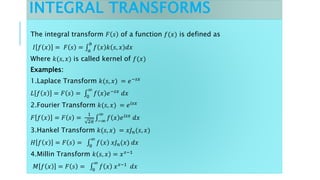
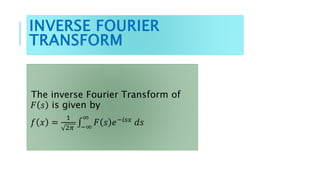
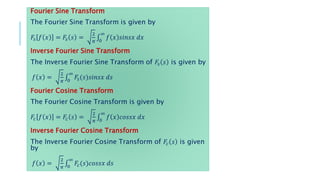
1. Fourier transforms represent a function as a sum of sinusoidal functions using integral transforms. The Fourier transform of a function f(x) is defined as an integral transform using a kernel function, with examples including the Laplace, Fourier, Hankel, and Mellin transforms. 2. The Fourier integral theorem states that if a function f(x) is piecewise continuous and differentiable, its Fourier transform represents the function as an integral using sinusoidal functions. 3. The Fourier transform and its inverse are defined by integrals using the function and a complex exponential kernel. Properties of Fourier transforms include linearity, shifting, scaling, and relationships between a function and its derivative or integral transforms.


