Solution to PDE
• In a solution to a PDE, if the number of
arbitrary constants and the number of
independent variables are equal, then the
solution is called complete solution or
complete integral.
:
• In a Complete Integral (Complete Solution) , if a
particular values found for the arbitrary constants ,
then it is called particular Solution or Particular
Integral.
• (i.e) A solution obtained by giving particular values to
the arbitrary constants in a complete integral is called
particular Integral or Particular Solution.
• A solution which contains no arbitrary terms
is called Singular Solution (or) Singular
Integral.
• A solution which contains only arbitrary
function but no arbitrary constants is called
General Solution or General Integral.
• (i.e) the solution contains maximum possible
number of arbitrary functions
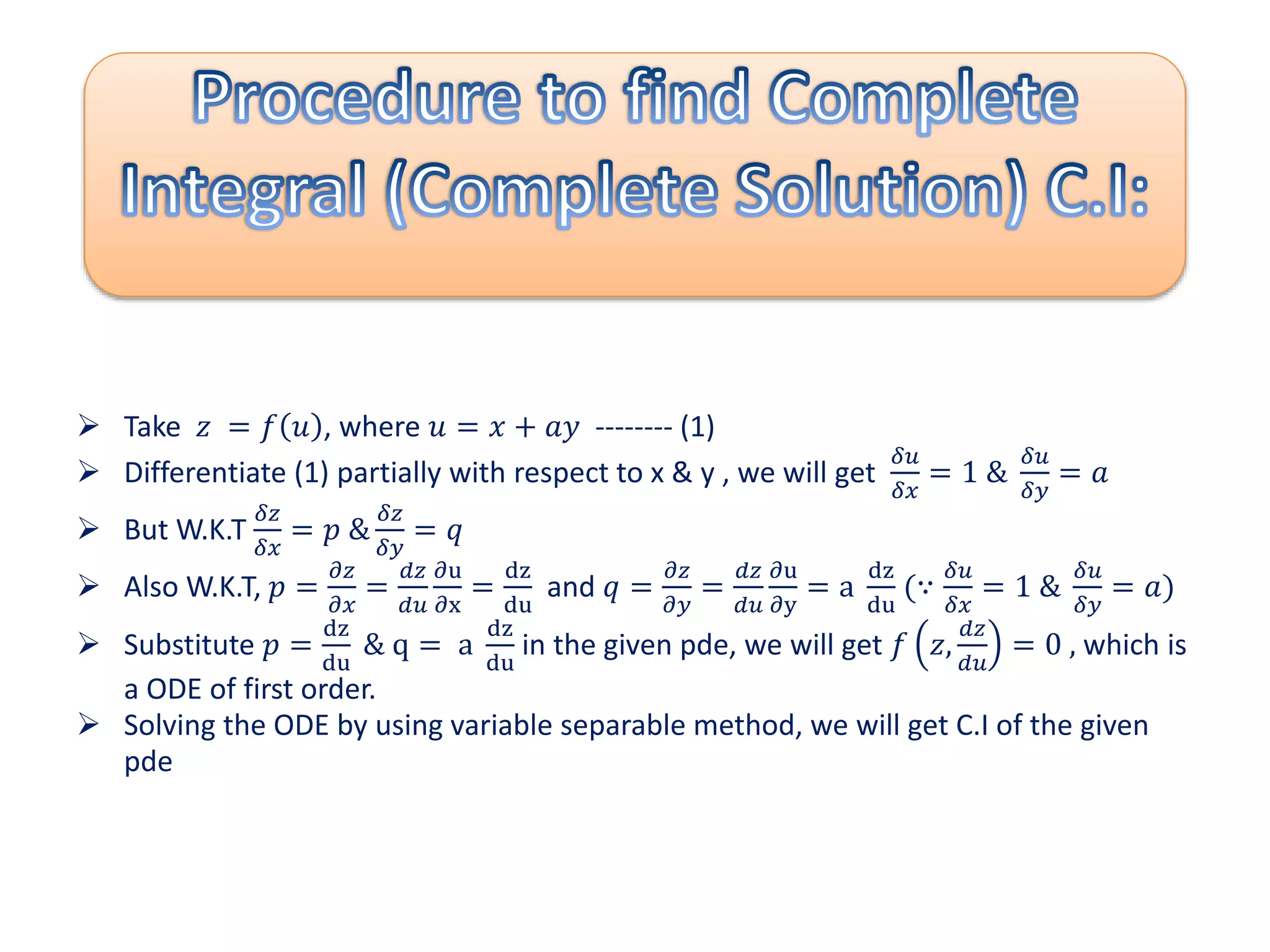
 Take 𝑧 = 𝑓 𝑢 , where 𝑢 = 𝑥 + 𝑎𝑦 -------- (1)
 Differentiate (1) partially with respect to x & y , we will get
𝛿𝑢
𝛿𝑥
= 1 &
𝛿𝑢
𝛿𝑦
= 𝑎
 But W.K.T
𝛿𝑧
𝛿𝑥
= 𝑝 &
𝛿𝑧
𝛿𝑦
= 𝑞
 Also W.K.T, 𝑝 =
𝜕𝑧
𝜕𝑥
=
𝑑𝑧
𝑑𝑢
𝜕u
𝜕x
=
dz
du
and 𝑞 =
𝜕𝑧
𝜕𝑦
=
𝑑𝑧
𝑑𝑢
𝜕u
𝜕y
= a
dz
du
(∵
𝛿𝑢
𝛿𝑥
= 1 &
𝛿𝑢
𝛿𝑦
= 𝑎)
 Substitute 𝑝 =
dz
du
& q = a
dz
du
in the given pde, we will get 𝑓 𝑧,
𝑑𝑧
𝑑𝑢
= 0 , which is
a ODE of first order.
 Solving the ODE by using variable separable method, we will get C.I of the given
pde
In this type, there is no Singular Solution like
TYPE I
Put 𝑐 = ∅(𝑎) in C.I and proceed same like
previous Type
The pde is in the form f(p, q, x) = 0
(PDE contains p, q & x)
 Take 𝑞 = 𝑎,
 Substitute 𝑞 = 𝑎 in the given equation f(p,q,x) = 0
 Then find p
 W.K.T dz = p dx +q dy & substitute the values of p & q
in this equation and integrate, we will get C.I
Procedure to find General Integral
(General Solution):
Put 𝑐 = ∅(𝑎) in C.I and proceed same like
previous Type
Type IV
The pde is in the form f(p, q, y) = 0
(PDE contains p, q & y)
Procedure to find Singular Integral
(Singular Solution) S.I:
• In this type, there is no Singular Solution like
TYPE I
Procedure to find General Integral
(General Solution):
Put 𝑐 = ∅(𝑎) in C.I and proceed same like
previous Type
 The pde is in the form z = px +qy + f(p,q)
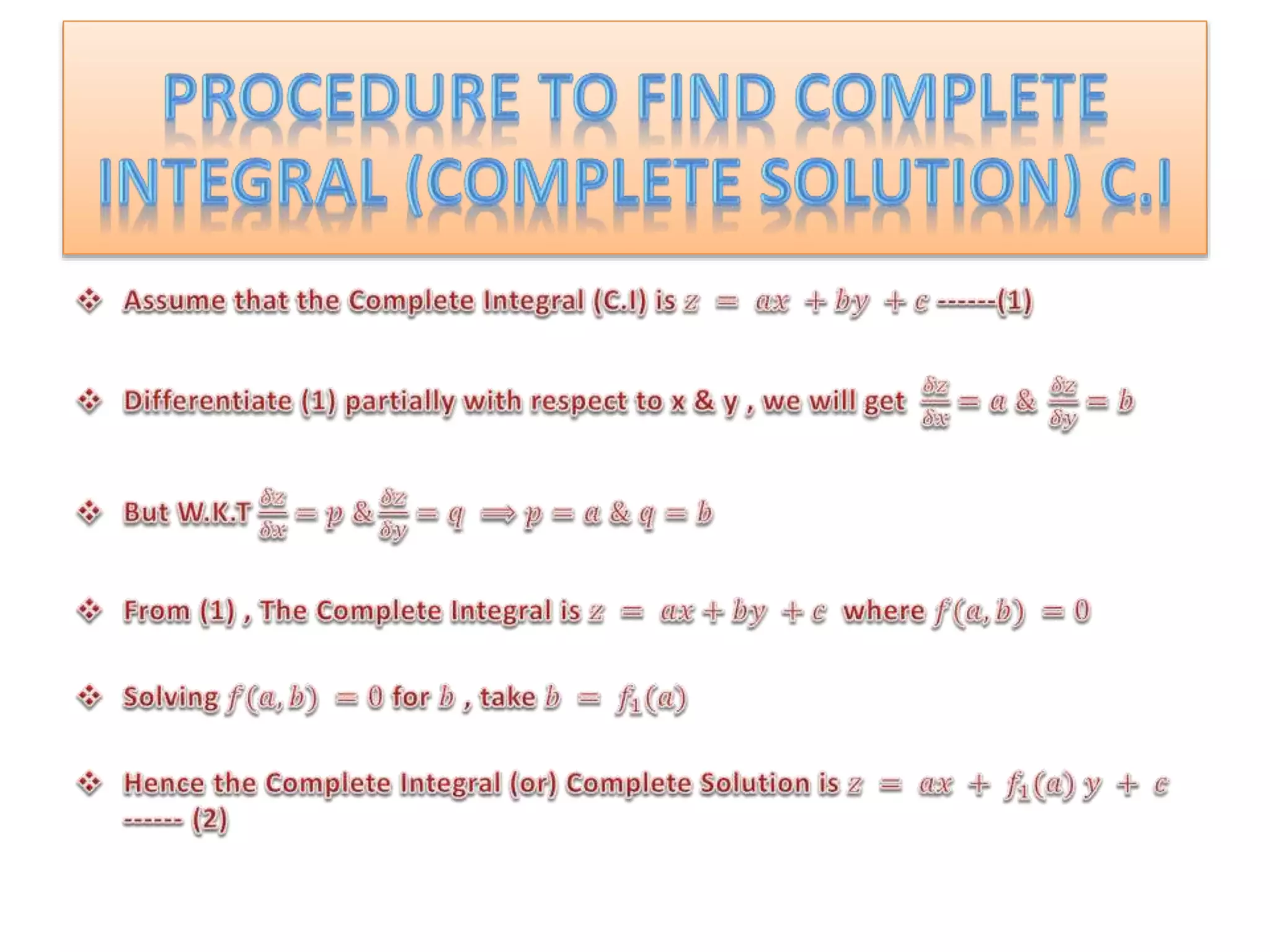
Procedure to find Complete Integral
(Complete Solution) C.I:
Take 𝑝 = 𝑎, & 𝑞 = 𝑏
 Substitute 𝑝 = 𝑎 & 𝑞 = 𝑏 in the given
equation 𝑧 = 𝑝𝑥 + 𝑞𝑦 + 𝑓(𝑝, 𝑞)
 𝑧 = 𝑎𝑥 + 𝑏𝑦 + 𝑓(𝑎, 𝑏), which is the C.I
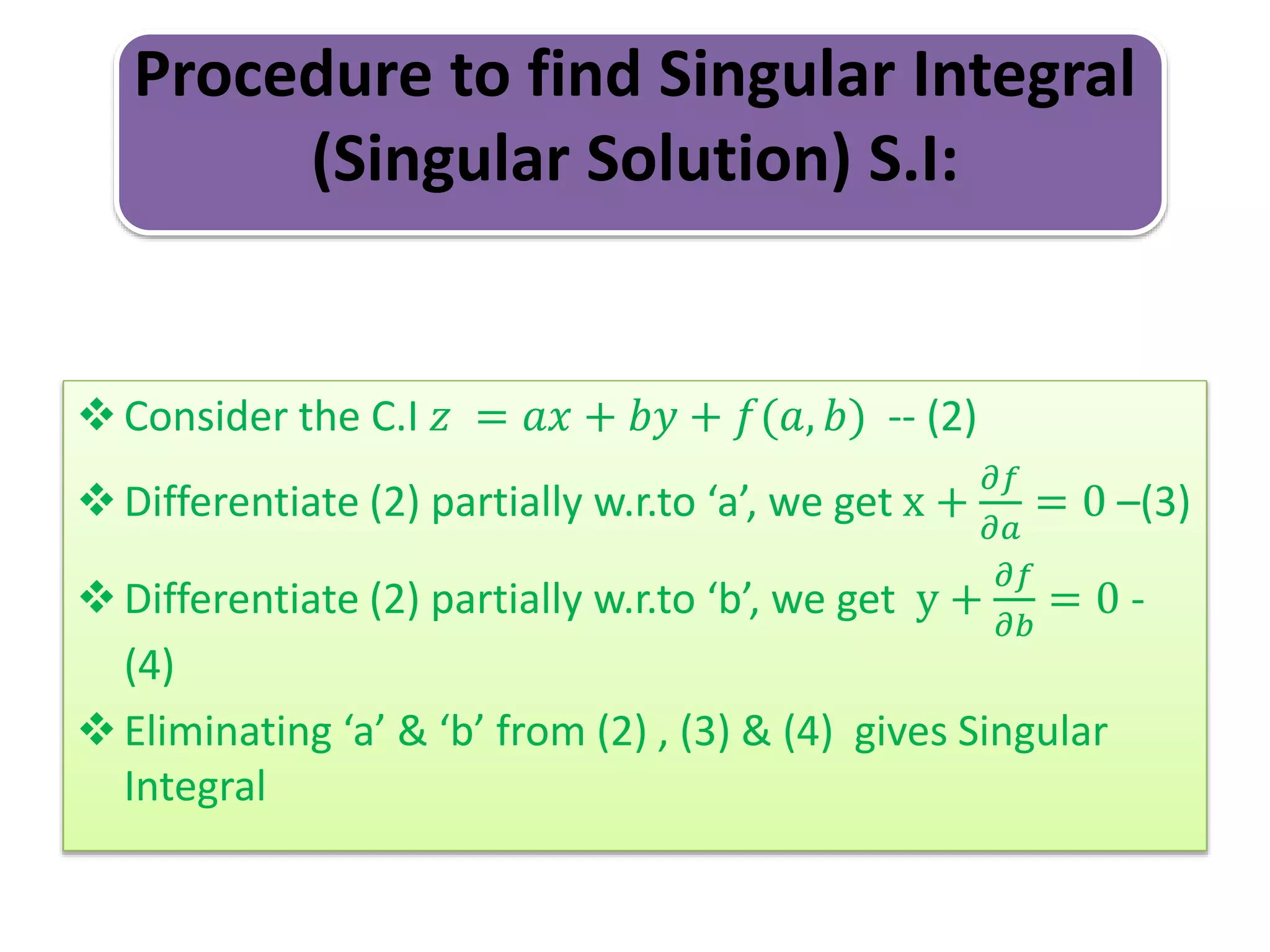
Procedure to find Singular Integral
(Singular Solution) S.I:
Consider the C.I 𝑧 = 𝑎𝑥 + 𝑏𝑦 + 𝑓(𝑎, 𝑏) -- (2)
Differentiate (2) partially w.r.to ‘a’, we get x +
𝜕𝑓
𝜕𝑎
= 0 –(3)
Differentiate (2) partially w.r.to ‘b’, we get y +
𝜕𝑓
𝜕𝑏
= 0 -
(4)
Eliminating ‘a’ & ‘b’ from (2) , (3) & (4) gives Singular
Integral
Procedure to find General Integral
(General Solution):
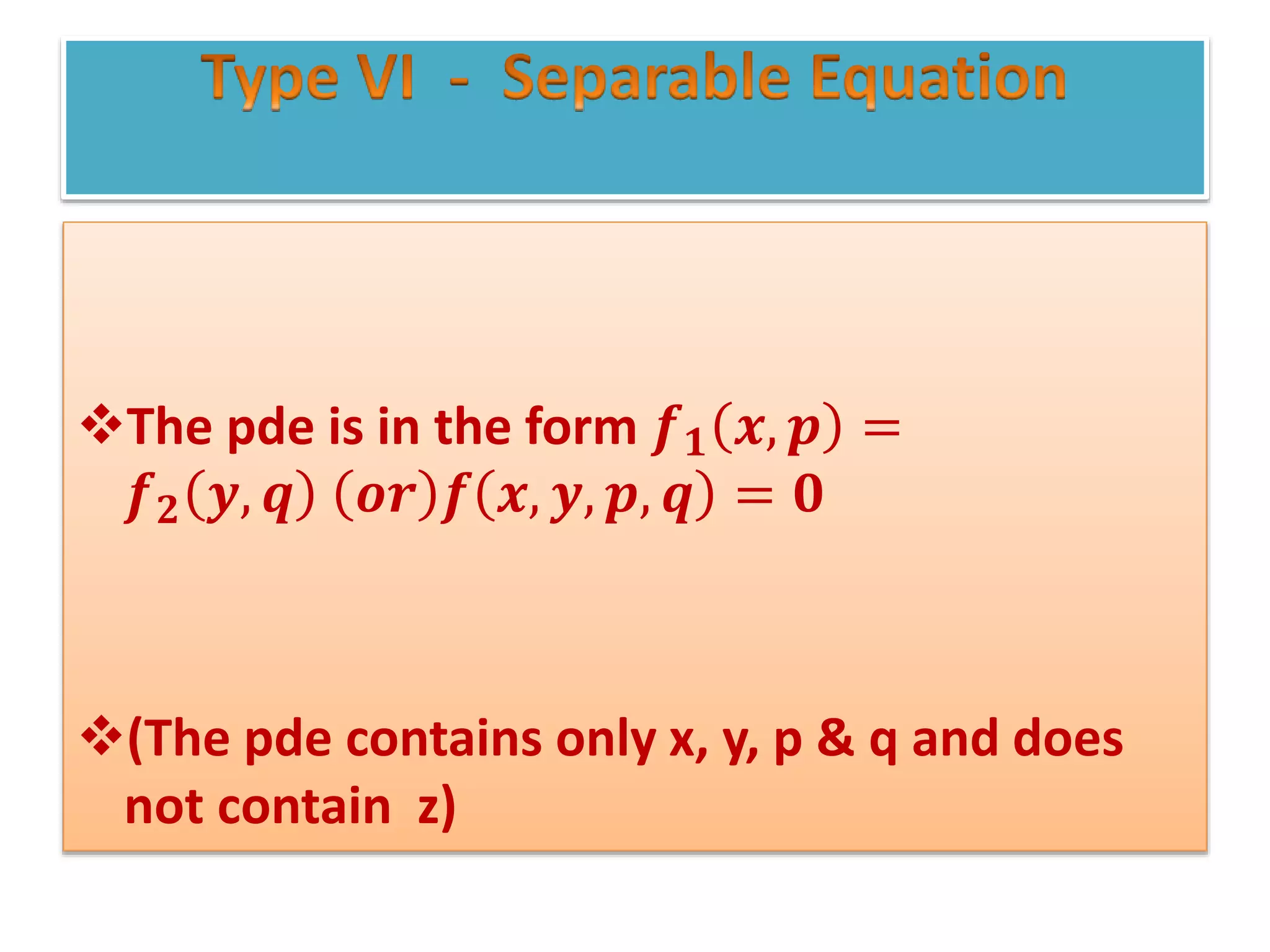
The pde is in the form 𝒇 𝟏 𝒙, 𝒑 =
𝒇 𝟐 𝒚, 𝒒 𝒐𝒓 𝒇 𝒙, 𝒚, 𝒑, 𝒒 = 𝟎
(The pde contains only x, y, p & q and does
not contain z)
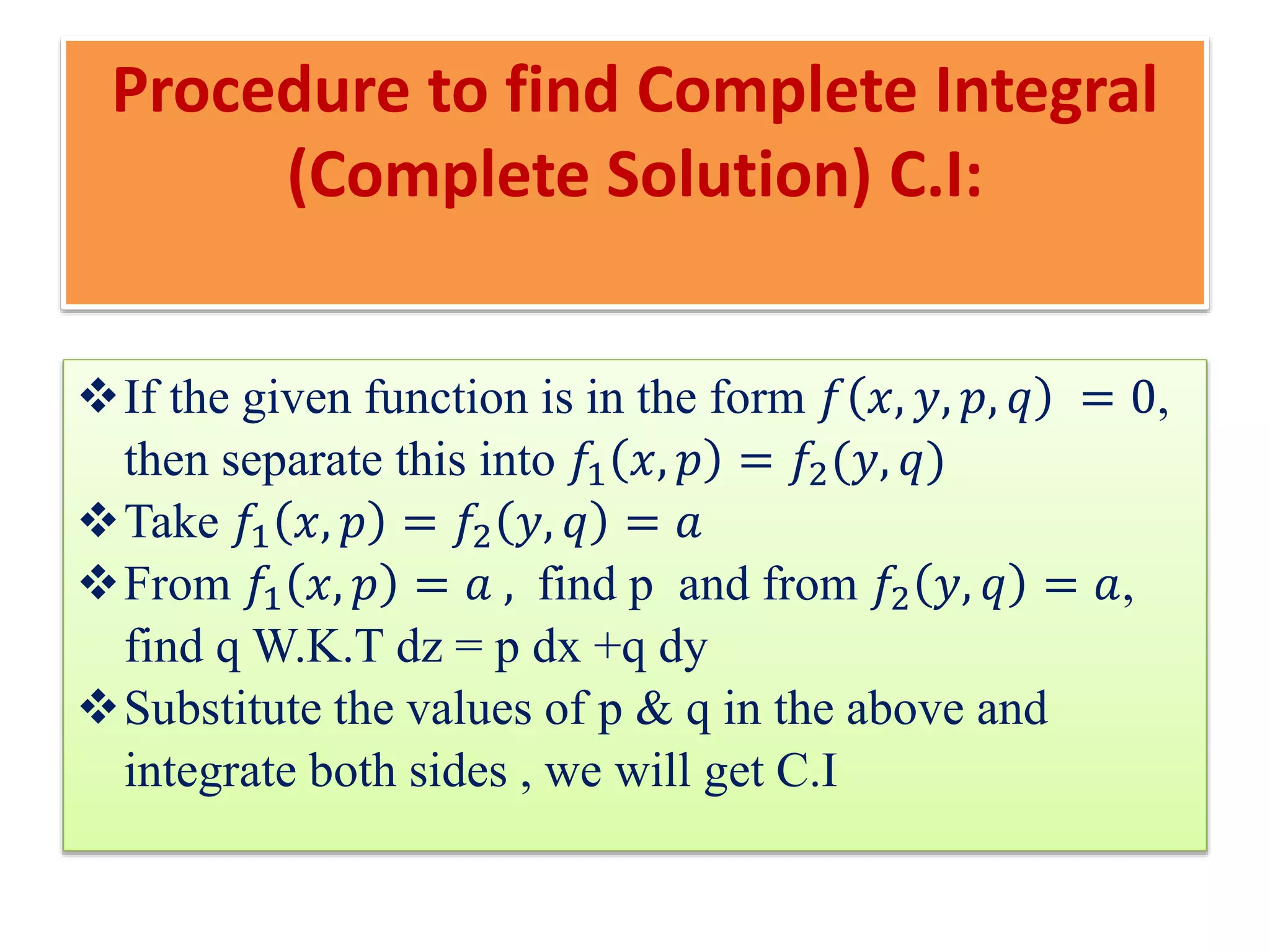
Procedure to find Complete Integral
(Complete Solution) C.I:
If the given function is in the form 𝑓 𝑥, 𝑦, 𝑝, 𝑞 = 0,
then separate this into 𝑓1 𝑥, 𝑝 = 𝑓2(𝑦, 𝑞)
Take 𝑓1 𝑥, 𝑝 = 𝑓2 𝑦, 𝑞 = 𝑎
From 𝑓1 𝑥, 𝑝 = 𝑎 , find p and from 𝑓2 𝑦, 𝑞 = 𝑎,
find q W.K.T dz = p dx +q dy
Substitute the values of p & q in the above and
integrate both sides , we will get C.I
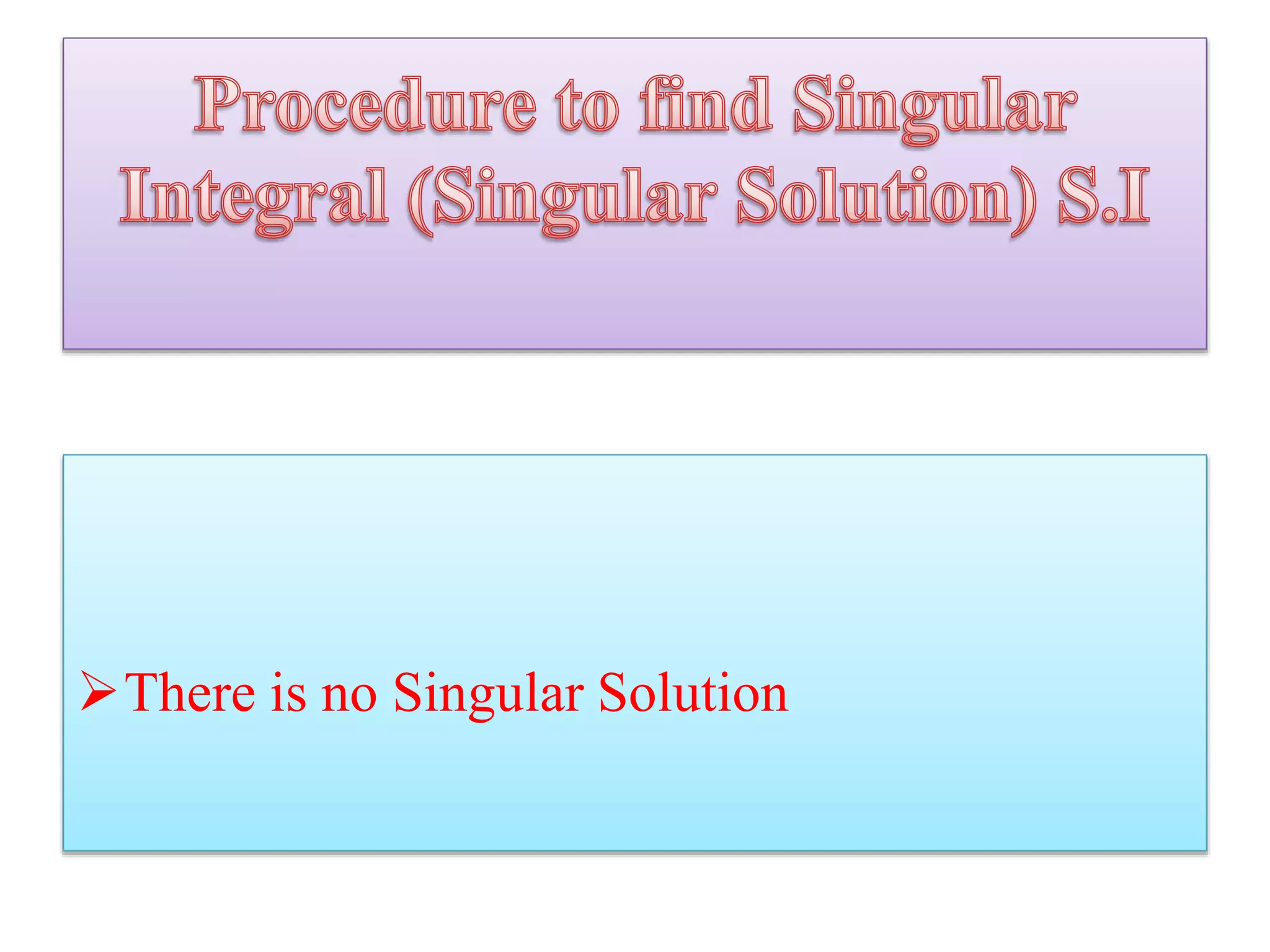
• There is no Singular Solution
Procedure to find General Integral
(General Solution):
Put 𝑐 = ∅(𝑎) in C.I and proceed same like
previous Type
Type VII - Equation reducible to
standard form
The pde is in the form 𝒇 𝒙 𝒎
𝒑 , 𝒚 𝒏
𝒒 = 𝟎 and
𝒇 𝒛, 𝒙 𝒎
𝒑, 𝒚 𝒏
𝒒 = 𝟎
Procedure to find Complete Integral
(Complete Solution) C.I:
 Case (i) If 𝒎 ≠ 𝟏 and 𝒏 ≠ 𝟏
 Put 𝑋 = 𝑥1−𝑚
& 𝑌 = 𝑦1−𝑛
 Substitute 𝑥 𝑚
𝑝 = 𝑃 1 − 𝑚 & 𝑦 𝑛
𝑞 = 𝑄(1 − 𝑛) in the given equation ,
where P =
𝜕𝑧
𝜕𝑋
, 𝑄 =
𝜕𝑧
𝜕𝑌
 After substitution, the given equation reduced to the equation of the form
𝑓 𝑃, 𝑄 = 0 𝑜𝑟 𝑓 𝑧, 𝑃, 𝑄 = 0, as per the previous procedure find the C.I
 Case(ii) If 𝒎 = 𝟏 𝒂𝒏𝒅 𝒏 = 𝟏
 Put 𝑋 = log 𝑥 & 𝑌 = log 𝑦
 Substitute 𝑥𝑝 = 𝑃 & 𝑦𝑞 = 𝑄 in the given equation where P =
𝜕𝑧
𝜕𝑋
, 𝑄 =
𝜕𝑧
𝜕𝑌
 After substitution, the given equation reduced to the equation of the form
𝑓 𝑃, 𝑄 = 0 𝑜𝑟 𝑓 𝑧, 𝑃, 𝑄 = 0, as per the previous procedure find the C.I
There is no Singular Solution
Procedure to find General
Integral (General Solution):
Put 𝑐 = ∅(𝑎) in C.I and proceed same like
previous Type
Type VIII - Equation reducible to
standard form
 The pde is in the form 𝒇 𝒛 𝒎 𝒑 , 𝒛 𝒎 𝒒 = 𝟎 and 𝒇 𝒙, 𝒛 𝒎 𝒑, 𝒛 𝒎 𝒒 = 𝟎
Procedure to find Complete Integral
(Complete Solution) C.I
 Case (i) If 𝒎 ≠ −𝟏
 Put 𝑍 = 𝑧 𝑚+1 ,
𝑃
𝑚+1
= 𝑧 𝑚 𝑝 &
𝑄
𝑚+1
= 𝑧 𝑚 𝑞 Where 𝑃 =
𝜕𝑍
𝜕𝑥
& 𝑄 =
𝜕𝑍
𝜕𝑦
 Substitute in given equation,
 After substitution, the given equation reduced to the equation of the form
𝑓 𝑃, 𝑄 = 0 𝑜𝑟 𝑓1 𝑥, 𝑃 = 𝑓2 𝑦, 𝑄 , as per the previous procedure find the C.I
 Case(ii) If 𝒎 = −𝟏
 Put 𝑍 = 𝑙𝑜𝑔𝑧
 Substitute 𝑧𝑃 = 𝑝 & 𝑧𝑄 = 𝑞 in the given equation , where 𝑃 =
𝜕𝑍
𝜕𝑥
& 𝑄 =
𝜕𝑍
𝜕𝑦
 After substitution, the given equation reduced to the equation of the form
𝑓 𝑃, 𝑄 = 0 𝑜𝑟 𝑓1 𝑥, 𝑃 = 𝑓2 𝑦, 𝑄 , as per the previous procedure find the C.I
Procedure to find Singular
Integral (Singular Solution) S.I
• There is no Singular Solution
Procedure to find General Integral (General
Solution):
Put c = ∅(a) in C.I and proceed same like
previous Type

Solution to pde

  • 1.
  • 2.
    • In asolution to a PDE, if the number of arbitrary constants and the number of independent variables are equal, then the solution is called complete solution or complete integral.
  • 3.
    : • In aComplete Integral (Complete Solution) , if a particular values found for the arbitrary constants , then it is called particular Solution or Particular Integral. • (i.e) A solution obtained by giving particular values to the arbitrary constants in a complete integral is called particular Integral or Particular Solution.
  • 4.
    • A solutionwhich contains no arbitrary terms is called Singular Solution (or) Singular Integral.
  • 5.
    • A solutionwhich contains only arbitrary function but no arbitrary constants is called General Solution or General Integral. • (i.e) the solution contains maximum possible number of arbitrary functions
  • 11.
     Take 𝑧= 𝑓 𝑢 , where 𝑢 = 𝑥 + 𝑎𝑦 -------- (1)  Differentiate (1) partially with respect to x & y , we will get 𝛿𝑢 𝛿𝑥 = 1 & 𝛿𝑢 𝛿𝑦 = 𝑎  But W.K.T 𝛿𝑧 𝛿𝑥 = 𝑝 & 𝛿𝑧 𝛿𝑦 = 𝑞  Also W.K.T, 𝑝 = 𝜕𝑧 𝜕𝑥 = 𝑑𝑧 𝑑𝑢 𝜕u 𝜕x = dz du and 𝑞 = 𝜕𝑧 𝜕𝑦 = 𝑑𝑧 𝑑𝑢 𝜕u 𝜕y = a dz du (∵ 𝛿𝑢 𝛿𝑥 = 1 & 𝛿𝑢 𝛿𝑦 = 𝑎)  Substitute 𝑝 = dz du & q = a dz du in the given pde, we will get 𝑓 𝑧, 𝑑𝑧 𝑑𝑢 = 0 , which is a ODE of first order.  Solving the ODE by using variable separable method, we will get C.I of the given pde
  • 12.
    In this type,there is no Singular Solution like TYPE I
  • 13.
    Put 𝑐 =∅(𝑎) in C.I and proceed same like previous Type
  • 14.
    The pde isin the form f(p, q, x) = 0 (PDE contains p, q & x)
  • 15.
     Take 𝑞= 𝑎,  Substitute 𝑞 = 𝑎 in the given equation f(p,q,x) = 0  Then find p  W.K.T dz = p dx +q dy & substitute the values of p & q in this equation and integrate, we will get C.I
  • 17.
    Procedure to findGeneral Integral (General Solution): Put 𝑐 = ∅(𝑎) in C.I and proceed same like previous Type
  • 18.
    Type IV The pdeis in the form f(p, q, y) = 0 (PDE contains p, q & y)
  • 19.
    Procedure to findSingular Integral (Singular Solution) S.I: • In this type, there is no Singular Solution like TYPE I
  • 20.
    Procedure to findGeneral Integral (General Solution): Put 𝑐 = ∅(𝑎) in C.I and proceed same like previous Type
  • 21.
     The pdeis in the form z = px +qy + f(p,q)
  • 22.
    Procedure to findComplete Integral (Complete Solution) C.I: Take 𝑝 = 𝑎, & 𝑞 = 𝑏  Substitute 𝑝 = 𝑎 & 𝑞 = 𝑏 in the given equation 𝑧 = 𝑝𝑥 + 𝑞𝑦 + 𝑓(𝑝, 𝑞)  𝑧 = 𝑎𝑥 + 𝑏𝑦 + 𝑓(𝑎, 𝑏), which is the C.I
  • 23.
    Procedure to findSingular Integral (Singular Solution) S.I: Consider the C.I 𝑧 = 𝑎𝑥 + 𝑏𝑦 + 𝑓(𝑎, 𝑏) -- (2) Differentiate (2) partially w.r.to ‘a’, we get x + 𝜕𝑓 𝜕𝑎 = 0 –(3) Differentiate (2) partially w.r.to ‘b’, we get y + 𝜕𝑓 𝜕𝑏 = 0 - (4) Eliminating ‘a’ & ‘b’ from (2) , (3) & (4) gives Singular Integral
  • 24.
    Procedure to findGeneral Integral (General Solution):
  • 25.
    The pde isin the form 𝒇 𝟏 𝒙, 𝒑 = 𝒇 𝟐 𝒚, 𝒒 𝒐𝒓 𝒇 𝒙, 𝒚, 𝒑, 𝒒 = 𝟎 (The pde contains only x, y, p & q and does not contain z)
  • 26.
    Procedure to findComplete Integral (Complete Solution) C.I: If the given function is in the form 𝑓 𝑥, 𝑦, 𝑝, 𝑞 = 0, then separate this into 𝑓1 𝑥, 𝑝 = 𝑓2(𝑦, 𝑞) Take 𝑓1 𝑥, 𝑝 = 𝑓2 𝑦, 𝑞 = 𝑎 From 𝑓1 𝑥, 𝑝 = 𝑎 , find p and from 𝑓2 𝑦, 𝑞 = 𝑎, find q W.K.T dz = p dx +q dy Substitute the values of p & q in the above and integrate both sides , we will get C.I
  • 27.
    • There isno Singular Solution
  • 28.
    Procedure to findGeneral Integral (General Solution): Put 𝑐 = ∅(𝑎) in C.I and proceed same like previous Type
  • 29.
    Type VII -Equation reducible to standard form The pde is in the form 𝒇 𝒙 𝒎 𝒑 , 𝒚 𝒏 𝒒 = 𝟎 and 𝒇 𝒛, 𝒙 𝒎 𝒑, 𝒚 𝒏 𝒒 = 𝟎
  • 30.
    Procedure to findComplete Integral (Complete Solution) C.I:  Case (i) If 𝒎 ≠ 𝟏 and 𝒏 ≠ 𝟏  Put 𝑋 = 𝑥1−𝑚 & 𝑌 = 𝑦1−𝑛  Substitute 𝑥 𝑚 𝑝 = 𝑃 1 − 𝑚 & 𝑦 𝑛 𝑞 = 𝑄(1 − 𝑛) in the given equation , where P = 𝜕𝑧 𝜕𝑋 , 𝑄 = 𝜕𝑧 𝜕𝑌  After substitution, the given equation reduced to the equation of the form 𝑓 𝑃, 𝑄 = 0 𝑜𝑟 𝑓 𝑧, 𝑃, 𝑄 = 0, as per the previous procedure find the C.I  Case(ii) If 𝒎 = 𝟏 𝒂𝒏𝒅 𝒏 = 𝟏  Put 𝑋 = log 𝑥 & 𝑌 = log 𝑦  Substitute 𝑥𝑝 = 𝑃 & 𝑦𝑞 = 𝑄 in the given equation where P = 𝜕𝑧 𝜕𝑋 , 𝑄 = 𝜕𝑧 𝜕𝑌  After substitution, the given equation reduced to the equation of the form 𝑓 𝑃, 𝑄 = 0 𝑜𝑟 𝑓 𝑧, 𝑃, 𝑄 = 0, as per the previous procedure find the C.I
  • 31.
    There is noSingular Solution
  • 32.
    Procedure to findGeneral Integral (General Solution): Put 𝑐 = ∅(𝑎) in C.I and proceed same like previous Type
  • 33.
    Type VIII -Equation reducible to standard form  The pde is in the form 𝒇 𝒛 𝒎 𝒑 , 𝒛 𝒎 𝒒 = 𝟎 and 𝒇 𝒙, 𝒛 𝒎 𝒑, 𝒛 𝒎 𝒒 = 𝟎
  • 34.
    Procedure to findComplete Integral (Complete Solution) C.I  Case (i) If 𝒎 ≠ −𝟏  Put 𝑍 = 𝑧 𝑚+1 , 𝑃 𝑚+1 = 𝑧 𝑚 𝑝 & 𝑄 𝑚+1 = 𝑧 𝑚 𝑞 Where 𝑃 = 𝜕𝑍 𝜕𝑥 & 𝑄 = 𝜕𝑍 𝜕𝑦  Substitute in given equation,  After substitution, the given equation reduced to the equation of the form 𝑓 𝑃, 𝑄 = 0 𝑜𝑟 𝑓1 𝑥, 𝑃 = 𝑓2 𝑦, 𝑄 , as per the previous procedure find the C.I  Case(ii) If 𝒎 = −𝟏  Put 𝑍 = 𝑙𝑜𝑔𝑧  Substitute 𝑧𝑃 = 𝑝 & 𝑧𝑄 = 𝑞 in the given equation , where 𝑃 = 𝜕𝑍 𝜕𝑥 & 𝑄 = 𝜕𝑍 𝜕𝑦  After substitution, the given equation reduced to the equation of the form 𝑓 𝑃, 𝑄 = 0 𝑜𝑟 𝑓1 𝑥, 𝑃 = 𝑓2 𝑦, 𝑄 , as per the previous procedure find the C.I
  • 35.
    Procedure to findSingular Integral (Singular Solution) S.I • There is no Singular Solution
  • 36.
    Procedure to findGeneral Integral (General Solution): Put c = ∅(a) in C.I and proceed same like previous Type