Vector Calculus
Point function
• A point function u = f(P) is a function that
assigns some number or value u to each point
P of some region R of space.
Scalar point function
• A scalar point function is a function that assigns a real
number (i.e. a scalar) to each point of some region of
space. If to each point (x, y, z) of a region R in space there is
assigned a real number u = Φ(x, y, z), then Φ is called a
scalar point function
• Examples
• 1. The temperature distribution within some body at a
particular point in time.
• 2. The density distribution within some fluid at a particular
point in time.
Vector point function
• A vector point function is a function that assigns a
vector to each point of some region of space. If to each
point (x, y, z) of a region R in space there is assigned a
vector F = F(x, y, z), then F is called a vector point
function. Such a function would have a representation
• Examples
• 1. Gravitational field of the earth.
• 2. Electric field about a current-carrying wire.
• 3. Magnetic field generated by a magnet.
• 3. Velocity at different points within a moving fluid.
• 4. Acceleration at different points within a moving fluid
Example of scalar and vector point
functions
• Consider a cactus, with long pointed thorns over
it. The presence or absence of a thorn at a
particular location (x,y,z) on the cactus is a scalar
point function; the function takes values 1 or 0,
depending upon whether the thorn is present or
not at location (x,y,z).
• Consider another function: direction of the
thorns. In this case, as a function of location ( x, y,
z) on the cactus you get a vector point function
represented by the vector in which the thorn is
pointing.
Field
• The word ‘field' signifies the variation of a
quantity (whether scalar or vector) with
position
Scalar Field
• A scalar field is a function that gives us a single value of
some variable for every point in space. (i.e) a scalar
field associates a scalar value to every point in a space
• Scalar field- where the quantity whose variation is
discussed is a scalar. For example - pressure,
temperature are scalar fields since they do not have
any direction.
Example:
• Atmospheric temperature variation as a function of
altitude above the
• Earth’s surface
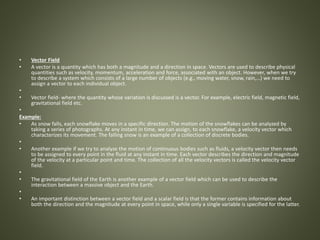
• Vector Field
• A vector is a quantity which has both a magnitude and a direction in space. Vectors are used to describe physical
quantities such as velocity, momentum, acceleration and force, associated with an object. However, when we try
to describe a system which consists of a large number of objects (e.g., moving water, snow, rain,…) we need to
assign a vector to each individual object.
•
• Vector field- where the quantity whose variation is discussed is a vector. For example, electric field, magnetic field,
gravitational field etc.
•
Example:
• As snow falls, each snowflake moves in a specific direction. The motion of the snowflakes can be analyzed by
taking a series of photographs. At any instant in time, we can assign, to each snowflake, a velocity vector which
characterizes its movement. The falling snow is an example of a collection of discrete bodies.
•
• Another example if we try to analyze the motion of continuous bodies such as fluids, a velocity vector then needs
to be assigned to every point in the fluid at any instant in time. Each vector describes the direction and magnitude
of the velocity at a particular point and time. The collection of all the velocity vectors is called the velocity vector
field.
•
• The gravitational field of the Earth is another example of a vector field which can be used to describe the
interaction between a massive object and the Earth.
•
• An important distinction between a vector field and a scalar field is that the former contains information about
both the direction and the magnitude at every point in space, while only a single variable is specified for the latter.
Vector differential operator (or) Del-
(𝛁) operator
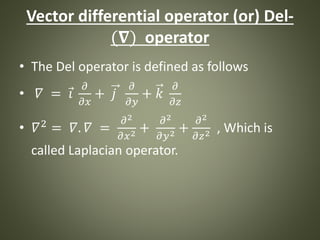
• The Del operator is defined as follows
• 𝛻 = 𝑖
𝜕
𝜕𝑥
+ 𝑗
𝜕
𝜕𝑦
+ 𝑘
𝜕
𝜕𝑧
• 𝛻2
= 𝛻. 𝛻 =
𝜕2
𝜕𝑥2 +
𝜕2
𝜕𝑦2 +
𝜕2
𝜕𝑧2 , Which is
called Laplacian operator.
The gradient of a scalar function
(grad)
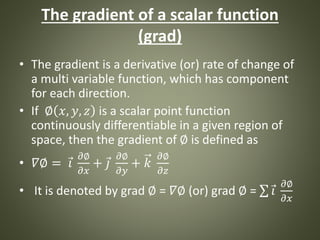
• The gradient is a derivative (or) rate of change of
a multi variable function, which has component
for each direction.
• If ∅ 𝑥, 𝑦, 𝑧 is a scalar point function
continuously differentiable in a given region of
space, then the gradient of ∅ is defined as
• 𝛻∅ = 𝑖
𝜕∅
𝜕𝑥
+ 𝑗
𝜕∅
𝜕𝑦
+ 𝑘
𝜕∅
𝜕𝑧
• It is denoted by grad ∅ = 𝛻∅ (or) grad ∅ = 𝑖
𝜕∅
𝜕𝑥
Few Properties of Del 𝛁
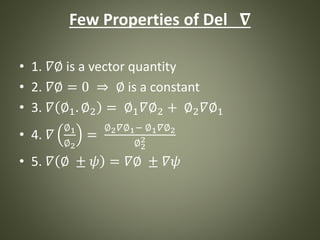
• 1. 𝛻∅ is a vector quantity
• 2. 𝛻∅ = 0 ⇒ ∅ is a constant
• 3. 𝛻 ∅1. ∅2 = ∅1 𝛻∅2 + ∅2 𝛻∅1
• 4. 𝛻
∅1
∅2
=
∅2 𝛻∅1− ∅1 𝛻∅2
∅2
2
• 5. 𝛻 ∅ ± 𝜓 = 𝛻∅ ± 𝛻𝜓
Directional Derivative
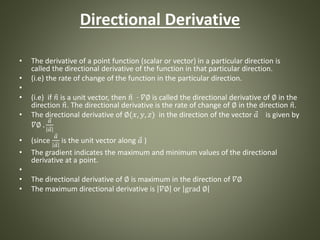
• The derivative of a point function (scalar or vector) in a particular direction is
called the directional derivative of the function in that particular direction.
• (i.e) the rate of change of the function in the particular direction.
•
• (i.e) if 𝑛 is a unit vector, then 𝑛 · 𝛻∅ is called the directional derivative of ∅ in the
direction 𝑛. The directional derivative is the rate of change of ∅ in the direction 𝑛.
• The directional derivative of ∅(𝑥, 𝑦, 𝑧) in the direction of the vector 𝑎 is given by
𝛻∅ .
𝑎
𝑎
• (since
𝑎
𝑎
is the unit vector along 𝑎 )
• The gradient indicates the maximum and minimum values of the directional
derivative at a point.
•
• The directional derivative of ∅ is maximum in the direction of 𝛻∅
• The maximum directional derivative is 𝛻∅ or grad ∅
Divergence of a vector function
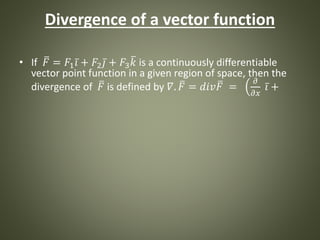
• If 𝐹 = 𝐹1 𝑖 + 𝐹2 𝑗 + 𝐹3 𝑘 is a continuously differentiable
vector point function in a given region of space, then the
divergence of 𝐹 is defined by 𝛻. 𝐹 = 𝑑𝑖𝑣 𝐹 =
𝜕
𝜕𝑥
𝑖 +
Solenoidal vector
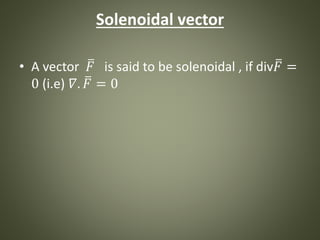
• A vector 𝐹 is said to be solenoidal , if div 𝐹 =
0 (i.e) 𝛻. 𝐹 = 0
Curl of vector function
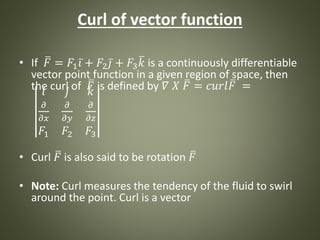
• If 𝐹 = 𝐹1 𝑖 + 𝐹2 𝑗 + 𝐹3 𝑘 is a continuously differentiable
vector point function in a given region of space, then
the curl of 𝐹 is defined by 𝛻 𝑋 𝐹 = 𝑐𝑢𝑟𝑙 𝐹 =𝑖 𝑗 𝑘
𝜕
𝜕𝑥
𝜕
𝜕𝑦
𝜕
𝜕𝑧
𝐹1 𝐹2 𝐹3
• Curl 𝐹 is also said to be rotation 𝐹
• Note: Curl measures the tendency of the fluid to swirl
around the point. Curl is a vector
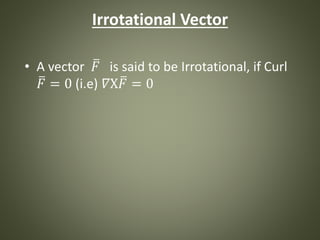
Irrotational Vector
• A vector 𝐹 is said to be Irrotational, if Curl
𝐹 = 0 (i.e) 𝛻X 𝐹 = 0
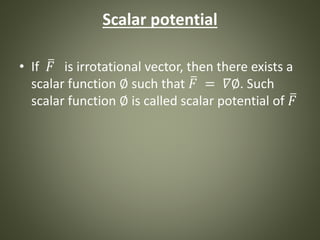
Scalar potential
• If 𝐹 is irrotational vector, then there exists a
scalar function ∅ such that 𝐹 = 𝛻∅. Such
scalar function ∅ is called scalar potential of 𝐹
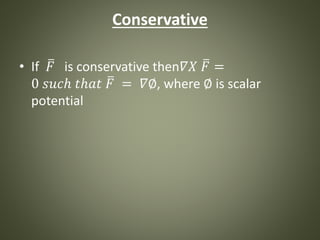
Conservative
• If 𝐹 is conservative then𝛻𝑋 𝐹 =
0 𝑠𝑢𝑐ℎ 𝑡ℎ𝑎𝑡 𝐹 = 𝛻∅, where ∅ is scalar
potential
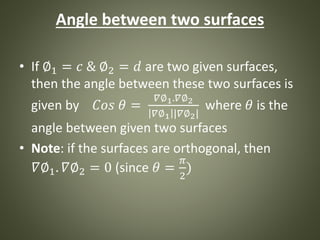
Angle between two surfaces
• If ∅1 = 𝑐 & ∅2 = 𝑑 are two given surfaces,
then the angle between these two surfaces is
given by 𝐶𝑜𝑠 𝜃 =
𝛻∅1.𝛻∅2
𝛻∅1 |𝛻∅2|
where 𝜃 is the
angle between given two surfaces
• Note: if the surfaces are orthogonal, then
𝛻∅1. 𝛻∅2 = 0 (since 𝜃 =
𝜋
2
)
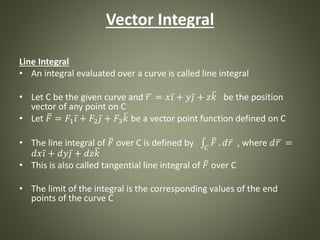
Vector Integral
Line Integral
• An integral evaluated over a curve is called line integral
• Let C be the given curve and 𝑟 = 𝑥 𝑖 + 𝑦 𝑗 + 𝑧 𝑘 be the position
vector of any point on C
• Let 𝐹 = 𝐹1 𝑖 + 𝐹2 𝑗 + 𝐹3 𝑘 be a vector point function defined on C
• The line integral of 𝐹 over C is defined by 𝐶
𝐹 . 𝑑 𝑟 , where 𝑑 𝑟 =
𝑑𝑥 𝑖 + 𝑑𝑦 𝑗 + 𝑑𝑧 𝑘
• This is also called tangential line integral of 𝐹 over C
• The limit of the integral is the corresponding values of the end
points of the curve C
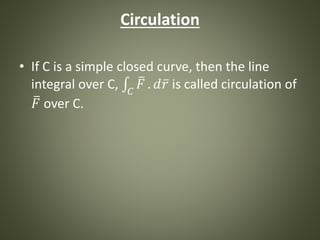
Circulation
• If C is a simple closed curve, then the line
integral over C, 𝐶
𝐹 . 𝑑 𝑟 is called circulation of
𝐹 over C.
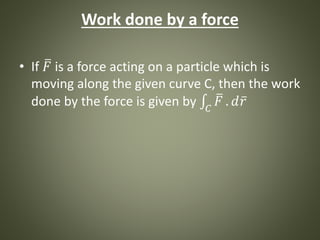
Work done by a force
• If 𝐹 is a force acting on a particle which is
moving along the given curve C, then the work
done by the force is given by 𝐶
𝐹 . 𝑑 𝑟
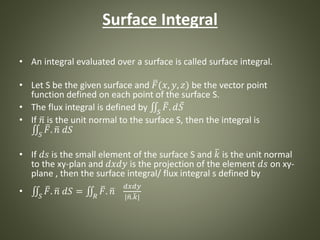
Surface Integral
• An integral evaluated over a surface is called surface integral.
• Let S be the given surface and 𝐹(𝑥, 𝑦, 𝑧) be the vector point
function defined on each point of the surface S.
• The flux integral is defined by 𝑆
𝐹. 𝑑 𝑆
• If 𝑛 is the unit normal to the surface S, then the integral is
𝑆
𝐹. 𝑛 𝑑𝑆
• If 𝑑𝑠 is the small element of the surface S and 𝑘 is the unit normal
to the xy-plan and 𝑑𝑥𝑑𝑦 is the projection of the element 𝑑𝑠 on xy-
plane , then the surface integral/ flux integral s defined by
• 𝑆
𝐹. 𝑛 𝑑𝑆 = 𝑅
𝐹. 𝑛
𝑑𝑥𝑑𝑦
| 𝑛. 𝑘|
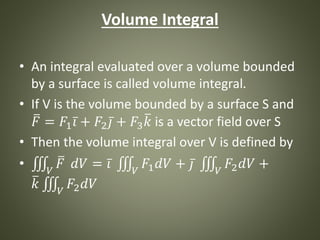
Volume Integral
• An integral evaluated over a volume bounded
by a surface is called volume integral.
• If V is the volume bounded by a surface S and
𝐹 = 𝐹1 𝑖 + 𝐹2 𝑗 + 𝐹3 𝑘 is a vector field over S
• Then the volume integral over V is defined by
• 𝑉
𝐹 𝑑𝑉 = 𝑖 𝑉
𝐹1 𝑑𝑉 + 𝑗 𝑉
𝐹2 𝑑𝑉 +
𝑘 𝑉
𝐹2 𝑑𝑉
Integral Theorem
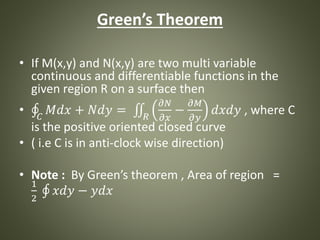
Green’s Theorem
• If M(x,y) and N(x,y) are two multi variable
continuous and differentiable functions in the
given region R on a surface then
• 𝐶
𝑀𝑑𝑥 + 𝑁𝑑𝑦 = 𝑅
𝜕𝑁
𝜕𝑥
−
𝜕𝑀
𝜕𝑦
𝑑𝑥𝑑𝑦 , where C
is the positive oriented closed curve
• ( i.e C is in anti-clock wise direction)
• Note : By Green’s theorem , Area of region =
1
2
𝑥𝑑𝑦 − 𝑦𝑑𝑥
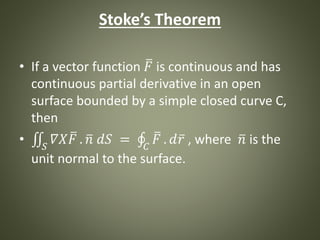
Stoke’s Theorem
• If a vector function 𝐹 is continuous and has
continuous partial derivative in an open
surface bounded by a simple closed curve C,
then
• 𝑆
𝛻𝑋 𝐹 . 𝑛 𝑑𝑆 = 𝐶
𝐹 . 𝑑 𝑟 , where 𝑛 is the
unit normal to the surface.
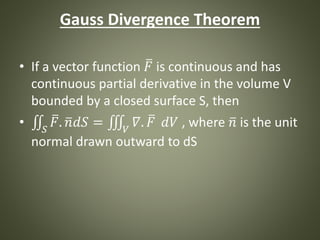
Gauss Divergence Theorem
• If a vector function 𝐹 is continuous and has
continuous partial derivative in the volume V
bounded by a closed surface S, then
• 𝑆
𝐹. 𝑛𝑑𝑆 = 𝑉
𝛻. 𝐹 𝑑𝑉 , where 𝑛 is the unit
normal drawn outward to dS

Vector calculus

  • 1.
  • 2.
    Point function • Apoint function u = f(P) is a function that assigns some number or value u to each point P of some region R of space.
  • 3.
    Scalar point function •A scalar point function is a function that assigns a real number (i.e. a scalar) to each point of some region of space. If to each point (x, y, z) of a region R in space there is assigned a real number u = Φ(x, y, z), then Φ is called a scalar point function • Examples • 1. The temperature distribution within some body at a particular point in time. • 2. The density distribution within some fluid at a particular point in time.
  • 4.
    Vector point function •A vector point function is a function that assigns a vector to each point of some region of space. If to each point (x, y, z) of a region R in space there is assigned a vector F = F(x, y, z), then F is called a vector point function. Such a function would have a representation • Examples • 1. Gravitational field of the earth. • 2. Electric field about a current-carrying wire. • 3. Magnetic field generated by a magnet. • 3. Velocity at different points within a moving fluid. • 4. Acceleration at different points within a moving fluid
  • 5.
    Example of scalarand vector point functions • Consider a cactus, with long pointed thorns over it. The presence or absence of a thorn at a particular location (x,y,z) on the cactus is a scalar point function; the function takes values 1 or 0, depending upon whether the thorn is present or not at location (x,y,z). • Consider another function: direction of the thorns. In this case, as a function of location ( x, y, z) on the cactus you get a vector point function represented by the vector in which the thorn is pointing.
  • 6.
    Field • The word‘field' signifies the variation of a quantity (whether scalar or vector) with position
  • 7.
    Scalar Field • Ascalar field is a function that gives us a single value of some variable for every point in space. (i.e) a scalar field associates a scalar value to every point in a space • Scalar field- where the quantity whose variation is discussed is a scalar. For example - pressure, temperature are scalar fields since they do not have any direction. Example: • Atmospheric temperature variation as a function of altitude above the • Earth’s surface
  • 8.
    • Vector Field •A vector is a quantity which has both a magnitude and a direction in space. Vectors are used to describe physical quantities such as velocity, momentum, acceleration and force, associated with an object. However, when we try to describe a system which consists of a large number of objects (e.g., moving water, snow, rain,…) we need to assign a vector to each individual object. • • Vector field- where the quantity whose variation is discussed is a vector. For example, electric field, magnetic field, gravitational field etc. • Example: • As snow falls, each snowflake moves in a specific direction. The motion of the snowflakes can be analyzed by taking a series of photographs. At any instant in time, we can assign, to each snowflake, a velocity vector which characterizes its movement. The falling snow is an example of a collection of discrete bodies. • • Another example if we try to analyze the motion of continuous bodies such as fluids, a velocity vector then needs to be assigned to every point in the fluid at any instant in time. Each vector describes the direction and magnitude of the velocity at a particular point and time. The collection of all the velocity vectors is called the velocity vector field. • • The gravitational field of the Earth is another example of a vector field which can be used to describe the interaction between a massive object and the Earth. • • An important distinction between a vector field and a scalar field is that the former contains information about both the direction and the magnitude at every point in space, while only a single variable is specified for the latter.
  • 9.
    Vector differential operator(or) Del- (𝛁) operator • The Del operator is defined as follows • 𝛻 = 𝑖 𝜕 𝜕𝑥 + 𝑗 𝜕 𝜕𝑦 + 𝑘 𝜕 𝜕𝑧 • 𝛻2 = 𝛻. 𝛻 = 𝜕2 𝜕𝑥2 + 𝜕2 𝜕𝑦2 + 𝜕2 𝜕𝑧2 , Which is called Laplacian operator.
  • 10.
    The gradient ofa scalar function (grad) • The gradient is a derivative (or) rate of change of a multi variable function, which has component for each direction. • If ∅ 𝑥, 𝑦, 𝑧 is a scalar point function continuously differentiable in a given region of space, then the gradient of ∅ is defined as • 𝛻∅ = 𝑖 𝜕∅ 𝜕𝑥 + 𝑗 𝜕∅ 𝜕𝑦 + 𝑘 𝜕∅ 𝜕𝑧 • It is denoted by grad ∅ = 𝛻∅ (or) grad ∅ = 𝑖 𝜕∅ 𝜕𝑥
  • 11.
    Few Properties ofDel 𝛁 • 1. 𝛻∅ is a vector quantity • 2. 𝛻∅ = 0 ⇒ ∅ is a constant • 3. 𝛻 ∅1. ∅2 = ∅1 𝛻∅2 + ∅2 𝛻∅1 • 4. 𝛻 ∅1 ∅2 = ∅2 𝛻∅1− ∅1 𝛻∅2 ∅2 2 • 5. 𝛻 ∅ ± 𝜓 = 𝛻∅ ± 𝛻𝜓
  • 12.
    Directional Derivative • Thederivative of a point function (scalar or vector) in a particular direction is called the directional derivative of the function in that particular direction. • (i.e) the rate of change of the function in the particular direction. • • (i.e) if 𝑛 is a unit vector, then 𝑛 · 𝛻∅ is called the directional derivative of ∅ in the direction 𝑛. The directional derivative is the rate of change of ∅ in the direction 𝑛. • The directional derivative of ∅(𝑥, 𝑦, 𝑧) in the direction of the vector 𝑎 is given by 𝛻∅ . 𝑎 𝑎 • (since 𝑎 𝑎 is the unit vector along 𝑎 ) • The gradient indicates the maximum and minimum values of the directional derivative at a point. • • The directional derivative of ∅ is maximum in the direction of 𝛻∅ • The maximum directional derivative is 𝛻∅ or grad ∅
  • 13.
    Divergence of avector function • If 𝐹 = 𝐹1 𝑖 + 𝐹2 𝑗 + 𝐹3 𝑘 is a continuously differentiable vector point function in a given region of space, then the divergence of 𝐹 is defined by 𝛻. 𝐹 = 𝑑𝑖𝑣 𝐹 = 𝜕 𝜕𝑥 𝑖 +
  • 14.
    Solenoidal vector • Avector 𝐹 is said to be solenoidal , if div 𝐹 = 0 (i.e) 𝛻. 𝐹 = 0
  • 15.
    Curl of vectorfunction • If 𝐹 = 𝐹1 𝑖 + 𝐹2 𝑗 + 𝐹3 𝑘 is a continuously differentiable vector point function in a given region of space, then the curl of 𝐹 is defined by 𝛻 𝑋 𝐹 = 𝑐𝑢𝑟𝑙 𝐹 =𝑖 𝑗 𝑘 𝜕 𝜕𝑥 𝜕 𝜕𝑦 𝜕 𝜕𝑧 𝐹1 𝐹2 𝐹3 • Curl 𝐹 is also said to be rotation 𝐹 • Note: Curl measures the tendency of the fluid to swirl around the point. Curl is a vector
  • 16.
    Irrotational Vector • Avector 𝐹 is said to be Irrotational, if Curl 𝐹 = 0 (i.e) 𝛻X 𝐹 = 0
  • 17.
    Scalar potential • If𝐹 is irrotational vector, then there exists a scalar function ∅ such that 𝐹 = 𝛻∅. Such scalar function ∅ is called scalar potential of 𝐹
  • 18.
    Conservative • If 𝐹is conservative then𝛻𝑋 𝐹 = 0 𝑠𝑢𝑐ℎ 𝑡ℎ𝑎𝑡 𝐹 = 𝛻∅, where ∅ is scalar potential
  • 19.
    Angle between twosurfaces • If ∅1 = 𝑐 & ∅2 = 𝑑 are two given surfaces, then the angle between these two surfaces is given by 𝐶𝑜𝑠 𝜃 = 𝛻∅1.𝛻∅2 𝛻∅1 |𝛻∅2| where 𝜃 is the angle between given two surfaces • Note: if the surfaces are orthogonal, then 𝛻∅1. 𝛻∅2 = 0 (since 𝜃 = 𝜋 2 )
  • 20.
    Vector Integral Line Integral •An integral evaluated over a curve is called line integral • Let C be the given curve and 𝑟 = 𝑥 𝑖 + 𝑦 𝑗 + 𝑧 𝑘 be the position vector of any point on C • Let 𝐹 = 𝐹1 𝑖 + 𝐹2 𝑗 + 𝐹3 𝑘 be a vector point function defined on C • The line integral of 𝐹 over C is defined by 𝐶 𝐹 . 𝑑 𝑟 , where 𝑑 𝑟 = 𝑑𝑥 𝑖 + 𝑑𝑦 𝑗 + 𝑑𝑧 𝑘 • This is also called tangential line integral of 𝐹 over C • The limit of the integral is the corresponding values of the end points of the curve C
  • 21.
    Circulation • If Cis a simple closed curve, then the line integral over C, 𝐶 𝐹 . 𝑑 𝑟 is called circulation of 𝐹 over C.
  • 22.
    Work done bya force • If 𝐹 is a force acting on a particle which is moving along the given curve C, then the work done by the force is given by 𝐶 𝐹 . 𝑑 𝑟
  • 23.
    Surface Integral • Anintegral evaluated over a surface is called surface integral. • Let S be the given surface and 𝐹(𝑥, 𝑦, 𝑧) be the vector point function defined on each point of the surface S. • The flux integral is defined by 𝑆 𝐹. 𝑑 𝑆 • If 𝑛 is the unit normal to the surface S, then the integral is 𝑆 𝐹. 𝑛 𝑑𝑆 • If 𝑑𝑠 is the small element of the surface S and 𝑘 is the unit normal to the xy-plan and 𝑑𝑥𝑑𝑦 is the projection of the element 𝑑𝑠 on xy- plane , then the surface integral/ flux integral s defined by • 𝑆 𝐹. 𝑛 𝑑𝑆 = 𝑅 𝐹. 𝑛 𝑑𝑥𝑑𝑦 | 𝑛. 𝑘|
  • 24.
    Volume Integral • Anintegral evaluated over a volume bounded by a surface is called volume integral. • If V is the volume bounded by a surface S and 𝐹 = 𝐹1 𝑖 + 𝐹2 𝑗 + 𝐹3 𝑘 is a vector field over S • Then the volume integral over V is defined by • 𝑉 𝐹 𝑑𝑉 = 𝑖 𝑉 𝐹1 𝑑𝑉 + 𝑗 𝑉 𝐹2 𝑑𝑉 + 𝑘 𝑉 𝐹2 𝑑𝑉
  • 25.
  • 26.
    Green’s Theorem • IfM(x,y) and N(x,y) are two multi variable continuous and differentiable functions in the given region R on a surface then • 𝐶 𝑀𝑑𝑥 + 𝑁𝑑𝑦 = 𝑅 𝜕𝑁 𝜕𝑥 − 𝜕𝑀 𝜕𝑦 𝑑𝑥𝑑𝑦 , where C is the positive oriented closed curve • ( i.e C is in anti-clock wise direction) • Note : By Green’s theorem , Area of region = 1 2 𝑥𝑑𝑦 − 𝑦𝑑𝑥
  • 27.
    Stoke’s Theorem • Ifa vector function 𝐹 is continuous and has continuous partial derivative in an open surface bounded by a simple closed curve C, then • 𝑆 𝛻𝑋 𝐹 . 𝑛 𝑑𝑆 = 𝐶 𝐹 . 𝑑 𝑟 , where 𝑛 is the unit normal to the surface.
  • 28.
    Gauss Divergence Theorem •If a vector function 𝐹 is continuous and has continuous partial derivative in the volume V bounded by a closed surface S, then • 𝑆 𝐹. 𝑛𝑑𝑆 = 𝑉 𝛻. 𝐹 𝑑𝑉 , where 𝑛 is the unit normal drawn outward to dS