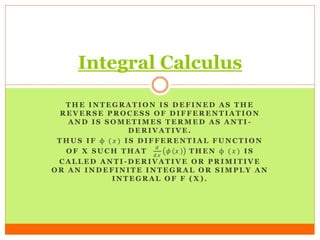
T H E I N T E G R A T I O N I S D E F I N E D A S T H E
R E V E R S E P R O C E S S O F D I F F E R E N T I A T I O N
A N D I S S O M E T I M E S T E R M E D A S A N T I -
D E R I V A T I V E .
T H U S I F ɸ ( 𝑥 ) I S D I F F E R E N T I A L F U N C T I O N
O F X S U C H T H A T
𝑑
𝑑 𝑥
𝜙 𝑥 T H E N ɸ ( 𝑥 ) I S
C A L L E D A N T I - D E R I V A T I V E O R P R I M I T I V E
O R A N I N D E F I N I T E I N T E G R A L O R S I M P L Y A N
I N T E G R A L O F F ( X ) .
Integral Calculus
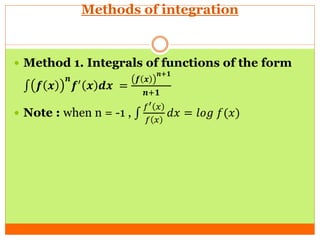
Methods of integration
 Method 1. Integrals of functions of the form
𝒇 𝒙
𝒏
𝒇′ 𝒙 𝒅𝒙 =
𝒇 𝒙
𝒏+𝟏
𝒏+𝟏
 Note : when n = -1 ,
𝑓′ 𝑥
𝑓 𝑥
𝑑𝑥 = 𝑙𝑜𝑔 𝑓(𝑥)
 Method 2. Evaluate Integral by using partial fraction method
 If the denominator can be resolved into rational factors, the method of partial fraction is to be
used
 Type 1.
𝒅𝒙
𝒂 𝟏 𝒙+𝒃 𝟏 𝒂 𝟐 𝒙+𝒃 𝟐
 Step 1. Take
𝟏
𝒂 𝟏 𝒙+𝒃 𝟏 𝒂 𝟐 𝒙+𝒃 𝟐
=
𝑨
𝒂 𝟏 𝒙+𝒃 𝟏
+
𝑩
𝒂 𝟐 𝒙+𝒃 𝟐
 Step 2. Find the value of A and B from step 1
 Step 3. Substitute the value of A and B and then integrate
 Type 2.
𝒅𝒙
𝒂 𝟏 𝒙+𝒃 𝟏
𝟐 𝒂 𝟐 𝒙+𝒃 𝟐
 Step 1. Take
𝟏
𝒂 𝟏 𝒙+𝒃 𝟏
𝟐 𝒂 𝟐 𝒙+𝒃 𝟐
=
𝑨
𝒂 𝟏 𝒙+𝒃 𝟏
+
𝑩
𝒂 𝟏 𝒙+𝒃 𝟏
𝟐 +
𝑪
𝒂 𝟐 𝒙+𝒃 𝟐
 Step 2. Find the value of A,B and C from step 1
 Step 3. Substitute the value of A,B and C and then integrate
 Type 3.
𝒅𝒙
(𝒂 𝟏 𝒙+𝒃 𝟏)(𝒂 𝟐 𝒙 𝟐+𝒃 𝟐 𝒙+𝒄 𝟐 )
 Step 1. Take
𝟏
𝒂 𝟏 𝒙+𝒃 𝟏 𝒂 𝟐 𝒙 𝟐+𝒃 𝟐 𝒙+𝒄 𝟐
=
𝑨
𝒂 𝟏 𝒙+𝒃 𝟏
+
𝑩𝒙+𝒄
𝒂 𝟐 𝒙 𝟐+𝒃 𝟐 𝒙+𝒄 𝟐
 Step 2. Find the value of A,B and C from step 1
 Step 3. Substitute the value of A,B and C and then integrate
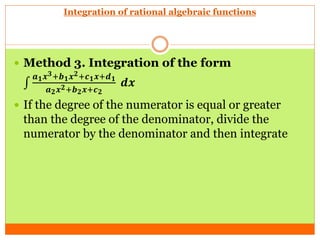
Integration of rational algebraic functions
 Method 3. Integration of the form
𝒂 𝟏 𝒙 𝟑+𝒃 𝟏 𝒙 𝟐+𝒄 𝟏 𝒙+𝒅 𝟏
𝒂 𝟐 𝒙 𝟐+𝒃 𝟐 𝒙+𝒄 𝟐
𝒅𝒙
 If the degree of the numerator is equal or greater
than the degree of the denominator, divide the
numerator by the denominator and then integrate
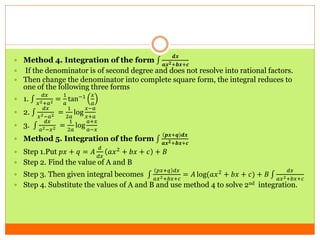
 Method 4. Integration of the form
𝒅𝒙
𝒂𝒙 𝟐+𝒃𝒙+𝒄
 If the denominator is of second degree and does not resolve into rational factors.
 Then change the denominator into complete square form, the integral reduces to
one of the following three forms
 1.
𝑑𝑥
𝑥2+𝑎2 =
1
𝑎
tan−1 𝑥
𝑎
 2.
𝑑𝑥
𝑥2−𝑎2 =
1
2𝑎
log
𝑥−𝑎
𝑥+𝑎
 3.
𝑑𝑥
𝑎2−𝑥2 =
1
2𝑎
log
𝑎+𝑥
𝑎−𝑥
 Method 5. Integration of the form
𝒑𝒙+𝒒 𝒅𝒙
𝒂𝒙 𝟐+𝒃𝒙+𝒄
 Step 1.Put 𝑝𝑥 + 𝑞 = 𝐴
𝑑
𝑑𝑥
𝑎𝑥2
+ 𝑏𝑥 + 𝑐 + 𝐵
 Step 2. Find the value of A and B
 Step 3. Then given integral becomes
𝑝𝑥+𝑞 𝑑𝑥
𝑎𝑥2+𝑏𝑥+𝑐
= 𝐴 log(𝑎𝑥2
+ 𝑏𝑥 + 𝑐) + 𝐵
𝑑𝑥
𝑎𝑥2+𝑏𝑥+𝑐
 Step 4. Substitute the values of A and B and use method 4 to solve 2nd integration.
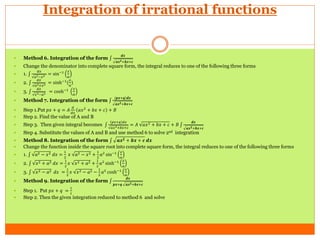
Integration of irrational functions
 Method 6. Integration of the form
𝒅𝒙
𝒂𝒙 𝟐+𝒃𝒙+𝒄
 Change the denominator into complete square form, the integral reduces to one of the following three forms
 1.
𝑑𝑥
𝑎2−𝑥2
= sin−1 𝑥
𝑎
 2.
𝑑𝑥
𝑎2+𝑥2
= sinh−1
(
𝑥
𝑎
)
 3.
𝑑𝑥
𝑥2−𝑎2
= cosh−1 𝑥
𝑎
 Method 7. Integration of the form
(𝒑𝒙+𝒒)𝒅𝒙
𝒂𝒙 𝟐+𝒃𝒙+𝒄
 Step 1.Put 𝑝𝑥 + 𝑞 = 𝐴
𝑑
𝑑𝑥
𝑎𝑥2
+ 𝑏𝑥 + 𝑐 + 𝐵
 Step 2. Find the value of A and B
 Step 3. Then given integral becomes
𝑝𝑥+𝑞 𝑑𝑥
𝑎𝑥2+𝑏𝑥+𝑐
= 𝐴 𝑎𝑥2 + 𝑏𝑥 + 𝑐 + 𝐵
𝒅𝒙
𝒂𝒙 𝟐+𝒃𝒙+𝒄
 Step 4. Substitute the values of A and B and use method 6 to solve 2nd integration
 Method 8. Integration of the form 𝒂𝒙 𝟐 + 𝒃𝒙 + 𝒄 𝒅𝒙
 Change the function inside the square root into complete square form, the integral reduces to one of the following three forms
 1. 𝑎2 − 𝑥2 𝑑𝑥 =
1
2
𝑥 𝑎2 − 𝑥2 +
1
2
𝑎2
sin−1 𝑥
𝑎
 2. 𝑥2 + 𝑎2 𝑑𝑥 =
1
2
𝑥 𝑥2 + 𝑎2 +
1
2
𝑎2
sinh−1 𝑥
𝑎
 3. 𝑥2 − 𝑎2 𝑑𝑥 =
1
2
𝑥 𝑥2 − 𝑎2 −
1
2
𝑎2
cosh−1 𝑥
𝑎
 Method 9. Integration of the form
𝒅𝒙
𝒑𝒙+𝒒 𝒂𝒙 𝟐+𝒃𝒙+𝒄
 Step 1. Put 𝑝𝑥 + 𝑞 =
1
𝑡
 Step 2. Then the given integration reduced to method 6 and solve
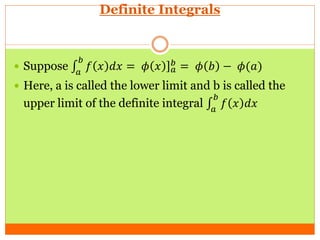
Definite Integrals
 Suppose 𝑎
𝑏
𝑓 𝑥 𝑑𝑥 = 𝜙 𝑥 𝑎
𝑏
= 𝜙 𝑏 − 𝜙(𝑎)
 Here, a is called the lower limit and b is called the
upper limit of the definite integral 𝑎
𝑏
𝑓 𝑥 𝑑𝑥
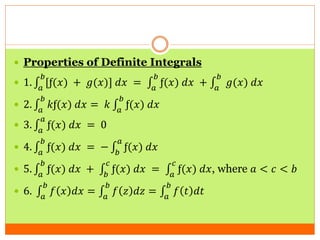
 Properties of Definite Integrals
 1. 𝑎
𝑏
[ƒ(𝑥) + 𝑔(𝑥) 𝑑𝑥 = 𝑎
𝑏
ƒ(𝑥) 𝑑𝑥 + 𝑎
𝑏
𝑔(𝑥) 𝑑𝑥
 2. 𝑎
𝑏
𝑘ƒ(𝑥) 𝑑𝑥 = 𝑘 𝑎
𝑏
ƒ(𝑥) 𝑑𝑥
 3. 𝑎
𝑎
ƒ(𝑥) 𝑑𝑥 = 0
 4. 𝑎
𝑏
ƒ(𝑥) 𝑑𝑥 = − 𝑏
𝑎
ƒ(𝑥) 𝑑𝑥
 5. 𝑎
𝑏
ƒ(𝑥) 𝑑𝑥 + 𝑏
𝑐
ƒ(𝑥) 𝑑𝑥 = 𝑎
𝑐
ƒ(𝑥) 𝑑𝑥, where 𝑎 < 𝑐 < 𝑏
 6. 𝑎
𝑏
𝑓 𝑥 𝑑𝑥 = 𝑎
𝑏
𝑓 𝑧 𝑑𝑧 = 𝑎
𝑏
𝑓 𝑡 𝑑𝑡
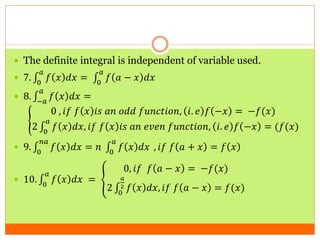
 The definite integral is independent of variable used.
 7. 0
𝑎
𝑓 𝑥 𝑑𝑥 = 0
𝑎
𝑓 𝑎 − 𝑥 𝑑𝑥
 8. −𝑎
𝑎
𝑓 𝑥 𝑑𝑥 =
0 , 𝑖𝑓 𝑓 𝑥 𝑖𝑠 𝑎𝑛 𝑜𝑑𝑑 𝑓𝑢𝑛𝑐𝑡𝑖𝑜𝑛, 𝑖. 𝑒 𝑓 −𝑥 = −𝑓(𝑥)
2 0
𝑎
𝑓 𝑥 𝑑𝑥, 𝑖𝑓 𝑓 𝑥 𝑖𝑠 𝑎𝑛 𝑒𝑣𝑒𝑛 𝑓𝑢𝑛𝑐𝑡𝑖𝑜𝑛, 𝑖. 𝑒 𝑓 −𝑥 = (𝑓(𝑥)
 9. 0
𝑛𝑎
𝑓 𝑥 𝑑𝑥 = 𝑛 0
𝑎
𝑓 𝑥 𝑑𝑥 , 𝑖𝑓 𝑓 𝑎 + 𝑥 = 𝑓 𝑥
 10. 0
𝑎
𝑓 𝑥 𝑑𝑥 =
0, 𝑖𝑓 𝑓 𝑎 − 𝑥 = −𝑓(𝑥)
2 0
𝑎
2 𝑓 𝑥 𝑑𝑥, 𝑖𝑓 𝑓 𝑎 − 𝑥 = 𝑓(𝑥)
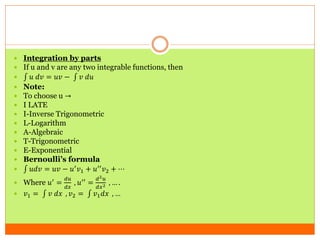
 Integration by parts
 If u and v are any two integrable functions, then
 𝑢 𝑑𝑣 = 𝑢𝑣 − 𝑣 𝑑𝑢
 Note:
 To choose u →
 I LATE
 I-Inverse Trigonometric
 L-Logarithm
 A-Algebraic
 T-Trigonometric
 E-Exponential
 Bernoulli’s formula
 𝑢𝑑𝑣 = 𝑢𝑣 − 𝑢′
𝑣1 + 𝑢′′
𝑣2 + ⋯
 Where 𝑢′
=
𝑑𝑢
𝑑𝑥
, 𝑢′′
=
𝑑2 𝑢
𝑑𝑥2 , … .
 𝑣1 = 𝑣 𝑑𝑥 , 𝑣2 = 𝑣1 𝑑𝑥 , …
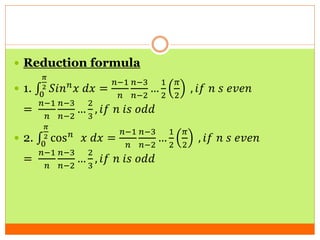
 Reduction formula
 1. 0
𝜋
2 𝑆𝑖𝑛 𝑛 𝑥 𝑑𝑥 =
𝑛−1
𝑛
𝑛−3
𝑛−2
…
1
2
𝜋
2
, 𝑖𝑓 𝑛 𝑠 𝑒𝑣𝑒𝑛
=
𝑛−1
𝑛
𝑛−3
𝑛−2
…
2
3
, 𝑖𝑓 𝑛 𝑖𝑠 𝑜𝑑𝑑
 2. 0
𝜋
2 cos 𝑛 𝑥 𝑑𝑥 =
𝑛−1
𝑛
𝑛−3
𝑛−2
…
1
2
𝜋
2
, 𝑖𝑓 𝑛 𝑠 𝑒𝑣𝑒𝑛
=
𝑛−1
𝑛
𝑛−3
𝑛−2
…
2
3
, 𝑖𝑓 𝑛 𝑖𝑠 𝑜𝑑𝑑

Integral calculus

  • 1.
    T H EI N T E G R A T I O N I S D E F I N E D A S T H E R E V E R S E P R O C E S S O F D I F F E R E N T I A T I O N A N D I S S O M E T I M E S T E R M E D A S A N T I - D E R I V A T I V E . T H U S I F ɸ ( 𝑥 ) I S D I F F E R E N T I A L F U N C T I O N O F X S U C H T H A T 𝑑 𝑑 𝑥 𝜙 𝑥 T H E N ɸ ( 𝑥 ) I S C A L L E D A N T I - D E R I V A T I V E O R P R I M I T I V E O R A N I N D E F I N I T E I N T E G R A L O R S I M P L Y A N I N T E G R A L O F F ( X ) . Integral Calculus
  • 2.
    Methods of integration Method 1. Integrals of functions of the form 𝒇 𝒙 𝒏 𝒇′ 𝒙 𝒅𝒙 = 𝒇 𝒙 𝒏+𝟏 𝒏+𝟏  Note : when n = -1 , 𝑓′ 𝑥 𝑓 𝑥 𝑑𝑥 = 𝑙𝑜𝑔 𝑓(𝑥)
  • 3.
     Method 2.Evaluate Integral by using partial fraction method  If the denominator can be resolved into rational factors, the method of partial fraction is to be used  Type 1. 𝒅𝒙 𝒂 𝟏 𝒙+𝒃 𝟏 𝒂 𝟐 𝒙+𝒃 𝟐  Step 1. Take 𝟏 𝒂 𝟏 𝒙+𝒃 𝟏 𝒂 𝟐 𝒙+𝒃 𝟐 = 𝑨 𝒂 𝟏 𝒙+𝒃 𝟏 + 𝑩 𝒂 𝟐 𝒙+𝒃 𝟐  Step 2. Find the value of A and B from step 1  Step 3. Substitute the value of A and B and then integrate  Type 2. 𝒅𝒙 𝒂 𝟏 𝒙+𝒃 𝟏 𝟐 𝒂 𝟐 𝒙+𝒃 𝟐  Step 1. Take 𝟏 𝒂 𝟏 𝒙+𝒃 𝟏 𝟐 𝒂 𝟐 𝒙+𝒃 𝟐 = 𝑨 𝒂 𝟏 𝒙+𝒃 𝟏 + 𝑩 𝒂 𝟏 𝒙+𝒃 𝟏 𝟐 + 𝑪 𝒂 𝟐 𝒙+𝒃 𝟐  Step 2. Find the value of A,B and C from step 1  Step 3. Substitute the value of A,B and C and then integrate  Type 3. 𝒅𝒙 (𝒂 𝟏 𝒙+𝒃 𝟏)(𝒂 𝟐 𝒙 𝟐+𝒃 𝟐 𝒙+𝒄 𝟐 )  Step 1. Take 𝟏 𝒂 𝟏 𝒙+𝒃 𝟏 𝒂 𝟐 𝒙 𝟐+𝒃 𝟐 𝒙+𝒄 𝟐 = 𝑨 𝒂 𝟏 𝒙+𝒃 𝟏 + 𝑩𝒙+𝒄 𝒂 𝟐 𝒙 𝟐+𝒃 𝟐 𝒙+𝒄 𝟐  Step 2. Find the value of A,B and C from step 1  Step 3. Substitute the value of A,B and C and then integrate
  • 4.
    Integration of rationalalgebraic functions  Method 3. Integration of the form 𝒂 𝟏 𝒙 𝟑+𝒃 𝟏 𝒙 𝟐+𝒄 𝟏 𝒙+𝒅 𝟏 𝒂 𝟐 𝒙 𝟐+𝒃 𝟐 𝒙+𝒄 𝟐 𝒅𝒙  If the degree of the numerator is equal or greater than the degree of the denominator, divide the numerator by the denominator and then integrate
  • 5.
     Method 4.Integration of the form 𝒅𝒙 𝒂𝒙 𝟐+𝒃𝒙+𝒄  If the denominator is of second degree and does not resolve into rational factors.  Then change the denominator into complete square form, the integral reduces to one of the following three forms  1. 𝑑𝑥 𝑥2+𝑎2 = 1 𝑎 tan−1 𝑥 𝑎  2. 𝑑𝑥 𝑥2−𝑎2 = 1 2𝑎 log 𝑥−𝑎 𝑥+𝑎  3. 𝑑𝑥 𝑎2−𝑥2 = 1 2𝑎 log 𝑎+𝑥 𝑎−𝑥  Method 5. Integration of the form 𝒑𝒙+𝒒 𝒅𝒙 𝒂𝒙 𝟐+𝒃𝒙+𝒄  Step 1.Put 𝑝𝑥 + 𝑞 = 𝐴 𝑑 𝑑𝑥 𝑎𝑥2 + 𝑏𝑥 + 𝑐 + 𝐵  Step 2. Find the value of A and B  Step 3. Then given integral becomes 𝑝𝑥+𝑞 𝑑𝑥 𝑎𝑥2+𝑏𝑥+𝑐 = 𝐴 log(𝑎𝑥2 + 𝑏𝑥 + 𝑐) + 𝐵 𝑑𝑥 𝑎𝑥2+𝑏𝑥+𝑐  Step 4. Substitute the values of A and B and use method 4 to solve 2nd integration.
  • 6.
    Integration of irrationalfunctions  Method 6. Integration of the form 𝒅𝒙 𝒂𝒙 𝟐+𝒃𝒙+𝒄  Change the denominator into complete square form, the integral reduces to one of the following three forms  1. 𝑑𝑥 𝑎2−𝑥2 = sin−1 𝑥 𝑎  2. 𝑑𝑥 𝑎2+𝑥2 = sinh−1 ( 𝑥 𝑎 )  3. 𝑑𝑥 𝑥2−𝑎2 = cosh−1 𝑥 𝑎  Method 7. Integration of the form (𝒑𝒙+𝒒)𝒅𝒙 𝒂𝒙 𝟐+𝒃𝒙+𝒄  Step 1.Put 𝑝𝑥 + 𝑞 = 𝐴 𝑑 𝑑𝑥 𝑎𝑥2 + 𝑏𝑥 + 𝑐 + 𝐵  Step 2. Find the value of A and B  Step 3. Then given integral becomes 𝑝𝑥+𝑞 𝑑𝑥 𝑎𝑥2+𝑏𝑥+𝑐 = 𝐴 𝑎𝑥2 + 𝑏𝑥 + 𝑐 + 𝐵 𝒅𝒙 𝒂𝒙 𝟐+𝒃𝒙+𝒄  Step 4. Substitute the values of A and B and use method 6 to solve 2nd integration  Method 8. Integration of the form 𝒂𝒙 𝟐 + 𝒃𝒙 + 𝒄 𝒅𝒙  Change the function inside the square root into complete square form, the integral reduces to one of the following three forms  1. 𝑎2 − 𝑥2 𝑑𝑥 = 1 2 𝑥 𝑎2 − 𝑥2 + 1 2 𝑎2 sin−1 𝑥 𝑎  2. 𝑥2 + 𝑎2 𝑑𝑥 = 1 2 𝑥 𝑥2 + 𝑎2 + 1 2 𝑎2 sinh−1 𝑥 𝑎  3. 𝑥2 − 𝑎2 𝑑𝑥 = 1 2 𝑥 𝑥2 − 𝑎2 − 1 2 𝑎2 cosh−1 𝑥 𝑎  Method 9. Integration of the form 𝒅𝒙 𝒑𝒙+𝒒 𝒂𝒙 𝟐+𝒃𝒙+𝒄  Step 1. Put 𝑝𝑥 + 𝑞 = 1 𝑡  Step 2. Then the given integration reduced to method 6 and solve
  • 7.
    Definite Integrals  Suppose𝑎 𝑏 𝑓 𝑥 𝑑𝑥 = 𝜙 𝑥 𝑎 𝑏 = 𝜙 𝑏 − 𝜙(𝑎)  Here, a is called the lower limit and b is called the upper limit of the definite integral 𝑎 𝑏 𝑓 𝑥 𝑑𝑥
  • 8.
     Properties ofDefinite Integrals  1. 𝑎 𝑏 [ƒ(𝑥) + 𝑔(𝑥) 𝑑𝑥 = 𝑎 𝑏 ƒ(𝑥) 𝑑𝑥 + 𝑎 𝑏 𝑔(𝑥) 𝑑𝑥  2. 𝑎 𝑏 𝑘ƒ(𝑥) 𝑑𝑥 = 𝑘 𝑎 𝑏 ƒ(𝑥) 𝑑𝑥  3. 𝑎 𝑎 ƒ(𝑥) 𝑑𝑥 = 0  4. 𝑎 𝑏 ƒ(𝑥) 𝑑𝑥 = − 𝑏 𝑎 ƒ(𝑥) 𝑑𝑥  5. 𝑎 𝑏 ƒ(𝑥) 𝑑𝑥 + 𝑏 𝑐 ƒ(𝑥) 𝑑𝑥 = 𝑎 𝑐 ƒ(𝑥) 𝑑𝑥, where 𝑎 < 𝑐 < 𝑏  6. 𝑎 𝑏 𝑓 𝑥 𝑑𝑥 = 𝑎 𝑏 𝑓 𝑧 𝑑𝑧 = 𝑎 𝑏 𝑓 𝑡 𝑑𝑡
  • 9.
     The definiteintegral is independent of variable used.  7. 0 𝑎 𝑓 𝑥 𝑑𝑥 = 0 𝑎 𝑓 𝑎 − 𝑥 𝑑𝑥  8. −𝑎 𝑎 𝑓 𝑥 𝑑𝑥 = 0 , 𝑖𝑓 𝑓 𝑥 𝑖𝑠 𝑎𝑛 𝑜𝑑𝑑 𝑓𝑢𝑛𝑐𝑡𝑖𝑜𝑛, 𝑖. 𝑒 𝑓 −𝑥 = −𝑓(𝑥) 2 0 𝑎 𝑓 𝑥 𝑑𝑥, 𝑖𝑓 𝑓 𝑥 𝑖𝑠 𝑎𝑛 𝑒𝑣𝑒𝑛 𝑓𝑢𝑛𝑐𝑡𝑖𝑜𝑛, 𝑖. 𝑒 𝑓 −𝑥 = (𝑓(𝑥)  9. 0 𝑛𝑎 𝑓 𝑥 𝑑𝑥 = 𝑛 0 𝑎 𝑓 𝑥 𝑑𝑥 , 𝑖𝑓 𝑓 𝑎 + 𝑥 = 𝑓 𝑥  10. 0 𝑎 𝑓 𝑥 𝑑𝑥 = 0, 𝑖𝑓 𝑓 𝑎 − 𝑥 = −𝑓(𝑥) 2 0 𝑎 2 𝑓 𝑥 𝑑𝑥, 𝑖𝑓 𝑓 𝑎 − 𝑥 = 𝑓(𝑥)
  • 10.
     Integration byparts  If u and v are any two integrable functions, then  𝑢 𝑑𝑣 = 𝑢𝑣 − 𝑣 𝑑𝑢  Note:  To choose u →  I LATE  I-Inverse Trigonometric  L-Logarithm  A-Algebraic  T-Trigonometric  E-Exponential  Bernoulli’s formula  𝑢𝑑𝑣 = 𝑢𝑣 − 𝑢′ 𝑣1 + 𝑢′′ 𝑣2 + ⋯  Where 𝑢′ = 𝑑𝑢 𝑑𝑥 , 𝑢′′ = 𝑑2 𝑢 𝑑𝑥2 , … .  𝑣1 = 𝑣 𝑑𝑥 , 𝑣2 = 𝑣1 𝑑𝑥 , …
  • 11.
     Reduction formula 1. 0 𝜋 2 𝑆𝑖𝑛 𝑛 𝑥 𝑑𝑥 = 𝑛−1 𝑛 𝑛−3 𝑛−2 … 1 2 𝜋 2 , 𝑖𝑓 𝑛 𝑠 𝑒𝑣𝑒𝑛 = 𝑛−1 𝑛 𝑛−3 𝑛−2 … 2 3 , 𝑖𝑓 𝑛 𝑖𝑠 𝑜𝑑𝑑  2. 0 𝜋 2 cos 𝑛 𝑥 𝑑𝑥 = 𝑛−1 𝑛 𝑛−3 𝑛−2 … 1 2 𝜋 2 , 𝑖𝑓 𝑛 𝑠 𝑒𝑣𝑒𝑛 = 𝑛−1 𝑛 𝑛−3 𝑛−2 … 2 3 , 𝑖𝑓 𝑛 𝑖𝑠 𝑜𝑑𝑑