Defects In Crystalline
Materials.
For more help contact me

  Muhammad Umair Bukhari
      Engr.umair.bukhari@gmail.com

          www.bzuiam.webs.com
             03136050151
Defects In Crystalline Materials.
 Metals, many ceramics and some
  polymers are crystalline.
 Real crystals contain various types of
  imperfections.
 Many of the important properties of
  materials are due to the presence of these
  imperfections.
Types Of Defects.
    Defects are categorized as:
1)   Point defects.
2)   Surface defects.
3)   Volume defects.
4)   Line defects.
Point Defects.
    All the atoms in a perfect lattice are at
     specific atomic site.
    In a pure metal two types of point defects
     are possible.
1)   Vacancies.
2)   Interstitial point defects.
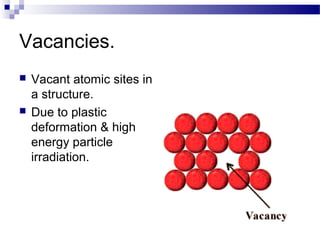
Vacancies.
   Vacant atomic sites in
    a structure.
   Due to plastic
    deformation & high
    energy particle
    irradiation.
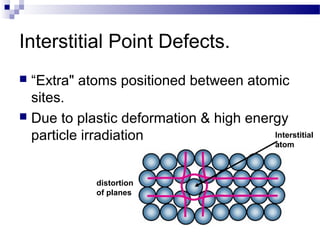
Interstitial Point Defects.
 “Extra" atoms positioned between atomic
  sites.
 Due to plastic deformation & high energy
  particle irradiation                  Interstitial
                                             atom


             distortion
             of planes
Extrinsic Point Defects.
 Introduction of outsider atom.
 They play an important role in physical &
  mechanical properties.
 Impurity atom can take two different sites
  in crystal.
 Substitutional or Interstitial.
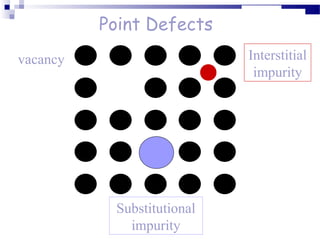
Point Defects
vacancy                     Interstitial
                             impurity


           Substitutional
             impurity
In metallic solids defects are not so
important but in ionic solids presence of a
vacant site (e.g. in NaCl), changes the
electrical properties.
Schottky & Frenkel Defects
 In order to conserve the overall neutral
  charge vacancy must be occurred either in
  pairs of opposite sign forming die-
  vacancies called Schottky defects.
 In association of the interstitial of same ion
  called Frenkel defects.
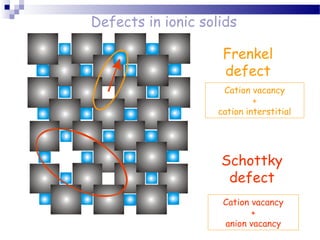
Defects in ionic solids

                     Frenkel
                     defect
                     Cation vacancy
                             +
                    cation interstitial


                    Schottky
                     defect
                     Cation vacancy
                            +
                     anion vacancy
Stacking Faults.
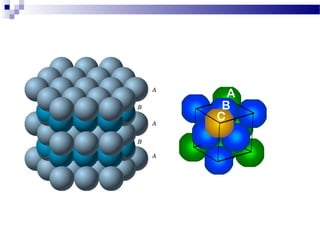
   Stacking fault is a planner defect and formed
    when regular sequence of stacking is disturbed.
   Stacking faults are not may observed In planes
    where the stacking sequence is
    ABABAB….because there is no alternative site
    for “A” layer other than resting on a “B” layer of
    vice versa.
   In ABCABABC….layers it is visible.
A
 B
C
Types Of Stacking Faults.
1)   Intrinsic stacking faults.
2)   Extrinsic stacking faults.
Intrinsic Stacking Faults.
 Removal of a layer from an arranged
  sequence layer.
 E.g. CBACBA…..becomes CBABAC….
Extrinsic Stacking Faults.
 Addition of layer to the arranged sequence
  layer.
 E.g. BACBAC….becomes BACABAC…
Grain Boundaries.
 A Grain Boundary is a general planar
  defect that separates regions of different
  crystalline orientation (i.e. grains) within a
  polycrystalline solid.
 The atoms in the grain boundary will not
  be in perfect crystalline arrangement
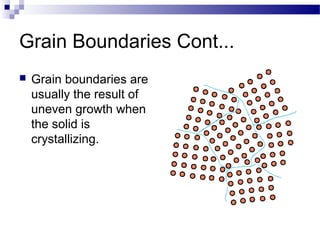
Grain Boundaries Cont...
   Grain boundaries are
    usually the result of
    uneven growth when
    the solid is
    crystallizing.

Defects in crystalline materials

  • 1.
  • 2.
    For more helpcontact me Muhammad Umair Bukhari Engr.umair.bukhari@gmail.com www.bzuiam.webs.com 03136050151
  • 3.
    Defects In CrystallineMaterials.  Metals, many ceramics and some polymers are crystalline.  Real crystals contain various types of imperfections.  Many of the important properties of materials are due to the presence of these imperfections.
  • 4.
    Types Of Defects.  Defects are categorized as: 1) Point defects. 2) Surface defects. 3) Volume defects. 4) Line defects.
  • 5.
    Point Defects.  All the atoms in a perfect lattice are at specific atomic site.  In a pure metal two types of point defects are possible. 1) Vacancies. 2) Interstitial point defects.
  • 6.
    Vacancies.  Vacant atomic sites in a structure.  Due to plastic deformation & high energy particle irradiation.
  • 7.
    Interstitial Point Defects. “Extra" atoms positioned between atomic sites.  Due to plastic deformation & high energy particle irradiation Interstitial atom distortion of planes
  • 8.
    Extrinsic Point Defects. Introduction of outsider atom.  They play an important role in physical & mechanical properties.  Impurity atom can take two different sites in crystal.  Substitutional or Interstitial.
  • 9.
    Point Defects vacancy Interstitial impurity Substitutional impurity
  • 10.
    In metallic solidsdefects are not so important but in ionic solids presence of a vacant site (e.g. in NaCl), changes the electrical properties.
  • 11.
    Schottky & FrenkelDefects  In order to conserve the overall neutral charge vacancy must be occurred either in pairs of opposite sign forming die- vacancies called Schottky defects.  In association of the interstitial of same ion called Frenkel defects.
  • 12.
    Defects in ionicsolids Frenkel defect Cation vacancy + cation interstitial Schottky defect Cation vacancy + anion vacancy
  • 13.
    Stacking Faults.  Stacking fault is a planner defect and formed when regular sequence of stacking is disturbed.  Stacking faults are not may observed In planes where the stacking sequence is ABABAB….because there is no alternative site for “A” layer other than resting on a “B” layer of vice versa.  In ABCABABC….layers it is visible.
  • 14.
  • 15.
    Types Of StackingFaults. 1) Intrinsic stacking faults. 2) Extrinsic stacking faults.
  • 16.
    Intrinsic Stacking Faults. Removal of a layer from an arranged sequence layer.  E.g. CBACBA…..becomes CBABAC….
  • 17.
    Extrinsic Stacking Faults. Addition of layer to the arranged sequence layer.  E.g. BACBAC….becomes BACABAC…
  • 18.
    Grain Boundaries.  AGrain Boundary is a general planar defect that separates regions of different crystalline orientation (i.e. grains) within a polycrystalline solid.  The atoms in the grain boundary will not be in perfect crystalline arrangement
  • 19.
    Grain Boundaries Cont...  Grain boundaries are usually the result of uneven growth when the solid is crystallizing.