DDIISSLLOOCCAATTIIOONNSS 
 Edge dislocation 
 Screw dislocation
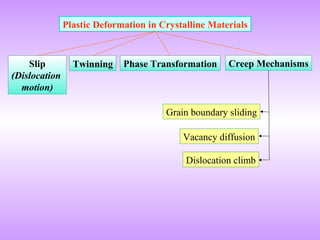
Slip 
(Dislocation 
motion) 
Plastic Deformation in Crystalline Materials 
Twinning Phase Transformation Creep Mechanisms 
Grain boundary sliding 
Vacancy diffusion 
Dislocation climb
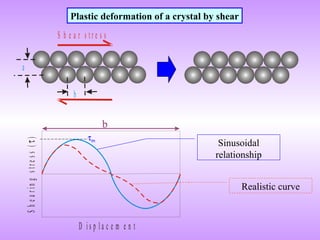
Plastic deformation of a crystal by shear 
S h e a r i n g s t r e s s ( t ) 
S h e a r s t r e s s 
D i s p l a c e m e n t 
Sinusoidal 
relationship 
Realistic curve 
a 
b 
tm
Sin x m 
As a first approximation the t t 2p 
ö çè 
÷ø 
= æ 
b 
stress-displacement curve can be 
written as 
At small values of displacement t = Gg = G x 
Hooke’s law should apply 
a 
t t 2p 
ö çè 
÷ø 
= æ 
b 
x 
m 
Þ For small values of x/b 
G b 
a 
t 
m p 
2 
Hence the maximum shear = 
stress at which slip should occur 
t G 
2 m 
p 
If b ~ a :
 The shear modulus of metals is in the range 20 – 150 GPa 
t G 
2 m 
p 
: 
 The theoretical shear stress will be 
in the range 3 – 30 GPa 
 Actual shear stress is 0.5 – 10 MPa 
 I.e. (Shear stress)theoretical > 100 * (Shear stress)experimental !!!! 
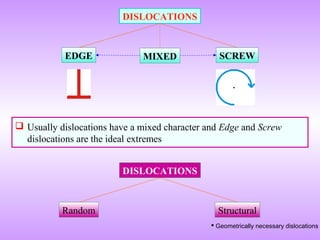
DISLOCATIONS 
Dislocations weaken the crystal
Carpet Pull
EDGE 
DISLOCATIONS 
MIXED SCREW 
 Usually dislocations have a mixed character and Edge and Screw 
dislocations are the ideal extremes 
Random 
DISLOCATIONS 
Structural 
 Geometrically necessary dislocations
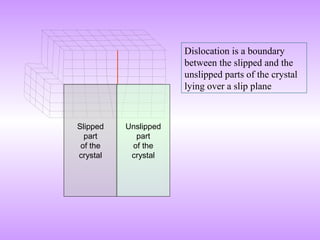
Slipped 
part 
of the 
crystal 
Unslipped 
part 
of the 
crystal 
Dislocation is a boundary 
between the slipped and the 
unslipped parts of the crystal 
lying over a slip plane
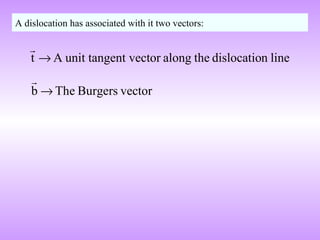
A dislocation has associated with it two vectors: 
 
t ® A unit tangent vector along the dislocation line 
 
b® The Burgers vector
Burgers Vector 
Perfect crystal 
Edge dislocation 
Crystal with edge dislocation 
RHFS: 
Right Hand Finish to Start 
convention
Edge dislocation 
t  
Direction of `t vector 
dislocation line vector 
b  
Direction of `b vector
 Dislocation is a boundary between the slipped and the unslipped parts 
of the crystal lying over a slip plane 
 The intersection of the extra half-plane of atoms with the slip plane 
defines the dislocation line (for an edge dislocation) 
 Direction and magnitude of slip is characterized by the Burgers vector 
of the dislocation 
(A dislocation is born with a Burgers vector and expresses it even in 
its death!) 
 The Burgers vector is determined by the Burgers Circuit 
 Right hand screw (finish to start) convention is used for determining 
the direction of the Burgers vector 
 As the periodic force field of a crystal requires that atoms must move 
from one equilibrium position to another Þ b must connect one 
lattice position to another (for a full dislocation) 
 Dislocations tend to have as small a Burgers vector as possible
 The edge dislocation has compressive stress field above and tensile 
stress field below the slip plane 
 Dislocations are non-equilibrium defects and would leave the crystal 
if given an opportunity
Compressive stress 
field 
Tensile stress 
field
O STRESS FIELD OFF AA EEDDGGEE DDIISSLLOOCCAATTIIOONN 
sX – FEM SIMULATED CONTOURS 
(MPa) 
FILM 
27 Å 28 Å 
SUBSTRATE 
b 
(x & y original grid size = b/2 = 1.92 Å)
Positive edge dislocation 
Negative edge dislocation 
ATTRACTION 
REPULSION 
Can come together and cancel 
one another
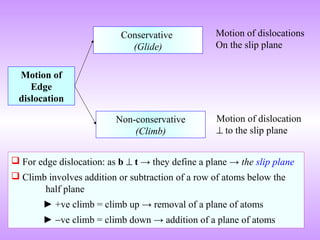
Motion of 
Edge 
dislocation 
Conservative 
(Glide) 
Non-conservative 
(Climb) 
Motion of dislocations 
On the slip plane 
Motion of dislocation 
^ to the slip plane 
 For edge dislocation: as b ^ t → they define a plane → the slip plane 
 Climb involves addition or subtraction of a row of atoms below the 
half plane 
► +ve climb = climb up → removal of a plane of atoms 
► -ve climb = climb down → addition of a plane of atoms
Edge Dislocation Glide 
Shear stress 
Surface 
step
Edge Climb 
Positive climb 
Removal of a row of atoms 
Negative climb 
Addition of a row of atoms
Screw dislocation 
[1] 
[1] Bryan Baker 
chemed.chem.purdue.edu/genchem/ topicreview/bp/materials/defects3.html -
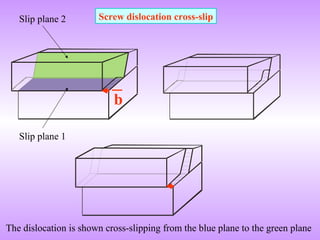
Screw dislocation cross-slip 
Slip plane 2 
Slip plane 1 
`b 
The dislocation is shown cross-slipping from the blue plane to the green plane
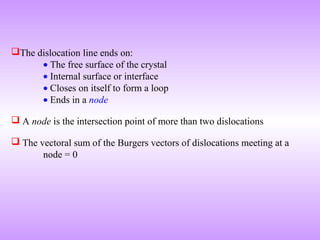
The dislocation line ends on: 
· The free surface of the crystal 
· Internal surface or interface 
· Closes on itself to form a loop 
· Ends in a node 
 A node is the intersection point of more than two dislocations 
 The vectoral sum of the Burgers vectors of dislocations meeting at a 
node = 0
Geometric properties of dislocations 
Dislocation Property 
Type of dislocation 
Edge Screw 
Relation between dislocation 
line (t) and b ^ || 
Slip direction || to b || to b 
Direction of dislocation line 
movement relative to b || ^ 
Process by which dislocation 
may leave slip plane climb Cross-slip
Mixed dislocations 
`b `t 
`b 
Pure screw Pure Edge
Motion of a mixed dislocation 
[1] http://www.tf.uni-kiel.de/matwis/amat/def_en/kap_5/backbone/r5_1_2.html 
[1] 
We are looking at the plane of the cut (sort of a semicircle centered in the lower left corner). Blue circles denote 
atoms just below, red circles atoms just above the cut. Up on the right the dislocation is a pure edge dislocation 
on the lower left it is pure screw. In between it is mixed. In the link this dislocation is shown moving in an 
animated illustration.
Energy of dislocations 
 Dislocations have distortion energy associated with them 
 E per unit length 
 Edge → Compressive and tensile stress fields 
Screw → Shear strains 
Energy of dislocation 
Elastic 
Non-elastic (Core) 
E 
~E/10 
2 
E @ 1 Gb Energy of a dislocation / unit length 
2 
G → (m) shear modulus 
b → |b|
E @ 1 Gb 2 
Þ Dislocations will have as small a b as possible 
2 
Dislocations 
(in terms of lattice translation) 
Full 
Partial 
b → Full lattice translation 
b → Fraction of lattice 
translation
Dissociation of dislocations 
Consider the reaction: 
2b → b + b 
Change in energy: 
G(2b)2/2 → 2[G(b)2/2] 
G(b)2 
Þ The reaction would be favorable
2 
1 211 
6 
b = éë ùû 
3 
1 12 1 
6 
b = éë ùû 
1 
(111) 
1 110 
2 
b = éë ùû 
(111) 
Slip plane 
(111) 
1 [110] 
2 
1 [121] 
6 
æ ö 
çè ø¸ (111) 
æ ö 
çè ø¸ (111) 
1 [211] 
6 
æ ö 
çè ø¸ → + 
b1 
2 > (b2 
2 + b3 
2) 
½ > ⅓ 
FCC 
Shockley Partials 
A 
B 
C 
(111) 
(111) 
Some of the atoms are omitted for clarity 
(111) 
1 [12 1] 
6 
æ ö 
çè ø¸ 
(111) 
1 [211] 
6 
æ ö 
çè ø¸
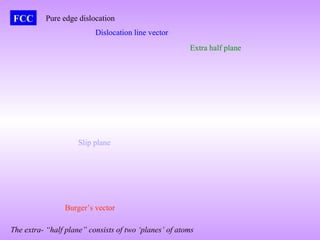
FCC Pure edge dislocation 
Dislocation line vector 
Slip plane 
Extra half plane 
Burger’s vector 
The extra- “half plane” consists of two ‘planes’ of atoms
BCC Pure edge dislocation 
Dislocation line vector 
(110) 
(110),(111) 
1 [1 1 1] 
2 
æ ö 
çè ø¸ 
1 [112] 
2 
æ ö 
çè ø¸ 
(111) 
(1 10) 
Slip plane 
Extra half plane 
Burger’s vector 
1 [111] 
1 2 112 
2 
éë ùû 
(110)
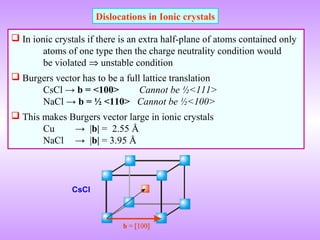
Dislocations in Ionic crystals 
 In ionic crystals if there is an extra half-plane of atoms contained only 
atoms of one type then the charge neutrality condition would 
be violated Þ unstable condition 
 Burgers vector has to be a full lattice translation 
CsCl → b = <100> Cannot be ½<111> 
NaCl → b = ½ <110> Cannot be ½<100> 
 This makes Burgers vector large in ionic crystals 
Cu → |b| = 2.55 Å 
NaCl → |b| = 3.95 Å 
CsCl
Formation of dislocations (in the bulk of the crystal) 
 Due to accidents in crystal growth from the melt 
 Mechanical deformation of the crystal 
 Annealed crystal: dislocation density (r) ~ 108 – 1010 /m2 
 Cold worked crystal: r ~ 1012 – 1014 /m2
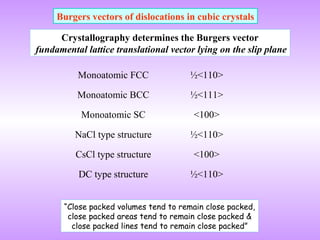
Burgers vectors of dislocations in cubic crystals 
Crystallography determines the Burgers vector 
fundamental lattice translational vector lying on the slip plane 
Monoatomic FCC ½<110> 
Monoatomic BCC ½<111> 
Monoatomic SC <100> 
NaCl type structure ½<110> 
CsCl type structure <100> 
DC type structure ½<110> 
“Close packed volumes tend to remain close packed, 
close packed areas tend to remain close packed & 
close packed lines tend to remain close packed”
Slip systems 
Crystal Slip plane(s) Slip direction 
FCC {111} <110> 
HCP (0001) <11`20> 
BCC 
Not close packed {110}, {112}, {123} [111] 
No clear choice 
Þ Wavy slip lines 
Anisotropic
Slip 
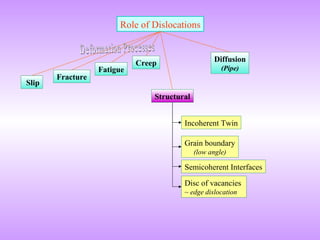
Role of Dislocations 
Fracture 
Fatigue 
Creep Diffusion 
(Pipe) 
Structural 
Incoherent Twin 
Grain boundary 
(low angle) 
Semicoherent Interfaces 
Disc of vacancies 
~ edge dislocation
Crystal imperfections dislocations

Crystal imperfections dislocations

  • 1.
    DDIISSLLOOCCAATTIIOONNSS  Edgedislocation  Screw dislocation
  • 2.
    Slip (Dislocation motion) Plastic Deformation in Crystalline Materials Twinning Phase Transformation Creep Mechanisms Grain boundary sliding Vacancy diffusion Dislocation climb
  • 3.
    Plastic deformation ofa crystal by shear S h e a r i n g s t r e s s ( t ) S h e a r s t r e s s D i s p l a c e m e n t Sinusoidal relationship Realistic curve a b tm
  • 4.
    Sin x m As a first approximation the t t 2p ö çè ÷ø = æ b stress-displacement curve can be written as At small values of displacement t = Gg = G x Hooke’s law should apply a t t 2p ö çè ÷ø = æ b x m Þ For small values of x/b G b a t m p 2 Hence the maximum shear = stress at which slip should occur t G 2 m p If b ~ a :
  • 5.
     The shearmodulus of metals is in the range 20 – 150 GPa t G 2 m p :  The theoretical shear stress will be in the range 3 – 30 GPa  Actual shear stress is 0.5 – 10 MPa  I.e. (Shear stress)theoretical > 100 * (Shear stress)experimental !!!! DISLOCATIONS Dislocations weaken the crystal
  • 6.
  • 7.
    EDGE DISLOCATIONS MIXEDSCREW  Usually dislocations have a mixed character and Edge and Screw dislocations are the ideal extremes Random DISLOCATIONS Structural  Geometrically necessary dislocations
  • 8.
    Slipped part ofthe crystal Unslipped part of the crystal Dislocation is a boundary between the slipped and the unslipped parts of the crystal lying over a slip plane
  • 9.
    A dislocation hasassociated with it two vectors:  t ® A unit tangent vector along the dislocation line  b® The Burgers vector
  • 10.
    Burgers Vector Perfectcrystal Edge dislocation Crystal with edge dislocation RHFS: Right Hand Finish to Start convention
  • 11.
    Edge dislocation t Direction of `t vector dislocation line vector b  Direction of `b vector
  • 12.
     Dislocation isa boundary between the slipped and the unslipped parts of the crystal lying over a slip plane  The intersection of the extra half-plane of atoms with the slip plane defines the dislocation line (for an edge dislocation)  Direction and magnitude of slip is characterized by the Burgers vector of the dislocation (A dislocation is born with a Burgers vector and expresses it even in its death!)  The Burgers vector is determined by the Burgers Circuit  Right hand screw (finish to start) convention is used for determining the direction of the Burgers vector  As the periodic force field of a crystal requires that atoms must move from one equilibrium position to another Þ b must connect one lattice position to another (for a full dislocation)  Dislocations tend to have as small a Burgers vector as possible
  • 13.
     The edgedislocation has compressive stress field above and tensile stress field below the slip plane  Dislocations are non-equilibrium defects and would leave the crystal if given an opportunity
  • 14.
    Compressive stress field Tensile stress field
  • 15.
    O STRESS FIELDOFF AA EEDDGGEE DDIISSLLOOCCAATTIIOONN sX – FEM SIMULATED CONTOURS (MPa) FILM 27 Å 28 Å SUBSTRATE b (x & y original grid size = b/2 = 1.92 Å)
  • 16.
    Positive edge dislocation Negative edge dislocation ATTRACTION REPULSION Can come together and cancel one another
  • 17.
    Motion of Edge dislocation Conservative (Glide) Non-conservative (Climb) Motion of dislocations On the slip plane Motion of dislocation ^ to the slip plane  For edge dislocation: as b ^ t → they define a plane → the slip plane  Climb involves addition or subtraction of a row of atoms below the half plane ► +ve climb = climb up → removal of a plane of atoms ► -ve climb = climb down → addition of a plane of atoms
  • 18.
    Edge Dislocation Glide Shear stress Surface step
  • 19.
    Edge Climb Positiveclimb Removal of a row of atoms Negative climb Addition of a row of atoms
  • 20.
    Screw dislocation [1] [1] Bryan Baker chemed.chem.purdue.edu/genchem/ topicreview/bp/materials/defects3.html -
  • 21.
    Screw dislocation cross-slip Slip plane 2 Slip plane 1 `b The dislocation is shown cross-slipping from the blue plane to the green plane
  • 22.
    The dislocation lineends on: · The free surface of the crystal · Internal surface or interface · Closes on itself to form a loop · Ends in a node  A node is the intersection point of more than two dislocations  The vectoral sum of the Burgers vectors of dislocations meeting at a node = 0
  • 23.
    Geometric properties ofdislocations Dislocation Property Type of dislocation Edge Screw Relation between dislocation line (t) and b ^ || Slip direction || to b || to b Direction of dislocation line movement relative to b || ^ Process by which dislocation may leave slip plane climb Cross-slip
  • 24.
    Mixed dislocations `b`t `b Pure screw Pure Edge
  • 25.
    Motion of amixed dislocation [1] http://www.tf.uni-kiel.de/matwis/amat/def_en/kap_5/backbone/r5_1_2.html [1] We are looking at the plane of the cut (sort of a semicircle centered in the lower left corner). Blue circles denote atoms just below, red circles atoms just above the cut. Up on the right the dislocation is a pure edge dislocation on the lower left it is pure screw. In between it is mixed. In the link this dislocation is shown moving in an animated illustration.
  • 26.
    Energy of dislocations  Dislocations have distortion energy associated with them  E per unit length  Edge → Compressive and tensile stress fields Screw → Shear strains Energy of dislocation Elastic Non-elastic (Core) E ~E/10 2 E @ 1 Gb Energy of a dislocation / unit length 2 G → (m) shear modulus b → |b|
  • 27.
    E @ 1Gb 2 Þ Dislocations will have as small a b as possible 2 Dislocations (in terms of lattice translation) Full Partial b → Full lattice translation b → Fraction of lattice translation
  • 28.
    Dissociation of dislocations Consider the reaction: 2b → b + b Change in energy: G(2b)2/2 → 2[G(b)2/2] G(b)2 Þ The reaction would be favorable
  • 29.
    2 1 211 6 b = éë ùû 3 1 12 1 6 b = éë ùû 1 (111) 1 110 2 b = éë ùû (111) Slip plane (111) 1 [110] 2 1 [121] 6 æ ö çè ø¸ (111) æ ö çè ø¸ (111) 1 [211] 6 æ ö çè ø¸ → + b1 2 > (b2 2 + b3 2) ½ > ⅓ FCC Shockley Partials A B C (111) (111) Some of the atoms are omitted for clarity (111) 1 [12 1] 6 æ ö çè ø¸ (111) 1 [211] 6 æ ö çè ø¸
  • 30.
    FCC Pure edgedislocation Dislocation line vector Slip plane Extra half plane Burger’s vector The extra- “half plane” consists of two ‘planes’ of atoms
  • 31.
    BCC Pure edgedislocation Dislocation line vector (110) (110),(111) 1 [1 1 1] 2 æ ö çè ø¸ 1 [112] 2 æ ö çè ø¸ (111) (1 10) Slip plane Extra half plane Burger’s vector 1 [111] 1 2 112 2 éë ùû (110)
  • 32.
    Dislocations in Ioniccrystals  In ionic crystals if there is an extra half-plane of atoms contained only atoms of one type then the charge neutrality condition would be violated Þ unstable condition  Burgers vector has to be a full lattice translation CsCl → b = <100> Cannot be ½<111> NaCl → b = ½ <110> Cannot be ½<100>  This makes Burgers vector large in ionic crystals Cu → |b| = 2.55 Å NaCl → |b| = 3.95 Å CsCl
  • 33.
    Formation of dislocations(in the bulk of the crystal)  Due to accidents in crystal growth from the melt  Mechanical deformation of the crystal  Annealed crystal: dislocation density (r) ~ 108 – 1010 /m2  Cold worked crystal: r ~ 1012 – 1014 /m2
  • 34.
    Burgers vectors ofdislocations in cubic crystals Crystallography determines the Burgers vector fundamental lattice translational vector lying on the slip plane Monoatomic FCC ½<110> Monoatomic BCC ½<111> Monoatomic SC <100> NaCl type structure ½<110> CsCl type structure <100> DC type structure ½<110> “Close packed volumes tend to remain close packed, close packed areas tend to remain close packed & close packed lines tend to remain close packed”
  • 35.
    Slip systems CrystalSlip plane(s) Slip direction FCC {111} <110> HCP (0001) <11`20> BCC Not close packed {110}, {112}, {123} [111] No clear choice Þ Wavy slip lines Anisotropic
  • 36.
    Slip Role ofDislocations Fracture Fatigue Creep Diffusion (Pipe) Structural Incoherent Twin Grain boundary (low angle) Semicoherent Interfaces Disc of vacancies ~ edge dislocation