Muhammad Umair
Bukhari
Engr.umair.bukhari@gmail.com
http://onlinemetallurgy.com
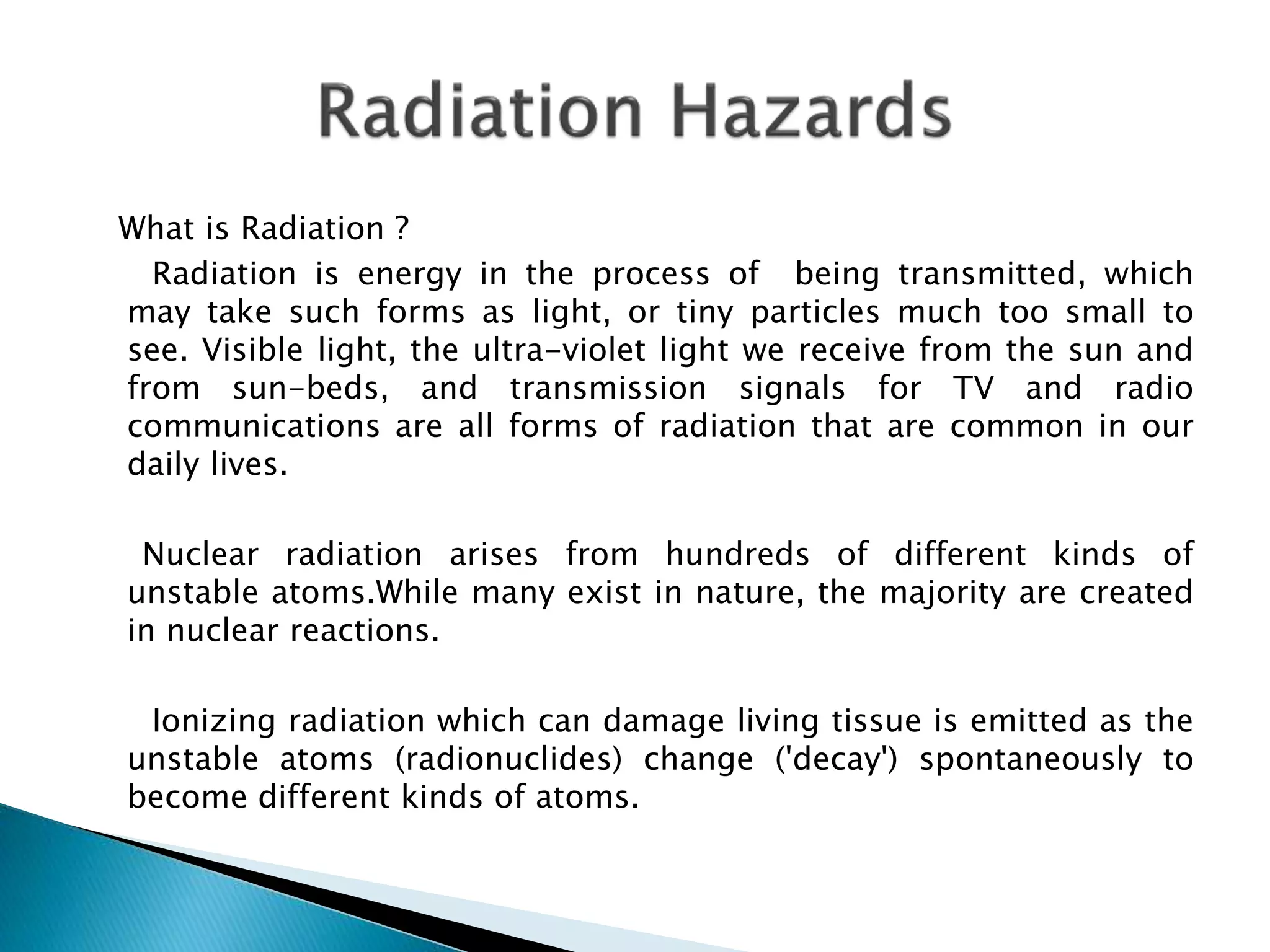
What is Radiation ?
Radiation is energy in the process of being transmitted, which
may take such forms as light, or tiny particles much too small to
see. Visible light, the ultra-violet light we receive from the sun and
from sun-beds, and transmission signals for TV and radio
communications are all forms of radiation that are common in our
daily lives.
Nuclear radiation arises from hundreds of different kinds of
unstable atoms.While many exist in nature, the majority are created
in nuclear reactions.
Ionizing radiation which can damage living tissue is emitted as the
unstable atoms (radionuclides) change ('decay') spontaneously to
become different kinds of atoms.
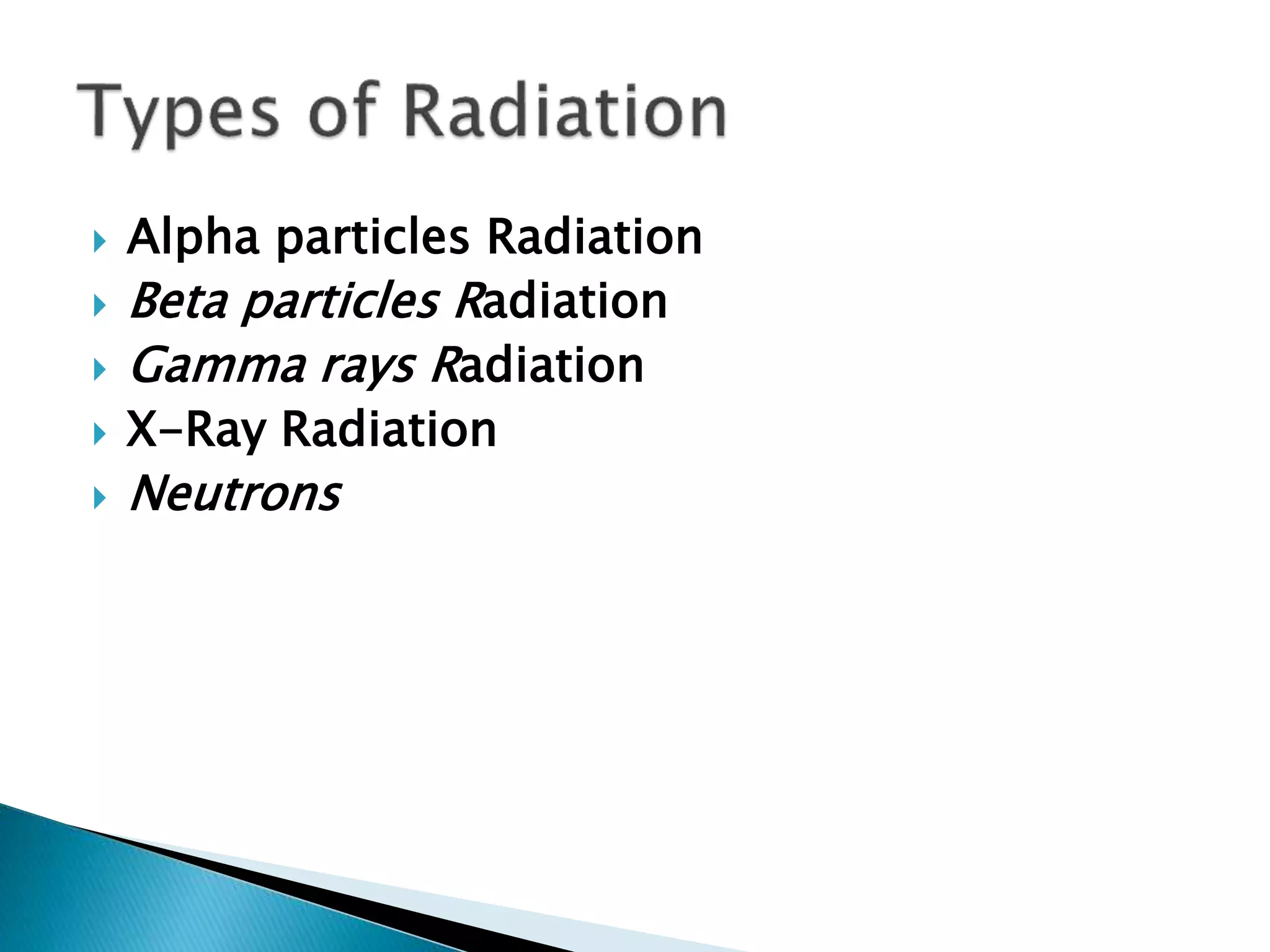
 Alpha particles Radiation
 Beta particles Radiation
 Gamma rays Radiation
 X-Ray Radiation
 Neutrons
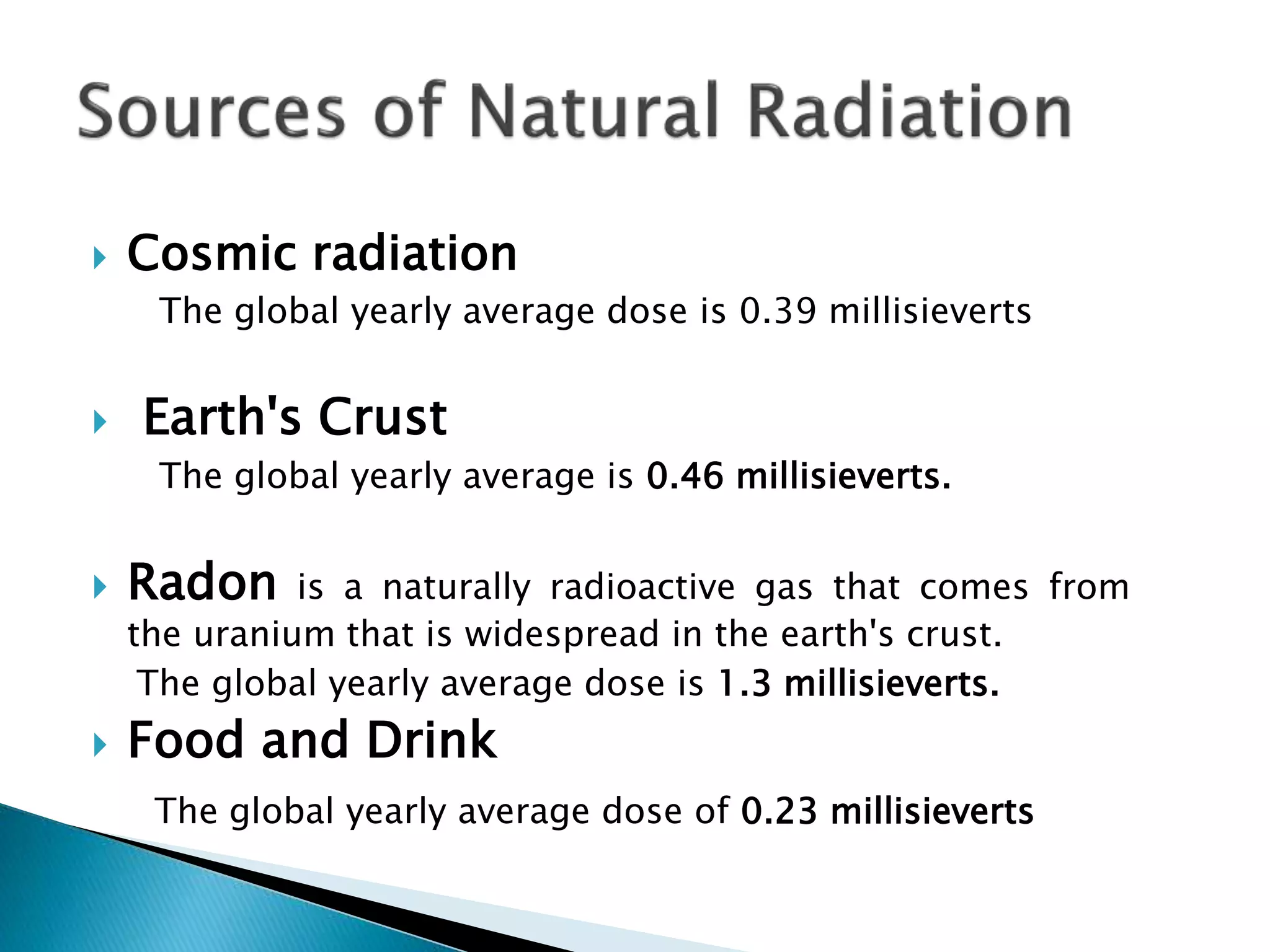
 Cosmic radiation
The global yearly average dose is 0.39 millisieverts
 Earth's Crust
The global yearly average is 0.46 millisieverts.
 Radon is a naturally radioactive gas that comes from
the uranium that is widespread in the earth's crust.
The global yearly average dose is 1.3 millisieverts.
 Food and Drink
The global yearly average dose of 0.23 millisieverts
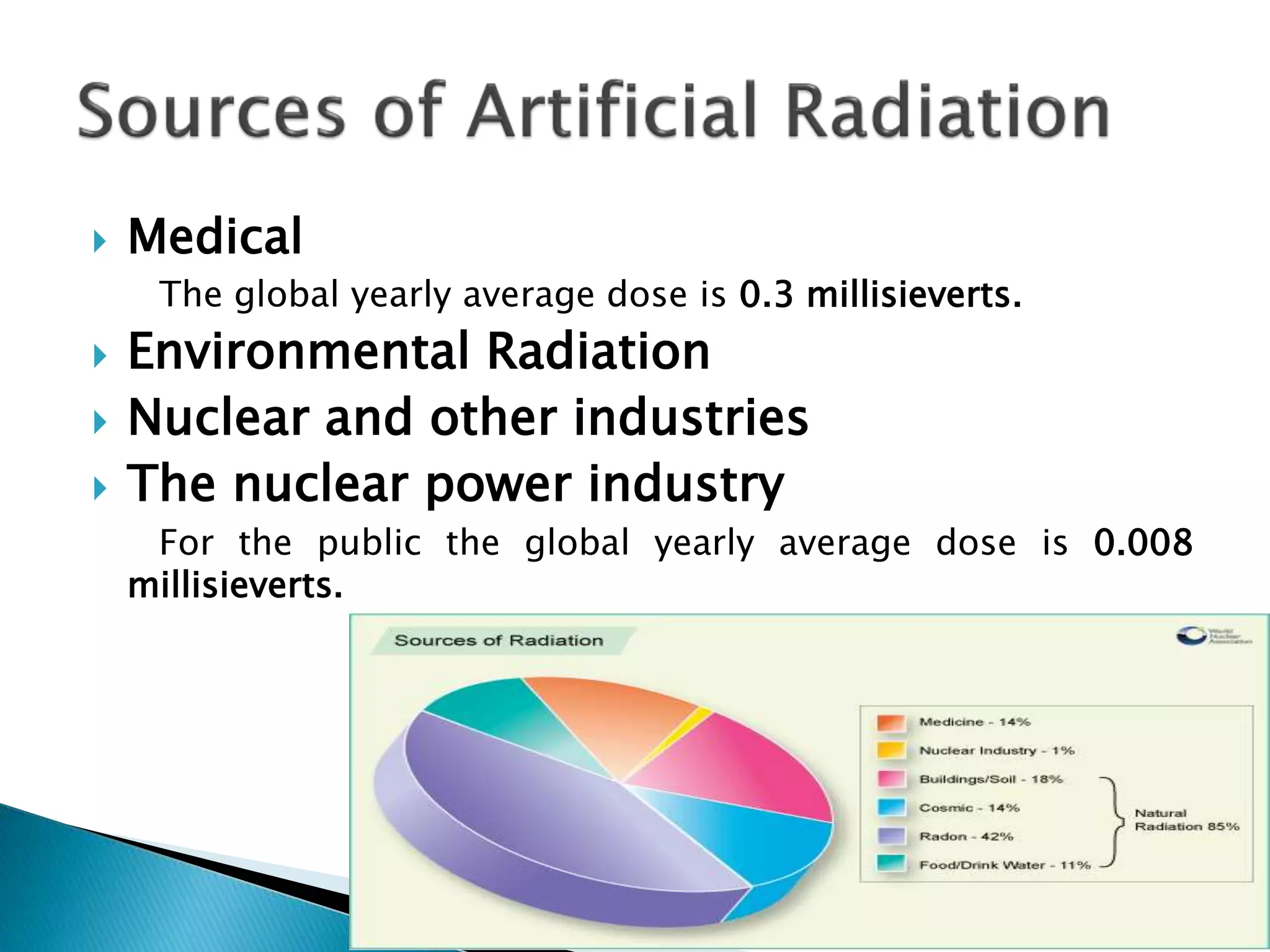
 Medical
The global yearly average dose is 0.3 millisieverts.
 Environmental Radiation
 Nuclear and other industries
 The nuclear power industry
For the public the global yearly average dose is 0.008
millisieverts.
Impurity
Impurity production,that is transmutation of nuclei into
other nuclei which themselves may be radioactive; this
mechanism is caused by neutrons through fission
andactivation (capture).Impurities can also be deposited from
the creation of hydrogen or helium when a proton or an alpha
particle, respectively, becomes neutralized in the material of
passage.
Ionization
That is, the removal of electrons from atoms in the material
and the formation of ion pairs in the path of the charged
particles.Large Energy Release in a small volume, which can
result in thermal heating of the material. This may be
especially important in those cases where the material is a
radiation shield.
Atom Displacement
Atom Displacement from their normal position in the
structure of the material displacement atoms may leave
lattice vacancies or cause interchange of dissimilar atoms in
the lattice structure.
Displacement damage is the result of nuclear interactions,
typically scattering, which cause lattice defects. Displacement
damage is due cumulative long-term non-ionizing damage
from the ionizing radiations.
Metals, Alloys, and Metal-to-Metal Bonds
The principal effect of radiation on metals and
alloys is the creation of lattice vacancies and
interstitial atoms in an otherwise perfect
crystal.This results in an overall dilation that
decreases the density of the material. Neutron
irradiation produces significant quantities of
helium and hydrogen in beryllium, with the
result that the metal decreases in density.
INAEA
According to The International Atomic Energy Agency
(INAEA), nuclear and radiation accident/ disaster is
defined as “An event that has led to significant
consequences to people, the environment or the facility.”
Whether accidental or planned.
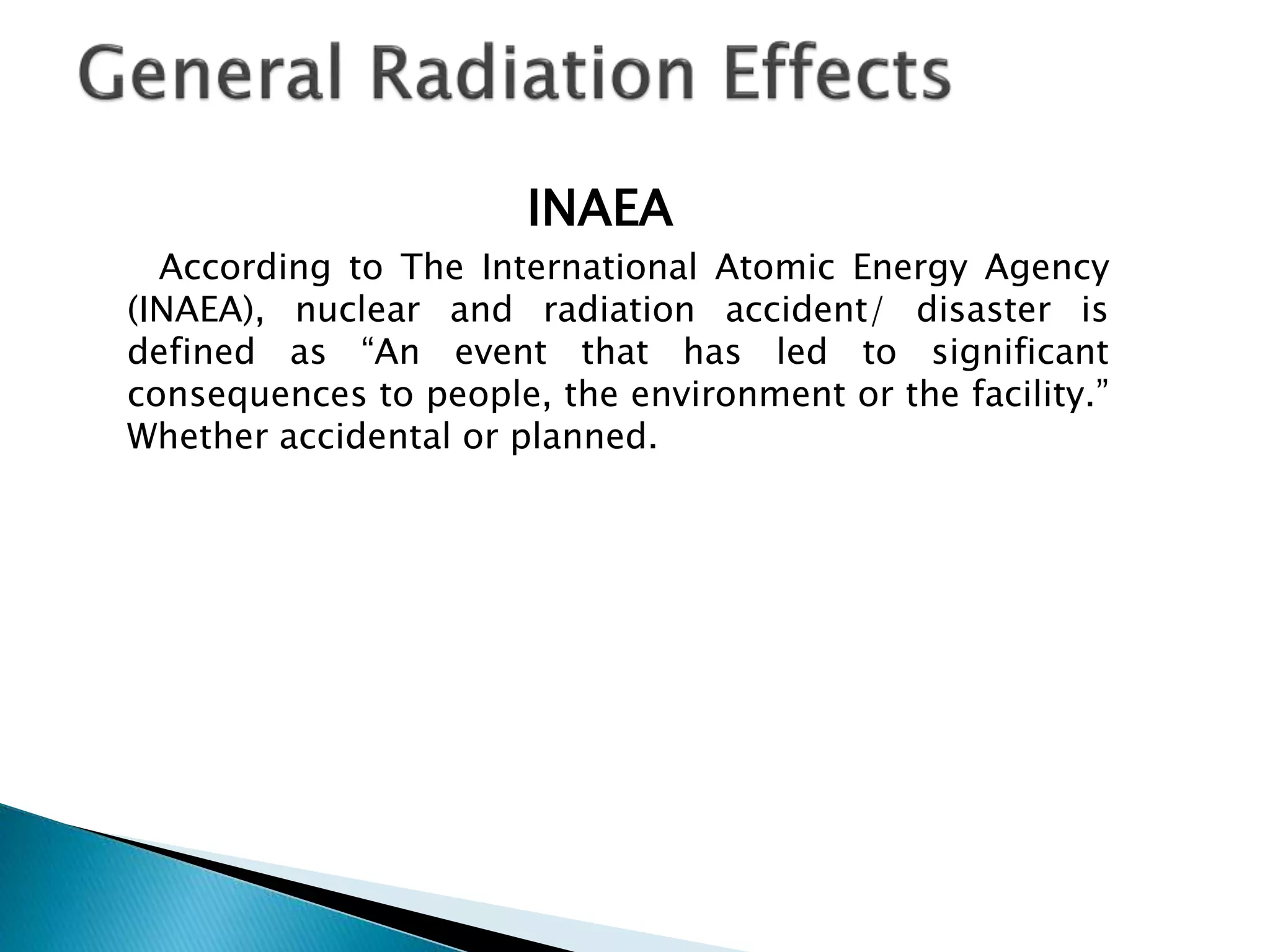
1-Atomic Bombings of Hiroshima and Nagasaki – World War II, 1945
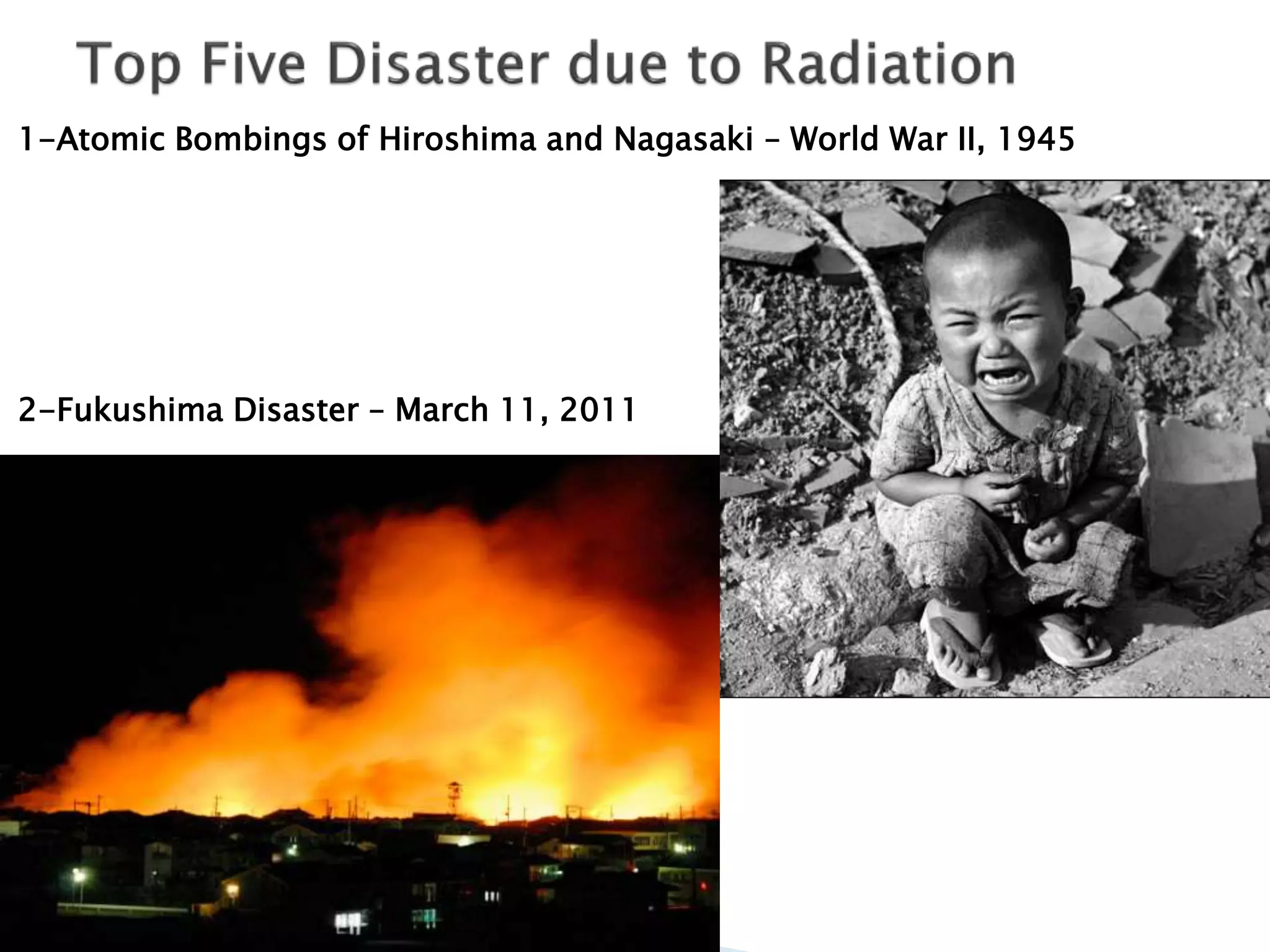
2-Fukushima Disaster – March 11, 2011
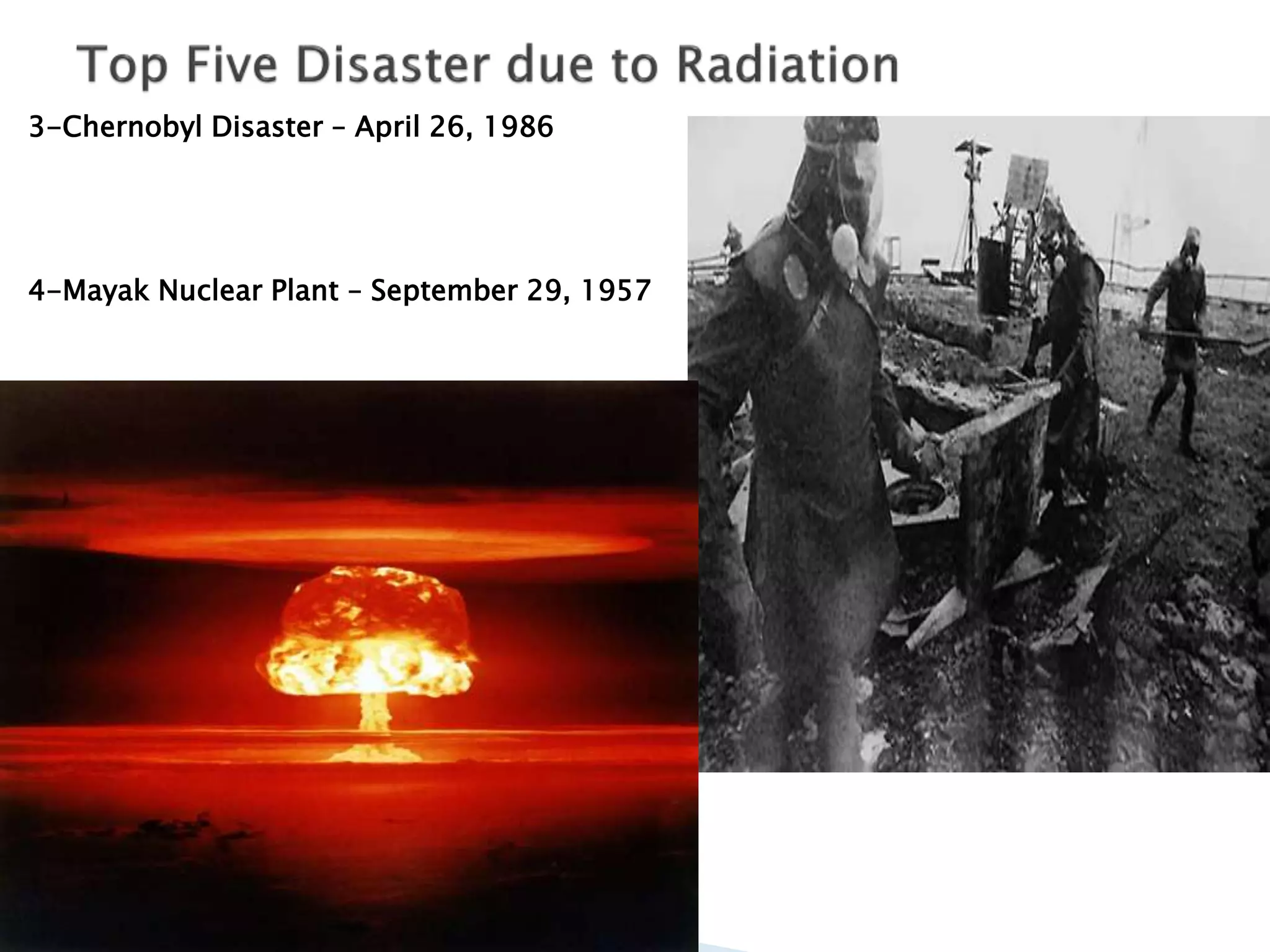
3-Chernobyl Disaster – April 26, 1986
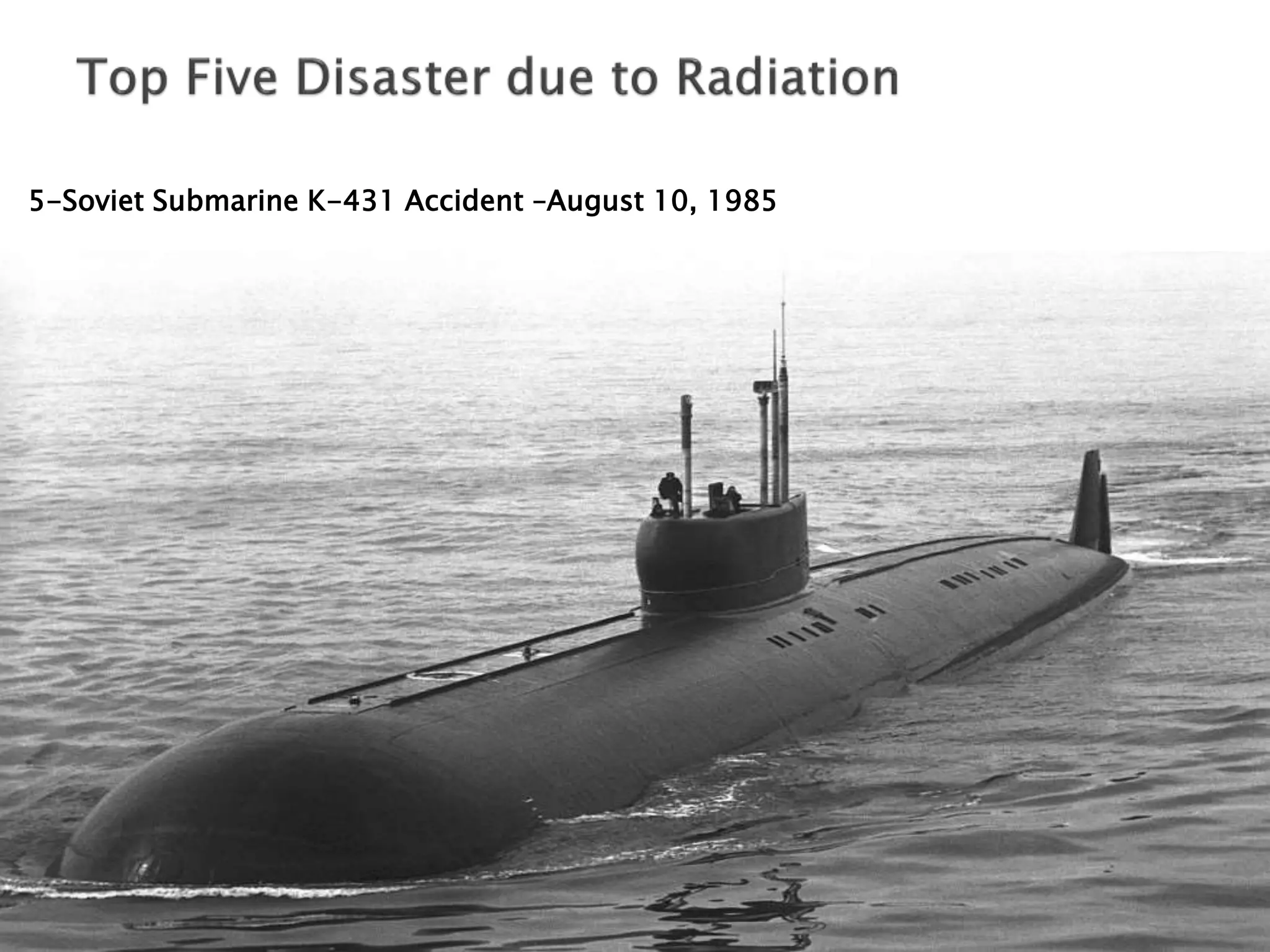
4-Mayak Nuclear Plant – September 29, 1957
5-Soviet Submarine K-431 Accident –August 10, 1985

Radiation hazards

  • 2.
  • 3.
    What is Radiation? Radiation is energy in the process of being transmitted, which may take such forms as light, or tiny particles much too small to see. Visible light, the ultra-violet light we receive from the sun and from sun-beds, and transmission signals for TV and radio communications are all forms of radiation that are common in our daily lives. Nuclear radiation arises from hundreds of different kinds of unstable atoms.While many exist in nature, the majority are created in nuclear reactions. Ionizing radiation which can damage living tissue is emitted as the unstable atoms (radionuclides) change ('decay') spontaneously to become different kinds of atoms.
  • 4.
     Alpha particlesRadiation  Beta particles Radiation  Gamma rays Radiation  X-Ray Radiation  Neutrons
  • 5.
     Cosmic radiation Theglobal yearly average dose is 0.39 millisieverts  Earth's Crust The global yearly average is 0.46 millisieverts.  Radon is a naturally radioactive gas that comes from the uranium that is widespread in the earth's crust. The global yearly average dose is 1.3 millisieverts.  Food and Drink The global yearly average dose of 0.23 millisieverts
  • 6.
     Medical The globalyearly average dose is 0.3 millisieverts.  Environmental Radiation  Nuclear and other industries  The nuclear power industry For the public the global yearly average dose is 0.008 millisieverts.
  • 7.
    Impurity Impurity production,that istransmutation of nuclei into other nuclei which themselves may be radioactive; this mechanism is caused by neutrons through fission andactivation (capture).Impurities can also be deposited from the creation of hydrogen or helium when a proton or an alpha particle, respectively, becomes neutralized in the material of passage. Ionization That is, the removal of electrons from atoms in the material and the formation of ion pairs in the path of the charged particles.Large Energy Release in a small volume, which can result in thermal heating of the material. This may be especially important in those cases where the material is a radiation shield.
  • 8.
    Atom Displacement Atom Displacementfrom their normal position in the structure of the material displacement atoms may leave lattice vacancies or cause interchange of dissimilar atoms in the lattice structure. Displacement damage is the result of nuclear interactions, typically scattering, which cause lattice defects. Displacement damage is due cumulative long-term non-ionizing damage from the ionizing radiations.
  • 9.
    Metals, Alloys, andMetal-to-Metal Bonds The principal effect of radiation on metals and alloys is the creation of lattice vacancies and interstitial atoms in an otherwise perfect crystal.This results in an overall dilation that decreases the density of the material. Neutron irradiation produces significant quantities of helium and hydrogen in beryllium, with the result that the metal decreases in density.
  • 10.
    INAEA According to TheInternational Atomic Energy Agency (INAEA), nuclear and radiation accident/ disaster is defined as “An event that has led to significant consequences to people, the environment or the facility.” Whether accidental or planned.
  • 11.
    1-Atomic Bombings ofHiroshima and Nagasaki – World War II, 1945 2-Fukushima Disaster – March 11, 2011
  • 12.
    3-Chernobyl Disaster –April 26, 1986 4-Mayak Nuclear Plant – September 29, 1957
  • 13.
    5-Soviet Submarine K-431Accident –August 10, 1985