Defects in crystals
4/5/2022 1
https://sites.google.com/site/ganeshbilla/
Imperfections in crystals
Crystalline imperfections can be classified
on the basis of their geometry as follows
4/5/2022 2
https://sites.google.com/site/ganeshbilla/
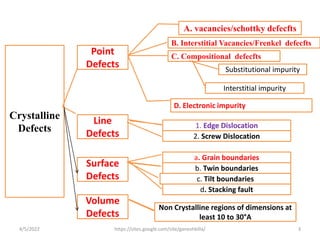
A. vacancies/schottky defecfts
B. Interstitial Vacancies/Frenkel defecfts
C. Compositional defecfts
Interstitial impurity
Substitutional impurity
D. Electronic impurity
Point
Defects
Line
Defects
Surface
Defects
Volume
Defects
1. Edge Dislocation
2. Screw Dislocation
a. Grain boundaries
b. Twin boundaries
c. Tilt boundaries
d. Stacking fault
Non Crystalline regions of dimensions at
least 10 to 30°A
Crystalline
Defects
4/5/2022 3
https://sites.google.com/site/ganeshbilla/
Point Defects
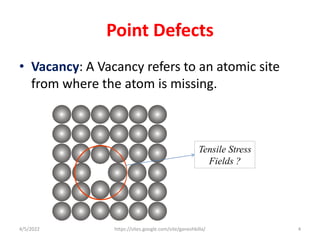
• Vacancy: A Vacancy refers to an atomic site
from where the atom is missing.
Tensile Stress
Fields ?
4/5/2022 4
https://sites.google.com/site/ganeshbilla/
Point Defects
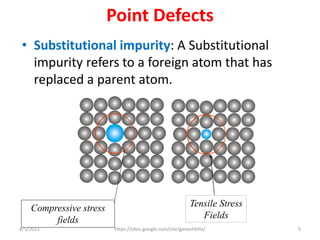
• Substitutional impurity: A Substitutional
impurity refers to a foreign atom that has
replaced a parent atom.
Tensile Stress
Fields
Compressive stress
fields
4/5/2022 5
https://sites.google.com/site/ganeshbilla/
Point Defects
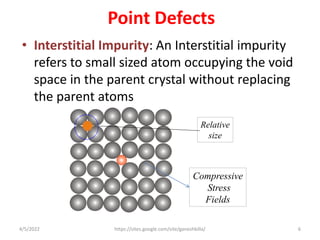
• Interstitial Impurity: An Interstitial impurity
refers to small sized atom occupying the void
space in the parent crystal without replacing
the parent atoms
Compressive
Stress
Fields
Relative
size
4/5/2022 6
https://sites.google.com/site/ganeshbilla/
Point Defects
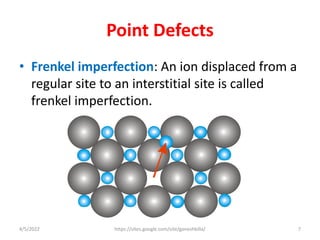
• Frenkel imperfection: An ion displaced from a
regular site to an interstitial site is called
frenkel imperfection.
4/5/2022 7
https://sites.google.com/site/ganeshbilla/
Point Defects
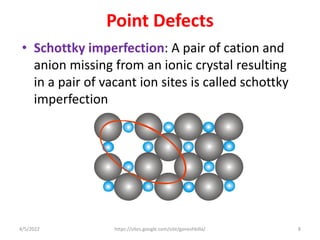
• Schottky imperfection: A pair of cation and
anion missing from an ionic crystal resulting
in a pair of vacant ion sites is called schottky
imperfection
4/5/2022 8
https://sites.google.com/site/ganeshbilla/
Point Defects
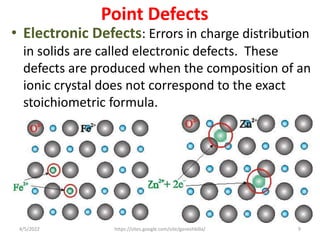
• Electronic Defects: Errors in charge distribution
in solids are called electronic defects. These
defects are produced when the composition of an
ionic crystal does not correspond to the exact
stoichiometric formula.
4/5/2022 9
https://sites.google.com/site/ganeshbilla/
Line Defects
Line defects are one dimensional imperfections
in the geometrical sense. Line imperfections
are called dislocations.
Edge dislocation
In perfect crystal atoms are arranged in both
vertical and horizontal planes parallel to the
side faces. If one of these planes does not
extend to the full length but ends in between
within the crystal it is called edge dislocation.
4/5/2022 10
https://sites.google.com/site/ganeshbilla/
Edge dislocation
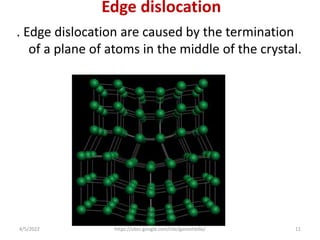
. Edge dislocation are caused by the termination
of a plane of atoms in the middle of the crystal.
4/5/2022 11
https://sites.google.com/site/ganeshbilla/
4/5/2022 12
https://sites.google.com/site/ganeshbilla/
Burger’s Vector
• The presence of dislocation results in lattice
strain (distortion). The direction and
magnitude of such distortion is expressed in
terms of a Burger’s vector.
Or
The magnitude and the direction of the
displacement are defined by a vector called
the burger vector.
4/5/2022 13
https://sites.google.com/site/ganeshbilla/
4
3 3
4
4
3 3
4
Above: Burger’s circuit for dislocation-free material.
To Right: Do same with dislocation and end up
“past” starting point.
Vector b = distance to get back to curcuit.
note “compressed bonds” and “elongated bonds.”
4/5/2022 14
https://sites.google.com/site/ganeshbilla/
• The Burgers vector(b) is perpendicular to the
edge dislocation line
• The Burgers vector(b) is parallel to the screw
dislocation line.
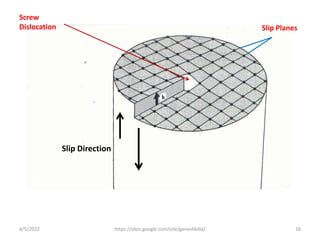
Screw Dislocation
Screw dislocation results from a displacement
of the atoms in one part of a crystal relative to
the rest of the crystal forming a spiral ramp
around the dislocation line.
4/5/2022 15
https://sites.google.com/site/ganeshbilla/
Screw
Dislocation Slip Planes
Slip Direction
4/5/2022 16
https://sites.google.com/site/ganeshbilla/
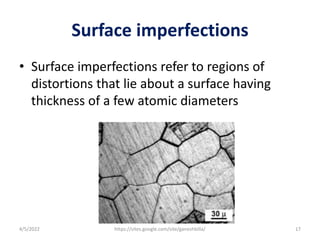
Surface imperfections
• Surface imperfections refer to regions of
distortions that lie about a surface having
thickness of a few atomic diameters
4/5/2022 17
https://sites.google.com/site/ganeshbilla/
Surface imperfections
• Grain Boundaries (or) Crystal Boundary
At the interface between two crystals
randomly oriented the atoms held in between
are attracted by crystals on either side and
depending on the forces the atoms occupy
equilibrium positions. This distorted region of
a few atomic diameter thickness is called grain
boundary.
4/5/2022 18
https://sites.google.com/site/ganeshbilla/
Surface imperfections
• The orientation difference is usually greater
than 10-15°. For this reason the grain
boundaries are also known as high angle
boundaries.
• When the orientation difference between two
crystals is less than 10° the distortion in the
boundary is not so drastic. They are called
low angle boundaries.
4/5/2022 19
https://sites.google.com/site/ganeshbilla/
Surface imperfections
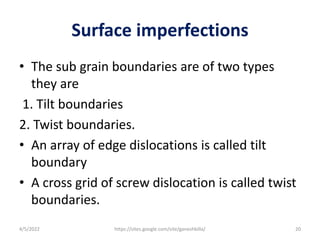
• The sub grain boundaries are of two types
they are
1. Tilt boundaries
2. Twist boundaries.
• An array of edge dislocations is called tilt
boundary
• A cross grid of screw dislocation is called twist
boundaries.
4/5/2022 20
https://sites.google.com/site/ganeshbilla/
4/5/2022 21
https://sites.google.com/site/ganeshbilla/
Tilt
boundaries
Twist
boundaries
Twin Boundaries
A twin boundary happens when
the crystals on either side of a
plane are mirror images of each
other. Two single crystal sections
are miss oriented but joined
together such that one plane is a
mirror image of the other. The
boundary common to the two
planes is a twin boundary. They
are formed during the growth of
crystal
The boundary between the
twinned crystals will be a single
plane of atoms.
4/5/2022 22
https://sites.google.com/site/ganeshbilla/
Stacking Faults
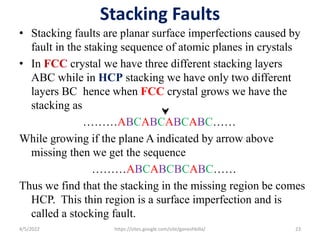
• Stacking faults are planar surface imperfections caused by
fault in the staking sequence of atomic planes in crystals
• In FCC crystal we have three different stacking layers
ABC while in HCP stacking we have only two different
layers BC hence when FCC crystal grows we have the
stacking as
………ABCABCABCABC……
While growing if the plane A indicated by arrow above
missing then we get the sequence
………ABCABCBCABC……
Thus we find that the stacking in the missing region be comes
HCP. This thin region is a surface imperfection and is
called a stocking fault.
4/5/2022 https://sites.google.com/site/ganeshbilla/ 23
Volume Defects
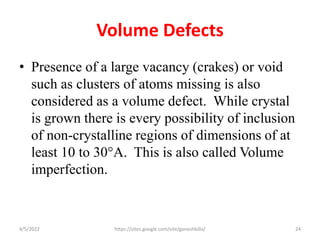
• Presence of a large vacancy (crakes) or void
such as clusters of atoms missing is also
considered as a volume defect. While crystal
is grown there is every possibility of inclusion
of non-crystalline regions of dimensions of at
least 10 to 30°A. This is also called Volume
imperfection.
4/5/2022 24
https://sites.google.com/site/ganeshbilla/
4/5/2022 25
https://sites.google.com/site/ganeshbilla/

Defects in crystals

  • 1.
    Defects in crystals 4/5/20221 https://sites.google.com/site/ganeshbilla/
  • 2.
    Imperfections in crystals Crystallineimperfections can be classified on the basis of their geometry as follows 4/5/2022 2 https://sites.google.com/site/ganeshbilla/
  • 3.
    A. vacancies/schottky defecfts B.Interstitial Vacancies/Frenkel defecfts C. Compositional defecfts Interstitial impurity Substitutional impurity D. Electronic impurity Point Defects Line Defects Surface Defects Volume Defects 1. Edge Dislocation 2. Screw Dislocation a. Grain boundaries b. Twin boundaries c. Tilt boundaries d. Stacking fault Non Crystalline regions of dimensions at least 10 to 30°A Crystalline Defects 4/5/2022 3 https://sites.google.com/site/ganeshbilla/
  • 4.
    Point Defects • Vacancy:A Vacancy refers to an atomic site from where the atom is missing. Tensile Stress Fields ? 4/5/2022 4 https://sites.google.com/site/ganeshbilla/
  • 5.
    Point Defects • Substitutionalimpurity: A Substitutional impurity refers to a foreign atom that has replaced a parent atom. Tensile Stress Fields Compressive stress fields 4/5/2022 5 https://sites.google.com/site/ganeshbilla/
  • 6.
    Point Defects • InterstitialImpurity: An Interstitial impurity refers to small sized atom occupying the void space in the parent crystal without replacing the parent atoms Compressive Stress Fields Relative size 4/5/2022 6 https://sites.google.com/site/ganeshbilla/
  • 7.
    Point Defects • Frenkelimperfection: An ion displaced from a regular site to an interstitial site is called frenkel imperfection. 4/5/2022 7 https://sites.google.com/site/ganeshbilla/
  • 8.
    Point Defects • Schottkyimperfection: A pair of cation and anion missing from an ionic crystal resulting in a pair of vacant ion sites is called schottky imperfection 4/5/2022 8 https://sites.google.com/site/ganeshbilla/
  • 9.
    Point Defects • ElectronicDefects: Errors in charge distribution in solids are called electronic defects. These defects are produced when the composition of an ionic crystal does not correspond to the exact stoichiometric formula. 4/5/2022 9 https://sites.google.com/site/ganeshbilla/
  • 10.
    Line Defects Line defectsare one dimensional imperfections in the geometrical sense. Line imperfections are called dislocations. Edge dislocation In perfect crystal atoms are arranged in both vertical and horizontal planes parallel to the side faces. If one of these planes does not extend to the full length but ends in between within the crystal it is called edge dislocation. 4/5/2022 10 https://sites.google.com/site/ganeshbilla/
  • 11.
    Edge dislocation . Edgedislocation are caused by the termination of a plane of atoms in the middle of the crystal. 4/5/2022 11 https://sites.google.com/site/ganeshbilla/
  • 12.
  • 13.
    Burger’s Vector • Thepresence of dislocation results in lattice strain (distortion). The direction and magnitude of such distortion is expressed in terms of a Burger’s vector. Or The magnitude and the direction of the displacement are defined by a vector called the burger vector. 4/5/2022 13 https://sites.google.com/site/ganeshbilla/
  • 14.
    4 3 3 4 4 3 3 4 Above:Burger’s circuit for dislocation-free material. To Right: Do same with dislocation and end up “past” starting point. Vector b = distance to get back to curcuit. note “compressed bonds” and “elongated bonds.” 4/5/2022 14 https://sites.google.com/site/ganeshbilla/
  • 15.
    • The Burgersvector(b) is perpendicular to the edge dislocation line • The Burgers vector(b) is parallel to the screw dislocation line. Screw Dislocation Screw dislocation results from a displacement of the atoms in one part of a crystal relative to the rest of the crystal forming a spiral ramp around the dislocation line. 4/5/2022 15 https://sites.google.com/site/ganeshbilla/
  • 16.
    Screw Dislocation Slip Planes SlipDirection 4/5/2022 16 https://sites.google.com/site/ganeshbilla/
  • 17.
    Surface imperfections • Surfaceimperfections refer to regions of distortions that lie about a surface having thickness of a few atomic diameters 4/5/2022 17 https://sites.google.com/site/ganeshbilla/
  • 18.
    Surface imperfections • GrainBoundaries (or) Crystal Boundary At the interface between two crystals randomly oriented the atoms held in between are attracted by crystals on either side and depending on the forces the atoms occupy equilibrium positions. This distorted region of a few atomic diameter thickness is called grain boundary. 4/5/2022 18 https://sites.google.com/site/ganeshbilla/
  • 19.
    Surface imperfections • Theorientation difference is usually greater than 10-15°. For this reason the grain boundaries are also known as high angle boundaries. • When the orientation difference between two crystals is less than 10° the distortion in the boundary is not so drastic. They are called low angle boundaries. 4/5/2022 19 https://sites.google.com/site/ganeshbilla/
  • 20.
    Surface imperfections • Thesub grain boundaries are of two types they are 1. Tilt boundaries 2. Twist boundaries. • An array of edge dislocations is called tilt boundary • A cross grid of screw dislocation is called twist boundaries. 4/5/2022 20 https://sites.google.com/site/ganeshbilla/
  • 21.
  • 22.
    Twin Boundaries A twinboundary happens when the crystals on either side of a plane are mirror images of each other. Two single crystal sections are miss oriented but joined together such that one plane is a mirror image of the other. The boundary common to the two planes is a twin boundary. They are formed during the growth of crystal The boundary between the twinned crystals will be a single plane of atoms. 4/5/2022 22 https://sites.google.com/site/ganeshbilla/
  • 23.
    Stacking Faults • Stackingfaults are planar surface imperfections caused by fault in the staking sequence of atomic planes in crystals • In FCC crystal we have three different stacking layers ABC while in HCP stacking we have only two different layers BC hence when FCC crystal grows we have the stacking as ………ABCABCABCABC…… While growing if the plane A indicated by arrow above missing then we get the sequence ………ABCABCBCABC…… Thus we find that the stacking in the missing region be comes HCP. This thin region is a surface imperfection and is called a stocking fault. 4/5/2022 https://sites.google.com/site/ganeshbilla/ 23
  • 24.
    Volume Defects • Presenceof a large vacancy (crakes) or void such as clusters of atoms missing is also considered as a volume defect. While crystal is grown there is every possibility of inclusion of non-crystalline regions of dimensions of at least 10 to 30°A. This is also called Volume imperfection. 4/5/2022 24 https://sites.google.com/site/ganeshbilla/
  • 25.