CRYSTAL DEFECTS
-MR. BIPIN KUMAR MISHRA
ASST. PROF. DEPTT. OF MECH. ENGG.,
GGSCMT, KHARAR(MOHALI)-140301
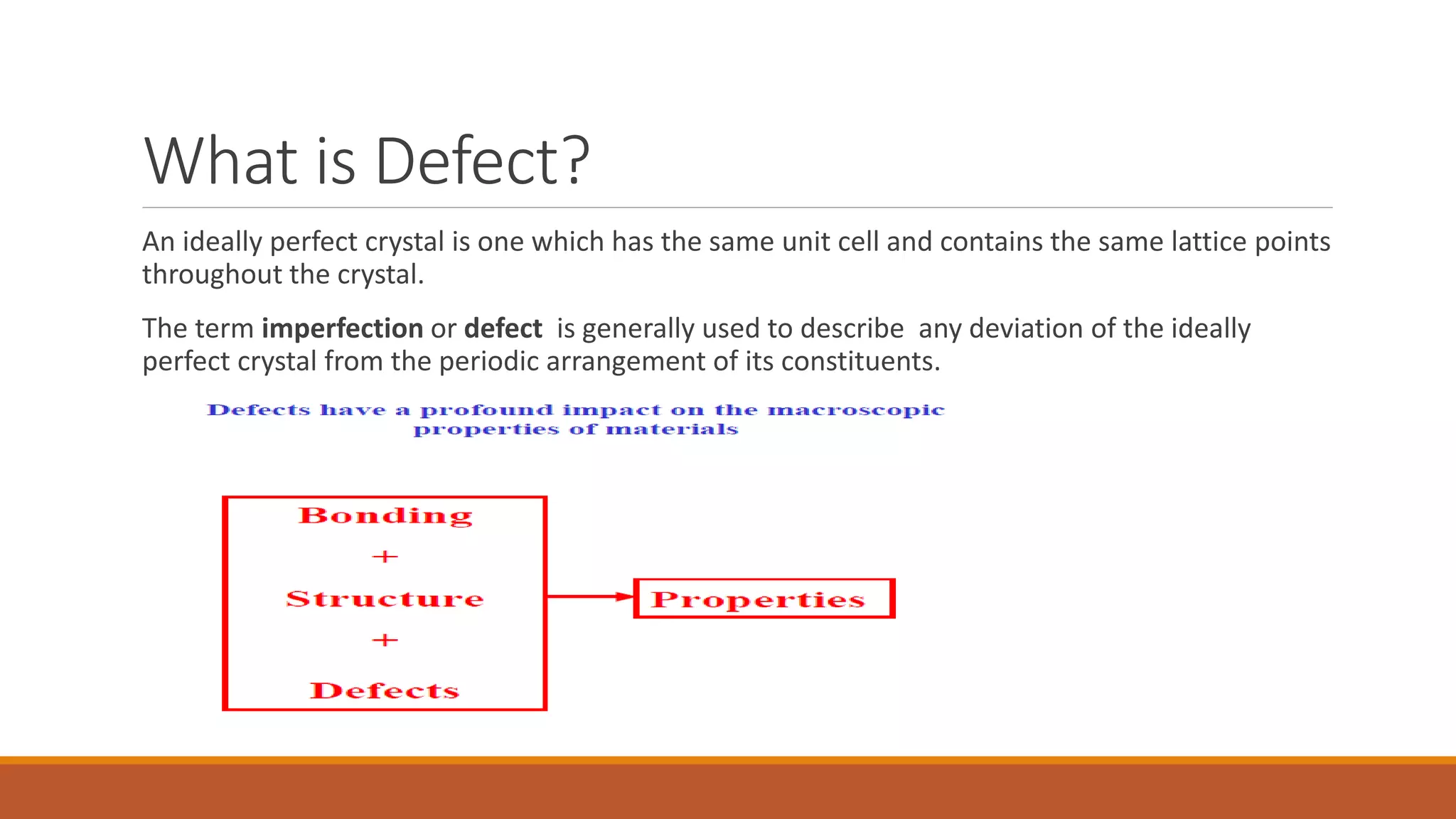
What is Defect?
An ideally perfect crystal is one which has the same unit cell and contains the same lattice points
throughout the crystal.
The term imperfection or defect is generally used to describe any deviation of the ideally
perfect crystal from the periodic arrangement of its constituents.
Types of defects in solids
It is broadly categorised into following :
1) Point defect
2) Line defect
3) Surface defect
4) Volume defect
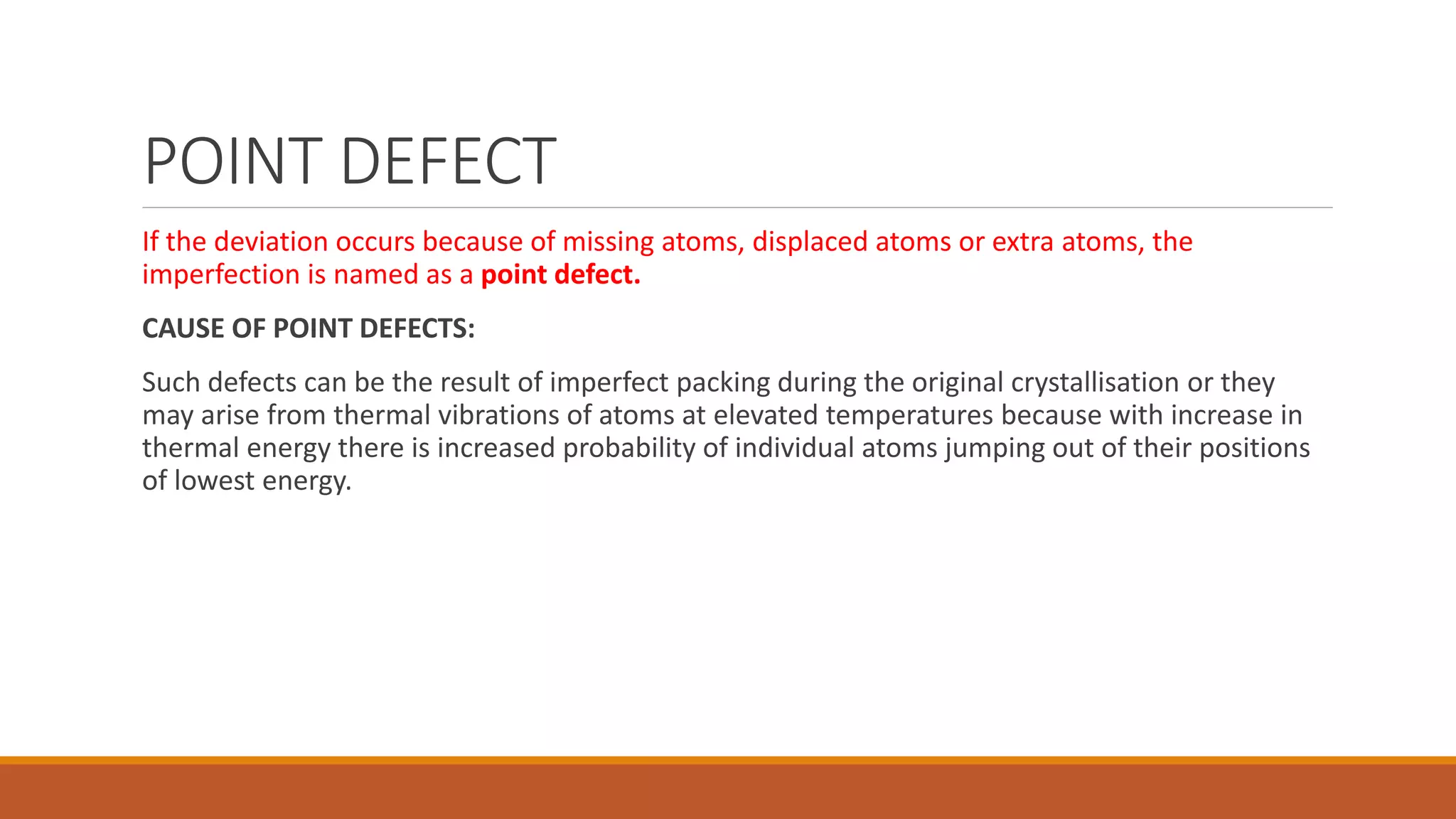
POINT DEFECT
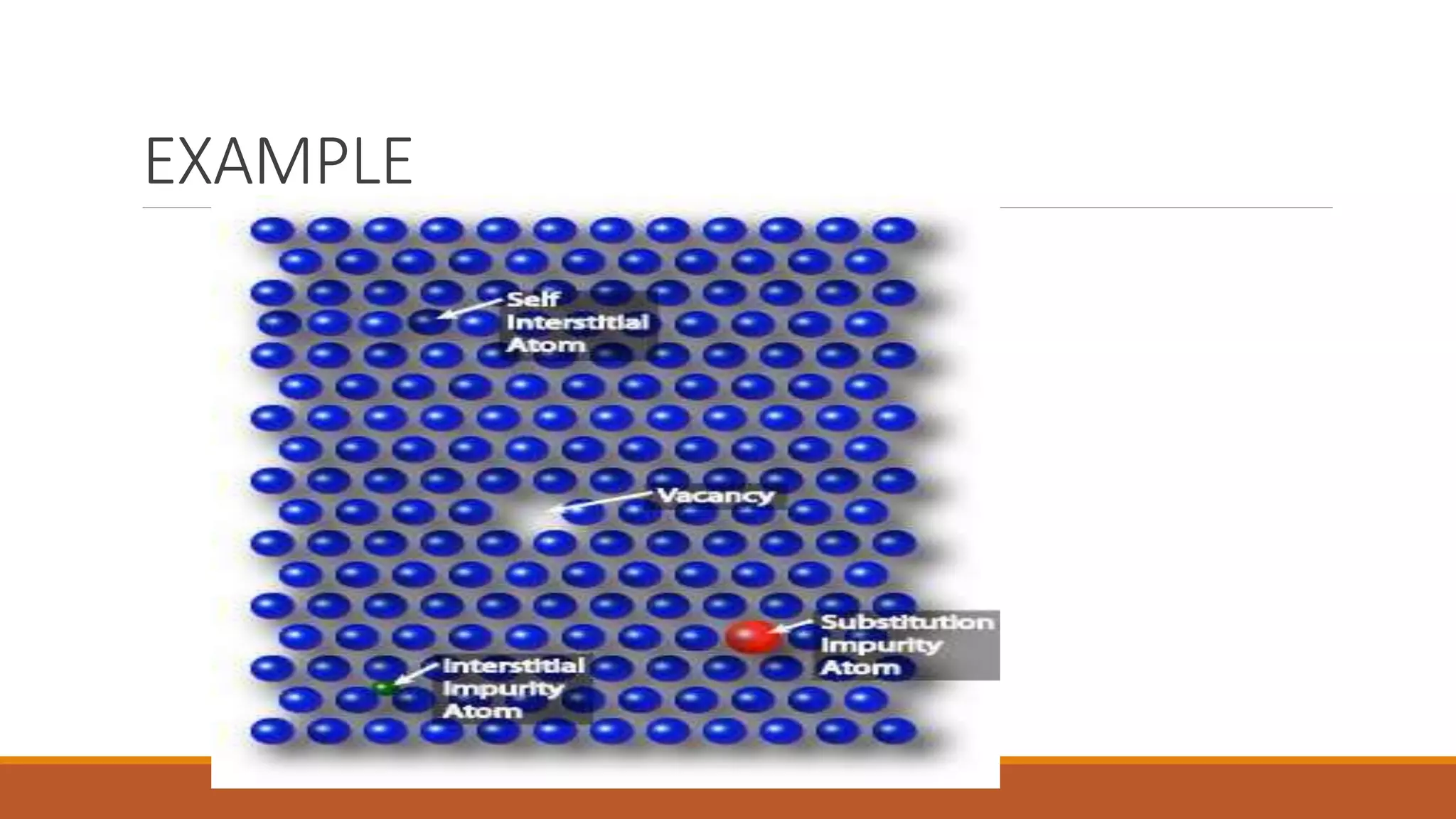
If the deviation occurs because of missing atoms, displaced atoms or extra atoms, the
imperfection is named as a point defect.
CAUSE OF POINT DEFECTS:
Such defects can be the result of imperfect packing during the original crystallisation or they
may arise from thermal vibrations of atoms at elevated temperatures because with increase in
thermal energy there is increased probability of individual atoms jumping out of their positions
of lowest energy.
EXAMPLE
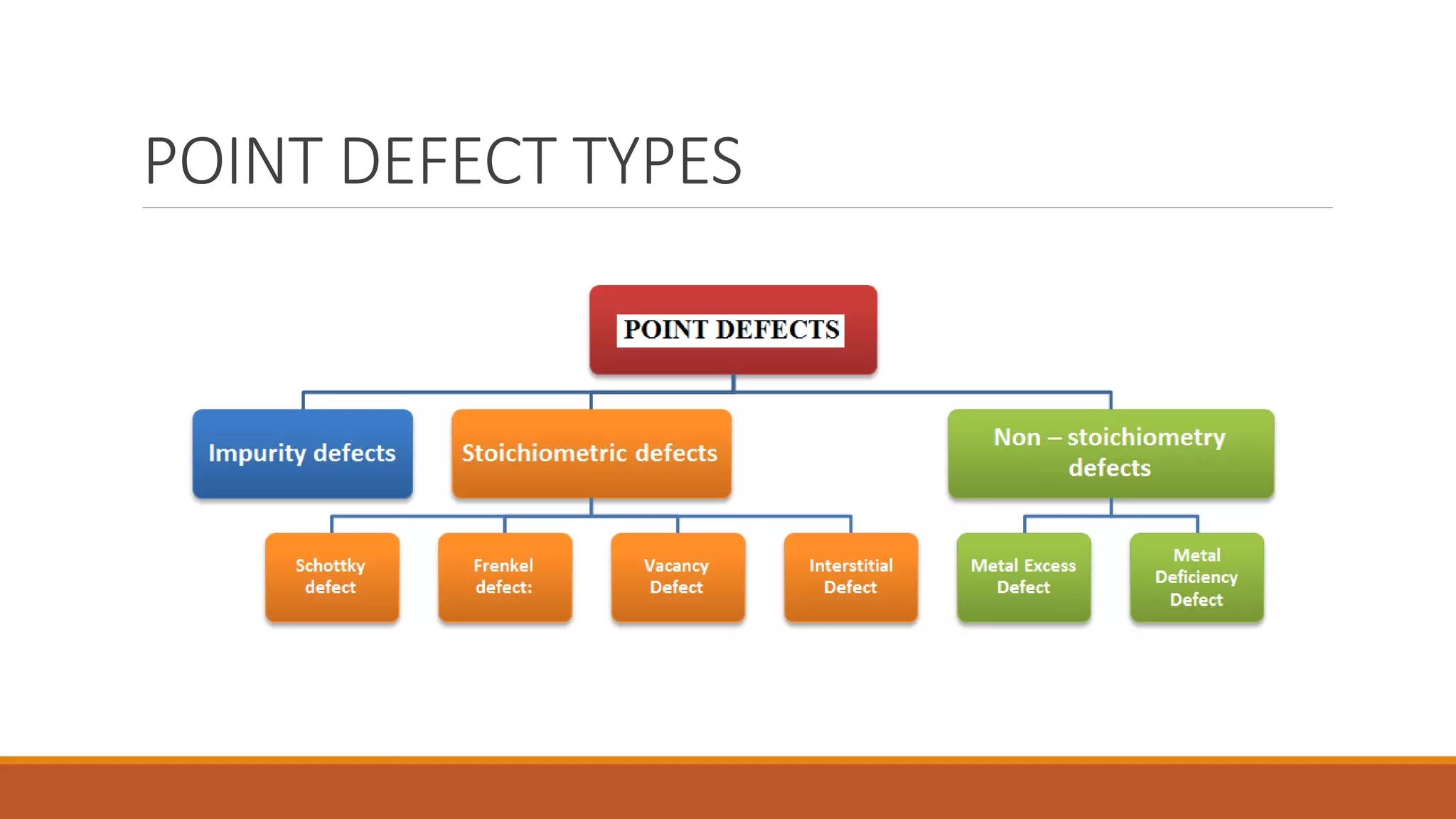
POINT DEFECT TYPES
IMPURITY DEFECTS
These defects are arises when foreign atoms are present at the lattice site in place of the
host atom. Or it is present at the vacant interstitial site example n – type semi conductor, p
– type semi conductor.
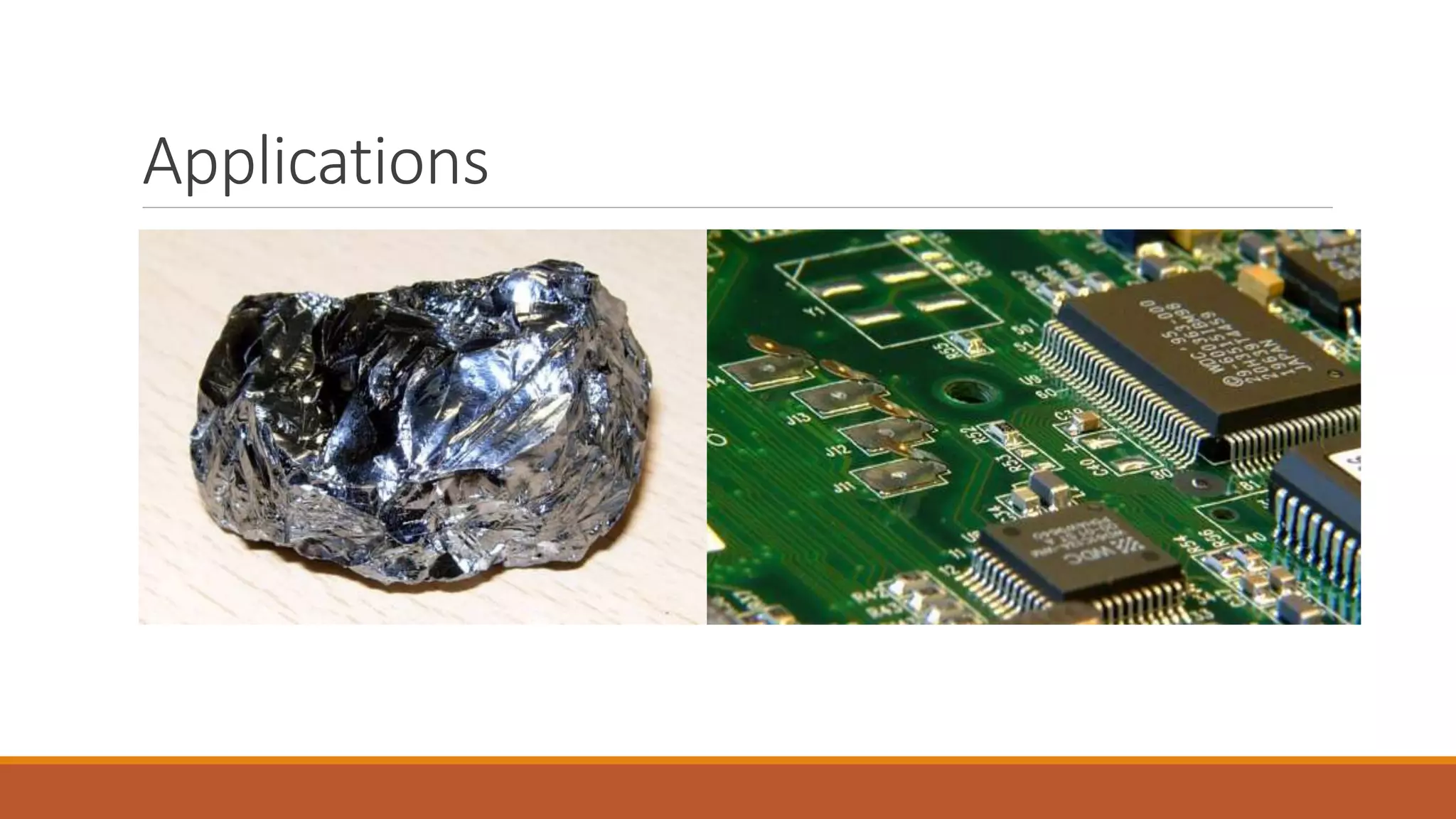
The process of adding impurities to the crystalline is called as doping.
Applications
STOICHIOMETRIC DEFECTS
The compounds in which the number of cation and anions are
exactly in the same ratio as represented by their chemical
formula are called stoichiometric compounds. The defects that
do not disturb the ratio of cations and anions are called
stoichiometric defect.
Types of stoichiometric defects
1) Frenkel Defect
2) Schottky defect
3) Vacancy Defect
4) Interstitial Defect
VACANCY DEFECT
1) When some of the lattice sites are vacant, the crystal is said to
have vacancy defect .
2) This results in decrease in density of the substance.
3) This defect can also develop when a substance is heated.
INTERSTITIAL DEFECT
1) When some constituent particles (atoms or molecules)
occupy an interstitial site, the crystal is said to have interstitial
defect
2) This defect increases the density of the substance.
Example
FRENKEL DEFECT
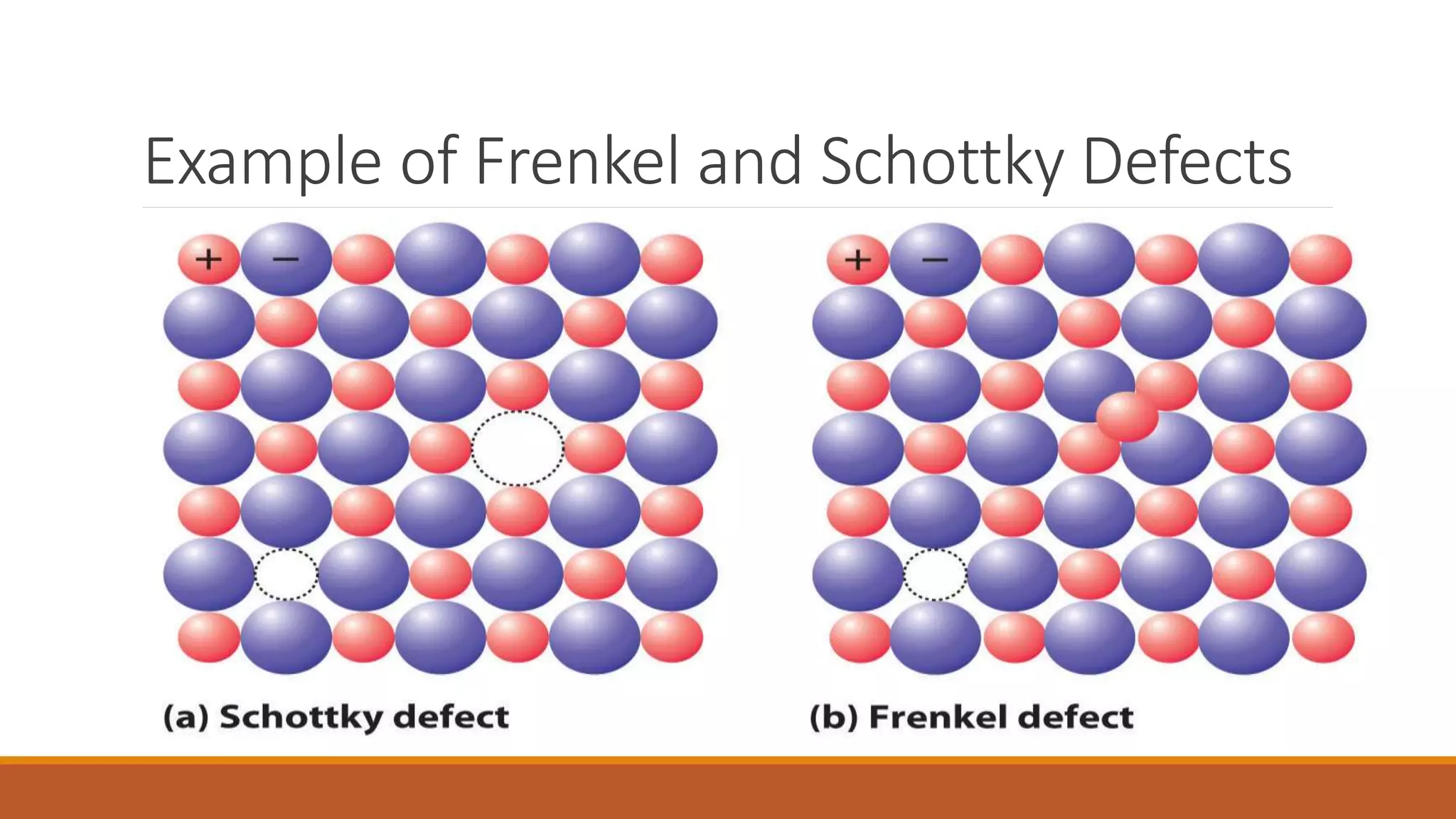
If an ion is missing from its correct lattice sites (causing a vacancy or a hole) and occupies an
interstitial site, electrical neutrality as well as stoichiometry of the compounds are maintained
This type of defect is called Frenkel defect.
Since cations are usually smaller, it is more common to find the cations occupying interstitial
sites.
This type of defect is present in ionic compounds which have:
i) Low co ordinations number
ii) Larger difference in size of cation and anions
iii) Compounds having highly polarising cation and easily polarisable anion. A few examples of
ionic compounds exhibiting this defect are AgCl, AgBr, AgI, ZnS etc.
SCHOTTKY DEFECT
If in an ionic crystal of the type A+ B-, equal number of cations and
anions are missing from their lattice. It is called Schottky defect.
This type of defect is shown by highly ionic compounds which have:
i) High Co – ordination number and
ii) Small difference in the sizes of cations and anions
A few examples of ionic compounds exhibiting Schottky defect are
NaCl, KCl, KBr and CsCl.
AgBr shows both type of defect.
Example of Frenkel and Schottky Defects
NON – STOICHIOMETRIC DEFECTS
If as a result of imperfection, the ratio of number of cation to
anion becomes different from that indicated by the ideal
chemical formula, the defects are called non – stoichiometric
defects.
These defects arise either due to excess of metal atoms or non
metal atom or presence of impurities / foreign particle.
Types
i) Metal Excess Defects (The Colour Centres)
ii)Metal Deficiency defects
METAL EXCESS DEFECTS
A negative ion may be missing from its lattice site, leaving a hole which is occupied by an
electron, there by maintain the electrical neutrality.
The interstitial sites containing the electron thus trapped in the anion vacancies are called
the F – centres. This name comes from the German word Farbenzentes meaning colour.
They are responsible for imparting colour to the crystals.
Example:- When NaCl is heated in an atmosphere of Na vapours. The excess of Na
atoms deposition the surface of NaCl crystal Cl- ions then diffuse to the surface where the
combine with Na+ ions which becomes due to losing electrons.
These electrons loses by Na atom are diffuse back into the crystal and occupy the vacant
site created by Cl- ions and imparts Yellow colour to NaCl crystal.
Example
Metal Deficiency Defect
In certain cases, one of the positive ions is missing from its lattice site and the extra negative
charge is balanced by some nearby metal ion acquiring two charges instead of one.
There is evidently, a deficiency of the metal ions although the crystal as a whole is neutral. This
type of defect is generally found amongst the compounds of transition metals which can exhibit
variable valency.
Crystals of FeO, FeS and NiO show this type of defects.
Example
LINE DEFFECT
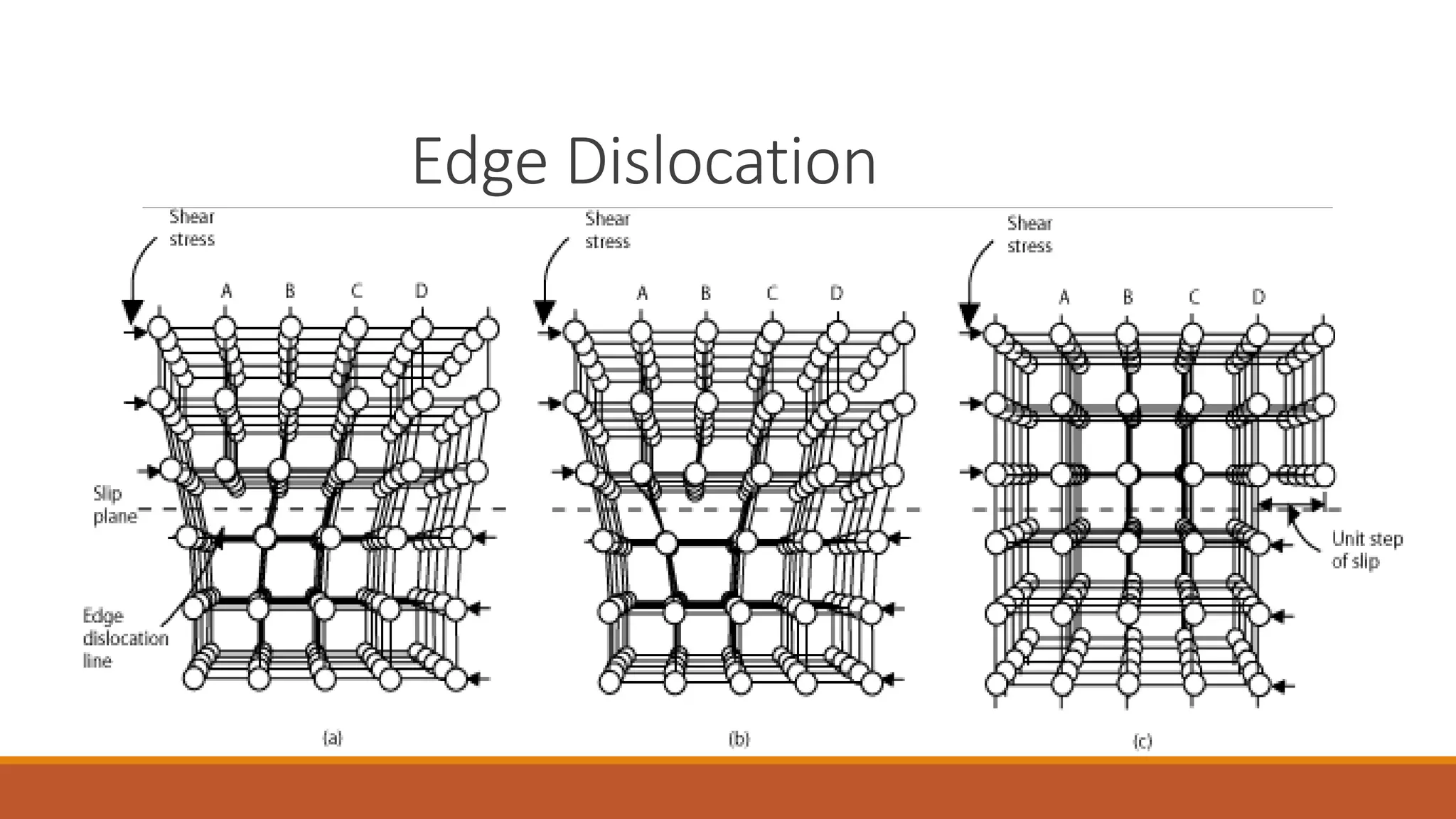
When the deviation from the perfect arrangement is present in the entire row of lattice points,
then the defect is known as line defect. These are commonly called as dislocation.
This can be further divided into two types:
1) Edge dislocation
2) Screw dislocation.
Edge Dislocation
Burger Vector
....
Screw Dislocation
...
Surface or Planer Defects
Surface imperfections arise from a change in the
stacking of atomic planes on or across a boundary.
The change may be one of the orientations or of the
stacking sequence of atomic planes.
In geometric concept, surface imperfections are
two- dimensional. They are of two types external
and internal surface imperfections.
Types of Surface defects
1) External defect
2) Internal defects:-Internal surface imperfections are the imperfections which occurred inside a
crystal. It is caused by the defects such as, grain boundaries. tilt boundaries, twin boundaries and
stacking faults.
It is of following types:
A) Grain boundary defect
B) Twin boundary defect
D) Stacking faults
External surface defect
The exterior dimensions of the material
represent surfaces at which the lattice abruptly
ends. Each atom at the surface no longer has
the proper coordination number and atomic
bonding is disrupted. The exterior surface may
also be very rough, may contain tiny notches,
and may be much more reactive than the bulk
of the material.
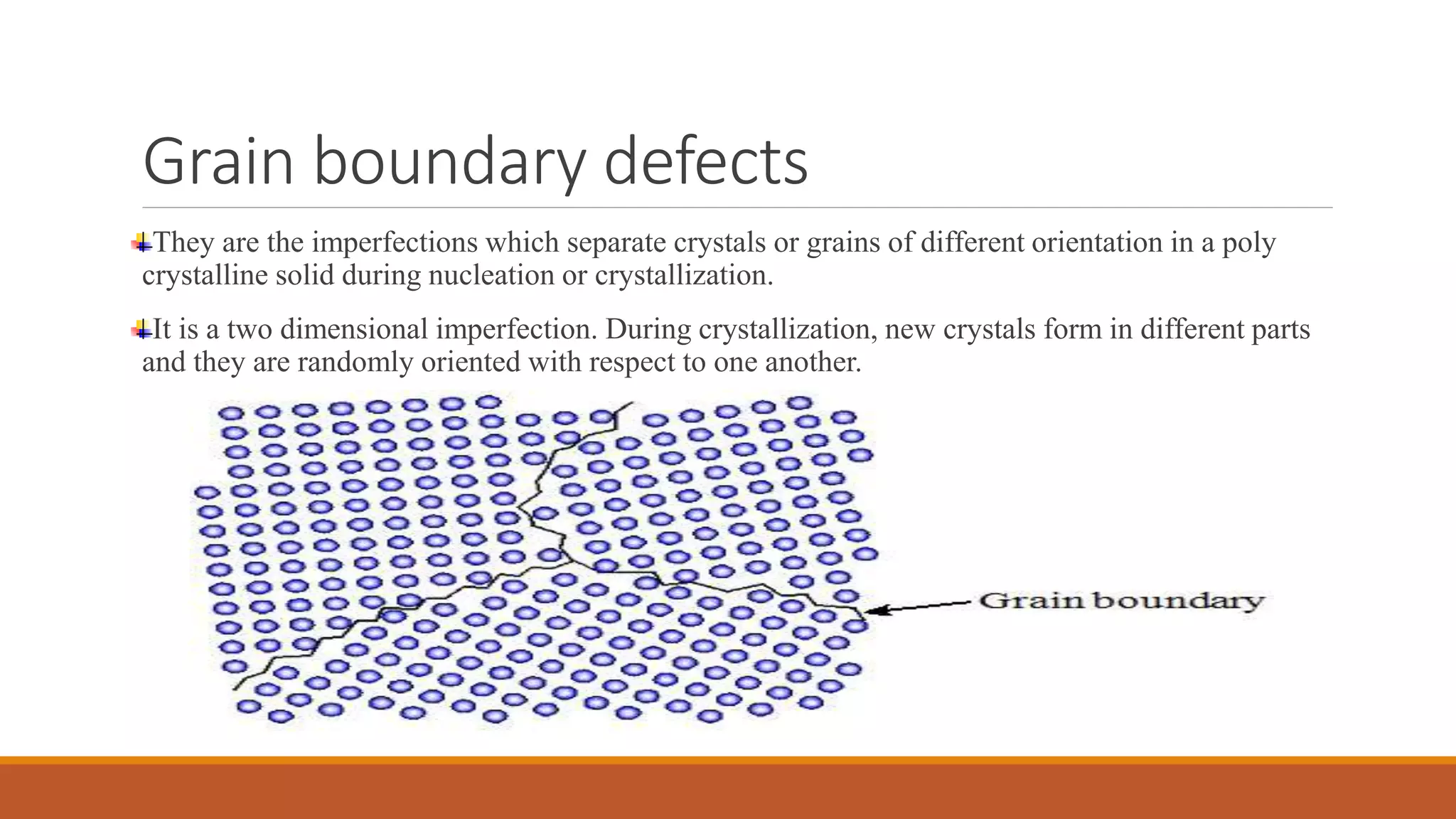
Grain boundary defects
They are the imperfections which separate crystals or grains of different orientation in a poly
crystalline solid during nucleation or crystallization.
It is a two dimensional imperfection. During crystallization, new crystals form in different parts
and they are randomly oriented with respect to one another.
Twin boundary defect
If the atomic arrangement on one side of a boundary is a mirror reflection of the arrangement on
the other side, then it is called as twin boundary.
As they occur in pair, they are called twin boundaries. At one boundary, orientation of atomic
arrangement changes.
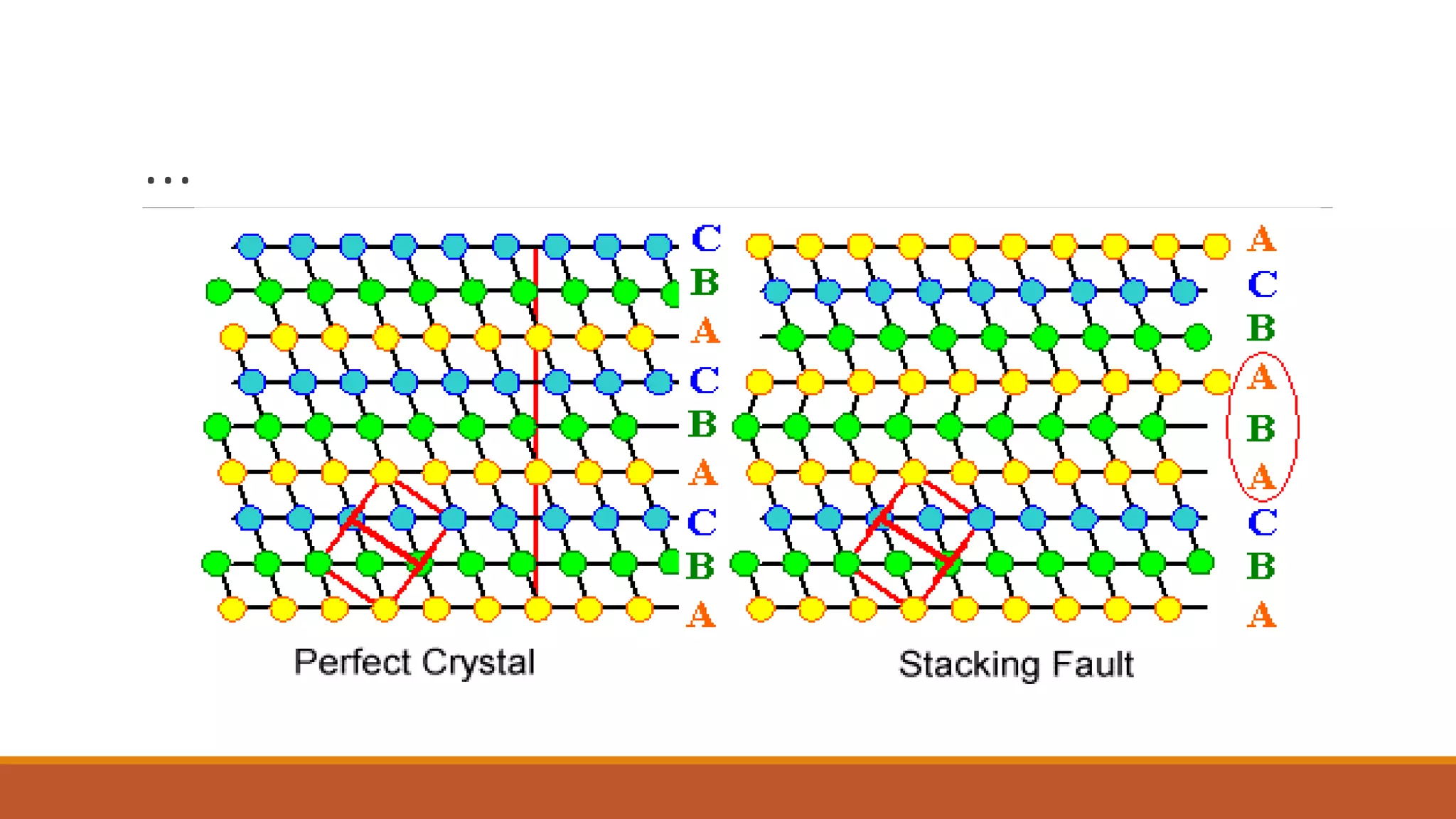
Stacking Faults
Whenever the stacking of atomic planes is not in a proper sequence throughout the crystal, the
fault caused is known as stacking fault.
For example, the stacking sequence in an ideal FCC crystal may be described as A-B-C-A-B-C-
A-B-C-……. But the stacking fault may change the sequence to A-B-C-A-B-A-B-A-B-C. The
region in which the stacking fault occurs (A-B-A-B) forms a thin region and it becomes HCP.
This thin region is a surface imperfection and is called a stacking fault.
...

Crystal defects

  • 1.
    CRYSTAL DEFECTS -MR. BIPINKUMAR MISHRA ASST. PROF. DEPTT. OF MECH. ENGG., GGSCMT, KHARAR(MOHALI)-140301
  • 2.
    What is Defect? Anideally perfect crystal is one which has the same unit cell and contains the same lattice points throughout the crystal. The term imperfection or defect is generally used to describe any deviation of the ideally perfect crystal from the periodic arrangement of its constituents.
  • 3.
    Types of defectsin solids It is broadly categorised into following : 1) Point defect 2) Line defect 3) Surface defect 4) Volume defect
  • 4.
    POINT DEFECT If thedeviation occurs because of missing atoms, displaced atoms or extra atoms, the imperfection is named as a point defect. CAUSE OF POINT DEFECTS: Such defects can be the result of imperfect packing during the original crystallisation or they may arise from thermal vibrations of atoms at elevated temperatures because with increase in thermal energy there is increased probability of individual atoms jumping out of their positions of lowest energy.
  • 5.
  • 6.
  • 7.
    IMPURITY DEFECTS These defectsare arises when foreign atoms are present at the lattice site in place of the host atom. Or it is present at the vacant interstitial site example n – type semi conductor, p – type semi conductor. The process of adding impurities to the crystalline is called as doping.
  • 8.
  • 9.
    STOICHIOMETRIC DEFECTS The compoundsin which the number of cation and anions are exactly in the same ratio as represented by their chemical formula are called stoichiometric compounds. The defects that do not disturb the ratio of cations and anions are called stoichiometric defect.
  • 10.
    Types of stoichiometricdefects 1) Frenkel Defect 2) Schottky defect 3) Vacancy Defect 4) Interstitial Defect
  • 11.
    VACANCY DEFECT 1) Whensome of the lattice sites are vacant, the crystal is said to have vacancy defect . 2) This results in decrease in density of the substance. 3) This defect can also develop when a substance is heated.
  • 12.
    INTERSTITIAL DEFECT 1) Whensome constituent particles (atoms or molecules) occupy an interstitial site, the crystal is said to have interstitial defect 2) This defect increases the density of the substance.
  • 13.
  • 14.
    FRENKEL DEFECT If anion is missing from its correct lattice sites (causing a vacancy or a hole) and occupies an interstitial site, electrical neutrality as well as stoichiometry of the compounds are maintained This type of defect is called Frenkel defect. Since cations are usually smaller, it is more common to find the cations occupying interstitial sites. This type of defect is present in ionic compounds which have: i) Low co ordinations number ii) Larger difference in size of cation and anions iii) Compounds having highly polarising cation and easily polarisable anion. A few examples of ionic compounds exhibiting this defect are AgCl, AgBr, AgI, ZnS etc.
  • 15.
    SCHOTTKY DEFECT If inan ionic crystal of the type A+ B-, equal number of cations and anions are missing from their lattice. It is called Schottky defect. This type of defect is shown by highly ionic compounds which have: i) High Co – ordination number and ii) Small difference in the sizes of cations and anions A few examples of ionic compounds exhibiting Schottky defect are NaCl, KCl, KBr and CsCl. AgBr shows both type of defect.
  • 16.
    Example of Frenkeland Schottky Defects
  • 17.
    NON – STOICHIOMETRICDEFECTS If as a result of imperfection, the ratio of number of cation to anion becomes different from that indicated by the ideal chemical formula, the defects are called non – stoichiometric defects. These defects arise either due to excess of metal atoms or non metal atom or presence of impurities / foreign particle.
  • 18.
    Types i) Metal ExcessDefects (The Colour Centres) ii)Metal Deficiency defects
  • 19.
    METAL EXCESS DEFECTS Anegative ion may be missing from its lattice site, leaving a hole which is occupied by an electron, there by maintain the electrical neutrality. The interstitial sites containing the electron thus trapped in the anion vacancies are called the F – centres. This name comes from the German word Farbenzentes meaning colour. They are responsible for imparting colour to the crystals. Example:- When NaCl is heated in an atmosphere of Na vapours. The excess of Na atoms deposition the surface of NaCl crystal Cl- ions then diffuse to the surface where the combine with Na+ ions which becomes due to losing electrons. These electrons loses by Na atom are diffuse back into the crystal and occupy the vacant site created by Cl- ions and imparts Yellow colour to NaCl crystal.
  • 20.
  • 21.
    Metal Deficiency Defect Incertain cases, one of the positive ions is missing from its lattice site and the extra negative charge is balanced by some nearby metal ion acquiring two charges instead of one. There is evidently, a deficiency of the metal ions although the crystal as a whole is neutral. This type of defect is generally found amongst the compounds of transition metals which can exhibit variable valency. Crystals of FeO, FeS and NiO show this type of defects.
  • 22.
  • 23.
    LINE DEFFECT When thedeviation from the perfect arrangement is present in the entire row of lattice points, then the defect is known as line defect. These are commonly called as dislocation. This can be further divided into two types: 1) Edge dislocation 2) Screw dislocation.
  • 24.
  • 25.
  • 26.
  • 27.
  • 28.
  • 29.
    Surface or PlanerDefects Surface imperfections arise from a change in the stacking of atomic planes on or across a boundary. The change may be one of the orientations or of the stacking sequence of atomic planes. In geometric concept, surface imperfections are two- dimensional. They are of two types external and internal surface imperfections.
  • 30.
    Types of Surfacedefects 1) External defect 2) Internal defects:-Internal surface imperfections are the imperfections which occurred inside a crystal. It is caused by the defects such as, grain boundaries. tilt boundaries, twin boundaries and stacking faults. It is of following types: A) Grain boundary defect B) Twin boundary defect D) Stacking faults
  • 31.
    External surface defect Theexterior dimensions of the material represent surfaces at which the lattice abruptly ends. Each atom at the surface no longer has the proper coordination number and atomic bonding is disrupted. The exterior surface may also be very rough, may contain tiny notches, and may be much more reactive than the bulk of the material.
  • 32.
    Grain boundary defects Theyare the imperfections which separate crystals or grains of different orientation in a poly crystalline solid during nucleation or crystallization. It is a two dimensional imperfection. During crystallization, new crystals form in different parts and they are randomly oriented with respect to one another.
  • 33.
    Twin boundary defect Ifthe atomic arrangement on one side of a boundary is a mirror reflection of the arrangement on the other side, then it is called as twin boundary. As they occur in pair, they are called twin boundaries. At one boundary, orientation of atomic arrangement changes.
  • 34.
    Stacking Faults Whenever thestacking of atomic planes is not in a proper sequence throughout the crystal, the fault caused is known as stacking fault. For example, the stacking sequence in an ideal FCC crystal may be described as A-B-C-A-B-C- A-B-C-……. But the stacking fault may change the sequence to A-B-C-A-B-A-B-A-B-C. The region in which the stacking fault occurs (A-B-A-B) forms a thin region and it becomes HCP. This thin region is a surface imperfection and is called a stacking fault.
  • 35.