Radioactivity & Waste
For more help contact me

Muhammad Umair Bukhari

   Engr.umair.bukhari@gmail.com

      www.bzuiam.webs.com
           03136050151
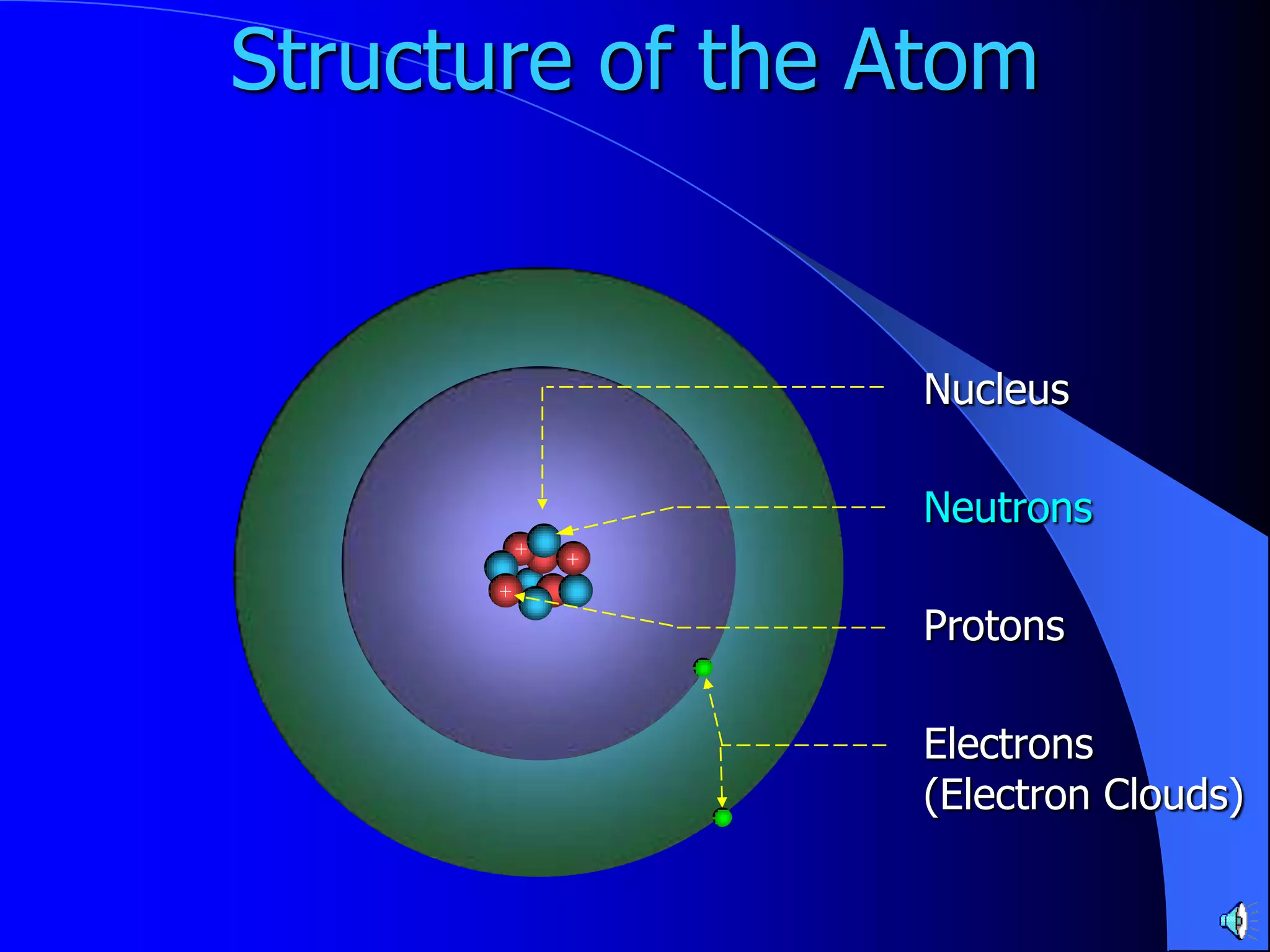
Structure of the Atom


                  Nucleus

                  Neutrons
          +   +
      +
                  Protons

                  Electrons
                  (Electron Clouds)
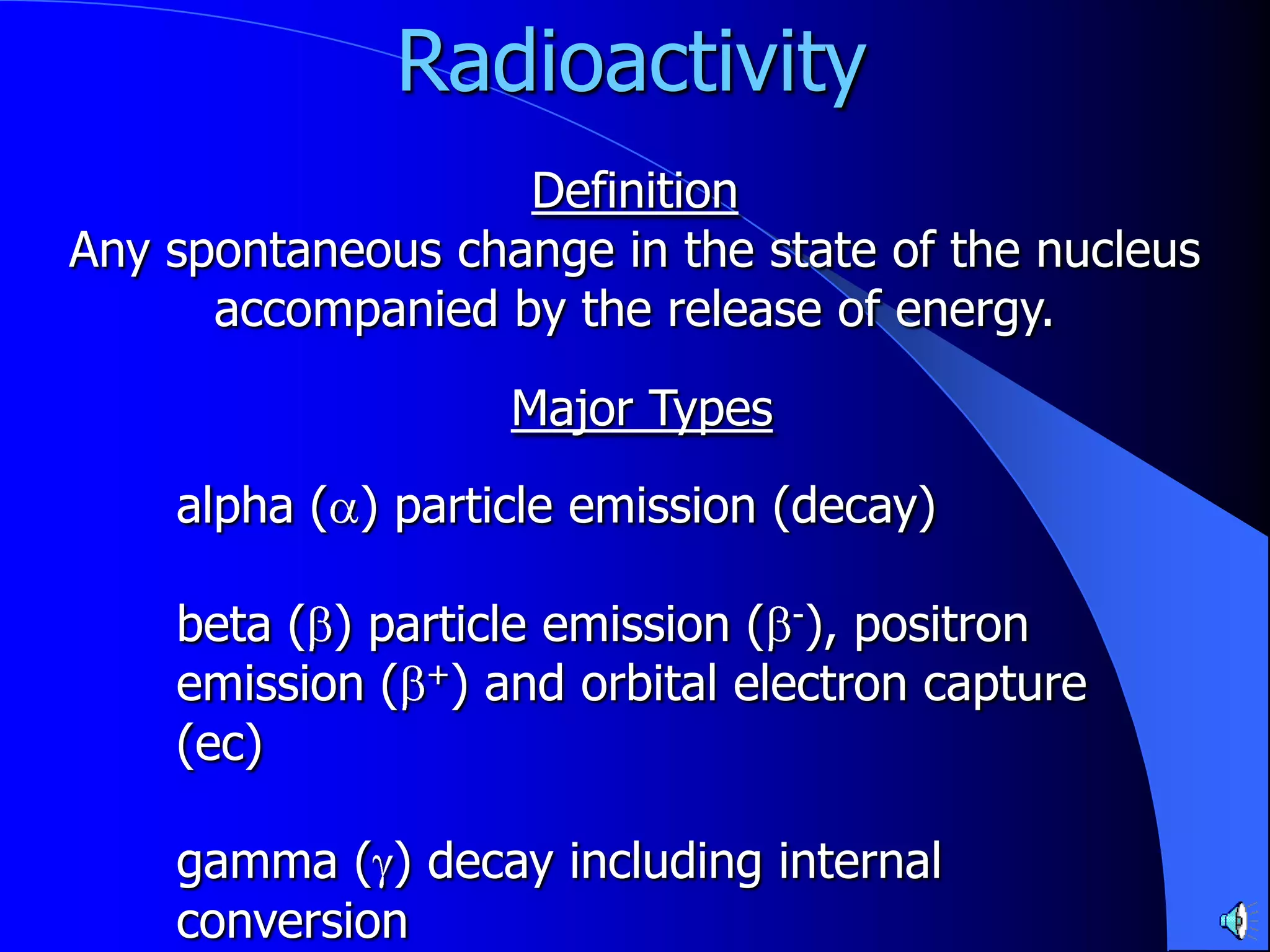
Radioactivity
                   Definition
Any spontaneous change in the state of the nucleus
      accompanied by the release of energy.

                   Major Types
    alpha ( ) particle emission (decay)

    beta ( ) particle emission ( -), positron
    emission ( +) and orbital electron capture
    (ec)

    gamma ( ) decay including internal
    conversion
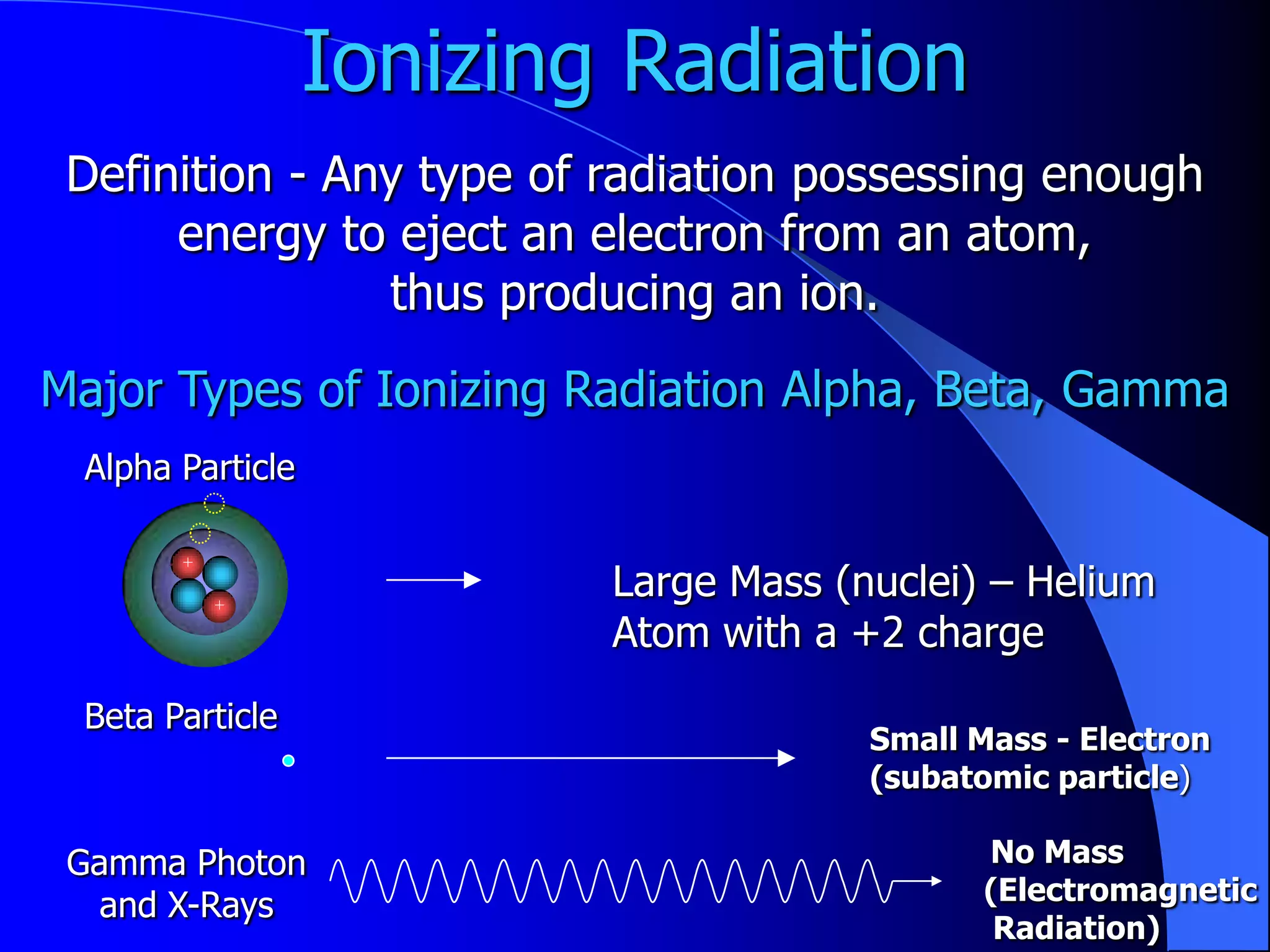
Ionizing Radiation
 Definition - Any type of radiation possessing enough
      energy to eject an electron from an atom,
                thus producing an ion.
Major Types of Ionizing Radiation Alpha, Beta, Gamma
 Alpha Particle


                          Large Mass (nuclei) – Helium
       +

           +

                          Atom with a +2 charge
 Beta Particle
                                       Small Mass - Electron
                                       (subatomic particle)

 Gamma Photon                                 No Mass
                                              (Electromagnetic
  and X-Rays
                                               Radiation)
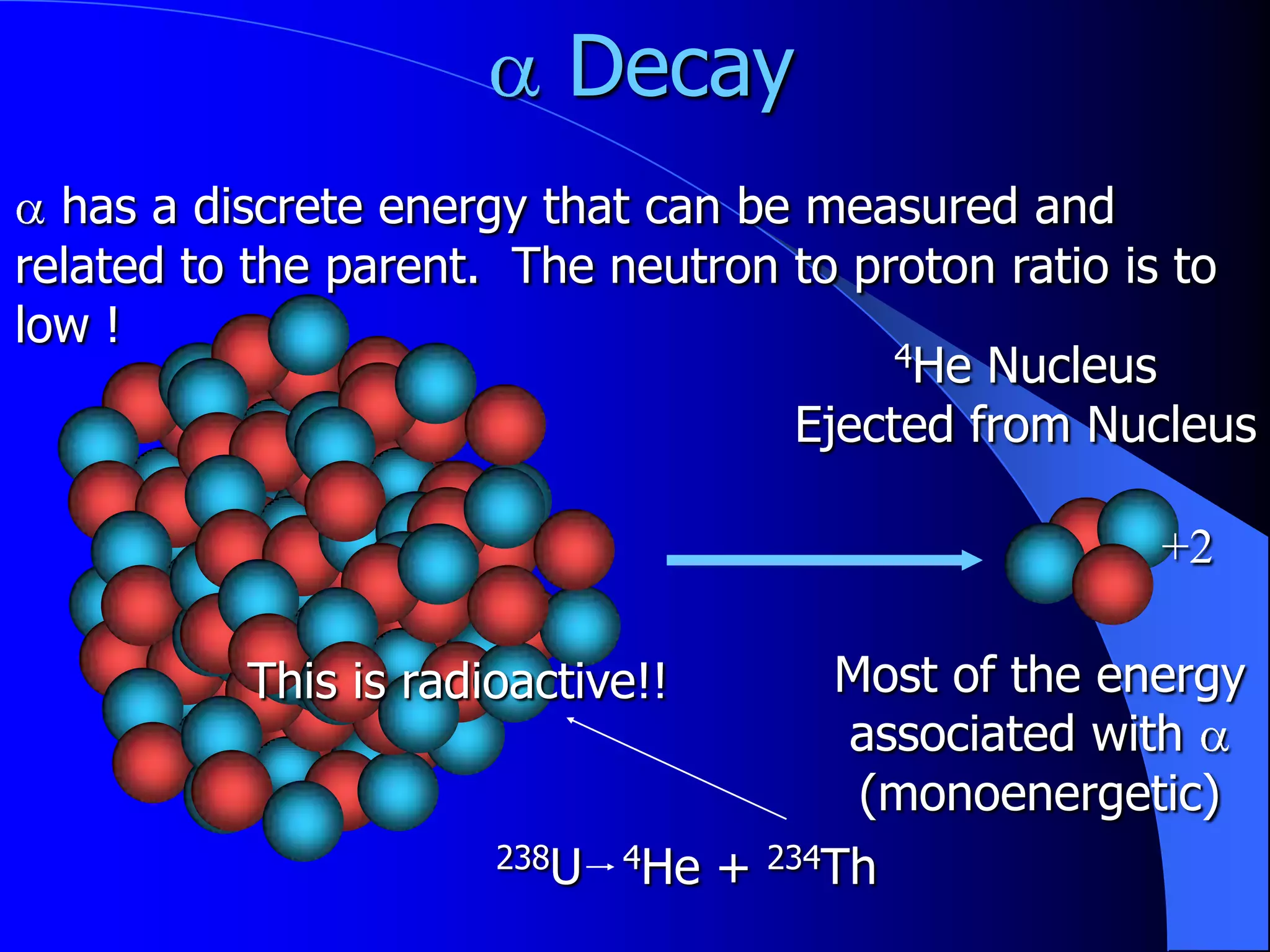
Decay
  has a discrete energy that can be measured and
related to the parent. The neutron to proton ratio is to
low !
          +                             4He Nucleus
               +
                                   Ejected from Nucleus
              +
          +            +
         +
                   +                                   +2
              +
          +
              This is radioactive!!      Most of the energy
                                          associated with
                                          (monoenergetic)
                           238U 4He + 234Th
Decay
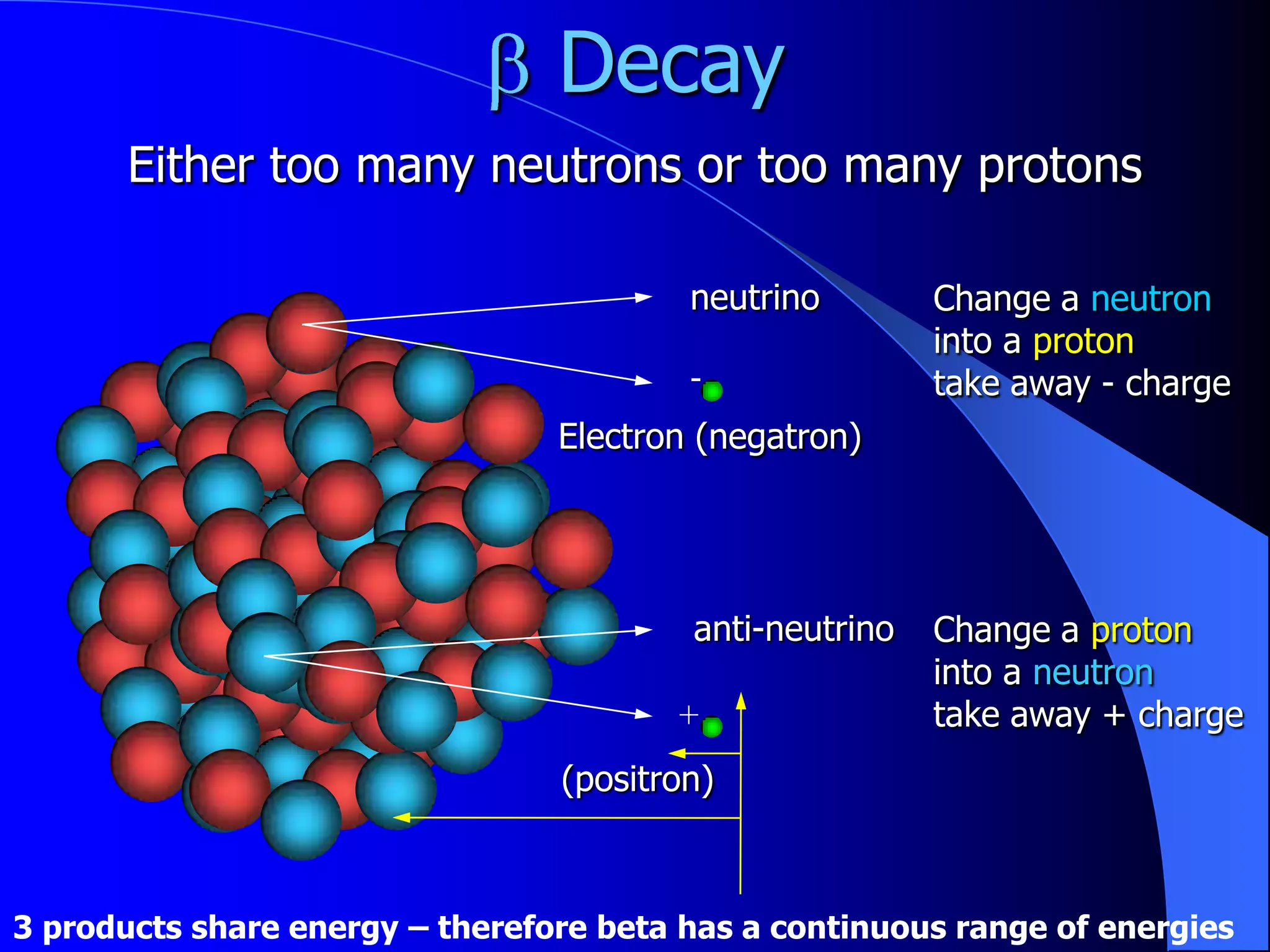
       Either too many neutrons or too many protons

                                            neutrino        Change a neutron
                                                            into a proton
                                                            take away - charge
            +
                                            -
                        +
                                    Electron (negatron)
                 +
             +                  +
            +
                            +


                    +                       anti-neutrino   Change a proton
                +                                           into a neutron
                                           +                take away + charge
                                    (positron)


3 products share energy – therefore beta has a continuous range of energies
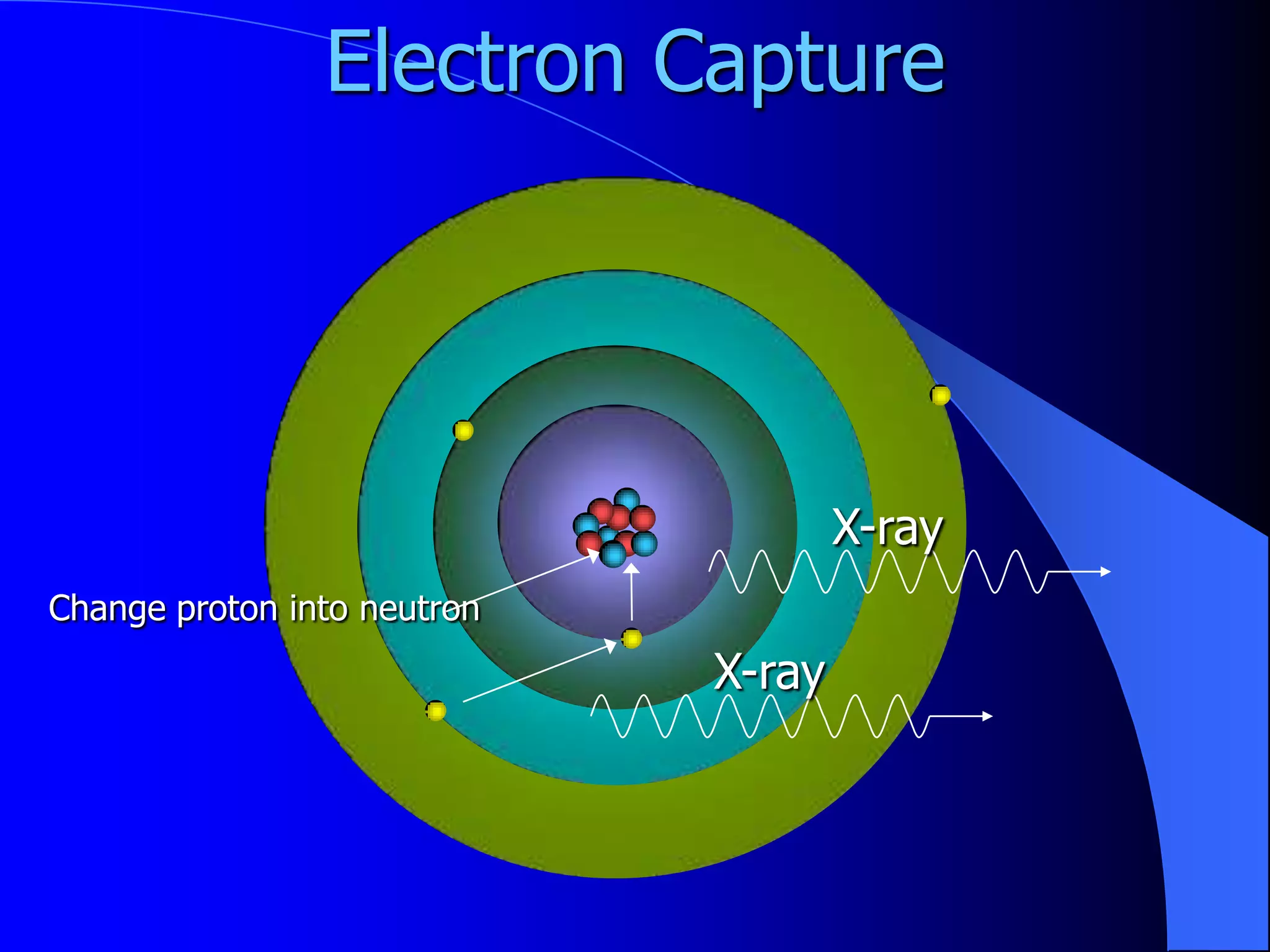
Electron Capture


                                     X-ray
Change proton into neutron
                             X-ray
Decay
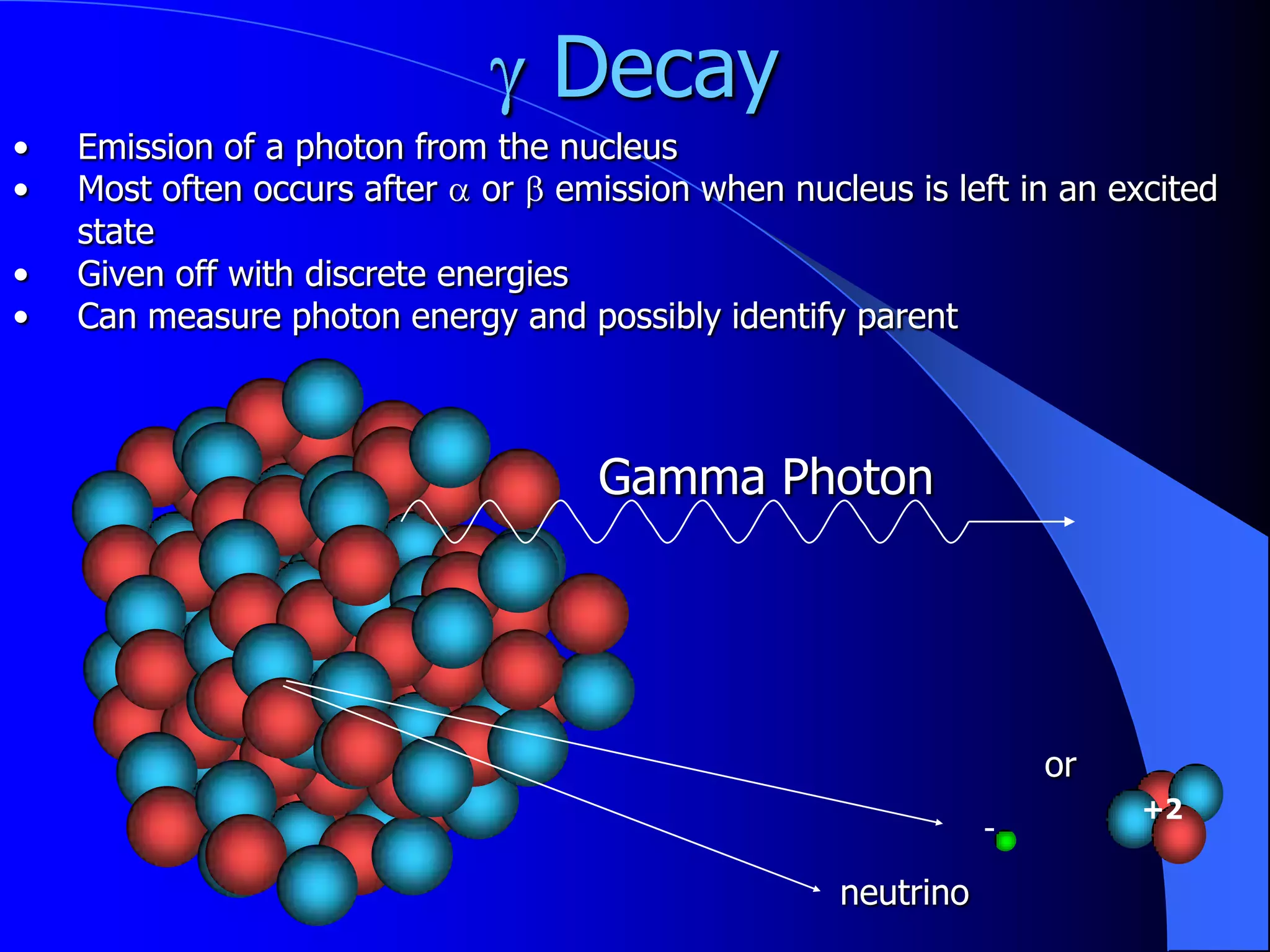
•   Emission of a photon from the nucleus
•   Most often occurs after or emission when nucleus is left in an excited
    state
•   Given off with discrete energies
•   Can measure photon energy and possibly identify parent


             +

                         +            Gamma Photon
                  +
              +                  +
             +
                             +


                     +
                 +
                                                                 or
                                                                      +2
                                                             -
                                                  neutrino
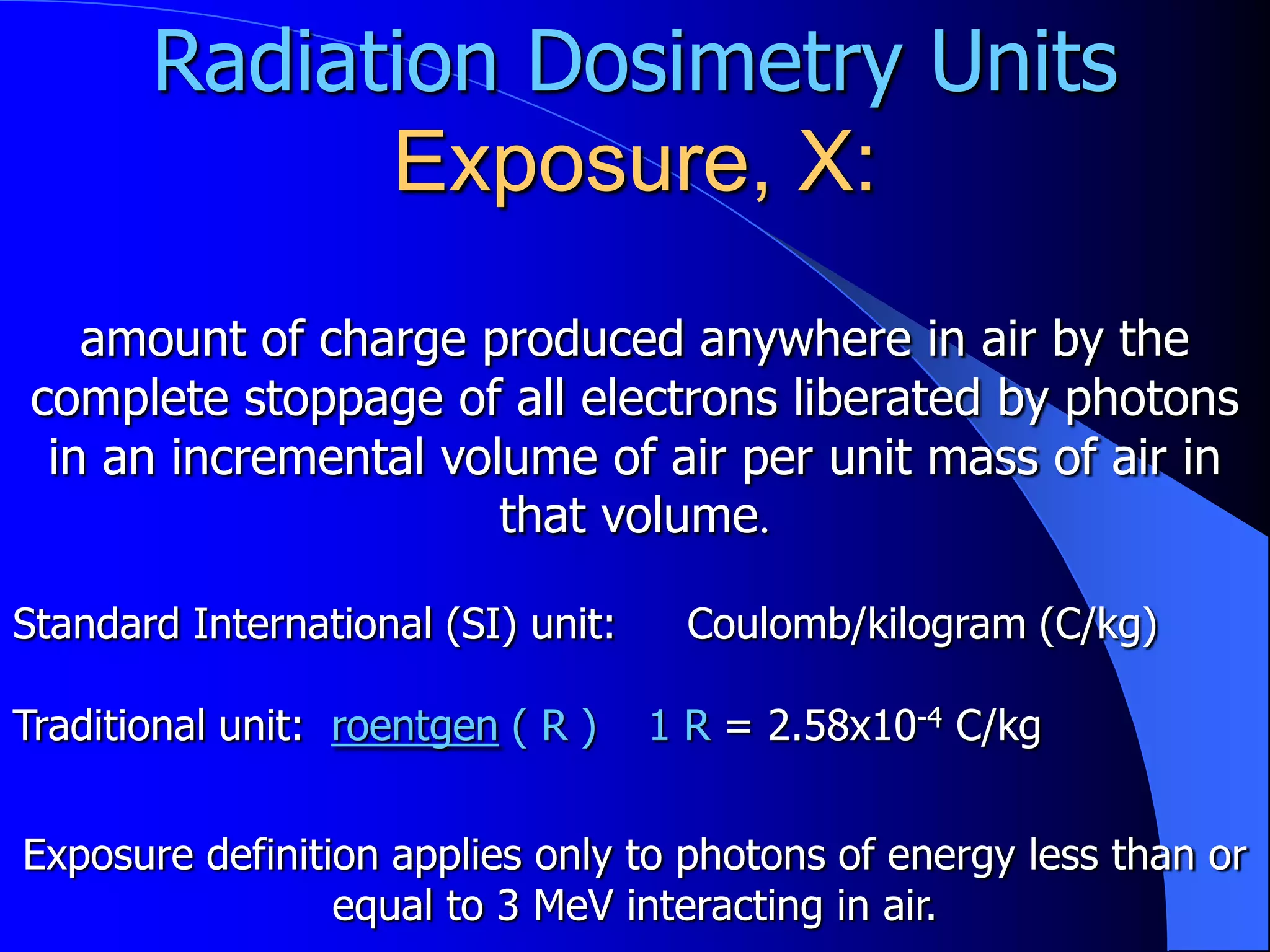
Radiation Dosimetry Units
             Exposure, X:
   amount of charge produced anywhere in air by the
complete stoppage of all electrons liberated by photons
 in an incremental volume of air per unit mass of air in
                      that volume.

Standard International (SI) unit:    Coulomb/kilogram (C/kg)

Traditional unit: roentgen ( R )    1 R = 2.58x10⁻⁴ C/kg


Exposure definition applies only to photons of energy less than or
                 equal to 3 MeV interacting in air.
Radiation Dosimetry Units
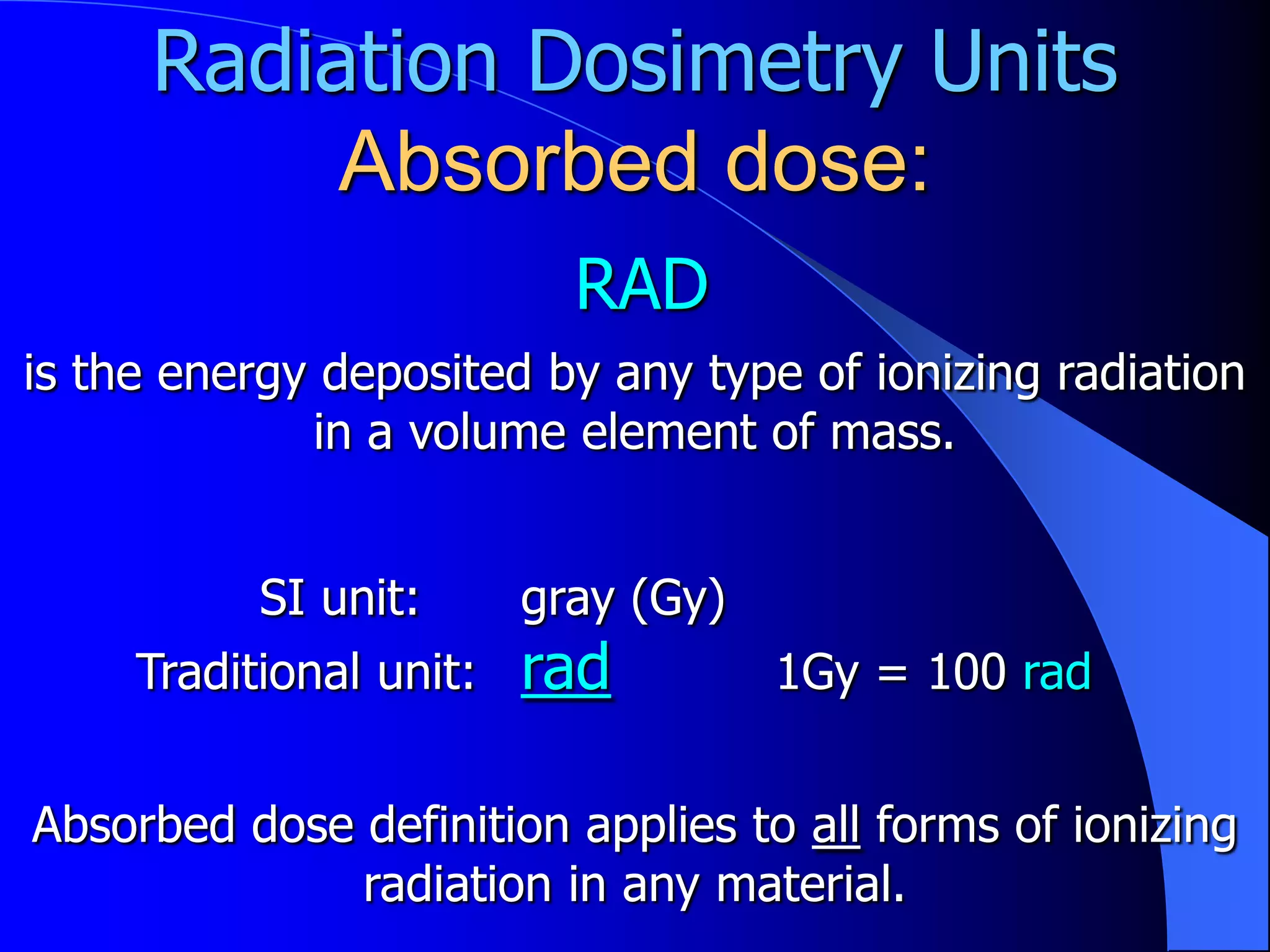
          Absorbed dose:
                           RAD
is the energy deposited by any type of ionizing radiation
             in a volume element of mass.


           SI unit:      gray (Gy)
     Traditional unit:   rad         1Gy = 100 rad


Absorbed dose definition applies to all forms of ionizing
              radiation in any material.
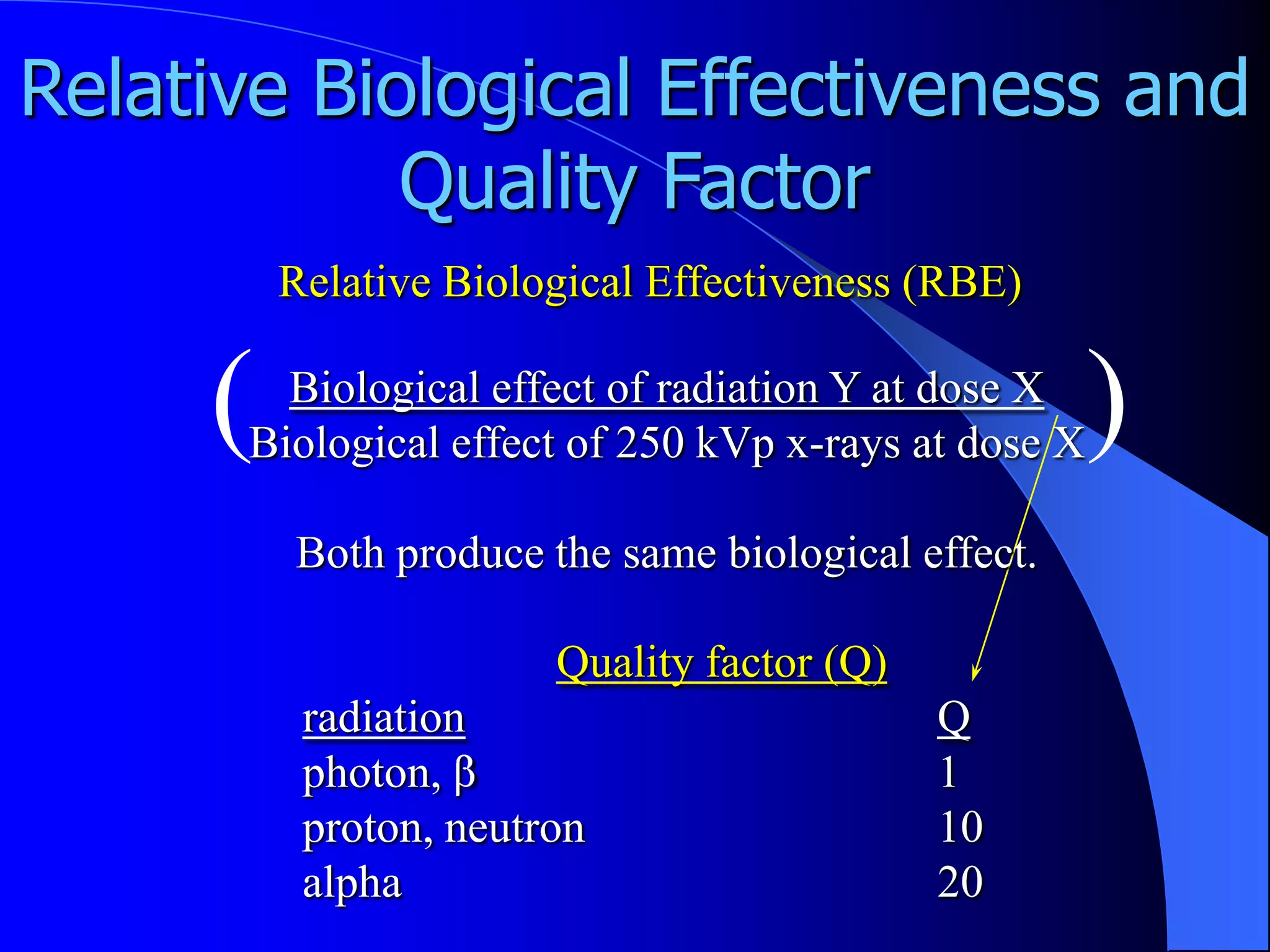
Relative Biological Effectiveness and
            Quality Factor
         Relative Biological Effectiveness (RBE)


     (  Biological effect of radiation Y at dose X
      Biological effect of 250 kVp x-rays at dose X   )
         Both produce the same biological effect.

                       Quality factor (Q)
          radiation                         Q
          photon,                           1
          proton, neutron                   10
          alpha                             20
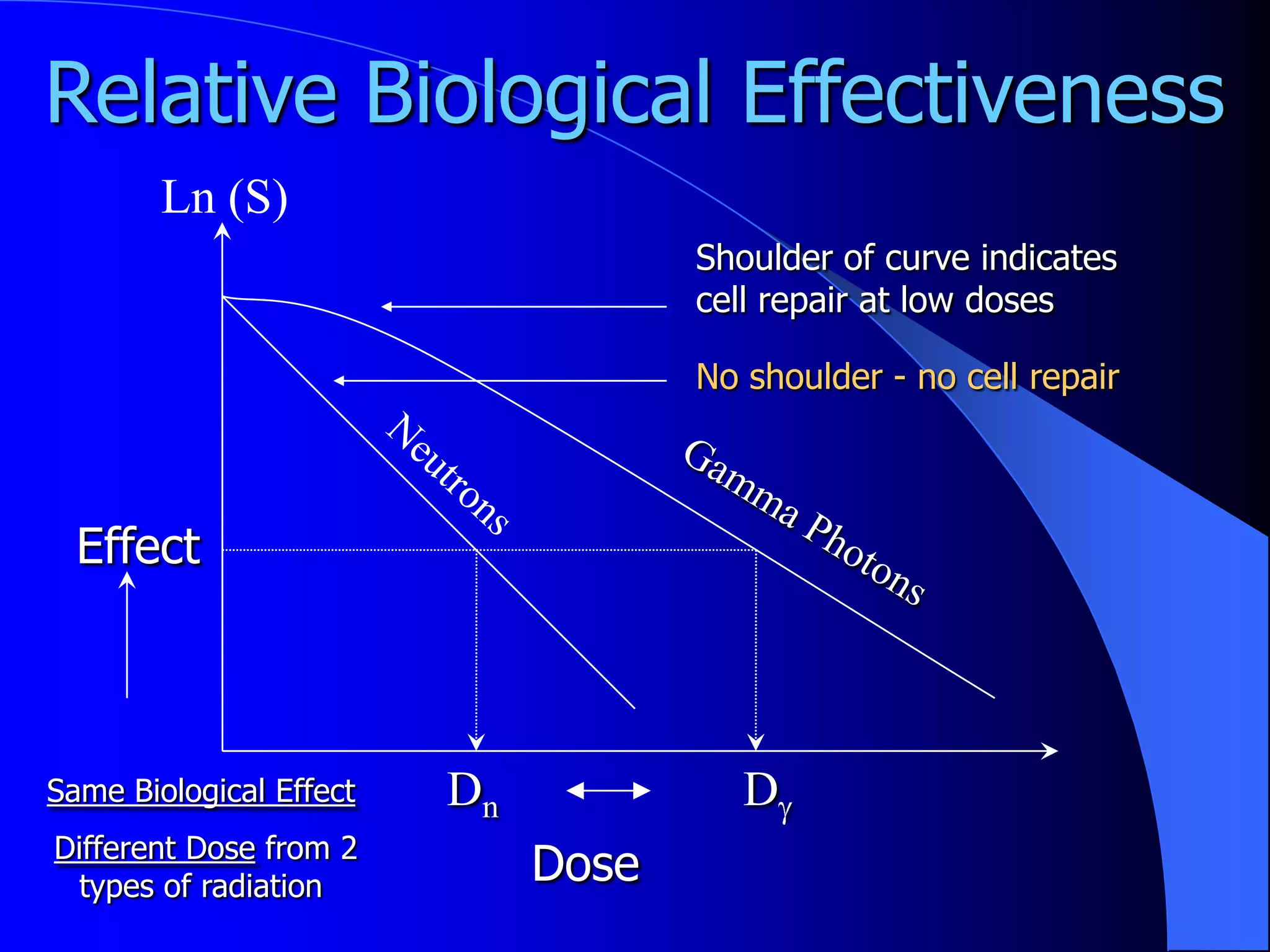
Relative Biological Effectiveness
        Ln (S)
                                     Shoulder of curve indicates
                                     cell repair at low doses

                                     No shoulder - no cell repair


  Effect


Same Biological Effect   Dn             D
Different Dose from 2
  types of radiation
                              Dose
Radiation Dosimetry Units
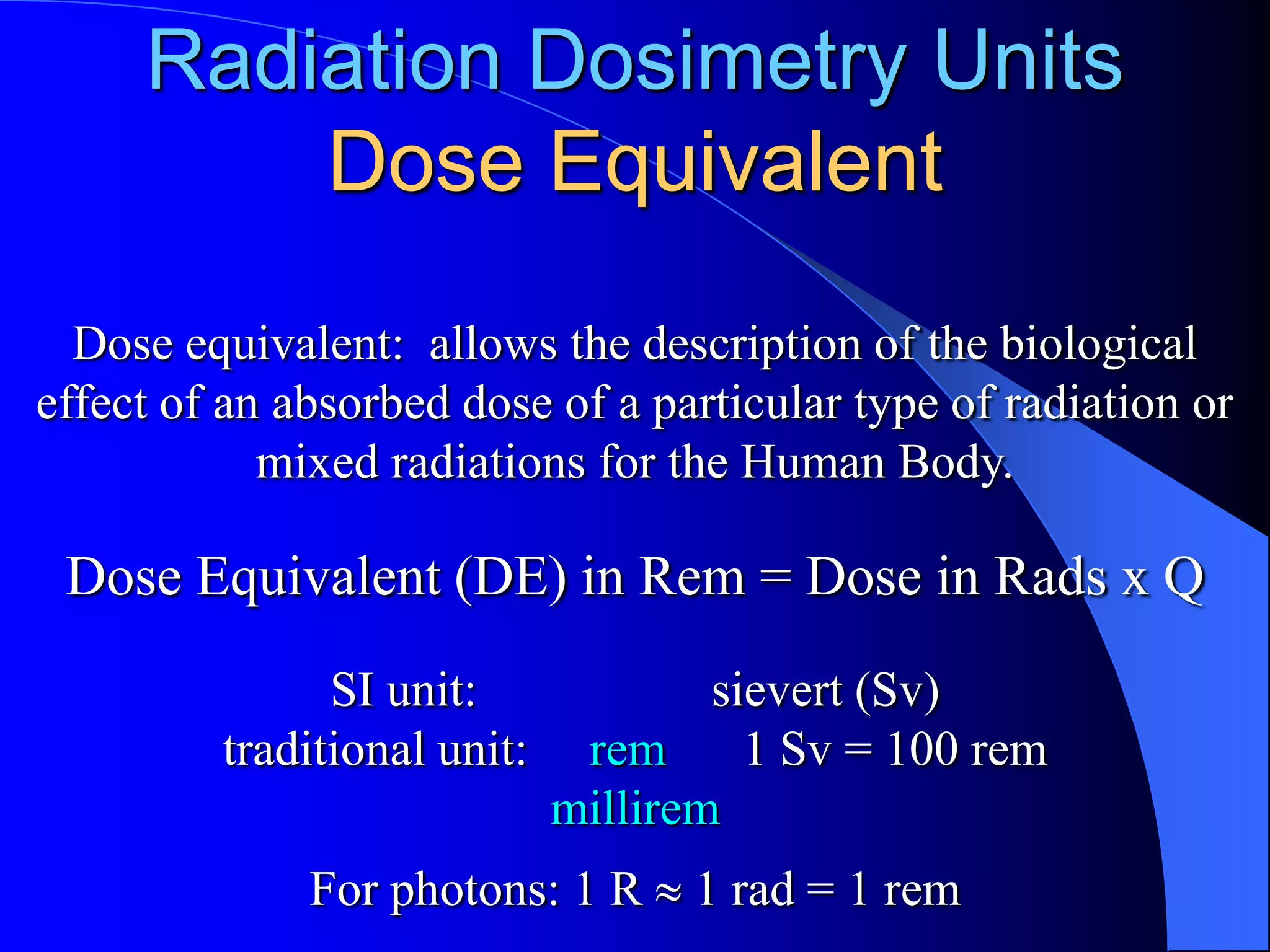
         Dose Equivalent
  Dose equivalent: allows the description of the biological
effect of an absorbed dose of a particular type of radiation or
            mixed radiations for the Human Body.

 Dose Equivalent (DE) in Rem = Dose in Rads x Q
               SI unit:              sievert (Sv)
         traditional unit:    rem      1 Sv = 100 rem
                             millirem
              For photons: 1 R     1 rad = 1 rem
PRECAUTIONS
                  FOR
AVOIDING UNNECESSARY RADIATION EXPOSURE
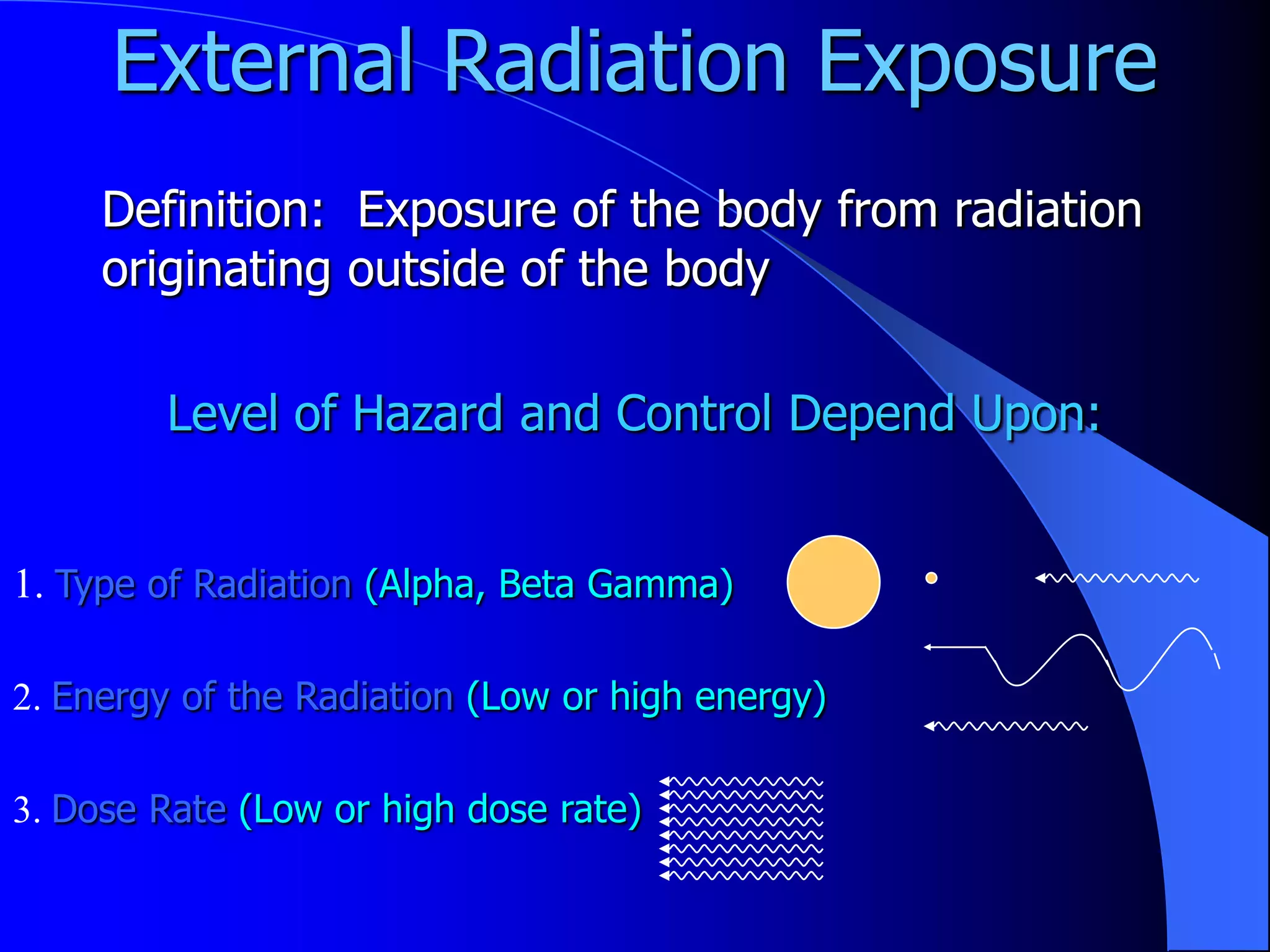
External Radiation Exposure
     Definition: Exposure of the body from radiation
     originating outside of the body

        Level of Hazard and Control Depend Upon:


1. Type of Radiation (Alpha, Beta Gamma)

2. Energy of the Radiation (Low or high energy)

3. Dose Rate (Low or high dose rate)
Reducing External Radiation
            Exposure
•Time:

     reduce time spent in radiation area
•Distance:

 stay as far away from the radiation source as possible

•Shielding:

interpose appropriate materials between the source and
the body
Radioactive Waste
We will discuss -
 Low Level Radioactive Waste
 High Level Radioactive Waste
 Mining Tailings
Radioactive Waste
Low Level Radioactive waste consists of
 microcurie, millicurie and at times curie
 activity waste.

(A Curie is a unit of nuclear transformations.
  1 Curie is 3.7 x10¹⁰ transformations per
  second)
Radioactive Waste
   Low level radioactive waste consists of:
    – Contaminated solids
    – liquids
    – animal carcasses
    – small sealed sources
Radioactive Waste
   Low level radioactive liquids are either:
    – Incinerated
    – Deep well injected (not as frequent anymore)
    – Solidified
    – Sewer Disposed (Regulations allow curie levels
      of some isotopes to be sewer disposed of if
      dilution is large enough)
Radioactive Waste
   Radioactive animal carcasses are either
    incinerated or buried onsite.
Radioactive Waste
   Small sealed sources
    are “Stabilized” in
    concrete and buried.
    Stabilized concrete is
    concrete that is
    certified to resist
    wear for a certain
    time period.
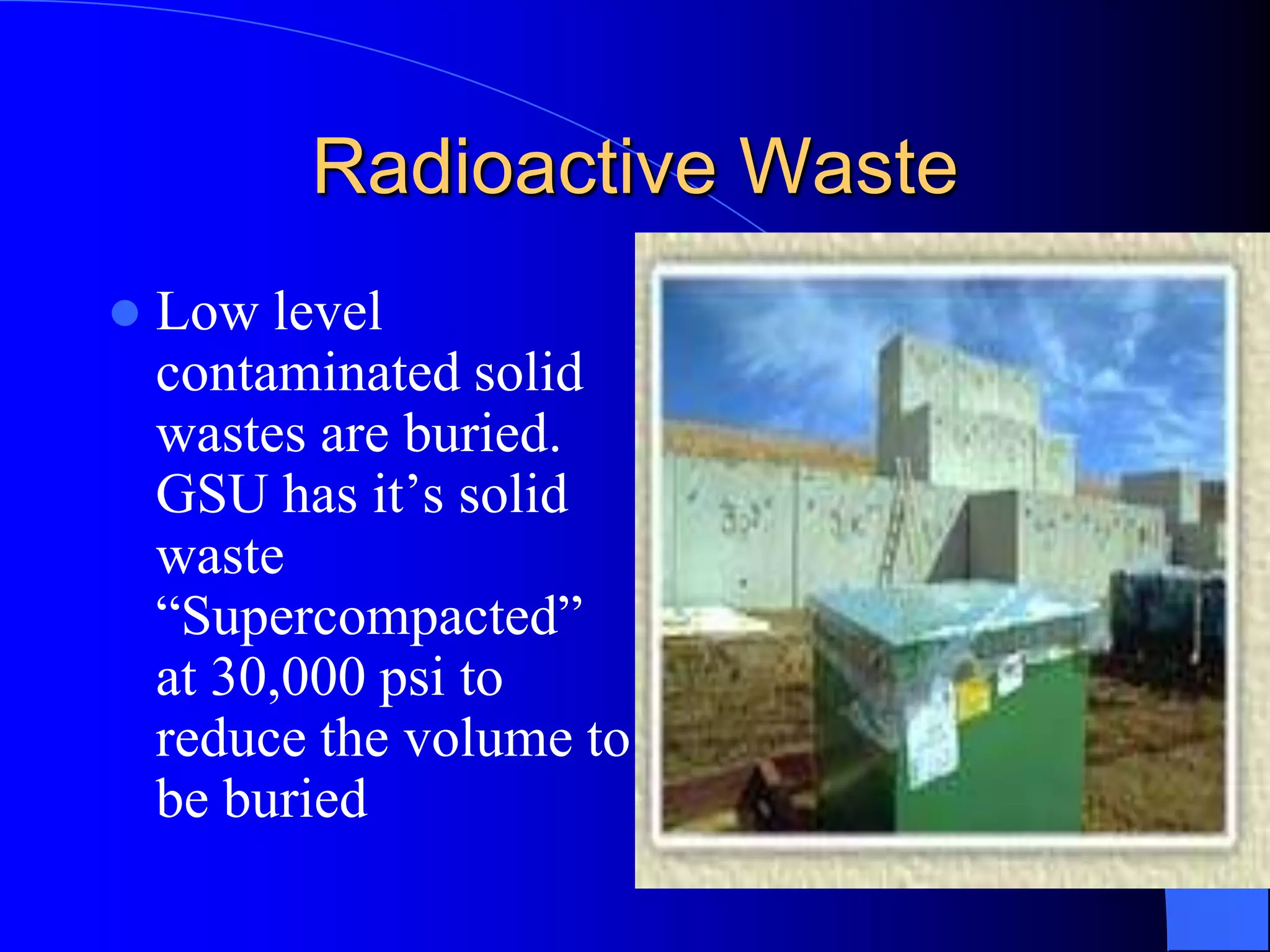
Radioactive Waste
   Low level
    contaminated solid
    wastes are buried.
    GSU has it’s solid
    waste
    “Supercompacted”
    at 30,000 psi to
    reduce the volume to
    be buried
Radioactive Waste
Most low level wastes come from Government
and Utilities. These consist of contaminated
solids from nuclear reactor usage and weapon
construction.
Radioactive Waste
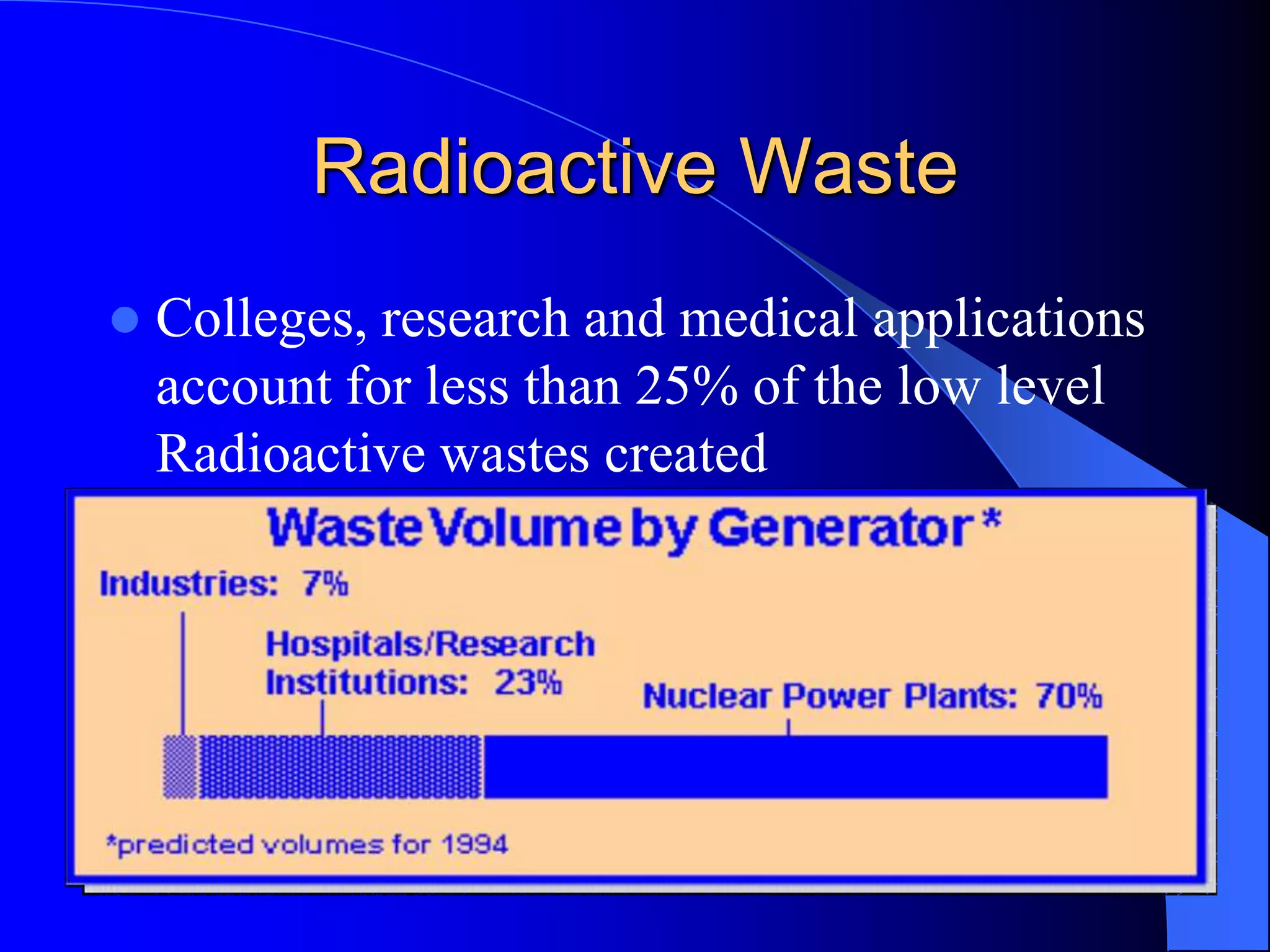
   Colleges, research and medical applications
    account for less than 25% of the low level
    Radioactive wastes created
Radioactive Waste
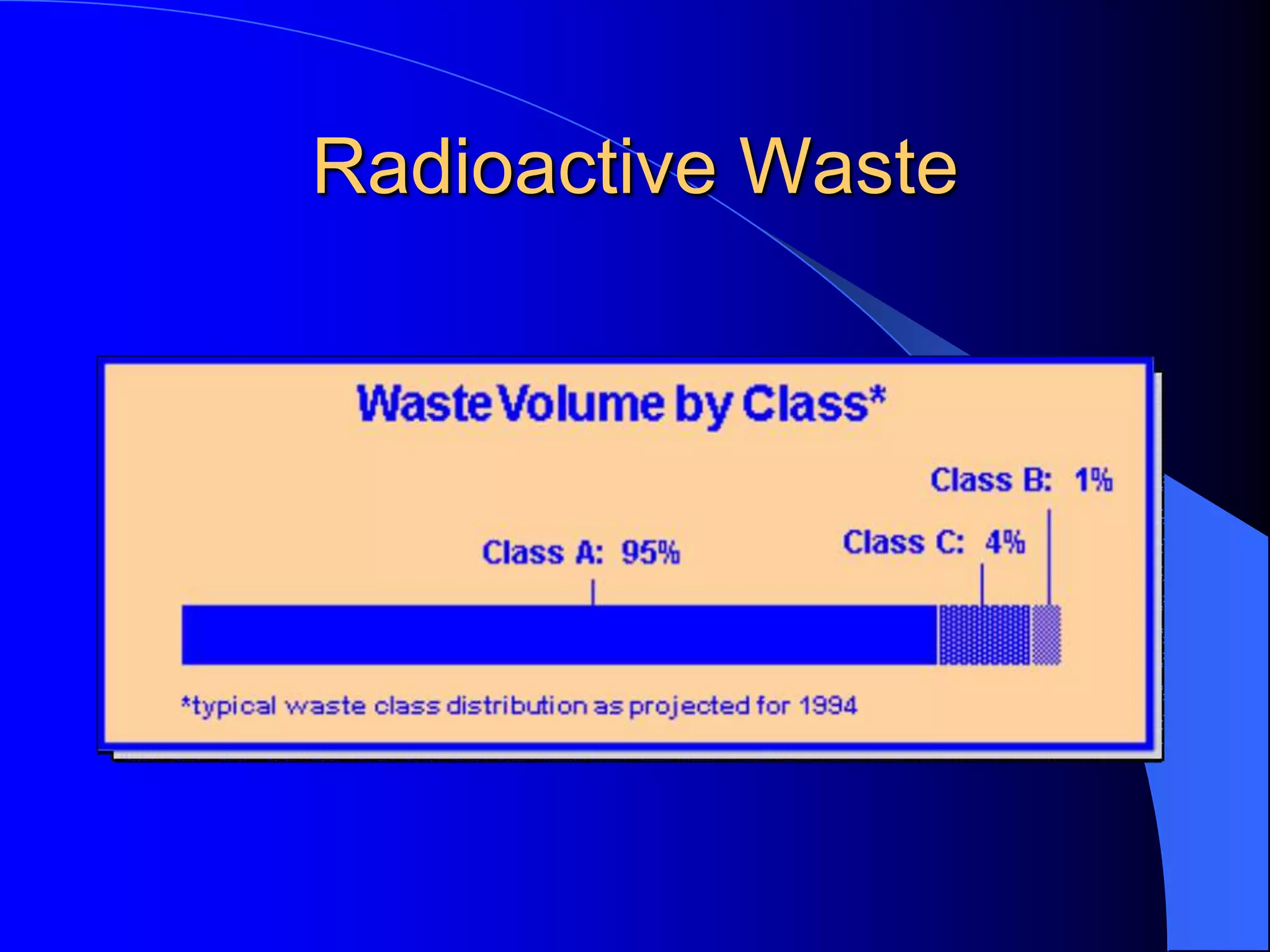
   Class A low-level radioactive waste is the least hazardous,
    containing mostly short-lived radionuclides that will be
    reduced in radioactivity (decay) in a relatively short time.
    It contains only small amounts of radionuclides that take a
    relatively short time to decay. Class A waste will be
    disposed of in concrete canisters that will maintain their
    shape and strength for hundreds of years.
Radioactive Waste
   Class B low-level radioactive waste is more hazardous
    than Class A waste. Most of it comes from nuclear
    reactors. It must be in a stable form for disposal and will
    also be disposed of in concrete canisters. Stabilization can
    be accomplished by solidifying liquid waste, compacting
    solid waste, or placing the low-level radioactive waste in a
    container that will be stable for many years. Class B low-
    level radioactive waste makes up only a small percent of
    the waste volume generated; but along with Class C waste,
    it contains the largest portion of the total radioactivity.
Radioactive Waste
   Class C low-level radioactive waste is the
    most hazardous and must be handled
    accordingly. It also must be disposed of in a
    stable form.
Radioactive Waste
Radioactive Waste
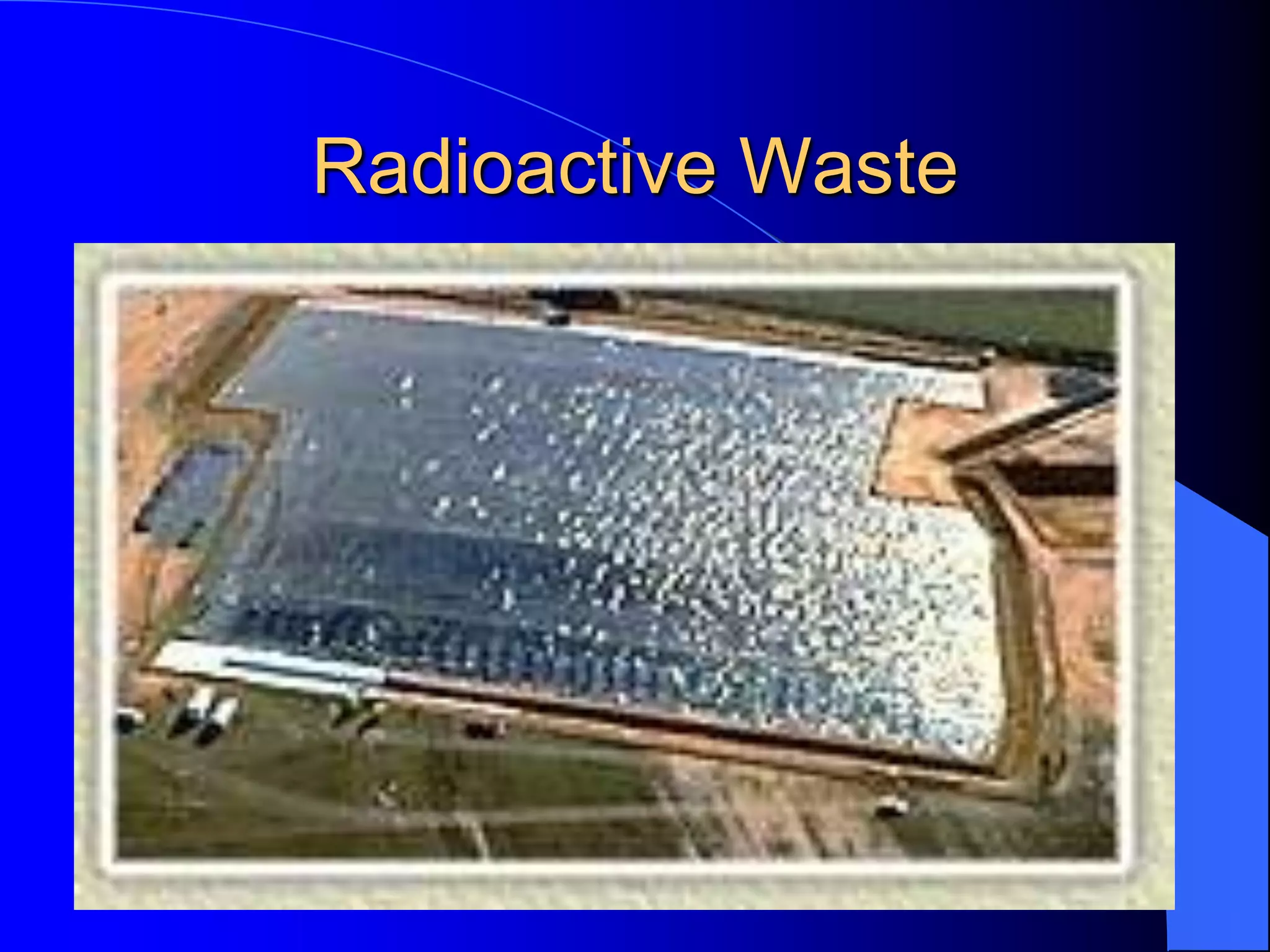
   There are 3
    LLRW
    Burial sites:
    – Hanford
    – Envirocare
    – Barnwell
Radioactive Waste
Radioactive Waste
Radioactive Waste
   Politics of LLRW
    – Compacts
    – On-site burial
    – NIMBY
Radioactive Waste
 The compact system was set up by NRC to
  have all states share in the responsibility of
  disposal of radioactive waste and to limit
  waste transport distance. Georgia is in the
  Southeast compact.
 Until 1992, all states within the SE compact
  (excluding Florida) would host a LLRW
  landfill on a 20-25 year revolving timetable.
Radioactive Waste
 Kentucky was the first (Maxie Flats), then South
  Carolina (Barnwell). In 1995, North Carolina was
  to open a site but the citizens protested and sued.
  The State legislature refused.
 North Carolina was then “kicked out” of the S.E.
  compact and left with no place to dispose of
  waste. Other States followed N.C.’s lead and
  refused
 This lead to the collapse of the traditional compact
  system and the
Radioactive Waste
Radioactive Waste
In the past, many Universities and
companies were allowed to bury their
radioactive wastes onsite. Some were
allowed to deep well inject liquid
radioactive waste.
Radioactive Waste
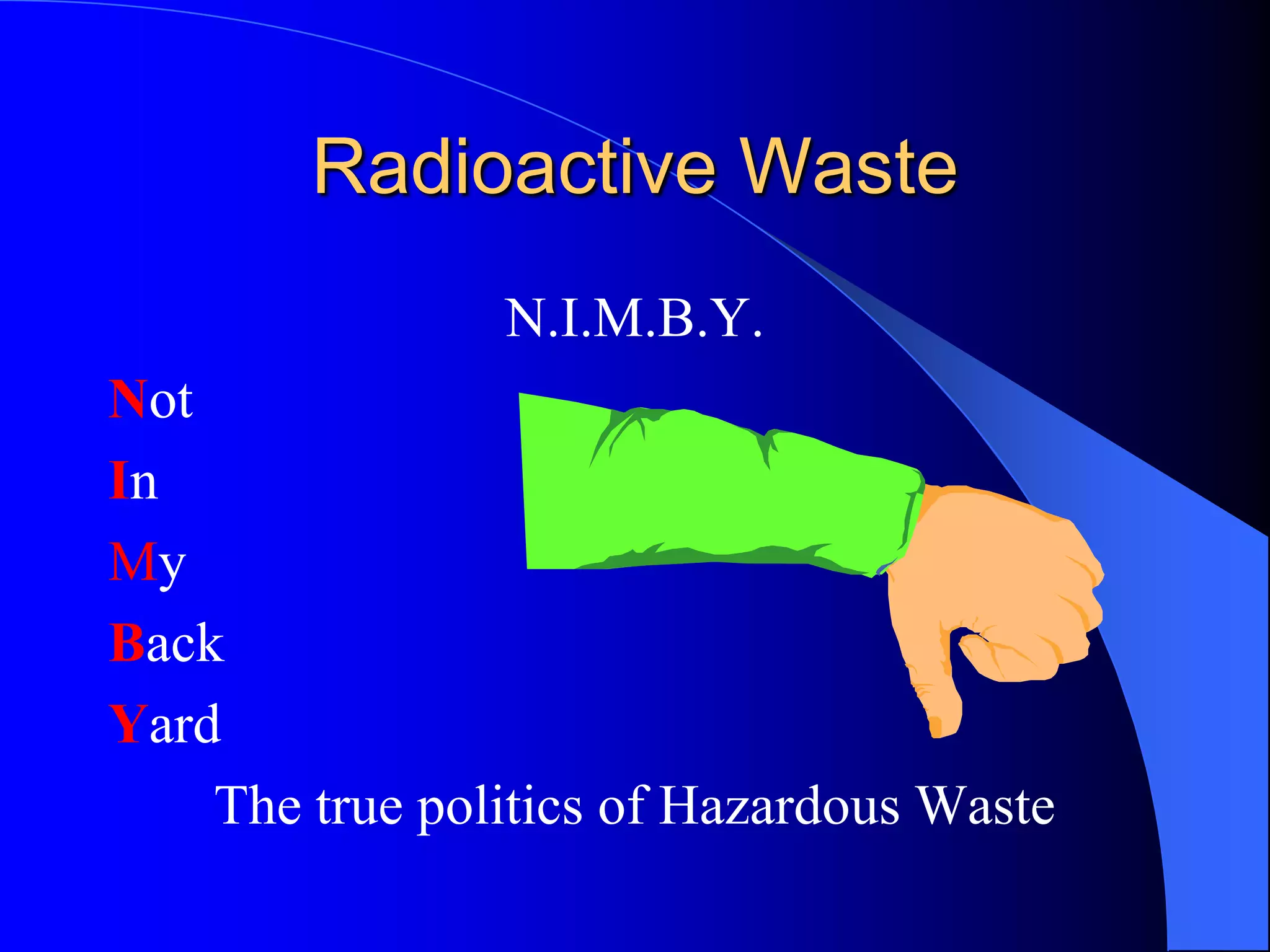
                N.I.M.B.Y.
Not
In
My
Back
Yard
    The true politics of Hazardous Waste
Radioactive Waste

Did North Carolina, by not
 opening up a waste site, better
 protect it’s citizens?
Radioactive Waste
   High-Level Radioactive Waste is: the
    irradiated fuel from the cores of nuclear
    reactors, the liquid and sludge wastes that
    are left over after irradiated fuel has been
    reprocessed (a procedure used to extract
    uranium and plutonium), the solid that
    would result from efforts to solidify that
    liquid and sludge from reprocessing.
Radioactive Waste
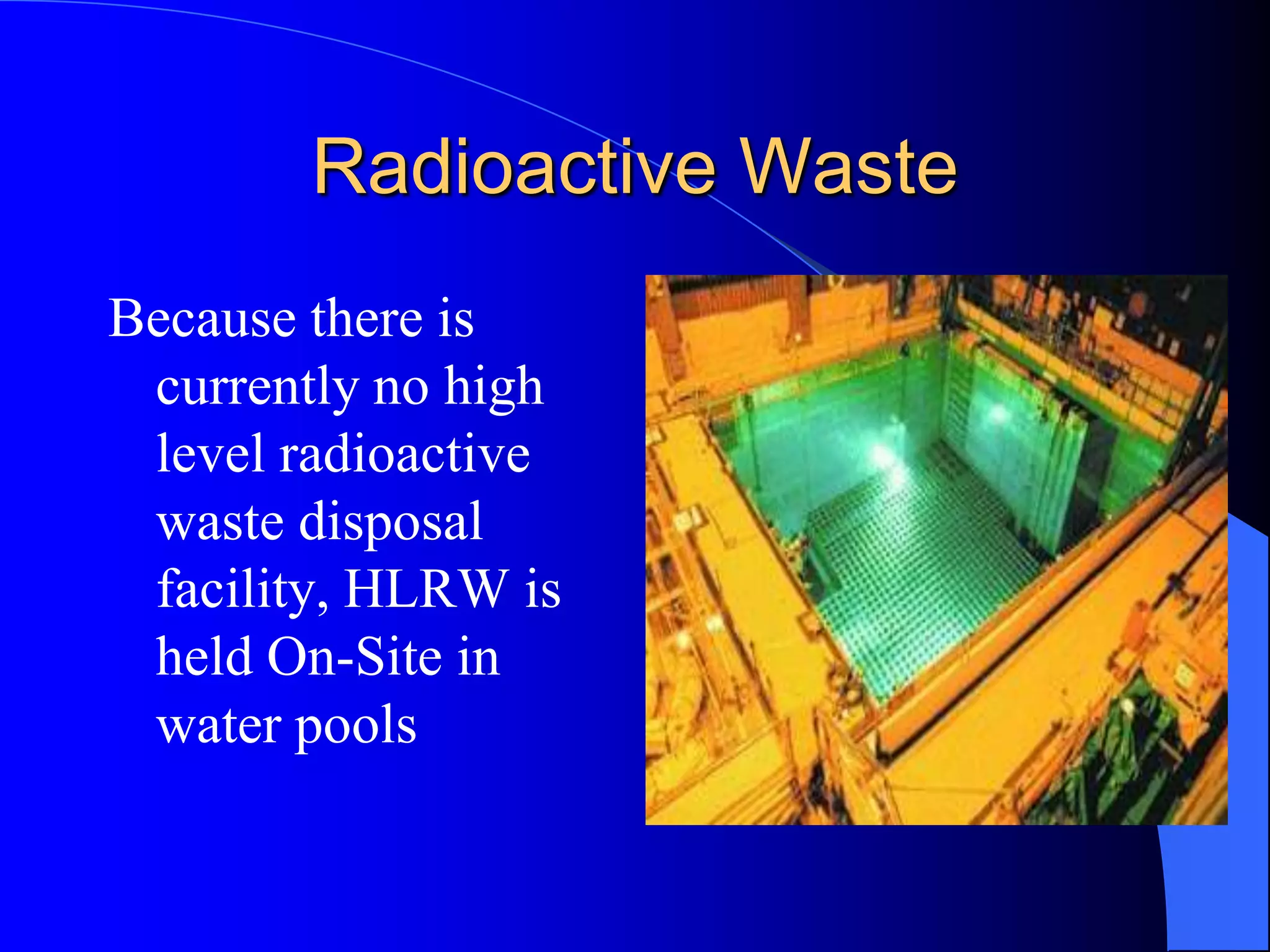
Because there is
 currently no high
 level radioactive
 waste disposal
 facility, HLRW is
 held On-Site in
 water pools
Radioactive Waste
Once these
 Pools are
 full, Waste
 is
 transferred
 to casks
 which are
 also held
 on-site
Radioactive Waste
Radioactive Waste
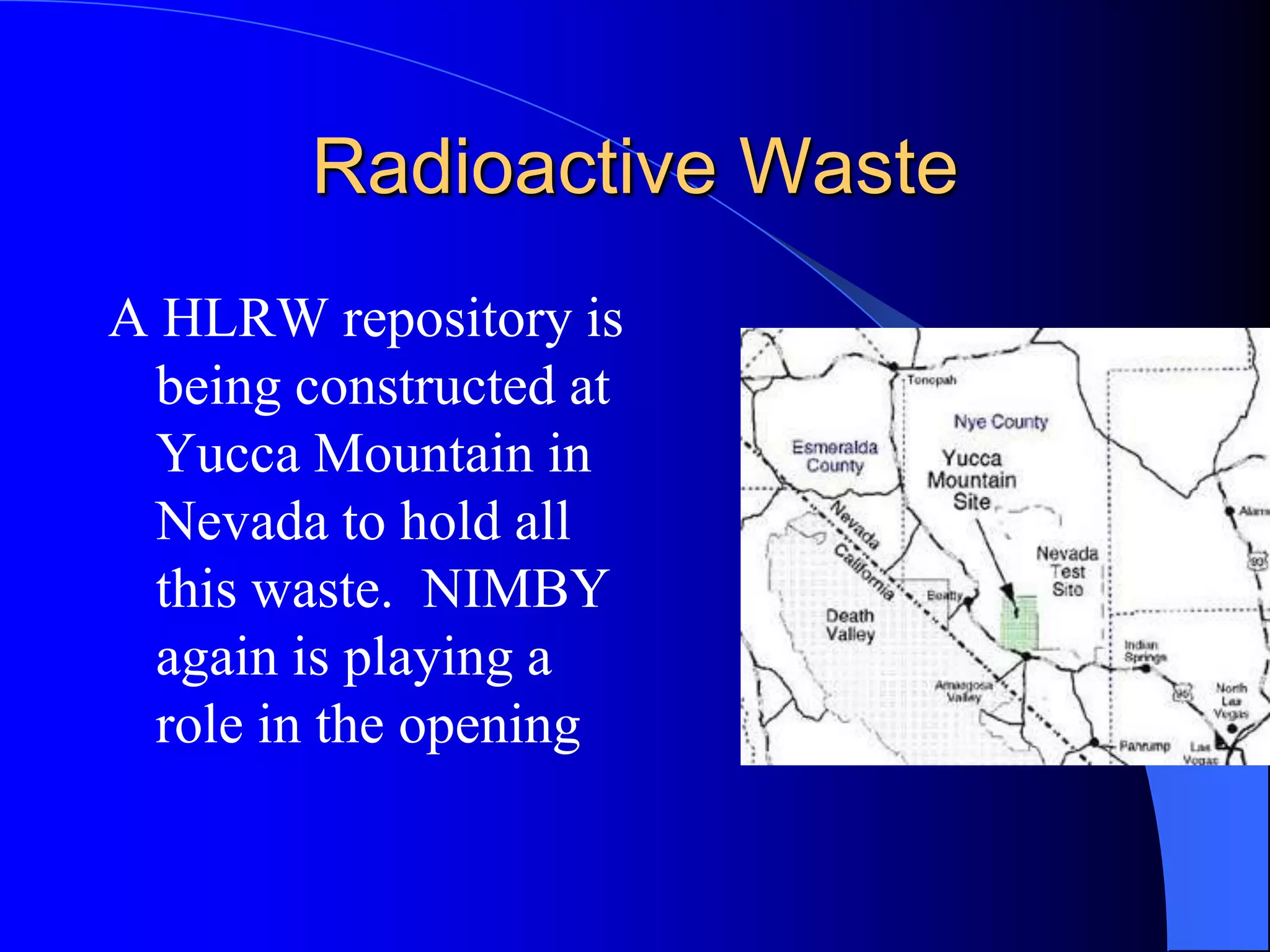
A HLRW repository is
 being constructed at
 Yucca Mountain in
 Nevada to hold all
 this waste. NIMBY
 again is playing a
 role in the opening
Radioactive Waste

YOUR THOUGHTS
 AND DISCUSSION

Radioactivity & waste

  • 1.
  • 2.
    For more helpcontact me Muhammad Umair Bukhari Engr.umair.bukhari@gmail.com www.bzuiam.webs.com 03136050151
  • 3.
    Structure of theAtom Nucleus Neutrons + + + Protons Electrons (Electron Clouds)
  • 4.
    Radioactivity Definition Any spontaneous change in the state of the nucleus accompanied by the release of energy. Major Types alpha ( ) particle emission (decay) beta ( ) particle emission ( -), positron emission ( +) and orbital electron capture (ec) gamma ( ) decay including internal conversion
  • 5.
    Ionizing Radiation Definition- Any type of radiation possessing enough energy to eject an electron from an atom, thus producing an ion. Major Types of Ionizing Radiation Alpha, Beta, Gamma Alpha Particle Large Mass (nuclei) – Helium + + Atom with a +2 charge Beta Particle Small Mass - Electron (subatomic particle) Gamma Photon No Mass (Electromagnetic and X-Rays Radiation)
  • 6.
    Decay hasa discrete energy that can be measured and related to the parent. The neutron to proton ratio is to low ! + 4He Nucleus + Ejected from Nucleus + + + + + +2 + + This is radioactive!! Most of the energy associated with (monoenergetic) 238U 4He + 234Th
  • 7.
    Decay Either too many neutrons or too many protons neutrino Change a neutron into a proton take away - charge + - + Electron (negatron) + + + + + + anti-neutrino Change a proton + into a neutron + take away + charge (positron) 3 products share energy – therefore beta has a continuous range of energies
  • 8.
    Electron Capture X-ray Change proton into neutron X-ray
  • 9.
    Decay • Emission of a photon from the nucleus • Most often occurs after or emission when nucleus is left in an excited state • Given off with discrete energies • Can measure photon energy and possibly identify parent + + Gamma Photon + + + + + + + or +2 - neutrino
  • 10.
    Radiation Dosimetry Units Exposure, X: amount of charge produced anywhere in air by the complete stoppage of all electrons liberated by photons in an incremental volume of air per unit mass of air in that volume. Standard International (SI) unit: Coulomb/kilogram (C/kg) Traditional unit: roentgen ( R ) 1 R = 2.58x10⁻⁴ C/kg Exposure definition applies only to photons of energy less than or equal to 3 MeV interacting in air.
  • 11.
    Radiation Dosimetry Units Absorbed dose: RAD is the energy deposited by any type of ionizing radiation in a volume element of mass. SI unit: gray (Gy) Traditional unit: rad 1Gy = 100 rad Absorbed dose definition applies to all forms of ionizing radiation in any material.
  • 12.
    Relative Biological Effectivenessand Quality Factor Relative Biological Effectiveness (RBE) ( Biological effect of radiation Y at dose X Biological effect of 250 kVp x-rays at dose X ) Both produce the same biological effect. Quality factor (Q) radiation Q photon, 1 proton, neutron 10 alpha 20
  • 13.
    Relative Biological Effectiveness Ln (S) Shoulder of curve indicates cell repair at low doses No shoulder - no cell repair Effect Same Biological Effect Dn D Different Dose from 2 types of radiation Dose
  • 14.
    Radiation Dosimetry Units Dose Equivalent Dose equivalent: allows the description of the biological effect of an absorbed dose of a particular type of radiation or mixed radiations for the Human Body. Dose Equivalent (DE) in Rem = Dose in Rads x Q SI unit: sievert (Sv) traditional unit: rem 1 Sv = 100 rem millirem For photons: 1 R 1 rad = 1 rem
  • 15.
    PRECAUTIONS FOR AVOIDING UNNECESSARY RADIATION EXPOSURE
  • 16.
    External Radiation Exposure Definition: Exposure of the body from radiation originating outside of the body Level of Hazard and Control Depend Upon: 1. Type of Radiation (Alpha, Beta Gamma) 2. Energy of the Radiation (Low or high energy) 3. Dose Rate (Low or high dose rate)
  • 17.
    Reducing External Radiation Exposure •Time: reduce time spent in radiation area •Distance: stay as far away from the radiation source as possible •Shielding: interpose appropriate materials between the source and the body
  • 18.
    Radioactive Waste We willdiscuss -  Low Level Radioactive Waste  High Level Radioactive Waste  Mining Tailings
  • 19.
    Radioactive Waste Low LevelRadioactive waste consists of microcurie, millicurie and at times curie activity waste. (A Curie is a unit of nuclear transformations. 1 Curie is 3.7 x10¹⁰ transformations per second)
  • 20.
    Radioactive Waste  Low level radioactive waste consists of: – Contaminated solids – liquids – animal carcasses – small sealed sources
  • 21.
    Radioactive Waste  Low level radioactive liquids are either: – Incinerated – Deep well injected (not as frequent anymore) – Solidified – Sewer Disposed (Regulations allow curie levels of some isotopes to be sewer disposed of if dilution is large enough)
  • 22.
    Radioactive Waste  Radioactive animal carcasses are either incinerated or buried onsite.
  • 23.
    Radioactive Waste  Small sealed sources are “Stabilized” in concrete and buried. Stabilized concrete is concrete that is certified to resist wear for a certain time period.
  • 24.
    Radioactive Waste  Low level contaminated solid wastes are buried. GSU has it’s solid waste “Supercompacted” at 30,000 psi to reduce the volume to be buried
  • 25.
    Radioactive Waste Most lowlevel wastes come from Government and Utilities. These consist of contaminated solids from nuclear reactor usage and weapon construction.
  • 26.
    Radioactive Waste  Colleges, research and medical applications account for less than 25% of the low level Radioactive wastes created
  • 27.
    Radioactive Waste  Class A low-level radioactive waste is the least hazardous, containing mostly short-lived radionuclides that will be reduced in radioactivity (decay) in a relatively short time. It contains only small amounts of radionuclides that take a relatively short time to decay. Class A waste will be disposed of in concrete canisters that will maintain their shape and strength for hundreds of years.
  • 28.
    Radioactive Waste  Class B low-level radioactive waste is more hazardous than Class A waste. Most of it comes from nuclear reactors. It must be in a stable form for disposal and will also be disposed of in concrete canisters. Stabilization can be accomplished by solidifying liquid waste, compacting solid waste, or placing the low-level radioactive waste in a container that will be stable for many years. Class B low- level radioactive waste makes up only a small percent of the waste volume generated; but along with Class C waste, it contains the largest portion of the total radioactivity.
  • 29.
    Radioactive Waste  Class C low-level radioactive waste is the most hazardous and must be handled accordingly. It also must be disposed of in a stable form.
  • 30.
  • 31.
    Radioactive Waste  There are 3 LLRW Burial sites: – Hanford – Envirocare – Barnwell
  • 32.
  • 33.
  • 34.
    Radioactive Waste  Politics of LLRW – Compacts – On-site burial – NIMBY
  • 35.
    Radioactive Waste  Thecompact system was set up by NRC to have all states share in the responsibility of disposal of radioactive waste and to limit waste transport distance. Georgia is in the Southeast compact.  Until 1992, all states within the SE compact (excluding Florida) would host a LLRW landfill on a 20-25 year revolving timetable.
  • 36.
    Radioactive Waste  Kentuckywas the first (Maxie Flats), then South Carolina (Barnwell). In 1995, North Carolina was to open a site but the citizens protested and sued. The State legislature refused.  North Carolina was then “kicked out” of the S.E. compact and left with no place to dispose of waste. Other States followed N.C.’s lead and refused  This lead to the collapse of the traditional compact system and the
  • 37.
  • 38.
    Radioactive Waste In thepast, many Universities and companies were allowed to bury their radioactive wastes onsite. Some were allowed to deep well inject liquid radioactive waste.
  • 39.
    Radioactive Waste N.I.M.B.Y. Not In My Back Yard The true politics of Hazardous Waste
  • 40.
    Radioactive Waste Did NorthCarolina, by not opening up a waste site, better protect it’s citizens?
  • 41.
    Radioactive Waste  High-Level Radioactive Waste is: the irradiated fuel from the cores of nuclear reactors, the liquid and sludge wastes that are left over after irradiated fuel has been reprocessed (a procedure used to extract uranium and plutonium), the solid that would result from efforts to solidify that liquid and sludge from reprocessing.
  • 42.
    Radioactive Waste Because thereis currently no high level radioactive waste disposal facility, HLRW is held On-Site in water pools
  • 43.
    Radioactive Waste Once these Pools are full, Waste is transferred to casks which are also held on-site
  • 44.
  • 45.
    Radioactive Waste A HLRWrepository is being constructed at Yucca Mountain in Nevada to hold all this waste. NIMBY again is playing a role in the opening
  • 46.