

For more help contact me
            ď‚–
Muhammad Umair Bukhari
      Engr.umair.bukhari@gmail.com

         www.bzuiam.webs.com
              03136050151
Introduction
                  ď‚–
 Shore hardness is a measure of the resistance of material
  to indentation by 3 spring-loaded indenter.
 The higher the number, the greater the resistance.
 The shore scleroscope measures hardness in terms of the
  elasticity of the material.
 A diamond-tipped hammer in a graduated glass tube is
  allowed to fall from a known height on the specimen to
  be tested, and the hardness number depends on the
  height to which the hammer rebounds; the harder the
  material, the higher the rebound
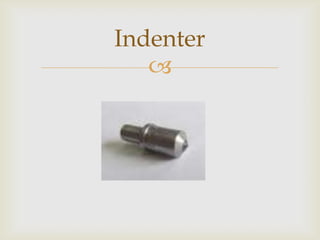
Indenter
   ď‚–
Shore Test
                  ď‚–
 The Shore hardness is measured with an apparatus
  known as a Durometer and consequently is also known
  as “Durometer hardness”.
 The hardness value is determined by the penetration of
  the Durometer indenter foot into the sample.
 Because of the resilience of rubbers and plastics, the
  hardness reading my change over time - so the
  indentation time is sometimes reported along with the
  hardness number.
 The ASTM test number is ASTM D2240 while the
  analogous ISO test method is ISO 868.
Shore Test
                   ď‚–
ď‚™ The results obtained from this test are a useful
  measure of relative resistance to indentation of
  various grades of polymers.
ď‚™ However, the Shore Durometer hardness test does
  not serve well as a predictor of other properties such
  as strength or resistance to scratches, abrasion, or
  wear, and should not be used alone for product
  design specifications.
Shore Scale
                   ď‚–
ď‚™ Shore Scale is of two types:-
   ď‚– Shore A
   ď‚– Shore D
 The Shore A scale is used for “softer” rubbers while
  the Shore D scale is used for 'harder' ones.
Shore A
                     ď‚–
ď‚™ The shore A Hardness is the relative hardness of
  elastic materials such as rubber or soft plastics can be
  determined with an instrument called a “Shore
  Durometer”.
ď‚™ If the indenter completely penetrates the sample, a
  reading of 0 is obtained, and if no penetration
  occurs, a reading of 100 results. The reading is
  dimensionless.
Shore Test Application
            ď‚–
ď‚™ The hardness testing of plastics is most commonly
  measured by this test or Rockwell hardness test.
ď‚™ Both methods measure the resistance of the plastic
  toward indentation. Both scales provide an empirical
  hardness value that doesn't correlate to other
  properties or fundamental characteristics.
Shore Test Application
            ď‚–
ď‚™ Shore Hardness is the preferred method for rubbers/
  elastomers.
ď‚™ Shore Test is commonly carried out for polymers
  such as:-
  ď‚– Polyolefin
  ď‚– Fluoropolymers
  ď‚– Vinyls.
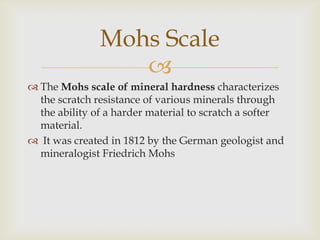
Mohs Scale
                  ď‚–
ď‚™ The Mohs scale of mineral hardness characterizes
  the scratch resistance of various minerals through
  the ability of a harder material to scratch a softer
  material.
ď‚™ It was created in 1812 by the German geologist and
  mineralogist Friedrich Mohs
Mohs Scale
            Arrangement
                 ď‚–
ď‚™ The Mohs scale of mineral hardness is based on the
  ability of one natural sample of matter to scratch
  another.
ď‚™ The samples of matter used by Mohs are all minerals.
  Minerals are pure substances found in nature. Rocks
  are made up of one or more minerals.
ď‚™ As the hardest known naturally occurring substance
  when the scale was designed, diamonds are at the
  top of the scale.
Mohs Scale
             Arrangement
                  ď‚–
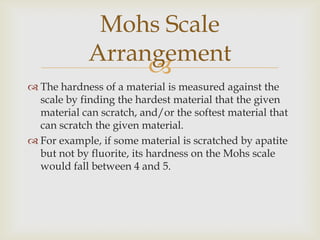
ď‚™ The hardness of a material is measured against the
  scale by finding the hardest material that the given
  material can scratch, and/or the softest material that
  can scratch the given material.
ď‚™ For example, if some material is scratched by apatite
  but not by fluorite, its hardness on the Mohs scale
  would fall between 4 and 5.
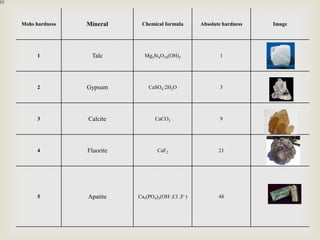
Mohs hardness   Mineral     Chemical formula       Absolute hardness   Image


      1          Talc        Mg3Si4O10(OH)2               1


      2         Gypsum         CaSO4·2H2O                 3


      3         Calcite           CaCO3                   9


      4         Fluorite           CaF2                   21


      5         Apatite    Ca5(PO4)3(OH–,Cl–,F–)          48
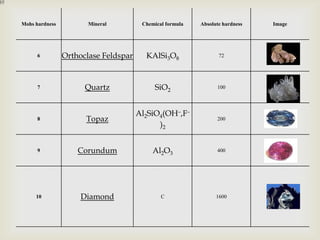
Mohs hardness          Mineral         Chemical formula   Absolute hardness   Image


      6         Orthoclase Feldspar     KAlSi3O8                 72


      7               Quartz               SiO2                 100


                                      Al2SiO4(OH–,F–
      8               Topaz                                     200
                                            )2


      9             Corundum               Al2O3                400


     10              Diamond                  C                 1600
Mohs scale Non-
          uniformity
              ď‚–
ď‚™ The Mohs scale is a purely ordinal scale. For
  example, corundum (9) is twice as hard as topaz (8),
  but diamond (10) is almost four times as hard as
  corundum.
Shore hardness

Shore hardness

  • 2.
    For more helpcontact me ď‚– Muhammad Umair Bukhari Engr.umair.bukhari@gmail.com www.bzuiam.webs.com 03136050151
  • 3.
    Introduction   Shore hardness is a measure of the resistance of material to indentation by 3 spring-loaded indenter.  The higher the number, the greater the resistance.  The shore scleroscope measures hardness in terms of the elasticity of the material.  A diamond-tipped hammer in a graduated glass tube is allowed to fall from a known height on the specimen to be tested, and the hardness number depends on the height to which the hammer rebounds; the harder the material, the higher the rebound
  • 4.
    Indenter ď‚–
  • 5.
    Shore Test   The Shore hardness is measured with an apparatus known as a Durometer and consequently is also known as “Durometer hardness”.  The hardness value is determined by the penetration of the Durometer indenter foot into the sample.  Because of the resilience of rubbers and plastics, the hardness reading my change over time - so the indentation time is sometimes reported along with the hardness number.  The ASTM test number is ASTM D2240 while the analogous ISO test method is ISO 868.
  • 6.
    Shore Test ď‚– ď‚™ The results obtained from this test are a useful measure of relative resistance to indentation of various grades of polymers. ď‚™ However, the Shore Durometer hardness test does not serve well as a predictor of other properties such as strength or resistance to scratches, abrasion, or wear, and should not be used alone for product design specifications.
  • 7.
    Shore Scale   Shore Scale is of two types:-  Shore A  Shore D  The Shore A scale is used for “softer” rubbers while the Shore D scale is used for 'harder' ones.
  • 8.
    Shore A   The shore A Hardness is the relative hardness of elastic materials such as rubber or soft plastics can be determined with an instrument called a “Shore Durometer”.  If the indenter completely penetrates the sample, a reading of 0 is obtained, and if no penetration occurs, a reading of 100 results. The reading is dimensionless.
  • 9.
    Shore Test Application ď‚– ď‚™ The hardness testing of plastics is most commonly measured by this test or Rockwell hardness test. ď‚™ Both methods measure the resistance of the plastic toward indentation. Both scales provide an empirical hardness value that doesn't correlate to other properties or fundamental characteristics.
  • 10.
    Shore Test Application ď‚– ď‚™ Shore Hardness is the preferred method for rubbers/ elastomers. ď‚™ Shore Test is commonly carried out for polymers such as:- ď‚– Polyolefin ď‚– Fluoropolymers ď‚– Vinyls.
  • 11.
    Mohs Scale ď‚– ď‚™ The Mohs scale of mineral hardness characterizes the scratch resistance of various minerals through the ability of a harder material to scratch a softer material. ď‚™ It was created in 1812 by the German geologist and mineralogist Friedrich Mohs
  • 12.
    Mohs Scale Arrangement ď‚– ď‚™ The Mohs scale of mineral hardness is based on the ability of one natural sample of matter to scratch another. ď‚™ The samples of matter used by Mohs are all minerals. Minerals are pure substances found in nature. Rocks are made up of one or more minerals. ď‚™ As the hardest known naturally occurring substance when the scale was designed, diamonds are at the top of the scale.
  • 13.
    Mohs Scale Arrangement ď‚– ď‚™ The hardness of a material is measured against the scale by finding the hardest material that the given material can scratch, and/or the softest material that can scratch the given material. ď‚™ For example, if some material is scratched by apatite but not by fluorite, its hardness on the Mohs scale would fall between 4 and 5.
  • 14.
    Mohs hardness Mineral Chemical formula Absolute hardness Image 1 Talc Mg3Si4O10(OH)2 1 2 Gypsum CaSO4·2H2O 3 3 Calcite CaCO3 9 4 Fluorite CaF2 21 5 Apatite Ca5(PO4)3(OH–,Cl–,F–) 48
  • 15.
    Mohs hardness Mineral Chemical formula Absolute hardness Image 6 Orthoclase Feldspar KAlSi3O8 72 7 Quartz SiO2 100 Al2SiO4(OH–,F– 8 Topaz 200 )2 9 Corundum Al2O3 400 10 Diamond C 1600
  • 16.
    Mohs scale Non- uniformity ď‚– ď‚™ The Mohs scale is a purely ordinal scale. For example, corundum (9) is twice as hard as topaz (8), but diamond (10) is almost four times as hard as corundum.