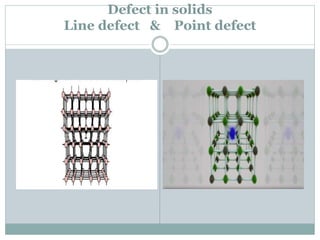
Defect in solids
Line defect & Point defect
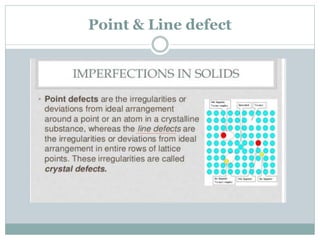
Point & Line defect
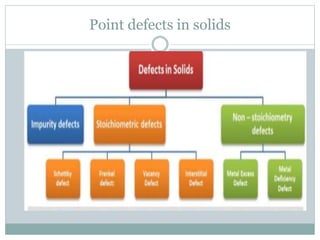
Point defects in solids
Stoichiometric defects
 These are the point defect that do not disturb the
stoichiometry of the constituent particles in the
crystal.
 They are called intrinsic or thermodynamic
defect.
 This defect is of two types.
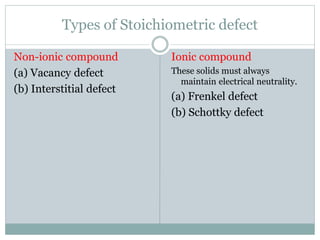
Types of Stoichiometric defect
Non-ionic compound
(a) Vacancy defect
(b) Interstitial defect
Ionic compound
These solids must always
maintain electrical neutrality.
(a) Frenkel defect
(b) Schottky defect
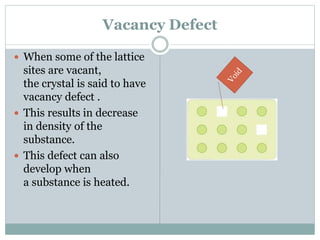
Vacancy Defect
 When some of the lattice
sites are vacant,
the crystal is said to have
vacancy defect .
 This results in decrease
in density of the
substance.
 This defect can also
develop when
a substance is heated.
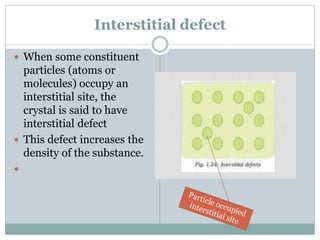
Interstitial defect
 When some constituent
particles (atoms or
molecules) occupy an
interstitial site, the
crystal is said to have
interstitial defect
 This defect increases the
density of the substance.

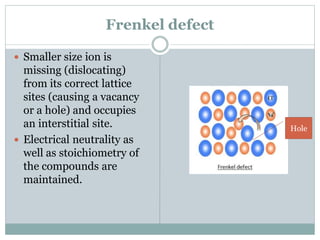
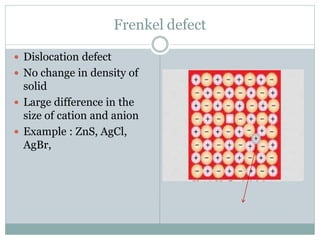
Frenkel defect
 Smaller size ion is
missing (dislocating)
from its correct lattice
sites (causing a vacancy
or a hole) and occupies
an interstitial site.
 Electrical neutrality as
well as stoichiometry of
the compounds are
maintained.
Hole
Frenkel defect
 Dislocation defect
 No change in density of
solid
 Large difference in the
size of cation and anion
 Example : ZnS, AgCl,
AgBr,
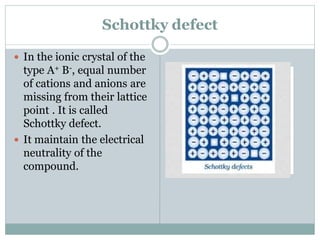
Schottky defect
 In the ionic crystal of the
type A+ B-, equal number
of cations and anions are
missing from their lattice
point . It is called
Schottky defect.
 It maintain the electrical
neutrality of the
compound.
Schottky defect
 Density of the crystal
decreases.
 The size of the Cation
and anion is almost
similar.
 Example : NaCl, KCl,
CsCl, AgBr.
 Example: In NaCl,
there are approximately
106 Schottky pair per cm3
at room temperature. In
1 cm3 there are about
1022 ions. Thus, there is
one Schottky defect per
1016 ions.
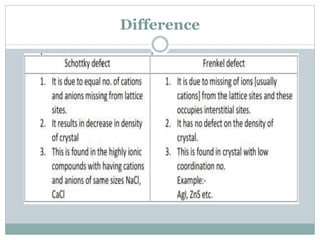
Difference
Impurity Defect
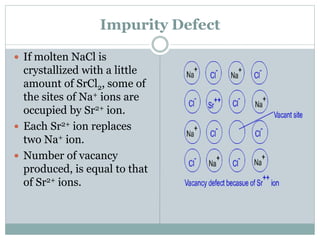
 If molten NaCl is
crystallized with a little
amount of SrCl2, some of
the sites of Na+ ions are
occupied by Sr2+ ion.
 Each Sr2+ ion replaces
two Na+ ion.
 Number of vacancy
produced, is equal to that
of Sr2+ ions.
Non-Stoichiometric defect
 Metal Excess defect
 It is of two types:
(a) Metal excess defect due to
anionic vacancies
(b) Metal excess defect due to
the presence of extra
cation
 Metal deficiency
defect
Non-Stoichiometric defect
Metal excess defect due to anionic vacancies
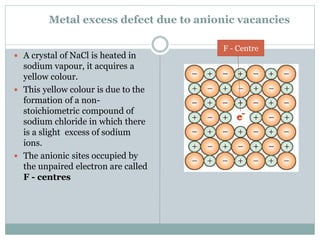
 A crystal of NaCl is heated in
sodium vapour, it acquires a
yellow colour.
 This yellow colour is due to the
formation of a non-
stoichiometric compound of
sodium chloride in which there
is a slight excess of sodium
ions.
 The anionic sites occupied by
the unpaired electron are called
F - centres
F - Centre
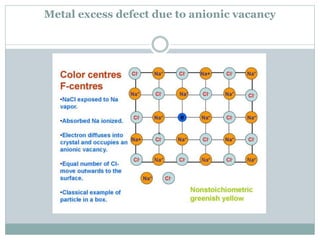
Metal excess defect due to anionic vacancy
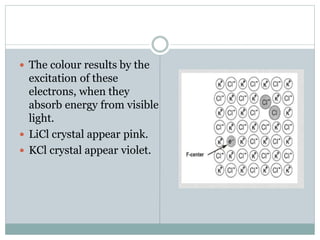
 The colour results by the
excitation of these
electrons, when they
absorb energy from visible
light.
 LiCl crystal appear pink.
 KCl crystal appear violet.
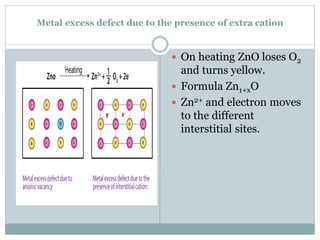
Metal excess defect due to the presence of extra cation
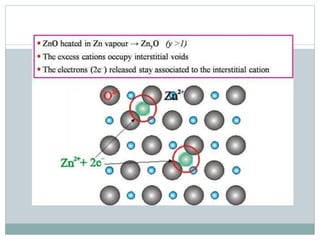
 On heating ZnO loses O2
and turns yellow.
 Formula Zn1+xO
 Zn2+ and electron moves
to the different
interstitial sites.
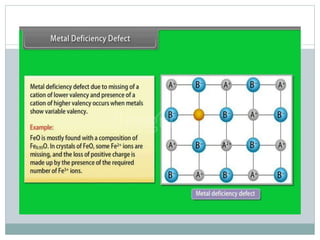
Metal Deficiency defect
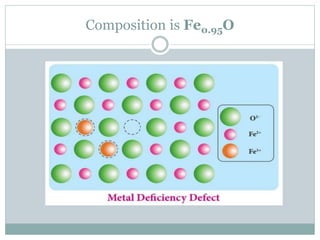
 One of the positive ions is missing from its lattice
site and the extra negative charge is balanced by
some nearby metal ion acquiring two charges
instead of one.
 This type of defect is generally found in the
compounds of transition metals which can
exhibit variable valency.
 Crystals of FeO, FeS and NiO show this type of
defects.
Composition is Fe0.95O
THANKS

Point defect in solids

  • 1.
    Defect in solids Linedefect & Point defect
  • 2.
  • 3.
  • 4.
    Stoichiometric defects  Theseare the point defect that do not disturb the stoichiometry of the constituent particles in the crystal.  They are called intrinsic or thermodynamic defect.  This defect is of two types.
  • 5.
    Types of Stoichiometricdefect Non-ionic compound (a) Vacancy defect (b) Interstitial defect Ionic compound These solids must always maintain electrical neutrality. (a) Frenkel defect (b) Schottky defect
  • 6.
    Vacancy Defect  Whensome of the lattice sites are vacant, the crystal is said to have vacancy defect .  This results in decrease in density of the substance.  This defect can also develop when a substance is heated.
  • 7.
    Interstitial defect  Whensome constituent particles (atoms or molecules) occupy an interstitial site, the crystal is said to have interstitial defect  This defect increases the density of the substance. 
  • 8.
    Frenkel defect  Smallersize ion is missing (dislocating) from its correct lattice sites (causing a vacancy or a hole) and occupies an interstitial site.  Electrical neutrality as well as stoichiometry of the compounds are maintained. Hole
  • 9.
    Frenkel defect  Dislocationdefect  No change in density of solid  Large difference in the size of cation and anion  Example : ZnS, AgCl, AgBr,
  • 10.
    Schottky defect  Inthe ionic crystal of the type A+ B-, equal number of cations and anions are missing from their lattice point . It is called Schottky defect.  It maintain the electrical neutrality of the compound.
  • 11.
    Schottky defect  Densityof the crystal decreases.  The size of the Cation and anion is almost similar.  Example : NaCl, KCl, CsCl, AgBr.  Example: In NaCl, there are approximately 106 Schottky pair per cm3 at room temperature. In 1 cm3 there are about 1022 ions. Thus, there is one Schottky defect per 1016 ions.
  • 12.
  • 13.
    Impurity Defect  Ifmolten NaCl is crystallized with a little amount of SrCl2, some of the sites of Na+ ions are occupied by Sr2+ ion.  Each Sr2+ ion replaces two Na+ ion.  Number of vacancy produced, is equal to that of Sr2+ ions.
  • 14.
    Non-Stoichiometric defect  MetalExcess defect  It is of two types: (a) Metal excess defect due to anionic vacancies (b) Metal excess defect due to the presence of extra cation  Metal deficiency defect
  • 15.
  • 16.
    Metal excess defectdue to anionic vacancies  A crystal of NaCl is heated in sodium vapour, it acquires a yellow colour.  This yellow colour is due to the formation of a non- stoichiometric compound of sodium chloride in which there is a slight excess of sodium ions.  The anionic sites occupied by the unpaired electron are called F - centres F - Centre
  • 17.
    Metal excess defectdue to anionic vacancy
  • 18.
     The colourresults by the excitation of these electrons, when they absorb energy from visible light.  LiCl crystal appear pink.  KCl crystal appear violet.
  • 19.
    Metal excess defectdue to the presence of extra cation  On heating ZnO loses O2 and turns yellow.  Formula Zn1+xO  Zn2+ and electron moves to the different interstitial sites.
  • 21.
    Metal Deficiency defect One of the positive ions is missing from its lattice site and the extra negative charge is balanced by some nearby metal ion acquiring two charges instead of one.  This type of defect is generally found in the compounds of transition metals which can exhibit variable valency.  Crystals of FeO, FeS and NiO show this type of defects.
  • 23.
  • 24.