Tolerance & Allowance
For more help contact me
Muhammad Umair
Bukhari
Engr.umair.bukhari@gmail.com
http://onlinemetallurgy.com
Introduction
 Modern industry has developed on the basis of
interchangeable manufacturing.
 Interchangeable manufacturing means production of
parts to such a degree of accuracy as is necessary to
permit assembly and proper functioning of parts
without further machining or fitting.
 To set the dimension for many product we make
certain gages that measure dimensions. So gages
used for interchangeable manufacturing.
Tolerance
• “The total amount by which a
given dimension may vary, or the
difference between the limits.”
Design Specifications and Tolerance
 Develop from quest for production quality and
efficiency.
 Early tolerances support design’s basic function.
 Mass production brought interchangeability.
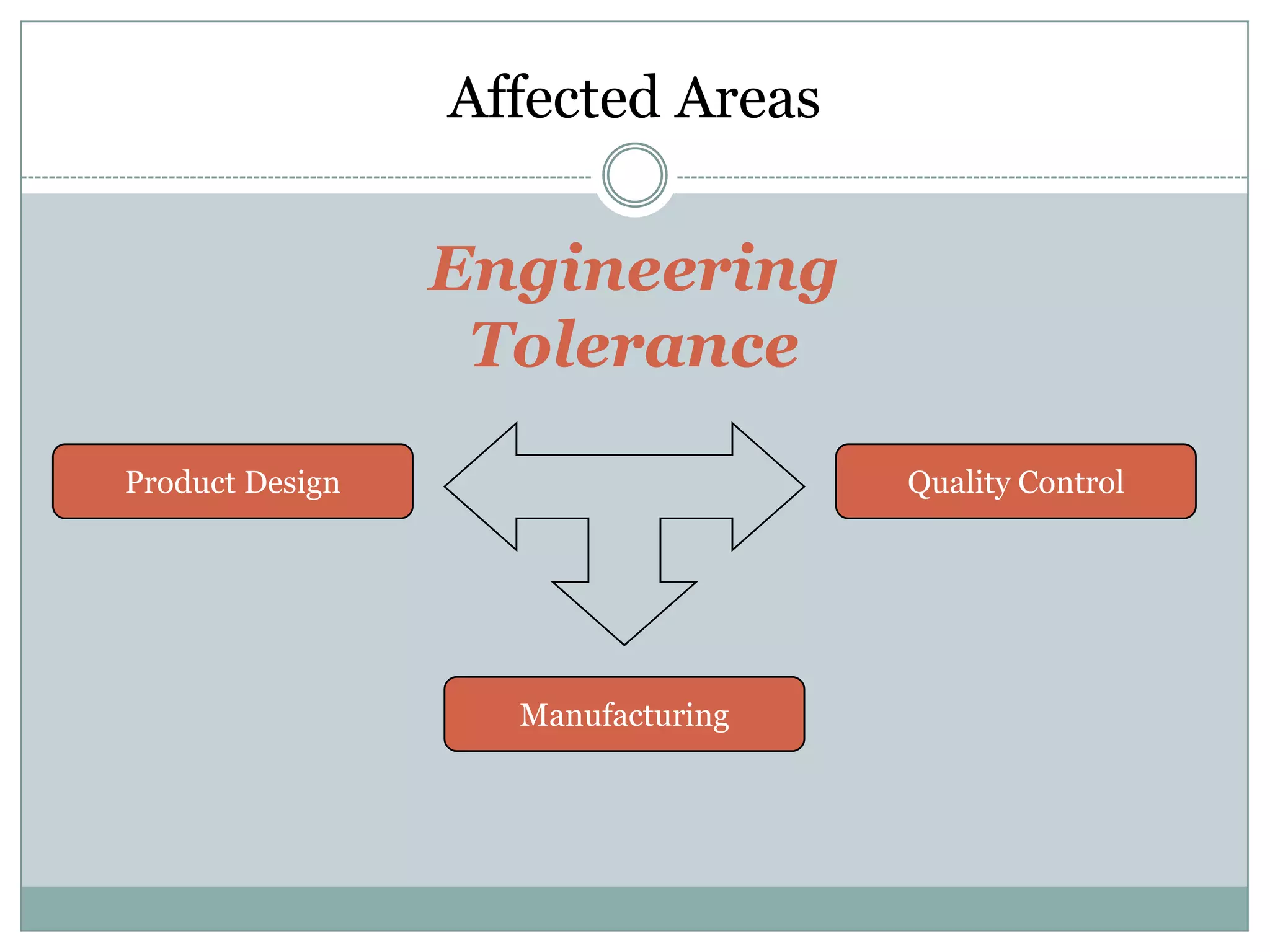
Affected Areas
Product Design Quality Control
Manufacturing
Engineering
Tolerance
Product design
 Product Design has the responsibility
of designing with consideration for
the maximum possible working
tolerances compatible with the
functional requirements of the design.
Manufacturing
 Manufacturing has the responsibility
of bringing the design into a physical
entity with consideration for process
methodologies, capabilities and
economics.
Quality control
 Quality control has the responsibility
of measuring and evaluating the final
product to ensure the integrity of the
product tolerance.
Variation is Unavoidable
• No two manufactured objects are
identical in every way. Some degree
of variation will exist.
• Engineers apply tolerances to part
dimensions to reduce the amount of
variation that occurs.
Tolerances
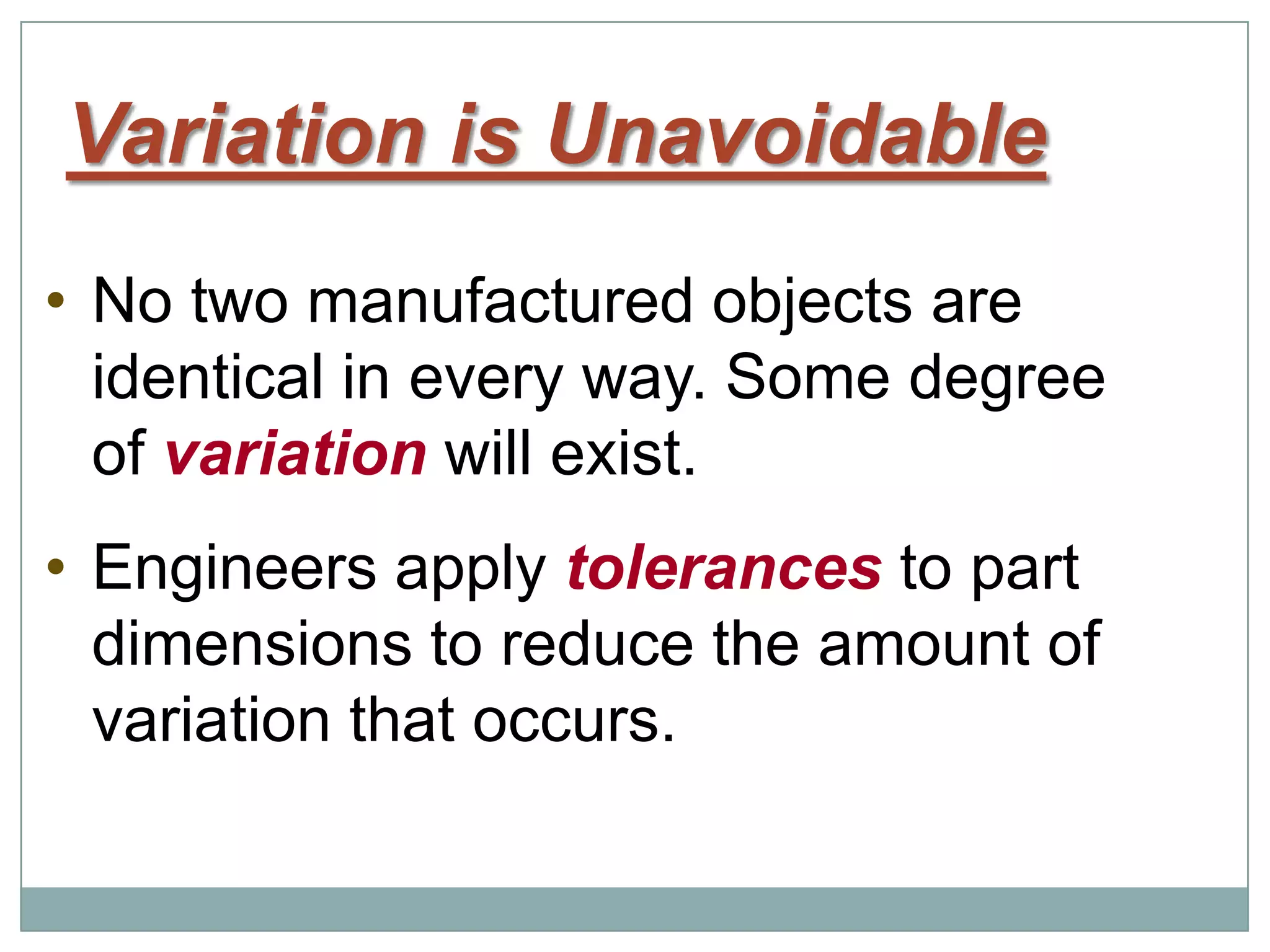
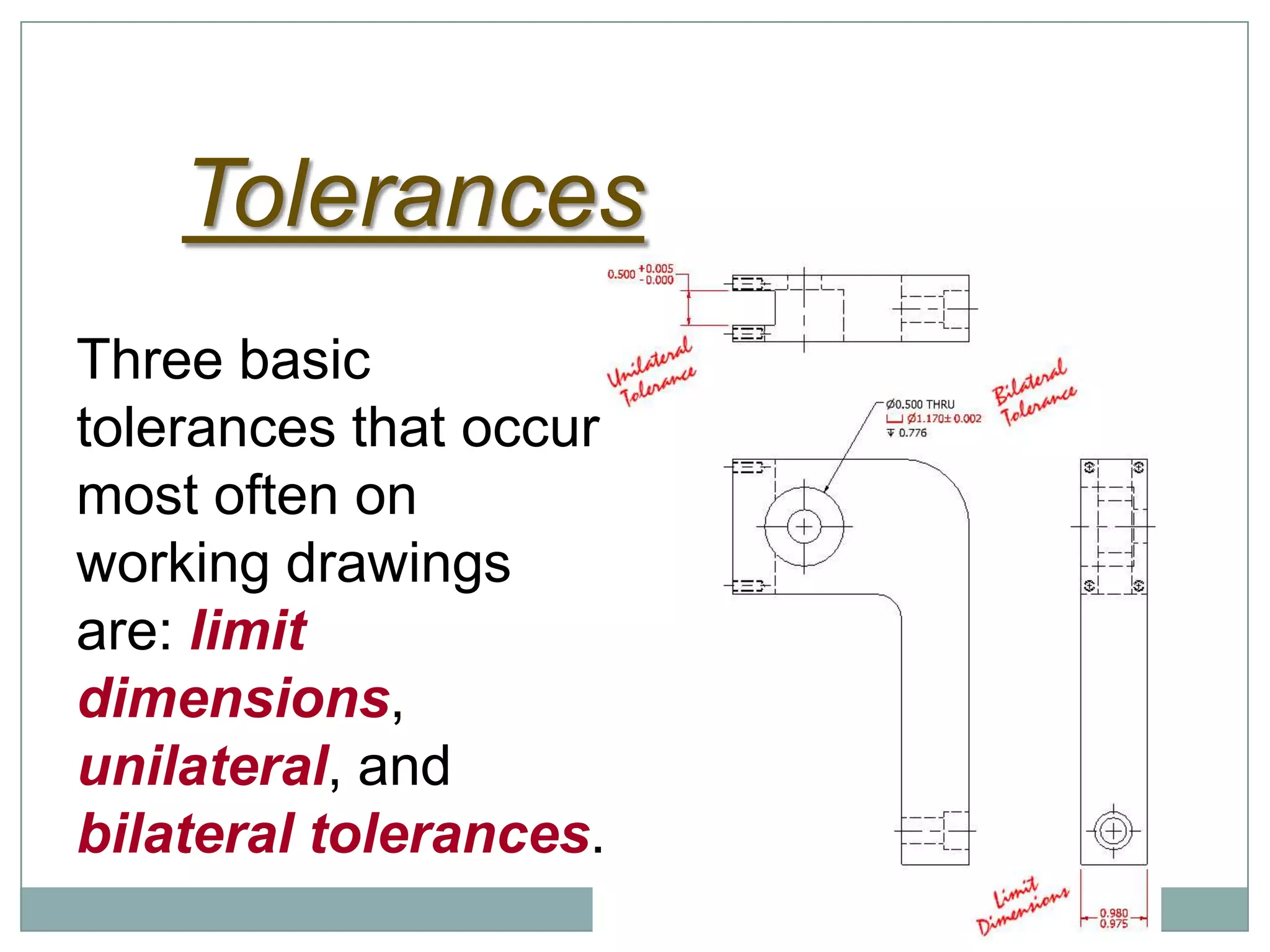
A tolerance is an
acceptable amount
of dimensional
variation that will
still allow an object
to function
correctly.
Tolerances
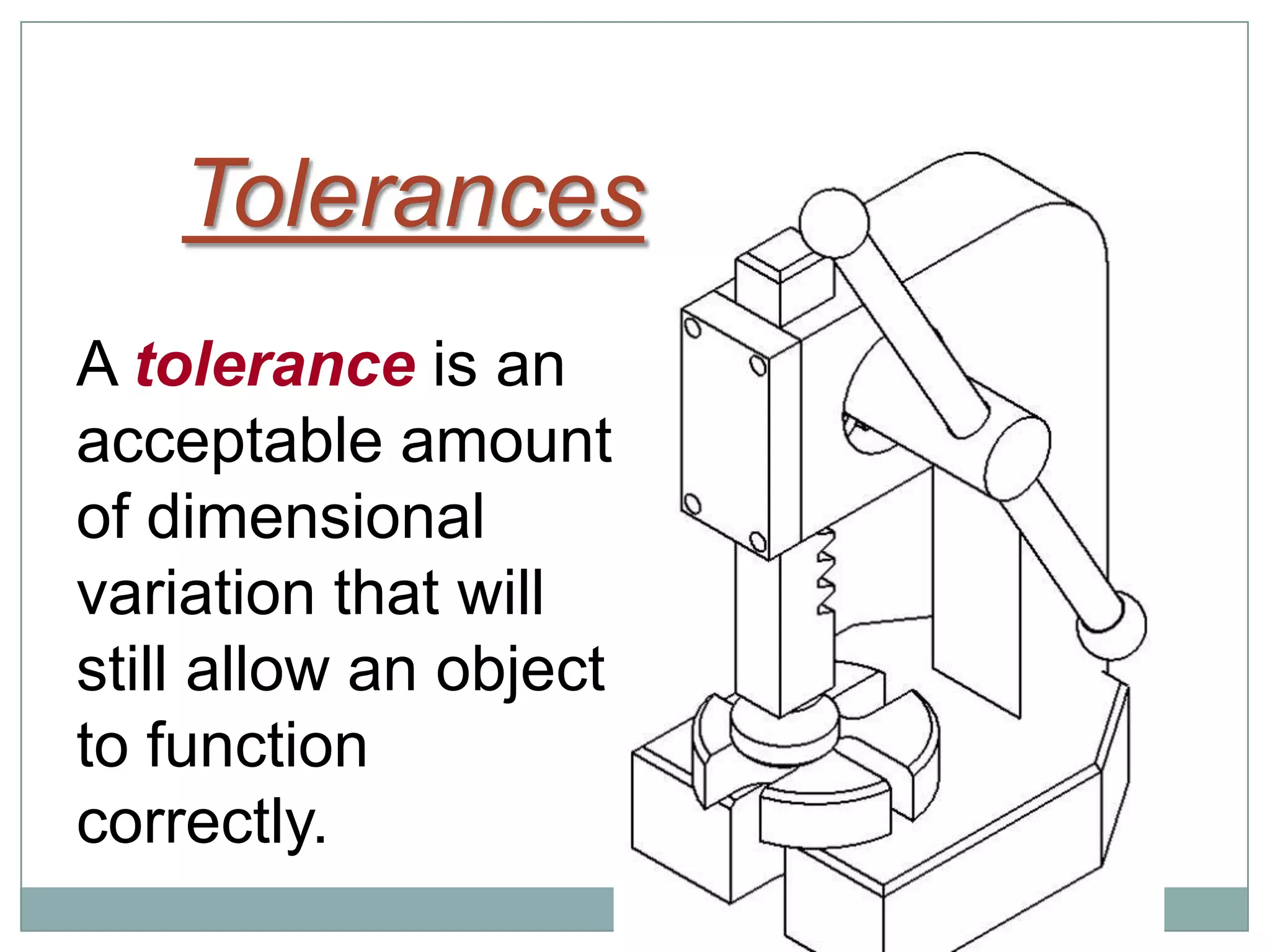
A tolerance is an
acceptable amount
of dimensional
variation that will
still allow an object
to function
correctly.
Tolerances
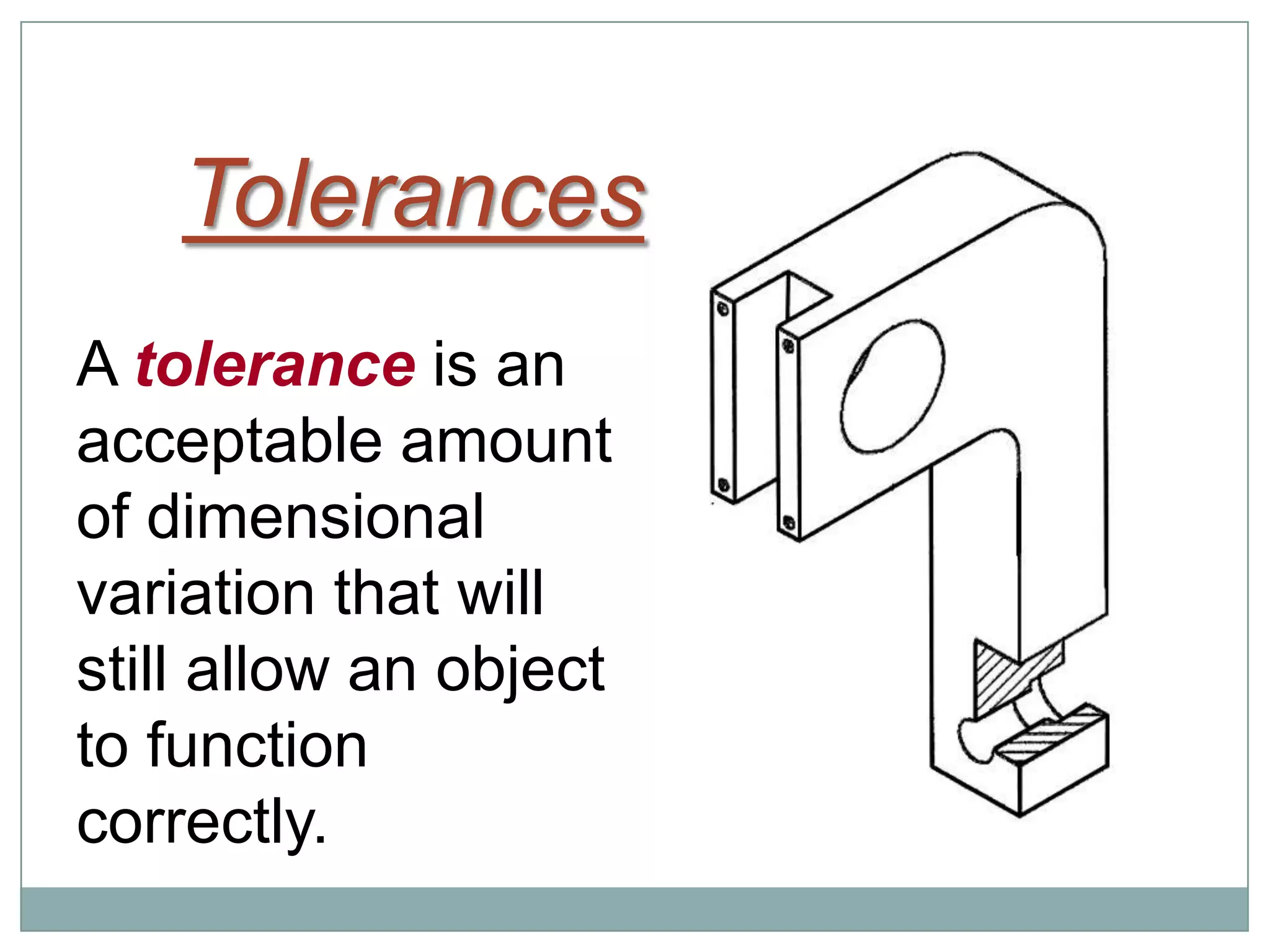
Three basic
tolerances that occur
most often on
working drawings
are: limit
dimensions,
unilateral, and
bilateral tolerances.
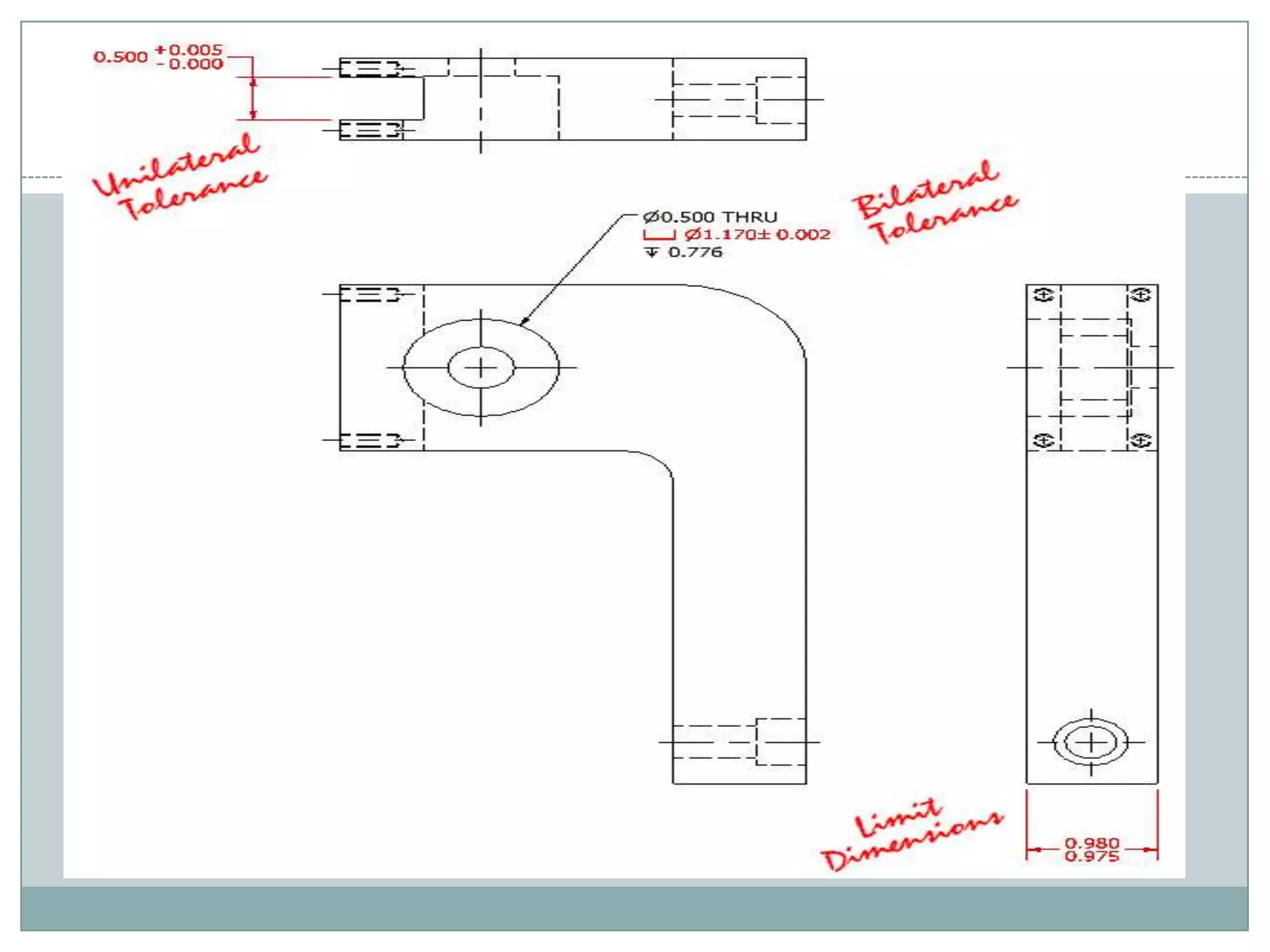
Limit Dimensions
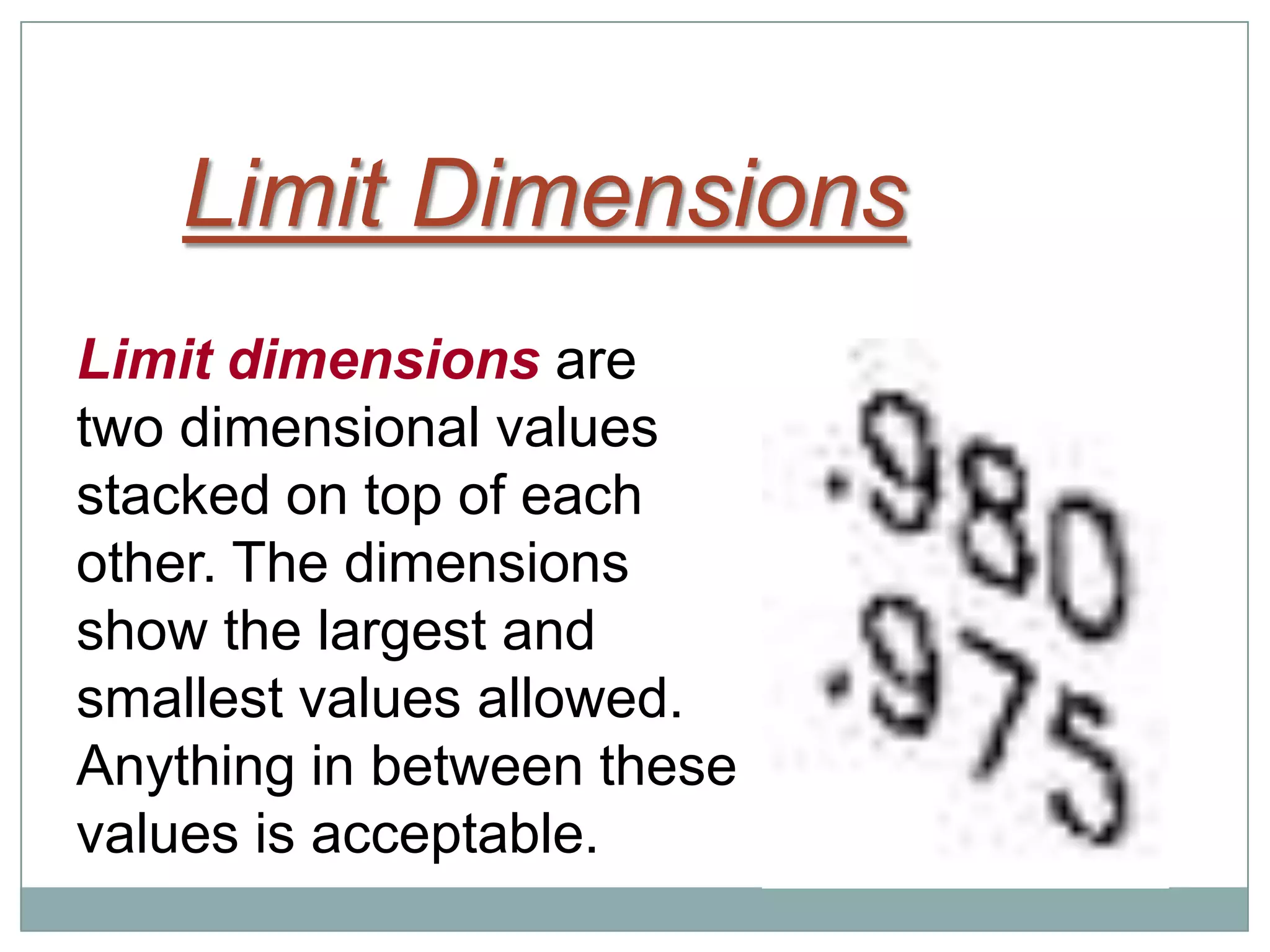
Limit dimensions are
two dimensional values
stacked on top of each
other. The dimensions
show the largest and
smallest values allowed.
Anything in between these
values is acceptable.
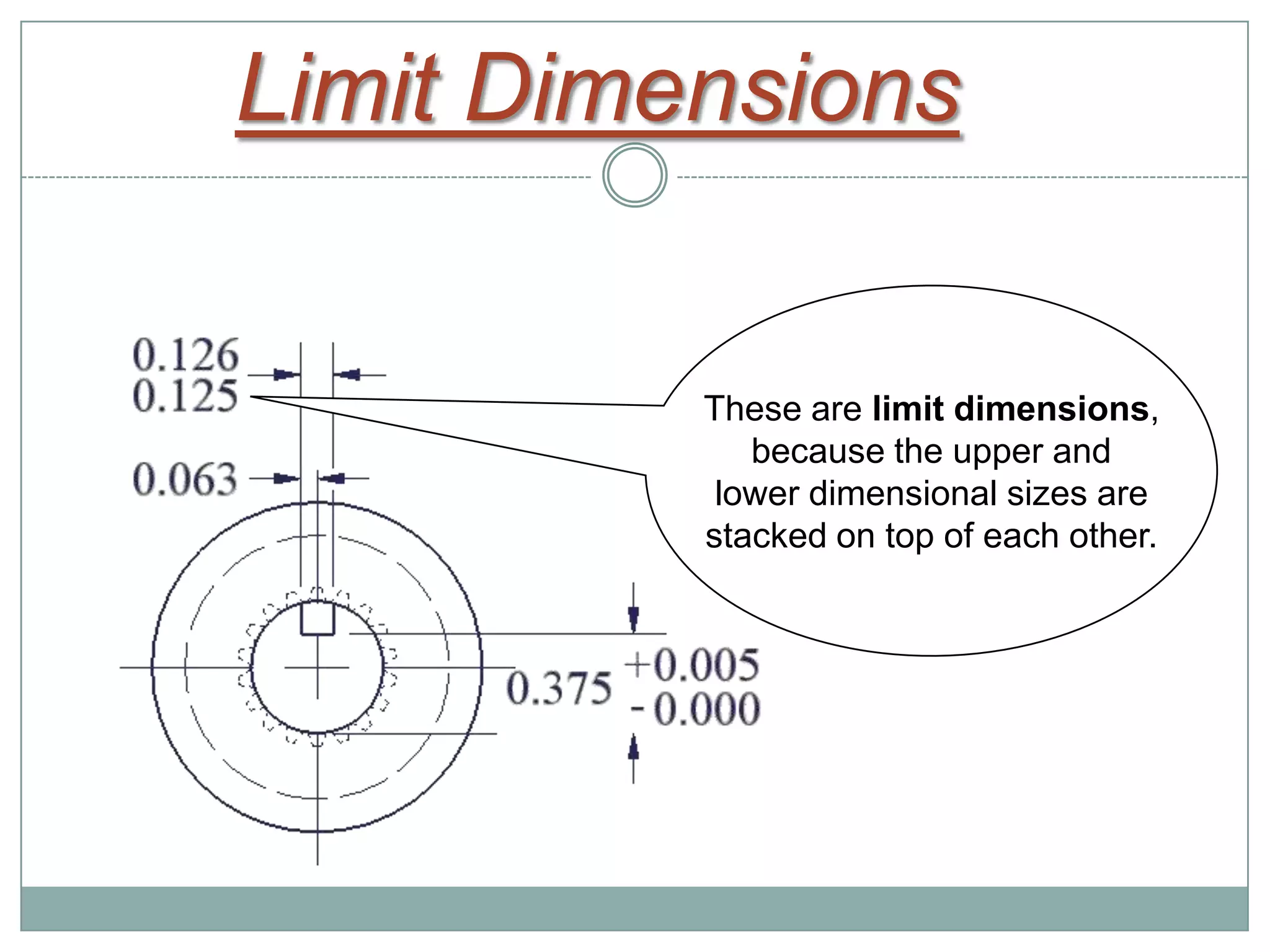
These are limit dimensions,
because the upper and
lower dimensional sizes are
stacked on top of each other.
Limit Dimensions
Unilateral Tolerance
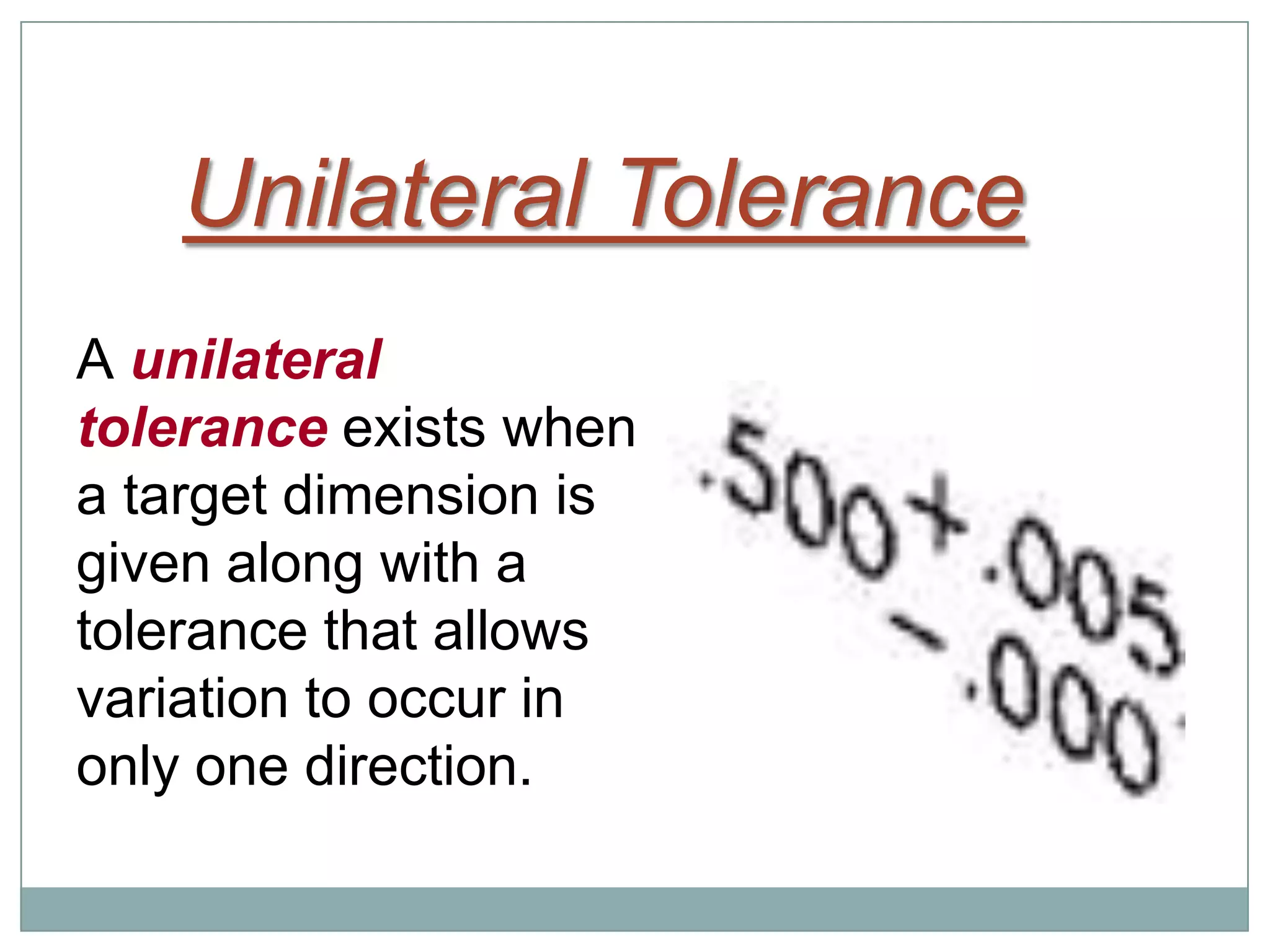
A unilateral
tolerance exists when
a target dimension is
given along with a
tolerance that allows
variation to occur in
only one direction.
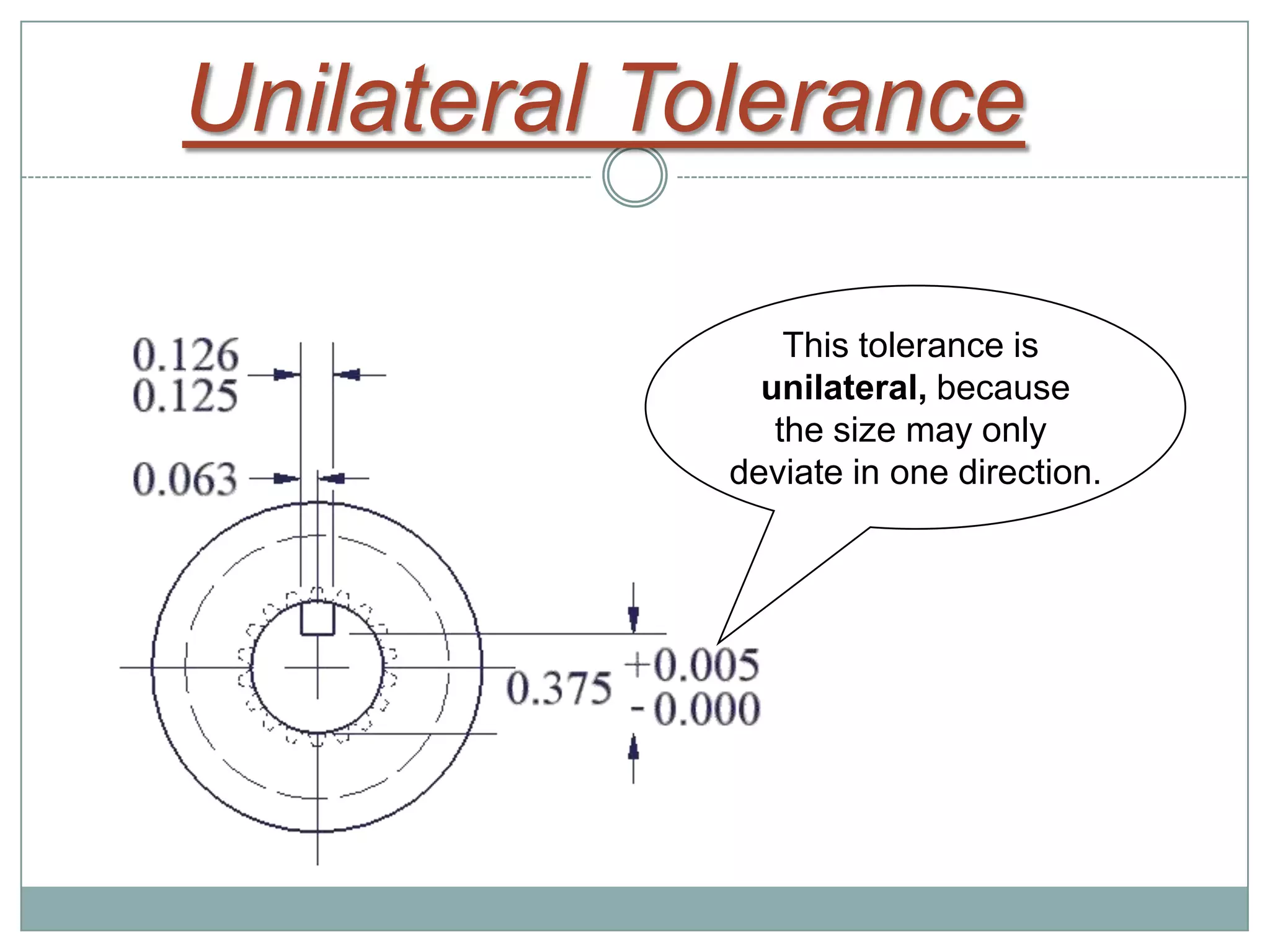
This tolerance is
unilateral, because
the size may only
deviate in one direction.
Unilateral Tolerance
Bilateral Tolerance
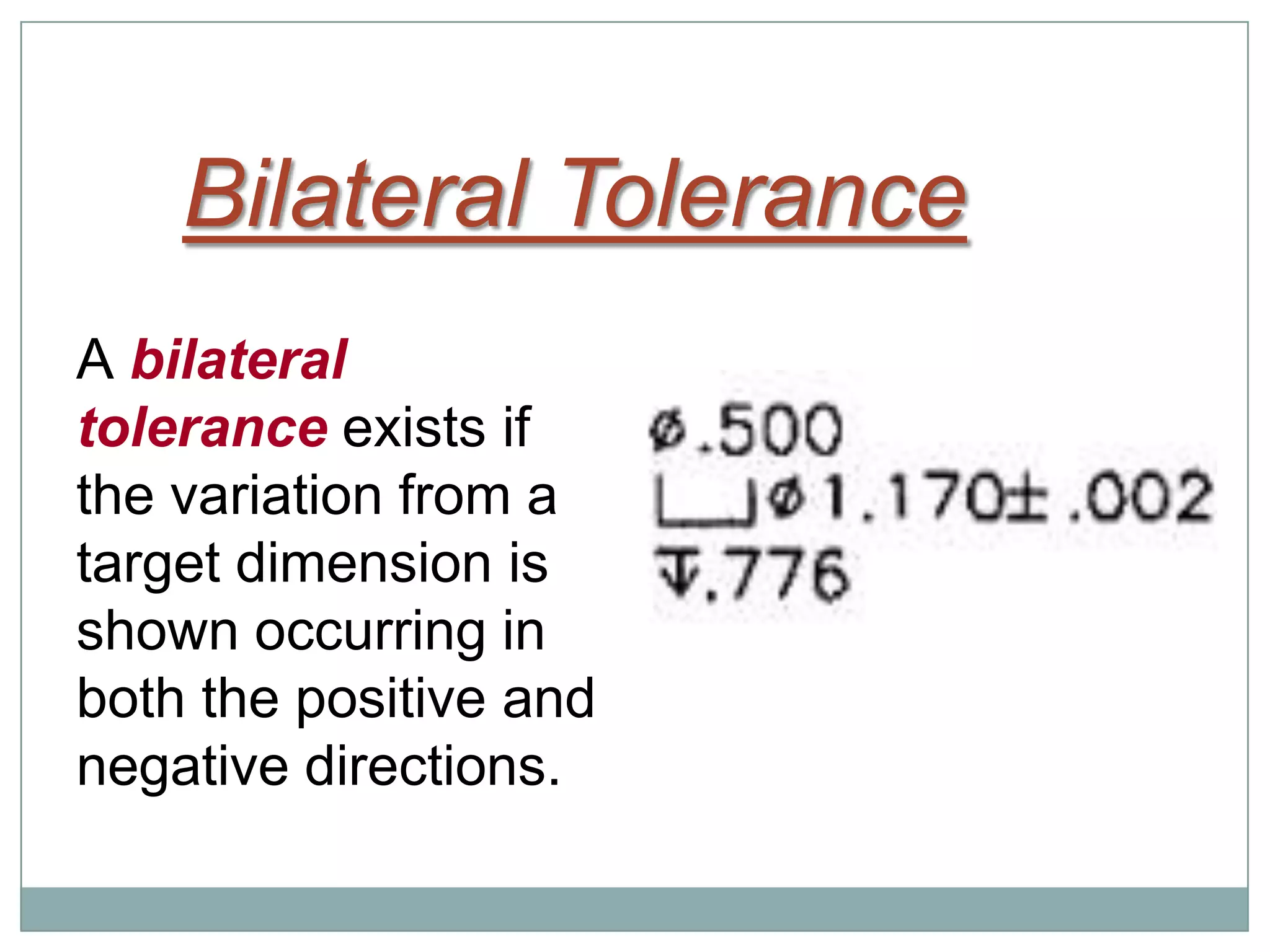
A bilateral
tolerance exists if
the variation from a
target dimension is
shown occurring in
both the positive and
negative directions.
Allowance
 Allowance is a planned deviation between an
actual dimension and
a nominal or theoretical dimension, or between an
intermediate-stage dimension and an intended
final dimension
example
 Outer dimensions (such as the length of a bar) may be
cut intentionally oversize, or inner dimensions (such as
the diameter of a hole) may be cut intentionally
undersize, to allow for a predictable dimensional change
following future cutting, grinding, or heat-
treating operations.
 For example:the outer diameter of a pin may be ground
to 0.0005 inches (0.013 mm) oversize because it is
known that subsequent heat-treatment of the pin is going
to cause it to shrink by 0.0005 inches (0.013 mm).
 A hole may be drilled 0.012 inches (0.30 mm) undersize
to allow for the material that will be removed by
subsequent reaming.
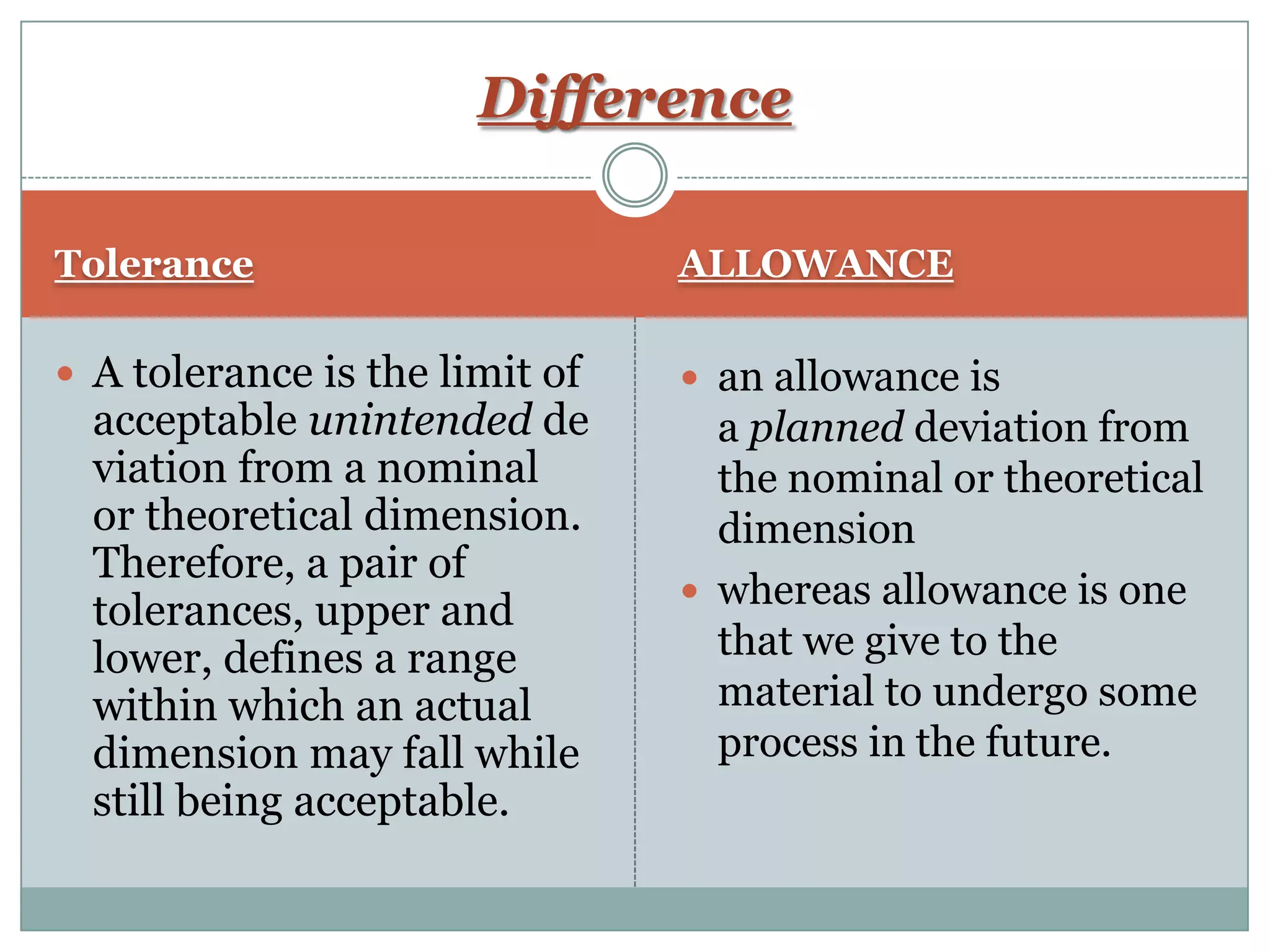
Tolerance ALLOWANCE
 A tolerance is the limit of
acceptable unintended de
viation from a nominal
or theoretical dimension.
Therefore, a pair of
tolerances, upper and
lower, defines a range
within which an actual
dimension may fall while
still being acceptable.
 an allowance is
a planned deviation from
the nominal or theoretical
dimension
 whereas allowance is one
that we give to the
material to undergo some
process in the future.
Difference

Tolerance and allowance 2

  • 1.
  • 2.
    For more helpcontact me Muhammad Umair Bukhari Engr.umair.bukhari@gmail.com http://onlinemetallurgy.com
  • 3.
    Introduction  Modern industryhas developed on the basis of interchangeable manufacturing.  Interchangeable manufacturing means production of parts to such a degree of accuracy as is necessary to permit assembly and proper functioning of parts without further machining or fitting.  To set the dimension for many product we make certain gages that measure dimensions. So gages used for interchangeable manufacturing.
  • 4.
    Tolerance • “The totalamount by which a given dimension may vary, or the difference between the limits.”
  • 5.
    Design Specifications andTolerance  Develop from quest for production quality and efficiency.  Early tolerances support design’s basic function.  Mass production brought interchangeability.
  • 6.
    Affected Areas Product DesignQuality Control Manufacturing Engineering Tolerance
  • 7.
    Product design  ProductDesign has the responsibility of designing with consideration for the maximum possible working tolerances compatible with the functional requirements of the design.
  • 8.
    Manufacturing  Manufacturing hasthe responsibility of bringing the design into a physical entity with consideration for process methodologies, capabilities and economics.
  • 9.
    Quality control  Qualitycontrol has the responsibility of measuring and evaluating the final product to ensure the integrity of the product tolerance.
  • 10.
    Variation is Unavoidable •No two manufactured objects are identical in every way. Some degree of variation will exist. • Engineers apply tolerances to part dimensions to reduce the amount of variation that occurs.
  • 11.
    Tolerances A tolerance isan acceptable amount of dimensional variation that will still allow an object to function correctly.
  • 12.
    Tolerances A tolerance isan acceptable amount of dimensional variation that will still allow an object to function correctly.
  • 13.
    Tolerances Three basic tolerances thatoccur most often on working drawings are: limit dimensions, unilateral, and bilateral tolerances.
  • 14.
    Limit Dimensions Limit dimensionsare two dimensional values stacked on top of each other. The dimensions show the largest and smallest values allowed. Anything in between these values is acceptable.
  • 15.
    These are limitdimensions, because the upper and lower dimensional sizes are stacked on top of each other. Limit Dimensions
  • 16.
    Unilateral Tolerance A unilateral toleranceexists when a target dimension is given along with a tolerance that allows variation to occur in only one direction.
  • 17.
    This tolerance is unilateral,because the size may only deviate in one direction. Unilateral Tolerance
  • 18.
    Bilateral Tolerance A bilateral toleranceexists if the variation from a target dimension is shown occurring in both the positive and negative directions.
  • 20.
    Allowance  Allowance isa planned deviation between an actual dimension and a nominal or theoretical dimension, or between an intermediate-stage dimension and an intended final dimension
  • 21.
    example  Outer dimensions(such as the length of a bar) may be cut intentionally oversize, or inner dimensions (such as the diameter of a hole) may be cut intentionally undersize, to allow for a predictable dimensional change following future cutting, grinding, or heat- treating operations.  For example:the outer diameter of a pin may be ground to 0.0005 inches (0.013 mm) oversize because it is known that subsequent heat-treatment of the pin is going to cause it to shrink by 0.0005 inches (0.013 mm).  A hole may be drilled 0.012 inches (0.30 mm) undersize to allow for the material that will be removed by subsequent reaming.
  • 22.
    Tolerance ALLOWANCE  Atolerance is the limit of acceptable unintended de viation from a nominal or theoretical dimension. Therefore, a pair of tolerances, upper and lower, defines a range within which an actual dimension may fall while still being acceptable.  an allowance is a planned deviation from the nominal or theoretical dimension  whereas allowance is one that we give to the material to undergo some process in the future. Difference