Muhammad Umair
Bukhari
Engr.umair.bukhari@gmail.com
http://onlinemetallurgy.com
TIME TEMPERATURE
TRANSFORMATION CURVES
Isothermal curves deals with the study
of the change in phase at constant
temperature
From these reaction curves, the time
required to start the transformation
and the time required to complete the
transformation can be obtained.
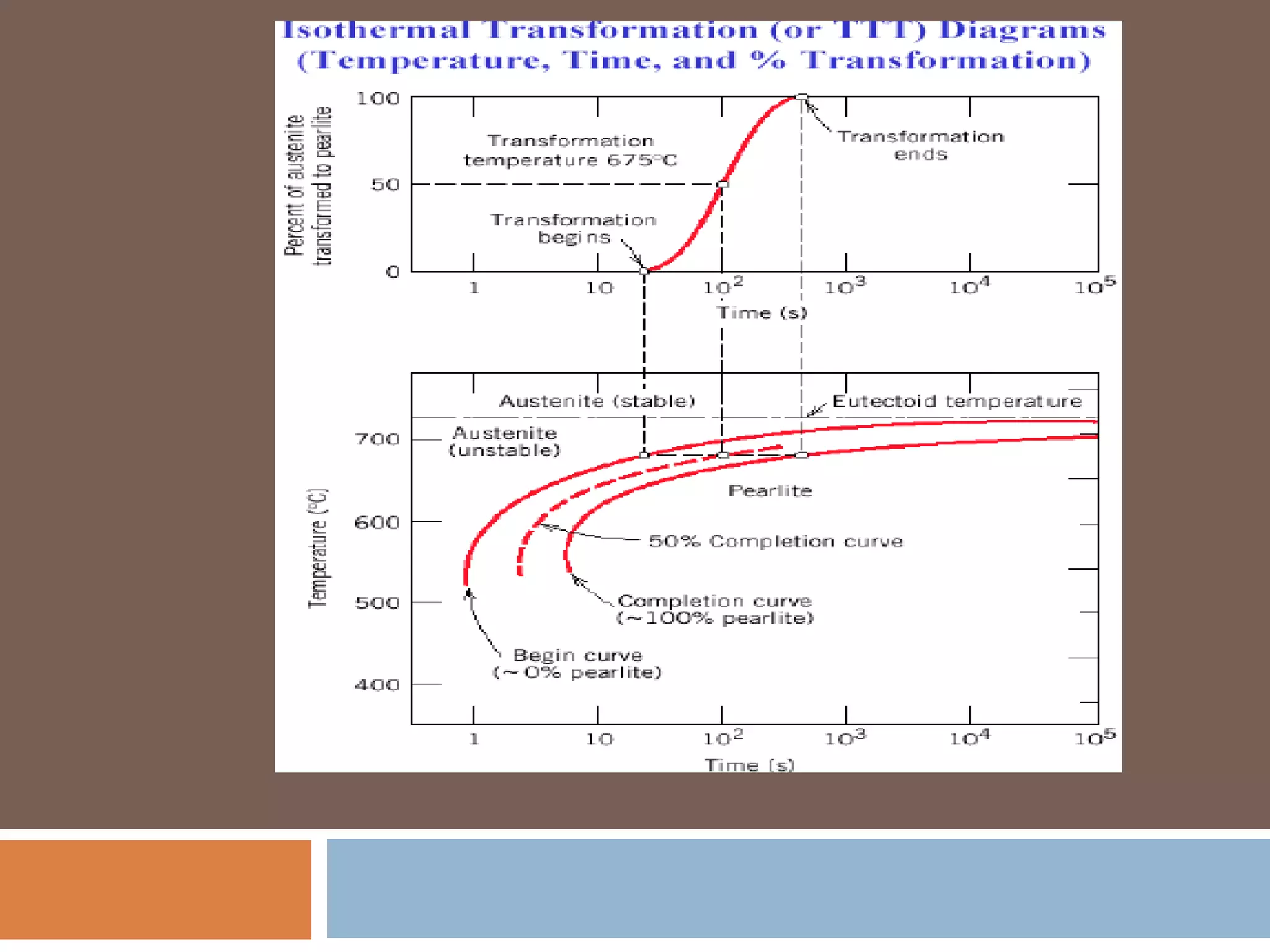
The partial isothermal diagram for the
iron-carbon steel is shown.
CONTD.
The area to the left of the C-shaped curve
represents an austenitic structure and the area to
the right of these two curves represents a pearlitic
structure.
Between these two curves is a region containing
pearlite and austenite with the relative ratios varying
from all austenite to pearlite as on moves from left to
right.
The most important information that we get from
TTT diagram is that very short time is required to
form pearlite at temperature around 600 C (800K).
CONTD.
This TTT diagram corresponds only to the
reaction of austenite to pearlite.It does not
corresponds to the transformation of austenite
which occur at temperature below about 823K
(550C).
For the complete study of TTT diagram, it is
necessary to understand two types of austenitic
reactions which are:
Austenitic to martensitic reaction.
Austenitic to bainitic reaction.
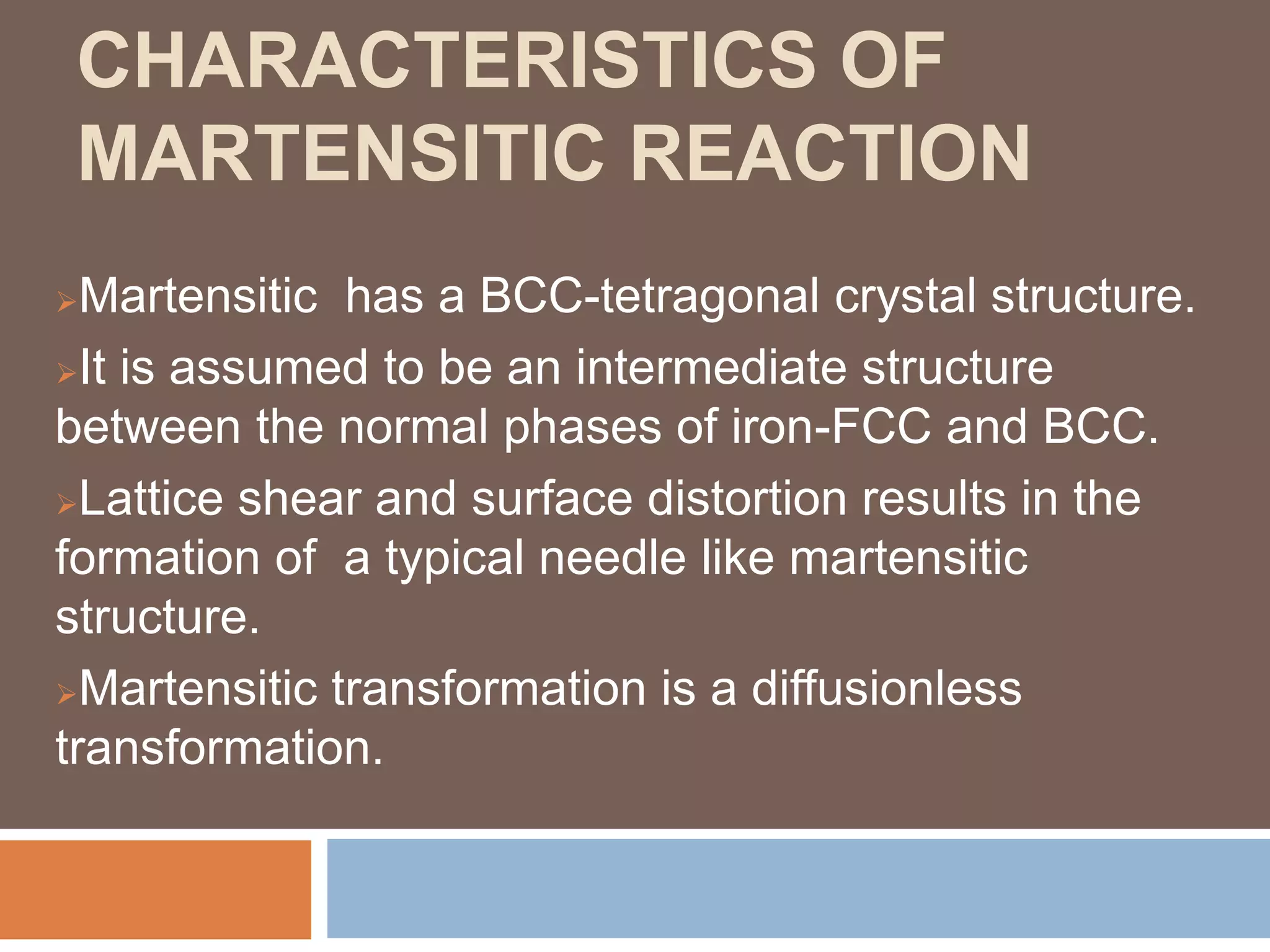
MARTENSITIC REACTION
A reaction which takes place
in some metals on cooling with
the formation of a needle like
structure is called a martensitic
reaction.
CHARACTERISTICS OF
MARTENSITIC REACTION
Martensitic has a BCC-tetragonal crystal structure.
It is assumed to be an intermediate structure
between the normal phases of iron-FCC and BCC.
Lattice shear and surface distortion results in the
formation of a typical needle like martensitic
structure.
Martensitic transformation is a diffusionless
transformation.
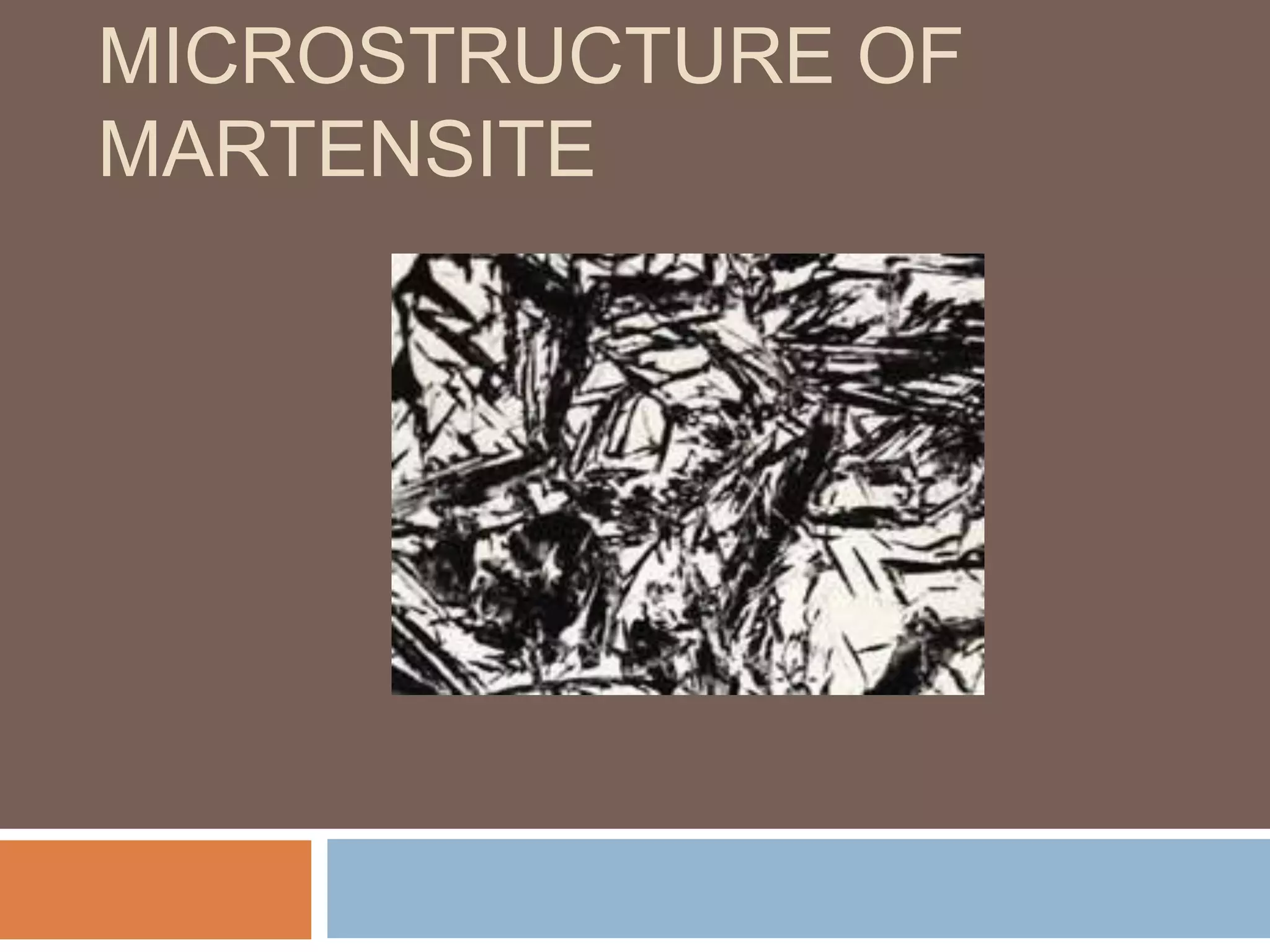
MICROSTRUCTURE OF
MARTENSITE
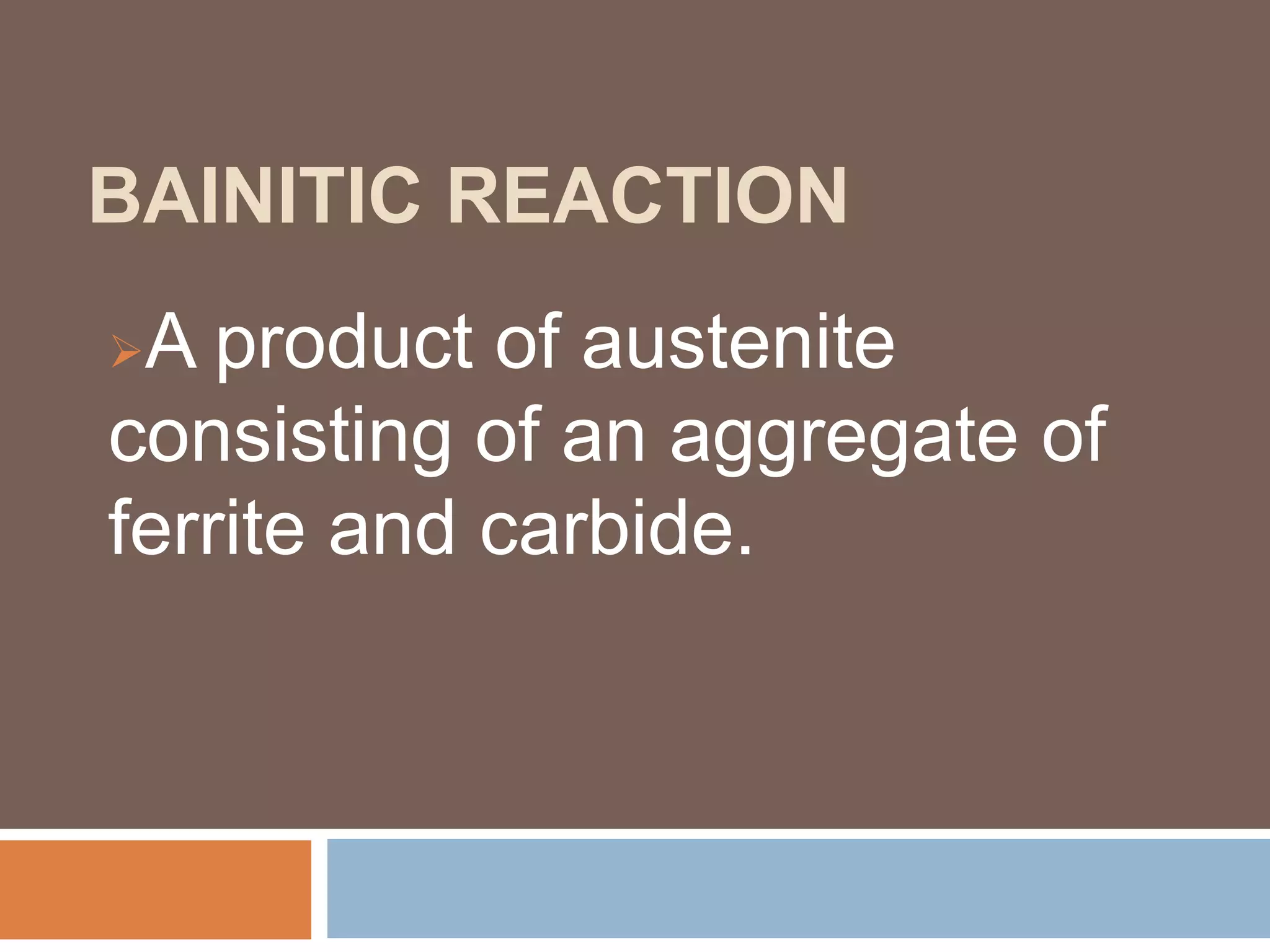
BAINITIC REACTION
A product of austenite
consisting of an aggregate of
ferrite and carbide.
CHARATERISTICS OF BAINITIC
REACTION
Bainite generally forms at temperature
lower than those where very fine pearlite
forms and higher than those where
martensite begins to form on cooling.
Bainite forms at temperature around 300-
500C is termed as “Upper bainite”.
Bainite forms at temperature around 200-
300C is termed as “Lower bainite”.
CONTD.
In iron-carbon steel, bainite transfornation
tend to overlap the austenite to pearlite
transformtion so it is difficult to distinguish
between pearlitic transformation and bainitic
transformation.
The puzzling feature of bainite reaction is its
dual nature i.e in a no. of respects it reavels
properties similar to that of paerlitic reaction
and at the same time it shows some
properties similar to that of martensitic-
transformation.
CONTD.
Bainitic transformation involves
compositional changes and requries the
diffusion of carbon. In this respect it
differs from a martensitic transformation.
Another property that differs it from a
martensitic transformation is that it is not
an athermal transformation.
CONTD.
Bainitic structure does not have
alternative parallel layers of ferrite and
cementite.In this respect it differs from a
pearlitic structure.
Due to unequal growth rates, bainite
tends to develop in the form of plates or
needle like structure which is a typical
martensitic characteristic.
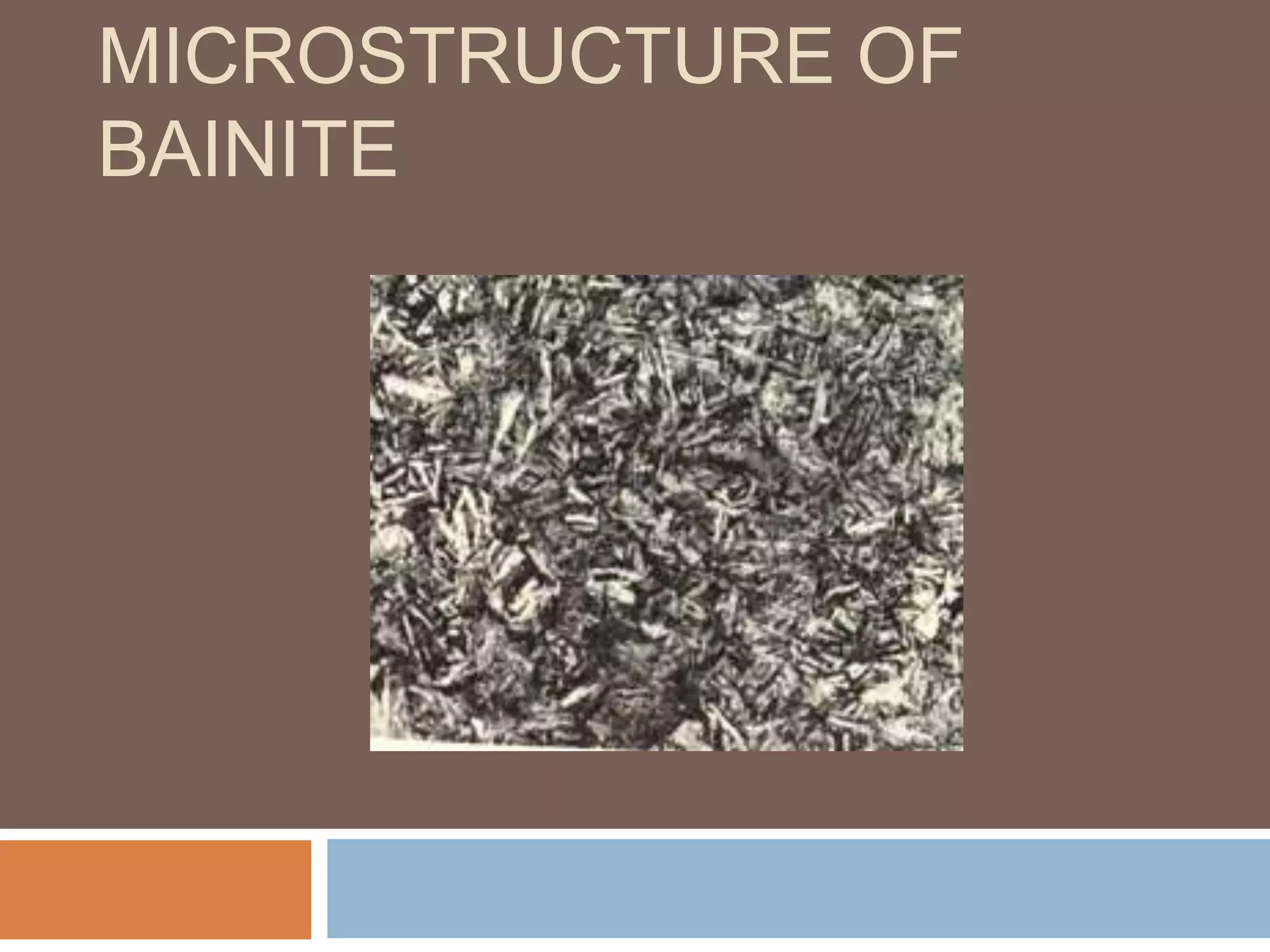
MICROSTRUCTURE OF
BAINITE
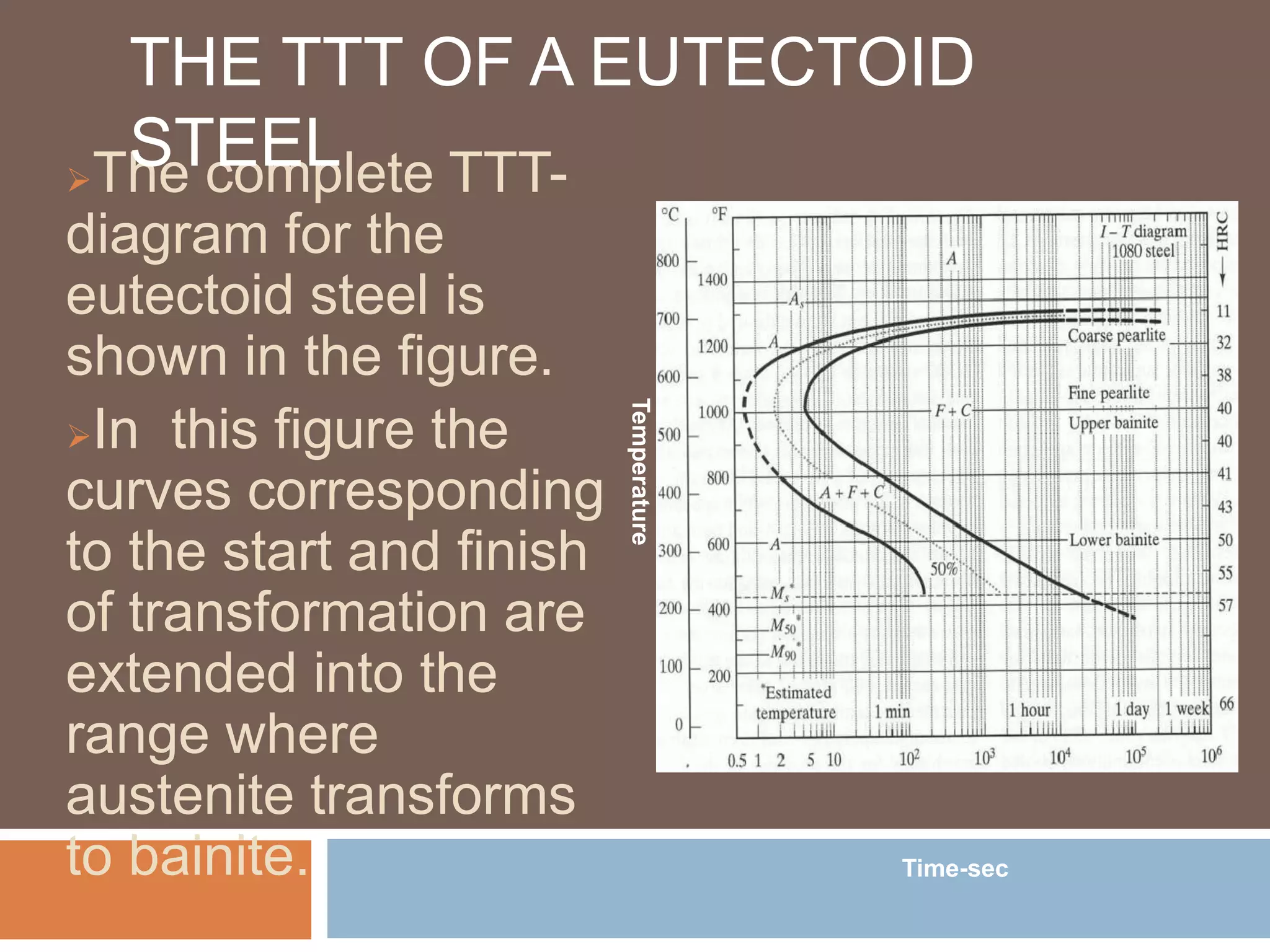
The complete TTT-
diagram for the
eutectoid steel is
shown in the figure.
In this figure the
curves corresponding
to the start and finish
of transformation are
extended into the
range where
austenite transforms
to bainite.
THE TTT OF A EUTECTOID
STEEL
Time-sec
Temperature
Cont’d
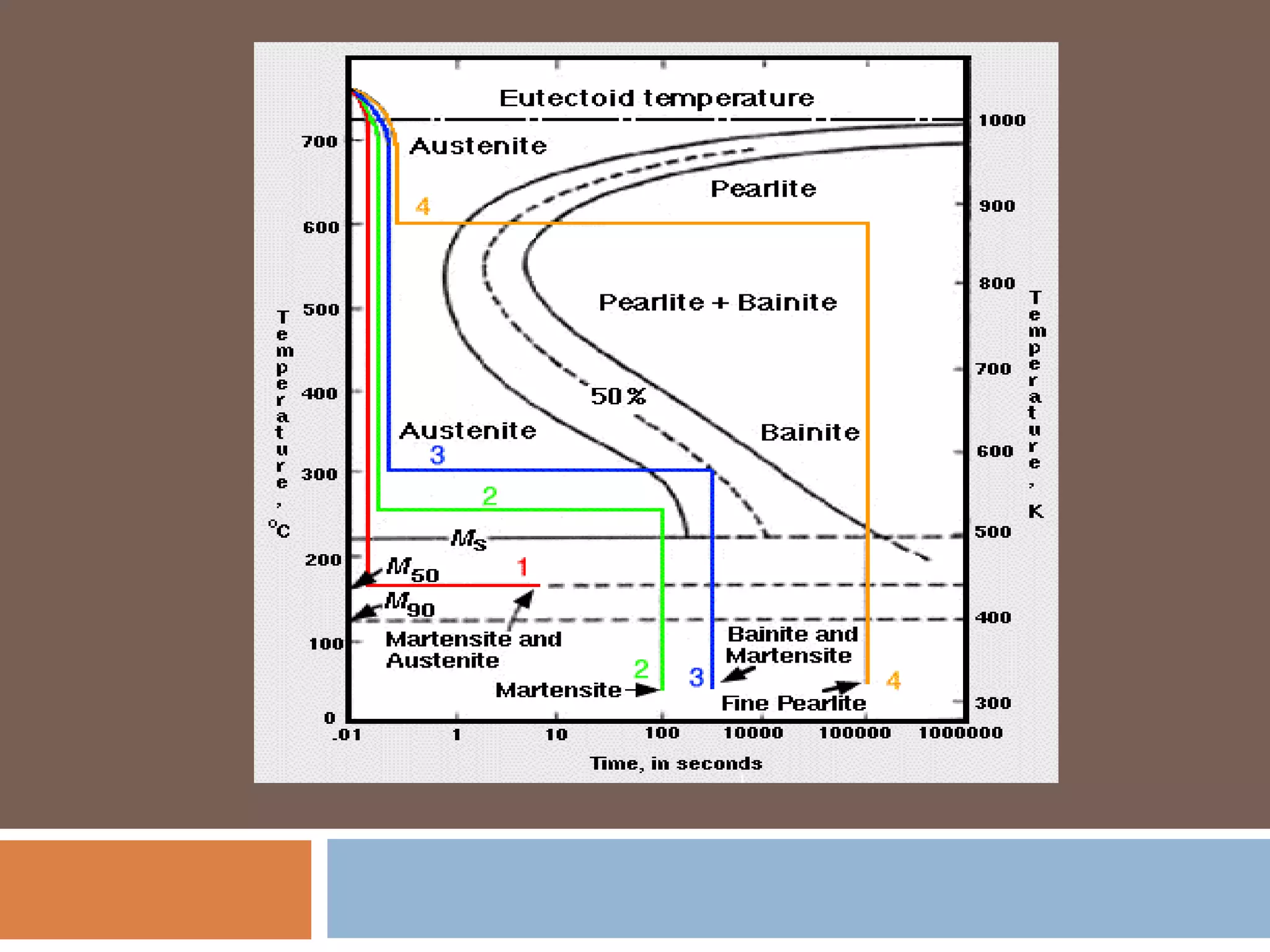
 Consider some arbitrary time-
temperature paths along which it
is assumed that austenitized
specimen are carried to room
temperature. These paths are
shown in the figure given as:
 PATH 1
 The specimen is cooled rapidly to 433k and left
there for 20 min, the steel remains in the
austenitic phase until the martensitic temp is
passed where martensite is begins to form
athermally @ 433k (160C) half of the austenite
transforms to martensite.
 PATH 2
 . The specimen is held at 523K and left there for
100 sec, so the second quench from 523K to
room temperature forms a martensitic structure
 PATH 3
 An isothermal hold at 573K for 500 sec produces
half bainite and half austenite. cooling quickly
would result in final structure of martensite and
bainite.
 PATH 4
 Austenite completely to fine pearlite after 8 sec at
873K.this phase is stable and will not be
changed on holding for 100,000 sec at 873 sec
the final structure, when cooled, is fine pearlite.
Conclusion
 Fine pearlite is harder and
stronger than coarse pearlite.
 Bainite is harder and stronger than
pearlite.
 Martensite is the hardest,
strongest and the most brittle.
References
Physical Metallurgy principle
By REED HILL

Time temperature transformation curves 2

  • 2.
  • 3.
    TIME TEMPERATURE TRANSFORMATION CURVES Isothermalcurves deals with the study of the change in phase at constant temperature From these reaction curves, the time required to start the transformation and the time required to complete the transformation can be obtained. The partial isothermal diagram for the iron-carbon steel is shown.
  • 5.
    CONTD. The area tothe left of the C-shaped curve represents an austenitic structure and the area to the right of these two curves represents a pearlitic structure. Between these two curves is a region containing pearlite and austenite with the relative ratios varying from all austenite to pearlite as on moves from left to right. The most important information that we get from TTT diagram is that very short time is required to form pearlite at temperature around 600 C (800K).
  • 6.
    CONTD. This TTT diagramcorresponds only to the reaction of austenite to pearlite.It does not corresponds to the transformation of austenite which occur at temperature below about 823K (550C). For the complete study of TTT diagram, it is necessary to understand two types of austenitic reactions which are: Austenitic to martensitic reaction. Austenitic to bainitic reaction.
  • 7.
    MARTENSITIC REACTION A reactionwhich takes place in some metals on cooling with the formation of a needle like structure is called a martensitic reaction.
  • 8.
    CHARACTERISTICS OF MARTENSITIC REACTION Martensitichas a BCC-tetragonal crystal structure. It is assumed to be an intermediate structure between the normal phases of iron-FCC and BCC. Lattice shear and surface distortion results in the formation of a typical needle like martensitic structure. Martensitic transformation is a diffusionless transformation.
  • 9.
  • 10.
    BAINITIC REACTION A productof austenite consisting of an aggregate of ferrite and carbide.
  • 11.
    CHARATERISTICS OF BAINITIC REACTION Bainitegenerally forms at temperature lower than those where very fine pearlite forms and higher than those where martensite begins to form on cooling. Bainite forms at temperature around 300- 500C is termed as “Upper bainite”. Bainite forms at temperature around 200- 300C is termed as “Lower bainite”.
  • 12.
    CONTD. In iron-carbon steel,bainite transfornation tend to overlap the austenite to pearlite transformtion so it is difficult to distinguish between pearlitic transformation and bainitic transformation. The puzzling feature of bainite reaction is its dual nature i.e in a no. of respects it reavels properties similar to that of paerlitic reaction and at the same time it shows some properties similar to that of martensitic- transformation.
  • 13.
    CONTD. Bainitic transformation involves compositionalchanges and requries the diffusion of carbon. In this respect it differs from a martensitic transformation. Another property that differs it from a martensitic transformation is that it is not an athermal transformation.
  • 14.
    CONTD. Bainitic structure doesnot have alternative parallel layers of ferrite and cementite.In this respect it differs from a pearlitic structure. Due to unequal growth rates, bainite tends to develop in the form of plates or needle like structure which is a typical martensitic characteristic.
  • 15.
  • 16.
    The complete TTT- diagramfor the eutectoid steel is shown in the figure. In this figure the curves corresponding to the start and finish of transformation are extended into the range where austenite transforms to bainite. THE TTT OF A EUTECTOID STEEL Time-sec Temperature
  • 17.
    Cont’d  Consider somearbitrary time- temperature paths along which it is assumed that austenitized specimen are carried to room temperature. These paths are shown in the figure given as:
  • 19.
     PATH 1 The specimen is cooled rapidly to 433k and left there for 20 min, the steel remains in the austenitic phase until the martensitic temp is passed where martensite is begins to form athermally @ 433k (160C) half of the austenite transforms to martensite.  PATH 2  . The specimen is held at 523K and left there for 100 sec, so the second quench from 523K to room temperature forms a martensitic structure
  • 20.
     PATH 3 An isothermal hold at 573K for 500 sec produces half bainite and half austenite. cooling quickly would result in final structure of martensite and bainite.  PATH 4  Austenite completely to fine pearlite after 8 sec at 873K.this phase is stable and will not be changed on holding for 100,000 sec at 873 sec the final structure, when cooled, is fine pearlite.
  • 21.
    Conclusion  Fine pearliteis harder and stronger than coarse pearlite.  Bainite is harder and stronger than pearlite.  Martensite is the hardest, strongest and the most brittle.
  • 22.