 An important feature of crystal is the regular atomic
arrangement but no crystal is perfectly regular.
 Any deviation from this perfect atomic periodicity is
an imperfection which also called as lattice defect.
 Lattice defect – a state in which the atomic
arrangement(it`s structure) in smaller region of a
crystal has departed from regularity.
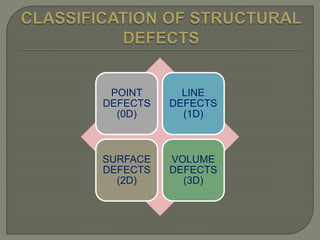
POINT
DEFECTS
(0D)
LINE
DEFECTS
(1D)
SURFACE
DEFECTS
(2D)
VOLUME
DEFECTS
(3D)
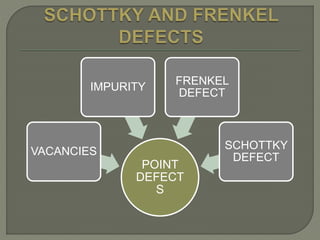
POINT
DEFECT
S
VACANCIES
IMPURITY
FRENKEL
DEFECT
SCHOTTKY
DEFECT
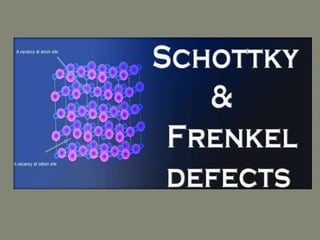
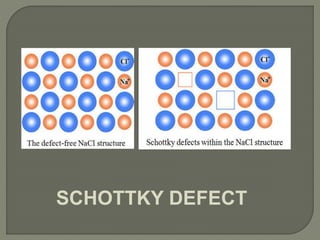
 A Schottky defect is a type of point defect in a crystal
lattice named after Walter H. Schottky.
 In non-ionic crystals it means a lattice vacancy
defect.
 In ionic crystals, the defect forms when oppositely
charged ions leave their lattice sites,
creating vacancies. These vacancies are formed
in stoichiometric units, to maintain an overall neutral
charge in the ionic solid.
 If in an ionic crystal of the type A+ B-, equal
number of cations and anions are missing from their
lattice. It is called Schottky defect.
 Just because the equal no. of anion and cation are
missing, the whole crystal arrangement is maintained
as electrically neutral.
 This occurs only when there is small difference in
size of cations and anions.
 This type of defect is shown by highly ionic
compounds such as
 NaCl,
 KCl,
 CsCl,
 AgBr,
 KBr
 And it also have a high co – ordination number.
Consequences of Schottky
defect
 As the number of ions decreases as a result of this
defect, the mass decreases whereas the volume
remains the same. Hence density of the solid
decreases,
 The crystal begins to conduct electricity to a
small extent by ionic mechanism,
 The presence of too many voids lowers lattice
energy and the stability of the crystal.
SCHOTTKY DEFECT
 The phenomenon is named after
the Soviet physicist YakovFrenkel, who
discovered it in 1926.
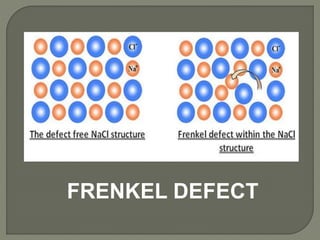
 A Frenkel defect is a type of defect in crystalline
solids wherein an atom is displaced from its lattice
position to an interstitial site, creating a vacancy at
the original site and an interstitial defect at the
new location within the same element without any
changes in chemical properties.
 A Frenkel defect, Frenkel pair, or Frenkel
disorder is a type of point defect in a crystal lattice.
The defect forms when an atom or smaller ion
(usually cation) leaves its place in the lattice, creating
a vacancy, and becomes an interstitial by lodging in a
nearby location.
 Since cations are usually smaller it is more
common to find the cations occupying interstitial
sites.
 So it is a combination of vacancy and interstitial
atom.
FRENKEL DEFECT
 Low co ordinations number,
 Larger difference in size of cation and anions,
 Compounds having highly polarising cation
and easily polarisable anion.
 A few examples of ionic compounds
exhibiting this defect are AgCl, AgBr, AgI, ZnS
etc.
As no ions are missing from the crystal lattice
as a whole, therefore density of the solid
remains the same,
The closeness of like charges tends to increases
the dielectric constant of the crystal,
The crystal conducts electricity to a small
extent by ionic mechanism.
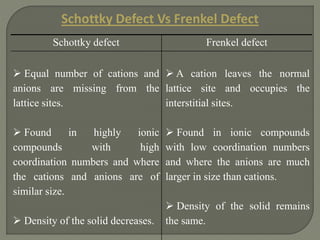
Schottky Defect Vs Frenkel Defect
Schottky defect Frenkel defect
 Equal number of cations and
anions are missing from the
lattice sites.
 Found in highly ionic
compounds with high
coordination numbers and where
the cations and anions are of
similar size.
 Density of the solid decreases.
 A cation leaves the normal
lattice site and occupies the
interstitial sites.
 Found in ionic compounds
with low coordination numbers
and where the anions are much
larger in size than cations.
 Density of the solid remains
the same.
 Solid state physics by Guptha and Kumar,
 Solid state physics by S.O.Pillai ,
 https://en.wikipedia.org/wiki/Schottky_defect
 https://en.wikipedia.org/wiki/Frenkel_defect
Solid state physics    (schottkey and frenkel)

Solid state physics (schottkey and frenkel)

  • 2.
     An importantfeature of crystal is the regular atomic arrangement but no crystal is perfectly regular.  Any deviation from this perfect atomic periodicity is an imperfection which also called as lattice defect.  Lattice defect – a state in which the atomic arrangement(it`s structure) in smaller region of a crystal has departed from regularity.
  • 3.
  • 4.
  • 5.
     A Schottkydefect is a type of point defect in a crystal lattice named after Walter H. Schottky.  In non-ionic crystals it means a lattice vacancy defect.  In ionic crystals, the defect forms when oppositely charged ions leave their lattice sites, creating vacancies. These vacancies are formed in stoichiometric units, to maintain an overall neutral charge in the ionic solid.
  • 6.
     If inan ionic crystal of the type A+ B-, equal number of cations and anions are missing from their lattice. It is called Schottky defect.  Just because the equal no. of anion and cation are missing, the whole crystal arrangement is maintained as electrically neutral.  This occurs only when there is small difference in size of cations and anions.
  • 7.
     This typeof defect is shown by highly ionic compounds such as  NaCl,  KCl,  CsCl,  AgBr,  KBr  And it also have a high co – ordination number.
  • 8.
    Consequences of Schottky defect As the number of ions decreases as a result of this defect, the mass decreases whereas the volume remains the same. Hence density of the solid decreases,  The crystal begins to conduct electricity to a small extent by ionic mechanism,  The presence of too many voids lowers lattice energy and the stability of the crystal.
  • 9.
  • 10.
     The phenomenonis named after the Soviet physicist YakovFrenkel, who discovered it in 1926.  A Frenkel defect is a type of defect in crystalline solids wherein an atom is displaced from its lattice position to an interstitial site, creating a vacancy at the original site and an interstitial defect at the new location within the same element without any changes in chemical properties.
  • 11.
     A Frenkeldefect, Frenkel pair, or Frenkel disorder is a type of point defect in a crystal lattice. The defect forms when an atom or smaller ion (usually cation) leaves its place in the lattice, creating a vacancy, and becomes an interstitial by lodging in a nearby location.  Since cations are usually smaller it is more common to find the cations occupying interstitial sites.  So it is a combination of vacancy and interstitial atom.
  • 12.
  • 13.
     Low coordinations number,  Larger difference in size of cation and anions,  Compounds having highly polarising cation and easily polarisable anion.  A few examples of ionic compounds exhibiting this defect are AgCl, AgBr, AgI, ZnS etc.
  • 14.
    As no ionsare missing from the crystal lattice as a whole, therefore density of the solid remains the same, The closeness of like charges tends to increases the dielectric constant of the crystal, The crystal conducts electricity to a small extent by ionic mechanism.
  • 15.
    Schottky Defect VsFrenkel Defect Schottky defect Frenkel defect  Equal number of cations and anions are missing from the lattice sites.  Found in highly ionic compounds with high coordination numbers and where the cations and anions are of similar size.  Density of the solid decreases.  A cation leaves the normal lattice site and occupies the interstitial sites.  Found in ionic compounds with low coordination numbers and where the anions are much larger in size than cations.  Density of the solid remains the same.
  • 17.
     Solid statephysics by Guptha and Kumar,  Solid state physics by S.O.Pillai ,  https://en.wikipedia.org/wiki/Schottky_defect  https://en.wikipedia.org/wiki/Frenkel_defect