Tolerances and Allowances
Tolerance Dimensioning
• Tolerance is the total amount that a specific dimension
is permitted to vary;
• It is the difference between the maximum and the
minimum limits for the dimension.
• For Example a dimension given as 1.625 ± .002 means
that the manufactured part may be 1.627” or 1.623”, or
anywhere between these limit dimensions.
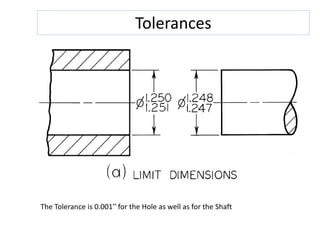
Tolerances
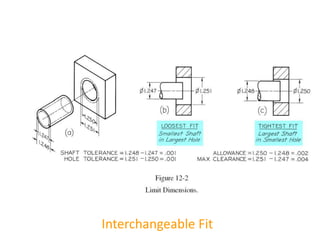
The Tolerance is 0.001” for the Hole as well as for the Shaft
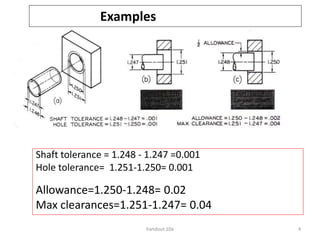
Examples
Shaft tolerance = 1.248 - 1.247 =0.001
Hole tolerance= 1.251-1.250= 0.001
Allowance=1.250-1.248= 0.02
Max clearances=1.251-1.247= 0.04
handout 10a 4
Why Tolerances are specified?
 Variations in properties of the material being
machined introduce errors.
 The production machines themselves may have
some inherent inaccuracies.
 It is impossible for an operator to make perfect
settings. While setting up the tools and workpiece
on the machine, some errors are likely to creep in.
Types of Tolerances
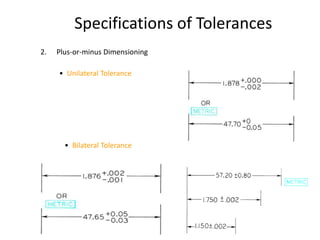
Unilateral Tolerance:
• When the two limit dimensions are only on one
side of the nominal size, (either above or below)
the tolerances are said to be unilateral.
For unilateral tolerances, a case may occur when
one of the limits coincide with the basic size.
Bilateral Tolerance:
• When the two limit dimensions are above and
below nominal size, (i.e. on either side of the
nominal size) the tolerances are said to be
bilateral.
Specifications of Tolerances
2. Plus-or-minus Dimensioning
• Unilateral Tolerance
• Bilateral Tolerance
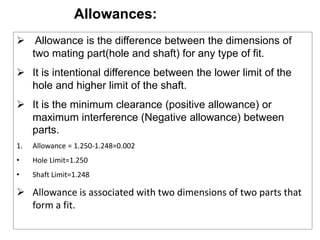
Allowances:
 Allowance is the difference between the dimensions of
two mating part(hole and shaft) for any type of fit.
 It is intentional difference between the lower limit of the
hole and higher limit of the shaft.
 It is the minimum clearance (positive allowance) or
maximum interference (Negative allowance) between
parts.
1. Allowance = 1.250-1.248=0.002
• Hole Limit=1.250
• Shaft Limit=1.248
 Allowance is associated with two dimensions of two parts that
form a fit.
Interchangeable Fit
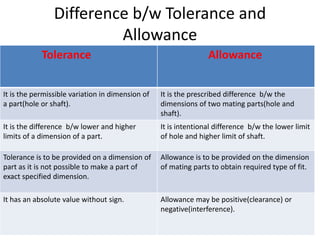
Difference b/w Tolerance and
Allowance
Tolerance Allowance
It is the permissible variation in dimension of
a part(hole or shaft).
It is the prescribed difference b/w the
dimensions of two mating parts(hole and
shaft).
It is the difference b/w lower and higher
limits of a dimension of a part.
It is intentional difference b/w the lower limit
of hole and higher limit of shaft.
Tolerance is to be provided on a dimension of
part as it is not possible to make a part of
exact specified dimension.
Allowance is to be provided on the dimension
of mating parts to obtain required type of fit.
It has an absolute value without sign. Allowance may be positive(clearance) or
negative(interference).
Tolerances and allowances

Tolerances and allowances

  • 1.
  • 2.
    Tolerance Dimensioning • Toleranceis the total amount that a specific dimension is permitted to vary; • It is the difference between the maximum and the minimum limits for the dimension. • For Example a dimension given as 1.625 ± .002 means that the manufactured part may be 1.627” or 1.623”, or anywhere between these limit dimensions.
  • 3.
    Tolerances The Tolerance is0.001” for the Hole as well as for the Shaft
  • 4.
    Examples Shaft tolerance =1.248 - 1.247 =0.001 Hole tolerance= 1.251-1.250= 0.001 Allowance=1.250-1.248= 0.02 Max clearances=1.251-1.247= 0.04 handout 10a 4
  • 5.
    Why Tolerances arespecified?  Variations in properties of the material being machined introduce errors.  The production machines themselves may have some inherent inaccuracies.  It is impossible for an operator to make perfect settings. While setting up the tools and workpiece on the machine, some errors are likely to creep in.
  • 6.
    Types of Tolerances UnilateralTolerance: • When the two limit dimensions are only on one side of the nominal size, (either above or below) the tolerances are said to be unilateral. For unilateral tolerances, a case may occur when one of the limits coincide with the basic size. Bilateral Tolerance: • When the two limit dimensions are above and below nominal size, (i.e. on either side of the nominal size) the tolerances are said to be bilateral.
  • 7.
    Specifications of Tolerances 2.Plus-or-minus Dimensioning • Unilateral Tolerance • Bilateral Tolerance
  • 8.
    Allowances:  Allowance isthe difference between the dimensions of two mating part(hole and shaft) for any type of fit.  It is intentional difference between the lower limit of the hole and higher limit of the shaft.  It is the minimum clearance (positive allowance) or maximum interference (Negative allowance) between parts. 1. Allowance = 1.250-1.248=0.002 • Hole Limit=1.250 • Shaft Limit=1.248  Allowance is associated with two dimensions of two parts that form a fit.
  • 9.
  • 10.
    Difference b/w Toleranceand Allowance Tolerance Allowance It is the permissible variation in dimension of a part(hole or shaft). It is the prescribed difference b/w the dimensions of two mating parts(hole and shaft). It is the difference b/w lower and higher limits of a dimension of a part. It is intentional difference b/w the lower limit of hole and higher limit of shaft. Tolerance is to be provided on a dimension of part as it is not possible to make a part of exact specified dimension. Allowance is to be provided on the dimension of mating parts to obtain required type of fit. It has an absolute value without sign. Allowance may be positive(clearance) or negative(interference).