Slip and Twining
G.Gopinath
Assistant Prof - Mechanical
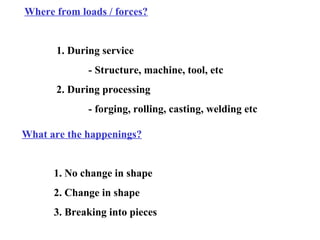
Where from loads / forces?
1. During service
- Structure, machine, tool, etc
2. During processing
- forging, rolling, casting, welding etc
What are the happenings?
1. No change in shape
2. Change in shape
3. Breaking into pieces
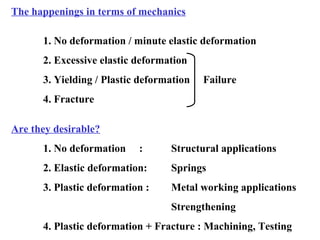
The happenings in terms of mechanics
1. No deformation / minute elastic deformation
2. Excessive elastic deformation
3. Yielding / Plastic deformation Failure
4. Fracture
Are they desirable?
1. No deformation : Structural applications
2. Elastic deformation: Springs
3. Plastic deformation : Metal working applications
Strengthening
4. Plastic deformation + Fracture : Machining, Testing
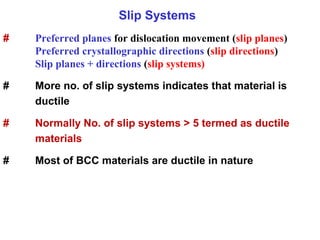
Slip Systems
# Preferred planes for dislocation movement (slip planes)
Preferred crystallographic directions (slip directions)
Slip planes + directions (slip systems)
# More no. of slip systems indicates that material is
ductile
# Normally No. of slip systems > 5 termed as ductile
materials
# Most of BCC materials are ductile in nature
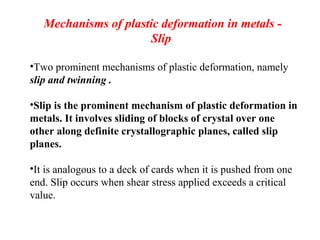
Mechanisms of plastic deformation in metals -
Slip
•Two prominent mechanisms of plastic deformation, namely
slip and twinning .
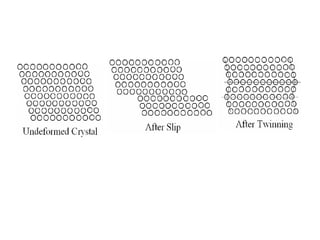
•Slip is the prominent mechanism of plastic deformation in
metals. It involves sliding of blocks of crystal over one
other along definite crystallographic planes, called slip
planes.
•It is analogous to a deck of cards when it is pushed from one
end. Slip occurs when shear stress applied exceeds a critical
value.
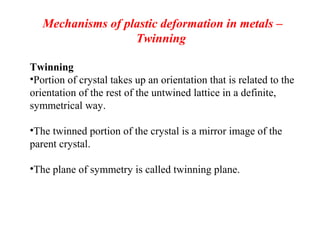
Mechanisms of plastic deformation in metals –
Twinning
Twinning
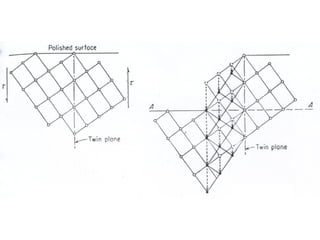
•Portion of crystal takes up an orientation that is related to the
orientation of the rest of the untwined lattice in a definite,
symmetrical way.
•The twinned portion of the crystal is a mirror image of the
parent crystal.
•The plane of symmetry is called twinning plane.
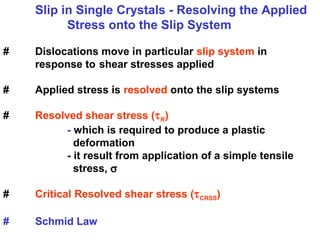
Slip in Single Crystals - Resolving the Applied
Stress onto the Slip System
# Dislocations move in particular slip system in
response to shear stresses applied
# Applied stress is resolved onto the slip systems
# Resolved shear stress (τR)
- which is required to produce a plastic
deformation
- it result from application of a simple tensile
stress, σ
# Critical Resolved shear stress (τCRSS)
# Schmid Law
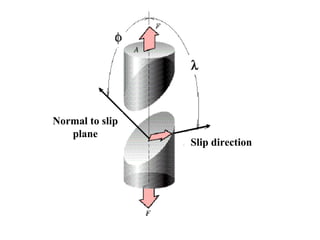
Normal to slip
plane
Slip direction
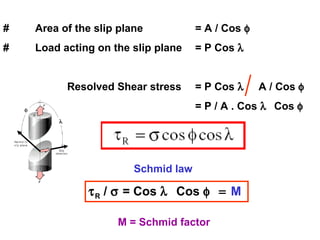
# Area of the slip plane = A / Cos φ
# Load acting on the slip plane = P Cos λ
Resolved Shear stress = P Cos λ A / Cos φ
= P / A . Cos λ Cos φ
Schmid law
τR / σ = Cos λ Cos φ = M
M = Schmid factor
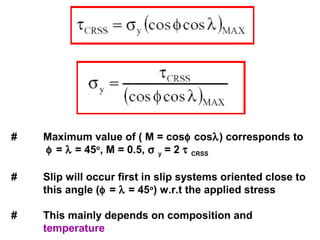
# Maximum value of ( M = cosφ cosλ) corresponds to
φ = λ = 45o
, M = 0.5, σ y = 2 τ CRSS
# Slip will occur first in slip systems oriented close to
this angle (φ = λ = 45o
) w.r.t the applied stress
# This mainly depends on composition and
temperature
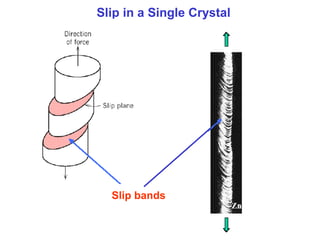
Slip in a Single Crystal
Slip bands
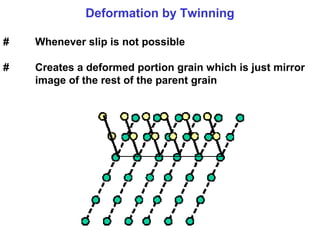
Deformation by Twinning
# Whenever slip is not possible
# Creates a deformed portion grain which is just mirror
image of the rest of the parent grain
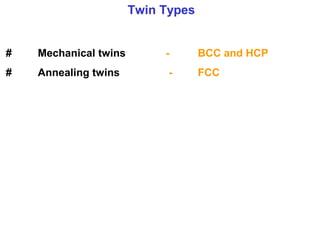
Twin Types
# Mechanical twins - BCC and HCP
# Annealing twins - FCC
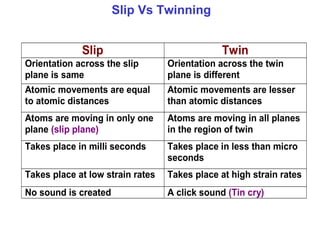
Slip Vs Twinning
Slip Twin
Orientation across the slip
plane is same
Orientation across the twin
plane is different
Atomic movements are equal
to atomic distances
Atomic movements are lesser
than atomic distances
Atoms are moving in only one
plane (slip plane)
Atoms are moving in all planes
in the region of twin
Takes place in milli seconds Takes place in less than micro
seconds
Takes place at low strain rates Takes place at high strain rates
No sound is created A click sound (Tin cry)

Slip and twiniing

  • 1.
  • 2.
    Where from loads/ forces? 1. During service - Structure, machine, tool, etc 2. During processing - forging, rolling, casting, welding etc What are the happenings? 1. No change in shape 2. Change in shape 3. Breaking into pieces
  • 3.
    The happenings interms of mechanics 1. No deformation / minute elastic deformation 2. Excessive elastic deformation 3. Yielding / Plastic deformation Failure 4. Fracture Are they desirable? 1. No deformation : Structural applications 2. Elastic deformation: Springs 3. Plastic deformation : Metal working applications Strengthening 4. Plastic deformation + Fracture : Machining, Testing
  • 4.
    Slip Systems # Preferredplanes for dislocation movement (slip planes) Preferred crystallographic directions (slip directions) Slip planes + directions (slip systems) # More no. of slip systems indicates that material is ductile # Normally No. of slip systems > 5 termed as ductile materials # Most of BCC materials are ductile in nature
  • 5.
    Mechanisms of plasticdeformation in metals - Slip •Two prominent mechanisms of plastic deformation, namely slip and twinning . •Slip is the prominent mechanism of plastic deformation in metals. It involves sliding of blocks of crystal over one other along definite crystallographic planes, called slip planes. •It is analogous to a deck of cards when it is pushed from one end. Slip occurs when shear stress applied exceeds a critical value.
  • 6.
    Mechanisms of plasticdeformation in metals – Twinning Twinning •Portion of crystal takes up an orientation that is related to the orientation of the rest of the untwined lattice in a definite, symmetrical way. •The twinned portion of the crystal is a mirror image of the parent crystal. •The plane of symmetry is called twinning plane.
  • 8.
    Slip in SingleCrystals - Resolving the Applied Stress onto the Slip System # Dislocations move in particular slip system in response to shear stresses applied # Applied stress is resolved onto the slip systems # Resolved shear stress (τR) - which is required to produce a plastic deformation - it result from application of a simple tensile stress, σ # Critical Resolved shear stress (τCRSS) # Schmid Law
  • 9.
  • 10.
    # Area ofthe slip plane = A / Cos φ # Load acting on the slip plane = P Cos λ Resolved Shear stress = P Cos λ A / Cos φ = P / A . Cos λ Cos φ Schmid law τR / σ = Cos λ Cos φ = M M = Schmid factor
  • 11.
    # Maximum valueof ( M = cosφ cosλ) corresponds to φ = λ = 45o , M = 0.5, σ y = 2 τ CRSS # Slip will occur first in slip systems oriented close to this angle (φ = λ = 45o ) w.r.t the applied stress # This mainly depends on composition and temperature
  • 12.
    Slip in aSingle Crystal Slip bands
  • 13.
    Deformation by Twinning #Whenever slip is not possible # Creates a deformed portion grain which is just mirror image of the rest of the parent grain
  • 15.
    Twin Types # Mechanicaltwins - BCC and HCP # Annealing twins - FCC
  • 16.
    Slip Vs Twinning SlipTwin Orientation across the slip plane is same Orientation across the twin plane is different Atomic movements are equal to atomic distances Atomic movements are lesser than atomic distances Atoms are moving in only one plane (slip plane) Atoms are moving in all planes in the region of twin Takes place in milli seconds Takes place in less than micro seconds Takes place at low strain rates Takes place at high strain rates No sound is created A click sound (Tin cry)