University of Hyderabad
School of Chemistry
CY551 : Chemistry of Materials
Part A
Basic Concepts
T. P. Radhakrishnan
This manual is provided as an aid for learning the subject by the students attending the lectures in
the above course; any typos/errors found may please be brought to the notice of the teacher.
This work is licensed under a
Creative Commons Attribution-NonCommercial-ShareAlike 4.0 International License
2
Section II: Defects and Non-stoichiometry
1. Point, line and plane defects 3
2. Intrinsic defects 5
1. Vacancy 6
2. Self interstitials 6
3. Schottky defects 7
4. Frenkel defects 7
3. Extrinsic defects 8
1. Substitutional/interstitial impurity 9
2. Aliovalent impurity 9
3. Charge compensation defect 9
4. Non-stoichiometry 10
1. Classifications 11
2. More examples of non-stoichiometric compounds 12
5. Color centres 14
3
II-1. Point, line and plane defects
 Ideal crystal structures discussed in Sec. I exist rarely; often there are defects in the
structure, which can occur in different ways. The defects often influence the materials
properties significantly, and hence are important targets for exploration.
 The term, point, line and plane defects indicates clearly the region over which a defect
(absence of the atom/molecule expected based on the bulk structure, or presence of a
wrong atom/molecule) exists – a lattice site or interstitial point, a whole row of lattice
sites or a plane formed by a 2-D array of lattice points.
 Plane defect: Typical examples are small angle grain boundaries and stacking faults (Fig.
II-1).
 Line defect: The most common are edge and screw dislocations (Fig. II-2). The defect
propagates parallel to the direction of the slip of the lattice planes in an edge dislocation;
the defect propagation is perpendicular to the slip direction in a screw dislocation.
Presence of a defect is shown by a mismatch (Burger’s vector) if one follows equal
number of unit cell vectors in opposite directions to make a circuit around the defect area.
Figure II-2. Schematic drawing of (a) edge and (b) screw dislocation [Source:
http://inspirehep.net/record/1094489/plots].
Burger’s vector
(a)
Direction of slip = Direction of defect
propagation
(b)
Direction of slip  Direction of defect
propagation
Figure II-1. Plane defects : (a) small angle grain boundary, (b) stacking fault in a hexagonal close packing (hcp)
sequence contrasted with defect-free hcp and ccp.
(a) hcp …. A B A B A B A B A B A B ….
ccp …. A B C A B C A B C A B C ….
defect hcp …. A B A B B A B A B A B A ….
 defect location
(b)
4
 A wide range of point defects occur in crystals. They are broadly classified into intrinsic
and extrinsic defects.
o Intrinsic defects: vacancy, self-interstitial, Schottky, Frenkel
o Extrinsic defects: substitutional/interstitial impurity, aliovalent impurity, charge
compensation defect, non-stoichiometry, color centers
o The defect formation is primarily driven by entropy factors
o We discuss first, intrinsic defects and some of the simple extrinsic ones
o A more detailed discussion of non-stoichiometry and color centers follow
5
II-2. Intrinsic defects
 Intrinsic defects arise when an atom or molecule is not present at the lattice site where it
is expected based on the bulk crystal structure, or when it is present at a site or interstitial
region (space between lattice points) where it is not expected to be.
 There is usually an energy cost associated with the formation of the defect (missing or
undesirable interactions); however, there is also an entropy gain due to the formation of
the defect. The defect arises when an overall free energy (depending on the temperature
of the system) gain is involved. The common types of intrinsic defects are :
o Vacancy
o Self-interstitial
o Schottky
o Frenkel
 Defects exert a significant influence on several materials properties such as electrical
conductivity, optical characteristics, magnetism and mechanical and thermal attributes.
6
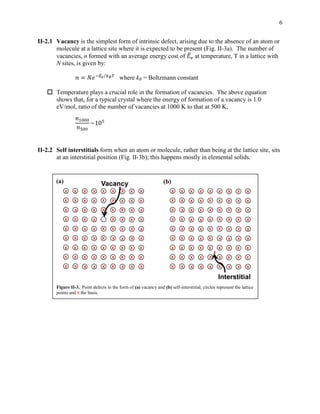
II-2.1 Vacancy is the simplest form of intrinsic defect, arising due to the absence of an atom or
molecule at a lattice site where it is expected to be present (Fig. II-3a). The number of
vacancies, n formed with an average energy cost of 𝐸
̅𝑣 at temperature, T in a lattice with
N sites, is given by:
𝑛 = 𝑁𝑒−𝐸
̅𝑣 𝑘𝐵𝑇
⁄
where kB = Boltzmann constant
 Temperature plays a crucial role in the formation of vacancies. The above equation
shows that, for a typical crystal where the energy of formation of a vacancy is 1.0
eV/mol, ratio of the number of vacancies at 1000 K to that at 500 K,
𝑛1000
𝑛500
~105
II-2.2 Self interstitials form when an atom or molecule, rather than being at the lattice site, sits
at an interstitial position (Fig. II-3b); this happens mostly in elemental solids.
Figure II-3. Point defects in the form of (a) vacancy and (b) self-interstitial; circles represent the lattice
points and x the basis.
X X X X X X X X
X X X X X X X X
X
X
X X X X X X X X
X X X X X X X
X
X
X X X X X X X X
X X X X X X X X
X
X
X X X X X X X X
X X X X X X X X
X
X
X X X X X X X X X
Vacancy
(a)
X X X X X X X X
X X X X X X X X
X
X
X X X X X X X X
X X X X X X X
X
X
X X X X X X X X
X X X X X X X X
X
X
X X X X X X X X
X X X X X X X X
X
X
X X X X X X X X X
X
X
Interstitial
(b)
7
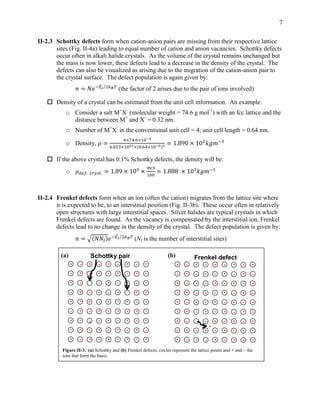
II-2.3 Schottky defects form when cation-anion pairs are missing from their respective lattice
sites (Fig. II-4a) leading to equal number of cation and anion vacancies. Schottky defects
occur often in alkali halide crystals. As the volume of the crystal remains unchanged but
the mass is now lower, these defects lead to a decrease in the density of the crystal. The
defects can also be visualized as arising due to the migration of the cation-anion pair to
the crystal surface. The defect population is again given by:
𝑛 = 𝑁𝑒−𝐸
̅𝑠 2𝑘𝐵𝑇
⁄
(the factor of 2 arises due to the pair of ions involved)
 Density of a crystal can be estimated from the unit cell information. An example:
o Consider a salt M+
X-
(molecular weight = 74.6 g mol-1
) with an fcc lattice and the
distance between M+
and X-
= 0.32 nm.
o Number of M+
X-
in the conventional unit cell = 4; unit cell length = 0.64 nm.
o Density, 𝜌 =
4×74.6×10−3
6.023×1023×(0.64×10−9)3
= 1.890 × 10³
𝑘𝑔𝑚−3
 If the above crystal has 0.1% Schottky defects, the density will be:
o 𝜌𝑑𝑒𝑓. 𝑐𝑟𝑦𝑠𝑡. = 1.89 × 103
×
99.9
100
= 1.888 × 10³
𝑘𝑔𝑚−3
II-2.4 Frenkel defects form when an ion (often the cation) migrates from the lattice site where
it is expected to be, to an interstitial position (Fig. II-3b). These occur often in relatively
open structures with large interstitial spaces. Silver halides are typical crystals in which
Frenkel defects are found. As the vacancy is compensated by the interstitial ion, Frenkel
defects lead to no change in the density of the crystal. The defect population is given by:
𝑛 = √(𝑁𝑁𝐼)𝑒−𝐸
̅𝑠 2𝑘𝐵𝑇
⁄
(NI is the number of interstitial sites)
Figure II-3. (a) Schottky and (b) Frenkel defects; circles represent the lattice points and + and – the
ions that form the basis.
Schottky pair
(a)
+ - + - + - + -
- + - + - + - +
+
-
+ - + - + - + -
- + - + + - +
+
-
+ - + - + - + -
- + - + - + - +
+
-
+ -
+
- + - + -
- + - + - + - +
+
-
+ - + - + - + - +
-
Frenkel defect
(b)
8
II-3. Extrinsic defects
 Extrinsic defects are characterized by the presence of impurities or foreign atoms, ions or
molecules in a crystal lattice; the percentage of impurity atoms will always be well below
that required to form stoichiometric compounds.
 Materials with extrinsic defects are often of great technological relevance; the well-
known examples are doped or extrinsic semiconductors.
 Some of the common forms of extrinsic defects are:
o Substitutional/interstitial impurity
o Aliovalent impurity
o Charge compensation defect
o Non-stoichiometry
o Color centers
 We consider the first three cases in this section, and the remaining two in the subsequent
sections.
9
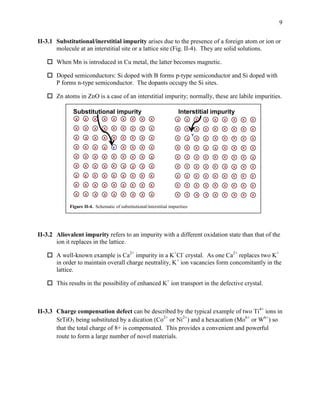
II-3.1 Substitutional/inerstitial impurity arises due to the presence of a foreign atom or ion or
molecule at an interstitial site or a lattice site (Fig. II-4). They are solid solutions.
 When Mn is introduced in Cu metal, the latter becomes magnetic.
 Doped semiconductors: Si doped with B forms p-type semiconductor and Si doped with
P forms n-type semiconductor. The dopants occupy the Si sites.
 Zn atoms in ZnO is a case of an interstitial impurity; normally, these are labile impurities.
II-3.2 Aliovalent impurity refers to an impurity with a different oxidation state than that of the
ion it replaces in the lattice.
 A well-known example is Ca2+
impurity in a K+
Cl-
crystal. As one Ca2+
replaces two K+
in order to maintain overall charge neutrality, K+
ion vacancies form concomitantly in the
lattice.
 This results in the possibility of enhanced K+
ion transport in the defective crystal.
II-3.3 Charge compensation defect can be described by the typical example of two Ti4+
ions in
SrTiO3 being substituted by a dication (Co2+
or Ni2+
) and a hexacation (Mo6+
or W6+
) so
that the total charge of 8+ is compensated. This provides a convenient and powerful
route to form a large number of novel materials.
Figure II-4. Schematic of substitutional/interstitial impurities
X X X X X X X X
X X X X X X X X
X
X
X X X X X X X X
X X X X X X X
X
X
X X X X X X X X
X X X X X X X X
X
X
X X X X X X X X
X X X X X X X X
X
X
X X X X X X X X X
Y
Substitutional impurity Interstitial impurity
10
II-4. Non-stoichiometry
 Generally compounds have a simple and well-defined stoichiometry in agreement with
the fundamental law of definite proportions.
 However with many compounds, especially those involving the transition metals that are
capable of stable variable valancies, compounds can contain their elements in rather
complex and variable ratios.
 This occurs especially in the case of early transition metals like Ti and V which have
relatively more diffuse d-orbitals which can penetrate into adjacent unit cells in a crystal;
the latter allows the ligand ions from the adjacent unit cells to coordinate to the metal ion
facilitating vacancies within the original unit cell.
 The idea of non-stoichiometry can be illustrated using an example, Fe1-xO.
o Elemental composition analysis of ferrous oxide (FeO) samples would rarely
show an exact 1:1 stoichiometric ratio between the elements. Usually, the Fe
would be slightly less.
o The reason for this is that part of the Fe2+
is oxidized to Fe3+
and hence slightly
less iron is sufficient to compensate for the charge (-2) on oxygen. The formula
may be written in detail as (Fe3+
)a(Fe2+
)bO.
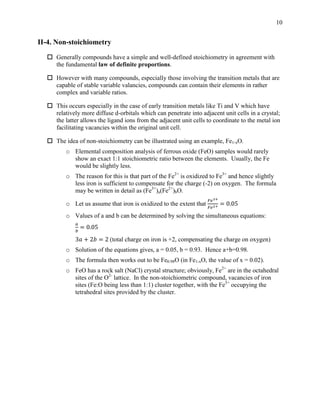
o Let us assume that iron is oxidized to the extent that
𝐹𝑒3+
𝐹𝑒2+
= 0.05
o Values of a and b can be determined by solving the simultaneous equations:
𝑎
𝑏
= 0.05
3𝑎 + 2𝑏 = 2 (total charge on iron is +2, compensating the charge on oxygen)
o Solution of the equations gives, a = 0.05, b = 0.93. Hence a+b=0.98.
o The formula then works out to be Fe0.98O (in Fe1-xO, the value of x = 0.02).
o FeO has a rock salt (NaCl) crystal structure; obviously, Fe2+
are in the octahedral
sites of the O2-
lattice. In the non-stoichiometric compound, vacancies of iron
sites (Fe:O being less than 1:1) cluster together, with the Fe3+
occupying the
tetrahedral sites provided by the cluster.
11
II-4.1 Classifications
 Common examples of non-stoichiometry may be found in metal oxides.
 Consider a metal compound with the stoichiometric composition, MX. During its
formation, if the partial pressure of X (eg. oxygen) is maintained higher or lower than the
equilibrium value required to form the stoichiometric composition (𝑝𝑋2
(𝑥) > 𝑝𝑋2
(0) or
𝑝𝑋2
(𝑥) < 𝑝𝑋2
(0) respectively) one could end up with non-stoichiometric oxides.
 The following represent the typical situations that follow. The equations represent the
origin of the non-stoichiometric system (I and L represent the interstitial and lattice sites
respectively); the figures show the defect formation. M+
and X-
represent metal cations
and their counter anions; the actual ions may have charges different from +1 and -1.
 The case of 𝑝𝑋2
(𝑥) > 𝑝𝑋2
(0):
o MX1+x:
1
2
𝑋2 + 𝑒−
→ 𝑋− (𝐼); 𝑀+
→ 𝑀2+
+ 𝑒− (𝐿)
Example: 𝑈𝑂2 +
𝑥
2
𝑂2
1150𝑜𝐶
→ 𝑈𝑂2+𝑥 [0 < 𝑥 < 0.25].
U4+
is partially oxidized, and O2-
formed at the interstitial sites.
o M1-xX:
1
2
𝑋2 + 𝑒−
→ 𝑋− (𝐿); 𝑀+
→ 𝑀2+
+ 𝑒− (𝐿)
Example: (1 −
𝑥
2
) 𝐶𝑢2𝑂 + (
𝑥
4
) 𝑂2 → 𝐶𝑢2−𝑥𝑂
Cu+
is partially oxidized, and vacancies appear at Cu+
sites.
X-
formed at
interstitial site
Vacancy
formed at
M+
site
12
 The case of 𝑝𝑋2
(𝑥) < 𝑝𝑋2
(0):
o MX1-x: 𝑋−
→
1
2
𝑋2 + 𝑒− (𝐿); 𝑀+
+ 𝑒−
→ 𝑀 (𝐿)
Example: TiO1-x
Ti2+
is partially reduced and O2-
vacancies form. Titanium oxide is known to
form a large range of non-stoichiometric compounds, TiO0.64 to TiO1.27.
o M1+xX: 𝑋−
→
1
2
𝑋2 + 𝑒− (𝐼); 𝑀+
+ 𝑒−
→ 𝑀 (𝐿)
Example: (1 + 𝑥)𝑍𝑛𝑂
∆
→ 𝑍𝑛1+𝑥𝑂 +
𝑥
2
𝑂2 ; ZnO is white and Zn1+xO yellow.
Zn2+
is partially reduced to Zn1+
[Ref.: Ceramic Materials: Science and Engineering, C. B.
Carter, M. G. Norton, Springer, 2007, p.188], and O2-
oxidized with O2 boiling out.
II-4.2 More examples of non-stoichiometric compounds are listed below with special
structural or materials attributes noted briefly.
o Several non-stoichiometric phases NiTex form between the two stoichiometric
extremes, NiTe (NiAs structure) and NiTe2 (CdI2 structure) (Fig. II-5).
Vacancy
formed at
X-
site
M+
and X-
vacancies form;
M migrates to
interstitial site
Figure II-5. NiTe [NiAs structure, Ni (red), As (blue)] and NiTe2 [CdI2 structure, Cd (red),
I (blue)]; view of the 2-D lattice of Ni (in NiAs) and Cd (in CdI2) are shown along with the
two types of lattice sites, A and B which are also marked on the 3-D structures.
A
B
A
B
A
B
A
B
A
B
13
o Praseodymium oxide has a range of non-stoichiometric compositions, PrO2-x (0 <
x < 0.25) at 1000o
C. At lower temperatures, infinitely adaptable structures with
the formula PrnO2n-2 (n = 4, 7, 9, 10, 11, 12, ) are observed. The series can be
visualized as ranging from Pr2O3 (n = 4) to PrO2 (n = ). PrO2 has the fluorite
structure with Pr forming an fcc lattice and O occupying all the Td sites (note that
a conventional unit cell with 4 atoms has 8 Td and 4 Oh sites). Pr2O3 has the C-
type rare earth M2O3 structure in which ¾ of the Td sites of the fcc lattice of Pr are
occupied by O. The O vacancies cluster to form superlattice structures.
o Tungsten bronzes are derived from WO3. Insertion of alkali metals, M (Na, K, Rb
or Cs) gives rise to the non-stoichiometric systems, MxWO3. The color and
electrical properties are dependent on x. For example, in NaxWO3 the color
ranges from golden to red, orange, purple and blue-black as x varies from 0.9 to
0.3; electrical conductivity decreases with x. WO3 has an ReO3 structure (Fig. II-
6); in NaxWO3, Na sits at the body centre of the cubic unit cell with W at the
vertices and O at the edge centres. The body centre has fractional occupation, x;
when x = 1, a perovskite structure is obtained.
o The high temperature superconductors, for example, YBa2Cu3O7-x form another
important class of non-stoichiometric compounds. When x = 0.5, all copper are in
the Cu2+
state. When x decreases (ie. O content increases), holes are formed in
the Cu-O layer (equivalent to the formation of Cu3+
); when x = 0, there are two
Cu2+
and one Cu3+
. Structural transformations accompany the variation of x. The
material is superconducting only for x < 0.5.
o An interesting example of non-stoichiometry in organic solids is the charge
transfer (donor-acceptor) complex (M2P)1-x(P)xTCNQ. P = phenazine, M2P =
N,N-dimethyl phenazine (a strong -electron donor), and TCNQ =
tetracyanoquinodimethane (a strong -electron acceptor). x = 0 corresponds to
M2P+
TCNQ-
, a semi-conductor. When x  0, P occupies the sites of M2P, but
remains neutral as it is a poor donor; (M2P+
)1-x(P)xTCNQ(1-x)-
has partial ionicity
on TCNQ leading to metallic behavior.
o The bromide salt of tetrathifulvalene, TTF(Br)x is another electrically conducting
organic solid, thanks to the partial oxidation of TTF.
Figure II-6. Unit cell of WO3 [ReO3 structure, Re (blue), O (red)]; the body-centre site, A is
occupied by the alkali metal (fractional occupation, x of Na in NaxWO3).
A
14
II-5. Color centres
 A typical observation when crystals of alkali metal halides are heated in presence of a
metal vapor is that they acquire a color; the color depends on the crystal and not on the
type of metal vapor. The color is attributed to F-centres (farbe = color in German).
 These arise due to anion vacancies (point defects) in the crystal which trap unpaired
electrons; if the energy levels of the electron confined in the vacancy site are such that
visible light of specific wavelengths can be absorbed, the crystal becomes colored.
o The phenomenon can be explained using the NaCl crystal.
NaCl + M vapor  (NaCl)-
M+
[M = Na, K etc.]
o As the unit cell of the crystal becomes larger, the energy levels get closer and the
wavelength of the light absorbed increases (Table II-1, Fig. II-7).
Table II-1. Correlation between unit cell size and F-centre absorption
Crystal
Unit cell
length (Å)
Light absorption
Energy (eV) Wavelength (nm)
NaCl 5.64 2.67 464
KCl 6.29 2.20 564
RbCl 6.58 1.97 629
KBr 6.54 2.00 620
 Combinations of two or three F-centres lead to defects called M and R-centres.
 The unpaired electrons make the materials paramagnetic.
Figure II-7. Color due to F-centres formed in NaCl, KCl, KBr crystals. Source:
http://archive.education.mrsec.wisc.edu/background/F_center/images/NaCl_KCl_KBr.jpg

A_II_Defects_Nonstoichiometry.pdf

  • 1.
    University of Hyderabad Schoolof Chemistry CY551 : Chemistry of Materials Part A Basic Concepts T. P. Radhakrishnan This manual is provided as an aid for learning the subject by the students attending the lectures in the above course; any typos/errors found may please be brought to the notice of the teacher. This work is licensed under a Creative Commons Attribution-NonCommercial-ShareAlike 4.0 International License
  • 2.
    2 Section II: Defectsand Non-stoichiometry 1. Point, line and plane defects 3 2. Intrinsic defects 5 1. Vacancy 6 2. Self interstitials 6 3. Schottky defects 7 4. Frenkel defects 7 3. Extrinsic defects 8 1. Substitutional/interstitial impurity 9 2. Aliovalent impurity 9 3. Charge compensation defect 9 4. Non-stoichiometry 10 1. Classifications 11 2. More examples of non-stoichiometric compounds 12 5. Color centres 14
  • 3.
    3 II-1. Point, lineand plane defects  Ideal crystal structures discussed in Sec. I exist rarely; often there are defects in the structure, which can occur in different ways. The defects often influence the materials properties significantly, and hence are important targets for exploration.  The term, point, line and plane defects indicates clearly the region over which a defect (absence of the atom/molecule expected based on the bulk structure, or presence of a wrong atom/molecule) exists – a lattice site or interstitial point, a whole row of lattice sites or a plane formed by a 2-D array of lattice points.  Plane defect: Typical examples are small angle grain boundaries and stacking faults (Fig. II-1).  Line defect: The most common are edge and screw dislocations (Fig. II-2). The defect propagates parallel to the direction of the slip of the lattice planes in an edge dislocation; the defect propagation is perpendicular to the slip direction in a screw dislocation. Presence of a defect is shown by a mismatch (Burger’s vector) if one follows equal number of unit cell vectors in opposite directions to make a circuit around the defect area. Figure II-2. Schematic drawing of (a) edge and (b) screw dislocation [Source: http://inspirehep.net/record/1094489/plots]. Burger’s vector (a) Direction of slip = Direction of defect propagation (b) Direction of slip  Direction of defect propagation Figure II-1. Plane defects : (a) small angle grain boundary, (b) stacking fault in a hexagonal close packing (hcp) sequence contrasted with defect-free hcp and ccp. (a) hcp …. A B A B A B A B A B A B …. ccp …. A B C A B C A B C A B C …. defect hcp …. A B A B B A B A B A B A ….  defect location (b)
  • 4.
    4  A widerange of point defects occur in crystals. They are broadly classified into intrinsic and extrinsic defects. o Intrinsic defects: vacancy, self-interstitial, Schottky, Frenkel o Extrinsic defects: substitutional/interstitial impurity, aliovalent impurity, charge compensation defect, non-stoichiometry, color centers o The defect formation is primarily driven by entropy factors o We discuss first, intrinsic defects and some of the simple extrinsic ones o A more detailed discussion of non-stoichiometry and color centers follow
  • 5.
    5 II-2. Intrinsic defects Intrinsic defects arise when an atom or molecule is not present at the lattice site where it is expected based on the bulk crystal structure, or when it is present at a site or interstitial region (space between lattice points) where it is not expected to be.  There is usually an energy cost associated with the formation of the defect (missing or undesirable interactions); however, there is also an entropy gain due to the formation of the defect. The defect arises when an overall free energy (depending on the temperature of the system) gain is involved. The common types of intrinsic defects are : o Vacancy o Self-interstitial o Schottky o Frenkel  Defects exert a significant influence on several materials properties such as electrical conductivity, optical characteristics, magnetism and mechanical and thermal attributes.
  • 6.
    6 II-2.1 Vacancy isthe simplest form of intrinsic defect, arising due to the absence of an atom or molecule at a lattice site where it is expected to be present (Fig. II-3a). The number of vacancies, n formed with an average energy cost of 𝐸 ̅𝑣 at temperature, T in a lattice with N sites, is given by: 𝑛 = 𝑁𝑒−𝐸 ̅𝑣 𝑘𝐵𝑇 ⁄ where kB = Boltzmann constant  Temperature plays a crucial role in the formation of vacancies. The above equation shows that, for a typical crystal where the energy of formation of a vacancy is 1.0 eV/mol, ratio of the number of vacancies at 1000 K to that at 500 K, 𝑛1000 𝑛500 ~105 II-2.2 Self interstitials form when an atom or molecule, rather than being at the lattice site, sits at an interstitial position (Fig. II-3b); this happens mostly in elemental solids. Figure II-3. Point defects in the form of (a) vacancy and (b) self-interstitial; circles represent the lattice points and x the basis. X X X X X X X X X X X X X X X X X X X X X X X X X X X X X X X X X X X X X X X X X X X X X X X X X X X X X X X X X X X X X X X X X X X X X X X X X X X X X X X X Vacancy (a) X X X X X X X X X X X X X X X X X X X X X X X X X X X X X X X X X X X X X X X X X X X X X X X X X X X X X X X X X X X X X X X X X X X X X X X X X X X X X X X X X X Interstitial (b)
  • 7.
    7 II-2.3 Schottky defectsform when cation-anion pairs are missing from their respective lattice sites (Fig. II-4a) leading to equal number of cation and anion vacancies. Schottky defects occur often in alkali halide crystals. As the volume of the crystal remains unchanged but the mass is now lower, these defects lead to a decrease in the density of the crystal. The defects can also be visualized as arising due to the migration of the cation-anion pair to the crystal surface. The defect population is again given by: 𝑛 = 𝑁𝑒−𝐸 ̅𝑠 2𝑘𝐵𝑇 ⁄ (the factor of 2 arises due to the pair of ions involved)  Density of a crystal can be estimated from the unit cell information. An example: o Consider a salt M+ X- (molecular weight = 74.6 g mol-1 ) with an fcc lattice and the distance between M+ and X- = 0.32 nm. o Number of M+ X- in the conventional unit cell = 4; unit cell length = 0.64 nm. o Density, 𝜌 = 4×74.6×10−3 6.023×1023×(0.64×10−9)3 = 1.890 × 10³ 𝑘𝑔𝑚−3  If the above crystal has 0.1% Schottky defects, the density will be: o 𝜌𝑑𝑒𝑓. 𝑐𝑟𝑦𝑠𝑡. = 1.89 × 103 × 99.9 100 = 1.888 × 10³ 𝑘𝑔𝑚−3 II-2.4 Frenkel defects form when an ion (often the cation) migrates from the lattice site where it is expected to be, to an interstitial position (Fig. II-3b). These occur often in relatively open structures with large interstitial spaces. Silver halides are typical crystals in which Frenkel defects are found. As the vacancy is compensated by the interstitial ion, Frenkel defects lead to no change in the density of the crystal. The defect population is given by: 𝑛 = √(𝑁𝑁𝐼)𝑒−𝐸 ̅𝑠 2𝑘𝐵𝑇 ⁄ (NI is the number of interstitial sites) Figure II-3. (a) Schottky and (b) Frenkel defects; circles represent the lattice points and + and – the ions that form the basis. Schottky pair (a) + - + - + - + - - + - + - + - + + - + - + - + - + - - + - + + - + + - + - + - + - + - - + - + - + - + + - + - + - + - + - - + - + - + - + + - + - + - + - + - + - Frenkel defect (b)
  • 8.
    8 II-3. Extrinsic defects Extrinsic defects are characterized by the presence of impurities or foreign atoms, ions or molecules in a crystal lattice; the percentage of impurity atoms will always be well below that required to form stoichiometric compounds.  Materials with extrinsic defects are often of great technological relevance; the well- known examples are doped or extrinsic semiconductors.  Some of the common forms of extrinsic defects are: o Substitutional/interstitial impurity o Aliovalent impurity o Charge compensation defect o Non-stoichiometry o Color centers  We consider the first three cases in this section, and the remaining two in the subsequent sections.
  • 9.
    9 II-3.1 Substitutional/inerstitial impurityarises due to the presence of a foreign atom or ion or molecule at an interstitial site or a lattice site (Fig. II-4). They are solid solutions.  When Mn is introduced in Cu metal, the latter becomes magnetic.  Doped semiconductors: Si doped with B forms p-type semiconductor and Si doped with P forms n-type semiconductor. The dopants occupy the Si sites.  Zn atoms in ZnO is a case of an interstitial impurity; normally, these are labile impurities. II-3.2 Aliovalent impurity refers to an impurity with a different oxidation state than that of the ion it replaces in the lattice.  A well-known example is Ca2+ impurity in a K+ Cl- crystal. As one Ca2+ replaces two K+ in order to maintain overall charge neutrality, K+ ion vacancies form concomitantly in the lattice.  This results in the possibility of enhanced K+ ion transport in the defective crystal. II-3.3 Charge compensation defect can be described by the typical example of two Ti4+ ions in SrTiO3 being substituted by a dication (Co2+ or Ni2+ ) and a hexacation (Mo6+ or W6+ ) so that the total charge of 8+ is compensated. This provides a convenient and powerful route to form a large number of novel materials. Figure II-4. Schematic of substitutional/interstitial impurities X X X X X X X X X X X X X X X X X X X X X X X X X X X X X X X X X X X X X X X X X X X X X X X X X X X X X X X X X X X X X X X X X X X X X X X X X X X X X X X X Y Substitutional impurity Interstitial impurity
  • 10.
    10 II-4. Non-stoichiometry  Generallycompounds have a simple and well-defined stoichiometry in agreement with the fundamental law of definite proportions.  However with many compounds, especially those involving the transition metals that are capable of stable variable valancies, compounds can contain their elements in rather complex and variable ratios.  This occurs especially in the case of early transition metals like Ti and V which have relatively more diffuse d-orbitals which can penetrate into adjacent unit cells in a crystal; the latter allows the ligand ions from the adjacent unit cells to coordinate to the metal ion facilitating vacancies within the original unit cell.  The idea of non-stoichiometry can be illustrated using an example, Fe1-xO. o Elemental composition analysis of ferrous oxide (FeO) samples would rarely show an exact 1:1 stoichiometric ratio between the elements. Usually, the Fe would be slightly less. o The reason for this is that part of the Fe2+ is oxidized to Fe3+ and hence slightly less iron is sufficient to compensate for the charge (-2) on oxygen. The formula may be written in detail as (Fe3+ )a(Fe2+ )bO. o Let us assume that iron is oxidized to the extent that 𝐹𝑒3+ 𝐹𝑒2+ = 0.05 o Values of a and b can be determined by solving the simultaneous equations: 𝑎 𝑏 = 0.05 3𝑎 + 2𝑏 = 2 (total charge on iron is +2, compensating the charge on oxygen) o Solution of the equations gives, a = 0.05, b = 0.93. Hence a+b=0.98. o The formula then works out to be Fe0.98O (in Fe1-xO, the value of x = 0.02). o FeO has a rock salt (NaCl) crystal structure; obviously, Fe2+ are in the octahedral sites of the O2- lattice. In the non-stoichiometric compound, vacancies of iron sites (Fe:O being less than 1:1) cluster together, with the Fe3+ occupying the tetrahedral sites provided by the cluster.
  • 11.
    11 II-4.1 Classifications  Commonexamples of non-stoichiometry may be found in metal oxides.  Consider a metal compound with the stoichiometric composition, MX. During its formation, if the partial pressure of X (eg. oxygen) is maintained higher or lower than the equilibrium value required to form the stoichiometric composition (𝑝𝑋2 (𝑥) > 𝑝𝑋2 (0) or 𝑝𝑋2 (𝑥) < 𝑝𝑋2 (0) respectively) one could end up with non-stoichiometric oxides.  The following represent the typical situations that follow. The equations represent the origin of the non-stoichiometric system (I and L represent the interstitial and lattice sites respectively); the figures show the defect formation. M+ and X- represent metal cations and their counter anions; the actual ions may have charges different from +1 and -1.  The case of 𝑝𝑋2 (𝑥) > 𝑝𝑋2 (0): o MX1+x: 1 2 𝑋2 + 𝑒− → 𝑋− (𝐼); 𝑀+ → 𝑀2+ + 𝑒− (𝐿) Example: 𝑈𝑂2 + 𝑥 2 𝑂2 1150𝑜𝐶 → 𝑈𝑂2+𝑥 [0 < 𝑥 < 0.25]. U4+ is partially oxidized, and O2- formed at the interstitial sites. o M1-xX: 1 2 𝑋2 + 𝑒− → 𝑋− (𝐿); 𝑀+ → 𝑀2+ + 𝑒− (𝐿) Example: (1 − 𝑥 2 ) 𝐶𝑢2𝑂 + ( 𝑥 4 ) 𝑂2 → 𝐶𝑢2−𝑥𝑂 Cu+ is partially oxidized, and vacancies appear at Cu+ sites. X- formed at interstitial site Vacancy formed at M+ site
  • 12.
    12  The caseof 𝑝𝑋2 (𝑥) < 𝑝𝑋2 (0): o MX1-x: 𝑋− → 1 2 𝑋2 + 𝑒− (𝐿); 𝑀+ + 𝑒− → 𝑀 (𝐿) Example: TiO1-x Ti2+ is partially reduced and O2- vacancies form. Titanium oxide is known to form a large range of non-stoichiometric compounds, TiO0.64 to TiO1.27. o M1+xX: 𝑋− → 1 2 𝑋2 + 𝑒− (𝐼); 𝑀+ + 𝑒− → 𝑀 (𝐿) Example: (1 + 𝑥)𝑍𝑛𝑂 ∆ → 𝑍𝑛1+𝑥𝑂 + 𝑥 2 𝑂2 ; ZnO is white and Zn1+xO yellow. Zn2+ is partially reduced to Zn1+ [Ref.: Ceramic Materials: Science and Engineering, C. B. Carter, M. G. Norton, Springer, 2007, p.188], and O2- oxidized with O2 boiling out. II-4.2 More examples of non-stoichiometric compounds are listed below with special structural or materials attributes noted briefly. o Several non-stoichiometric phases NiTex form between the two stoichiometric extremes, NiTe (NiAs structure) and NiTe2 (CdI2 structure) (Fig. II-5). Vacancy formed at X- site M+ and X- vacancies form; M migrates to interstitial site Figure II-5. NiTe [NiAs structure, Ni (red), As (blue)] and NiTe2 [CdI2 structure, Cd (red), I (blue)]; view of the 2-D lattice of Ni (in NiAs) and Cd (in CdI2) are shown along with the two types of lattice sites, A and B which are also marked on the 3-D structures. A B A B A B A B A B
  • 13.
    13 o Praseodymium oxidehas a range of non-stoichiometric compositions, PrO2-x (0 < x < 0.25) at 1000o C. At lower temperatures, infinitely adaptable structures with the formula PrnO2n-2 (n = 4, 7, 9, 10, 11, 12, ) are observed. The series can be visualized as ranging from Pr2O3 (n = 4) to PrO2 (n = ). PrO2 has the fluorite structure with Pr forming an fcc lattice and O occupying all the Td sites (note that a conventional unit cell with 4 atoms has 8 Td and 4 Oh sites). Pr2O3 has the C- type rare earth M2O3 structure in which ¾ of the Td sites of the fcc lattice of Pr are occupied by O. The O vacancies cluster to form superlattice structures. o Tungsten bronzes are derived from WO3. Insertion of alkali metals, M (Na, K, Rb or Cs) gives rise to the non-stoichiometric systems, MxWO3. The color and electrical properties are dependent on x. For example, in NaxWO3 the color ranges from golden to red, orange, purple and blue-black as x varies from 0.9 to 0.3; electrical conductivity decreases with x. WO3 has an ReO3 structure (Fig. II- 6); in NaxWO3, Na sits at the body centre of the cubic unit cell with W at the vertices and O at the edge centres. The body centre has fractional occupation, x; when x = 1, a perovskite structure is obtained. o The high temperature superconductors, for example, YBa2Cu3O7-x form another important class of non-stoichiometric compounds. When x = 0.5, all copper are in the Cu2+ state. When x decreases (ie. O content increases), holes are formed in the Cu-O layer (equivalent to the formation of Cu3+ ); when x = 0, there are two Cu2+ and one Cu3+ . Structural transformations accompany the variation of x. The material is superconducting only for x < 0.5. o An interesting example of non-stoichiometry in organic solids is the charge transfer (donor-acceptor) complex (M2P)1-x(P)xTCNQ. P = phenazine, M2P = N,N-dimethyl phenazine (a strong -electron donor), and TCNQ = tetracyanoquinodimethane (a strong -electron acceptor). x = 0 corresponds to M2P+ TCNQ- , a semi-conductor. When x  0, P occupies the sites of M2P, but remains neutral as it is a poor donor; (M2P+ )1-x(P)xTCNQ(1-x)- has partial ionicity on TCNQ leading to metallic behavior. o The bromide salt of tetrathifulvalene, TTF(Br)x is another electrically conducting organic solid, thanks to the partial oxidation of TTF. Figure II-6. Unit cell of WO3 [ReO3 structure, Re (blue), O (red)]; the body-centre site, A is occupied by the alkali metal (fractional occupation, x of Na in NaxWO3). A
  • 14.
    14 II-5. Color centres A typical observation when crystals of alkali metal halides are heated in presence of a metal vapor is that they acquire a color; the color depends on the crystal and not on the type of metal vapor. The color is attributed to F-centres (farbe = color in German).  These arise due to anion vacancies (point defects) in the crystal which trap unpaired electrons; if the energy levels of the electron confined in the vacancy site are such that visible light of specific wavelengths can be absorbed, the crystal becomes colored. o The phenomenon can be explained using the NaCl crystal. NaCl + M vapor  (NaCl)- M+ [M = Na, K etc.] o As the unit cell of the crystal becomes larger, the energy levels get closer and the wavelength of the light absorbed increases (Table II-1, Fig. II-7). Table II-1. Correlation between unit cell size and F-centre absorption Crystal Unit cell length (Å) Light absorption Energy (eV) Wavelength (nm) NaCl 5.64 2.67 464 KCl 6.29 2.20 564 RbCl 6.58 1.97 629 KBr 6.54 2.00 620  Combinations of two or three F-centres lead to defects called M and R-centres.  The unpaired electrons make the materials paramagnetic. Figure II-7. Color due to F-centres formed in NaCl, KCl, KBr crystals. Source: http://archive.education.mrsec.wisc.edu/background/F_center/images/NaCl_KCl_KBr.jpg