CRYSTAL DEFECTS
CRYSTAL DEFECTS
* If atoms in the solid are not arranged in
a perfectly manner, it is called defects in crystals.
* The effect of imperfections or defects is
found to be very important in understanding the
properties of crystals.
* Because, the structure sensitive
properties like mechanical strength, ductility,
magnetic hysteresis, dielectric properties, electrical
and electronic properties are greatly affected by the
presence of defects.
The various types of structural defects in crystals are
classified as
1. Point defects or 0D defects
(a) Vacancies
(b) Interstitial defects
(c) Self-interstitial defects
(d) Schottky defects
(e) Frenkel defects
2. Line defects or 1D defects or dislocations
(a) Edge dislocations
(b) Screw dislocations
3. Surface defects or plane defects or 2D defects
(a) Grain boundaries
(b) Twin boundaries
(c) Tilt boundaries
(d) Stacking faults
4. Volume defects or 3D defects or bulk defects
POINT DEFECTS
Point Defects are the irregularities
or deviations from ideal arrangement around
a point or an atom in a crystalline substance.
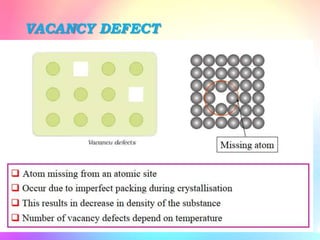
VACANCY DEFECT
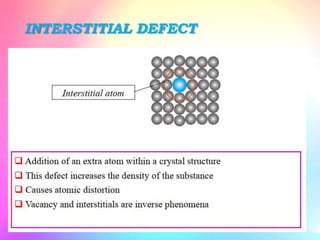
INTERSTITIAL DEFECT
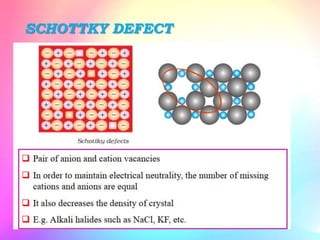
SCHOTTKY DEFECT
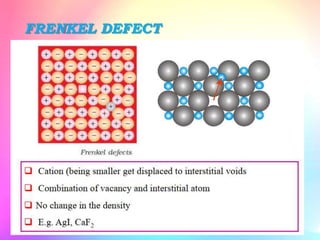
FRENKEL DEFECT
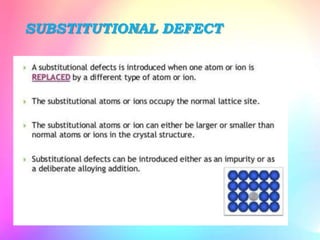
SUBSTITUTIONAL DEFECT
Application of point defects
1. If there is any point defect
introduced by adding some impurities can
improve the hardness of the materials.
2. Similarly, ductility of the
material also improved by creating point
defects.
3. Bearing properties of copper can
be increased.
LINE DEFECTS OR DISLOCATIONS OR 1D
DEFECTS
The defects which take place due to dislocations or
distortion of atoms along a line in some direction
is called line defect.
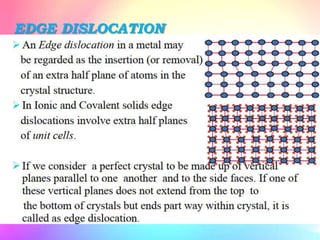
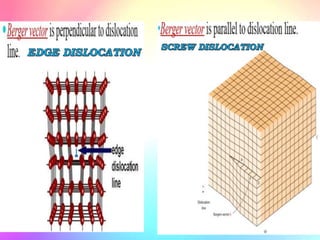
EDGE DISLOCATION
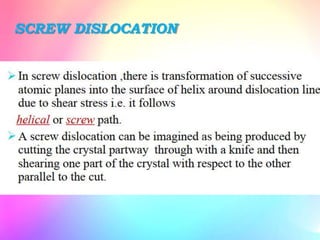
SCREW DISLOCATION
SURFACE DEFECTS OR PLANE DEFECTS OR 2D
DEFECTS
The defects which take place on
the surface of a material are known as surface defects
or plane defects.
These defects are takes place due
to imperfect packing of atoms during crystallization
or defective orientation of the surface.
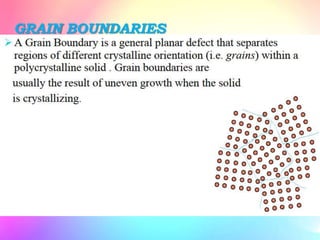
GRAIN BOUNDARIES
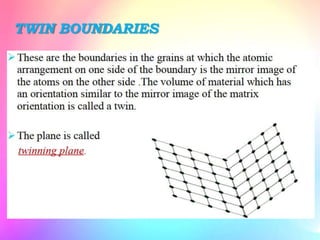
TWIN BOUNDARIES
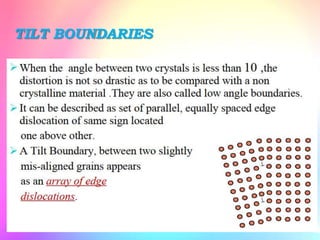
TILT BOUNDARIES
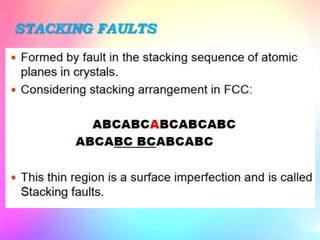
STACKING FAULTS
VOLUME DEFECTS
Volume defects such as cracks may arise
when there are only small electrostatic imperfections
between the stacking sequences of close packed
planes in metals.
Whenever a cluster of atoms are missing
large vacancies or voids is produced also volume
defect.
Foreign particle inclusions, not
crystalline regions existed inside the crystals with
dimension of 2nm are also called volume
imperfections.
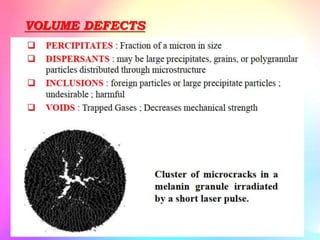
VOLUME DEFECTS
THANK YOU

Crystal defects t

  • 1.
  • 2.
    CRYSTAL DEFECTS * Ifatoms in the solid are not arranged in a perfectly manner, it is called defects in crystals. * The effect of imperfections or defects is found to be very important in understanding the properties of crystals. * Because, the structure sensitive properties like mechanical strength, ductility, magnetic hysteresis, dielectric properties, electrical and electronic properties are greatly affected by the presence of defects.
  • 3.
    The various typesof structural defects in crystals are classified as 1. Point defects or 0D defects (a) Vacancies (b) Interstitial defects (c) Self-interstitial defects (d) Schottky defects (e) Frenkel defects 2. Line defects or 1D defects or dislocations (a) Edge dislocations (b) Screw dislocations 3. Surface defects or plane defects or 2D defects (a) Grain boundaries (b) Twin boundaries (c) Tilt boundaries (d) Stacking faults 4. Volume defects or 3D defects or bulk defects
  • 4.
    POINT DEFECTS Point Defectsare the irregularities or deviations from ideal arrangement around a point or an atom in a crystalline substance.
  • 5.
  • 6.
  • 7.
  • 8.
  • 9.
  • 10.
    Application of pointdefects 1. If there is any point defect introduced by adding some impurities can improve the hardness of the materials. 2. Similarly, ductility of the material also improved by creating point defects. 3. Bearing properties of copper can be increased.
  • 11.
    LINE DEFECTS ORDISLOCATIONS OR 1D DEFECTS The defects which take place due to dislocations or distortion of atoms along a line in some direction is called line defect.
  • 12.
  • 13.
  • 15.
    SURFACE DEFECTS ORPLANE DEFECTS OR 2D DEFECTS The defects which take place on the surface of a material are known as surface defects or plane defects. These defects are takes place due to imperfect packing of atoms during crystallization or defective orientation of the surface.
  • 16.
  • 17.
  • 18.
  • 19.
  • 20.
    VOLUME DEFECTS Volume defectssuch as cracks may arise when there are only small electrostatic imperfections between the stacking sequences of close packed planes in metals. Whenever a cluster of atoms are missing large vacancies or voids is produced also volume defect. Foreign particle inclusions, not crystalline regions existed inside the crystals with dimension of 2nm are also called volume imperfections.
  • 21.
  • 22.