CURRICULUM DESIGN
MAP- 311
SUBMITTED BY
SHAHEEN PARVEEN
M.ARCH 2ND
YEAR
SUBMITTED TO
AR. M.AMIR KHAN
What is Curriculum?
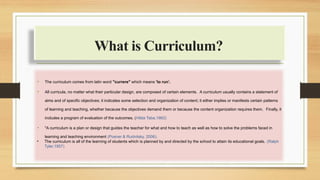
• The curriculum comes from latin word "currere" which means 'to run’.
• All curricula, no matter what their particular design, are composed of certain elements. A curriculum usually contains a statement of
aims and of specific objectives; it indicates some selection and organization of content; it either implies or manifests certain patterns
of learning and teaching, whether because the objectives demand them or because the content organization requires them. Finally, it
includes a program of evaluation of the outcomes. (Hilda Taba,1962)
• "A curriculum is a plan or design that guides the teacher for what and how to teach as well as how to solve the problems faced in
learning and teaching environment (Posner & Rudnitsky, 2006).
• The curriculum is all of the learning of students which is planned by and directed by the school to attain its educational goals. (Ralph
Tyler,1957)
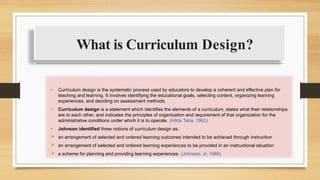
• Curriculum design is the systematic process used by educators to develop a coherent and effective plan for
teaching and learning. It involves identifying the educational goals, selecting content, organizing learning
experiences, and deciding on assessment methods.
• Curriculum design is a statement which identifies the elements of a curriculum, states what their relationships
are to each other, and indicates the principles of organization and requirement of that organization for the
administrative conditions under which it is to operate. (Hilda Taba, 1962)
• Johnson identified three notions of curriculum design as;
 an arrangement of selected and ordered learning outcomes intended to be achieved through instruction
 an arrangement of selected and ordered learning experiences to be provided in an instructional situation
 a scheme for planning and providing learning experiences. (Johnson. Jr, 1969)
What is Curriculum Design?
What is SYLLABUS?
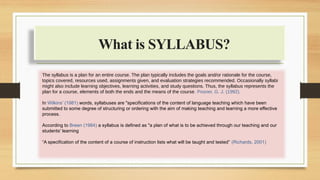
The syllabus is a plan for an entire course. The plan typically includes the goals and/or rationale for the course,
topics covered, resources used, assignments given, and evaluation strategies recommended. Occasionally syllabi
might also include learning objectives, learning activities, and study questions. Thus, the syllabus represents the
plan for a course, elements of both the ends and the means of the course. Posner, G. J. (1992).
In Wilkins' (1981) words, syllabuses are "specifications of the content of language teaching which have been
submitted to some degree of structuring or ordering with the aim of making teaching and learning a more effective
process.
According to Breen (1984) a syllabus is defined as "a plan of what is to be achieved through our teaching and our
students' learning
“A specification of the content of a course of instruction lists what will be taught and tested” (Richards, 2001)
SIGNIFICANCE OF CURRICULUM DESIGN
The significance of curriculum design is a key focus in educational research, where it is highlighted as crucial for shaping
effective educational experiences.
Enhancing Student Learning Outcomes
Curriculum design directly influences the quality of student learning by ensuring that the curriculum is aligned with educational
goals. Well-designed curricula incorporate clear learning objectives, appropriate content, and effective assessment methods,
which together promote better understanding and retention of knowledge. Wiggins, G., & McTighe, J. (2005).
Curriculum design is critical for addressing the diverse needs of students. By considering the different learning styles,
backgrounds, and abilities of students, curriculum design can create more inclusive educational environments that
cater to all learners. Ornstein, A. C., & Hunkins, F. P. (2017). Curriculum: Foundations, Principles, and Issues
Thoughtful curriculum design can increase student engagement by incorporating relevant content, interactive learning
activities, and assessments that motivate students to actively participate in their education. Tyler, R. W. (1949). Basic
Principles of Curriculum and Instruction. University of Chicago Press.
SIGNIFICANCE OF CURRICULUM DESIGN
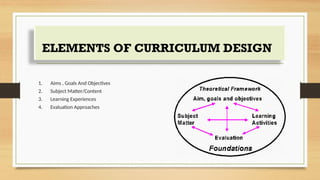
ELEMENTS OF CURRICULUM DESIGN
1. Aims , Goals And Objectives
2. Subject Matter/Content
3. Learning Experiences
4. Evaluation Approaches
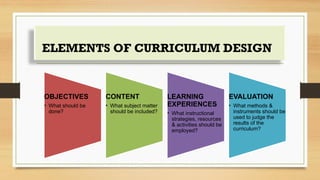
ELEMENTS OF CURRICULUM DESIGN
OBJECTIVES
• What should be
done?
CONTENT
• What subject matter
should be included?
LEARNING
EXPERIENCES
• What instructional
strategies, resources
& activities should be
employed?
EVALUATION
• What methods &
instruments should be
used to judge the
results of the
curriculum?
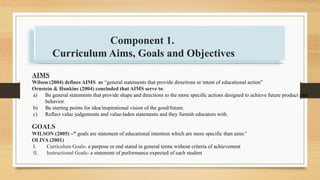
AIMS
Wilson (2004) defines AIMS as “general statements that provide directions or intent of educational action”
Ornstein & Hunkins (2004) concluded that AIMS serve to:
a) Be general statements that provide shape and directions to the more specific actions designed to achieve future product and
behavior.
b) Be starting points for idea/inspirational vision of the good/future.
c) Reflect value judgements and value-laden statements and they furnish educators with.
GOALS
WILSON (2005) –” goals are statement of educational intention which are more specific than aims”
OLIVA (2001)
I. Curriculum Goals- a purpose or end stated in general terms without criteria of achievement
II. Instructional Goals- a statement of performance expected of each student
Component 1.
Curriculum Aims, Goals and Objectives
OBJECTIVES
Stated more specifically than goals, are designed to communicate to involved parties-students and teachers intent of
particular actions.
TWO TYPES OF EDUCATION OBJECTIVES (TABA- 1962)
I. GENERAL OBJECTIVES- those that describe school-wide outcomes (curricular goals).
Example: improving students skills in information processing when dealing with science materials.
II. SPECIFIC OBJECTIVES- more specific an describe behaviors to be attained in a particular unit, a subject/course
or a particular grade level programme ( curricular objectives)
seek to identify kinds of objectives like cognitive, the effective and the psychomotor domains.
BENJAMIN BLOOM and his associates classified.
3 Big Domains: cognitive, affective and psychomotor domains
Domains of educational objective
(Bloom’s Taxonomy)
Cognitive Domain( Bloom et al 1956)
Cognitive : knowledge comprehension application analysis synthesis
evaluation
Affective Domain – ( Krawthwohl, 1964)-
Affective : receiving responding valuing organization characterization
Psychomotor Domain- ( Simpson, 1972)
Psychomotor : perception set guided response mechanism complex overt response
adaptation origination
CONTENT / SUBJECT MATTER
-Knowledge
-It is a compendium of facts, concepts , generalization, principles and theories.
Subject-Centered view of curriculum- the fund of human knowledge represents the respiratory of
accumulated discoveries and inventions of man down to the centuries, due to man’s exploration of his world.
Learner-Centered view of curriculum- related knowledge to the individuals personal and social world and
how he/she defines reality.
According to Gerome Bruner: “knowledge is a model we construct to give meaning structure to regularities
in experience”
COMPONENT 2.
CURRICULUM CONTENT OR SUBJECT MATTER
Teaching strategies convert the written curriculum to instructions.
Both the teacher and the learner take actions to facilitate learning.
The actions are based on planned objectives, the subject matter to be taken and the support materials to be used. These will
includes the teaching methods and educational activities which will enhance learning.
Methods that teacher utilizes to implement the curriculum.
1. Teaching methods are means to achieve the end. They are used to translate the objectives into action.
2. There is no single best teaching methods. Its effectiveness will depend on the learning objectives, th learners and skill
of the teacher.
3. Teaching methods should stimulatethe learners desire to develop the cognitive affective, psychomotor, social and
spiritual domain of the individual.
4. In the choice of teaching methods, learning styles of the student should be considered.
5. Every method should lead to the development of the learning outcomes in the three domains: cognitive affective and
psychomotor.
6. Flexibility should be a consideration in the use on the teaching methods.
COMPONENT 3
CURRICULUM EXPERIENCES
CURRICULUM EVALUATION- refers to the formal determination of the quality, effectiveness or value of the program,
process, product of the curriculum
WORTHEN & SANDERS, 1987- All curricula to be effective must be the element of evaluation.
TUCKMAN, 1985- defines evaluation as meeting the goals and matching them with the intended outcomes.
COMPONENT 4
CURRICULUM EVALUATION
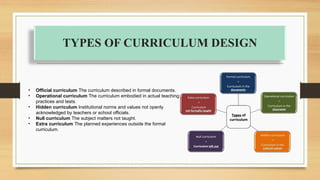
• Official curriculum The curriculum described in formal documents.
• Operational curriculum The curriculum embodied in actual teaching
practices and tests.
• Hidden curriculum Institutional norms and values not openly
acknowledged by teachers or school officials.
• Null curriculum The subject matters not taught.
• Extra curriculum The planned experiences outside the formal
curriculum.
TYPES OF CURRICULUM DESIGN
Integrated Curriculum
According to Roberts & kellough, (2000).
“ The term integrated curriculum refers to a way of teaching, planning, & organizing so the discrete disciplines of subject matter are
integrated and match the developmental needs of the learner, help to meaningfully connect the student’ learning to their current and past
experiences”
What is Integration?
Problem, concerns real to the student and real in the community.
Student and teacher work together to select the specific topic of interest to them and together they plan how, when, where and why they
pursue it.
Develop essential skills intrinsic to their learning.
References
:
• Hilda Taba (1962): Curriculum Development Theory and Practice, Harcourt Brace, Jovanvich New York
• Richards, Jack C. 2001. Curriculum Development in Language Teaching. Cambridge: Cambridge University Press.
• Mauritz Johnson, Jr (1969) On the Meaning of Curriculum Design, Curriculum Theory Network,
• Giles,H. H.; McCutchen, S. P.; and Zechiel, A. N. 1942. Exploring the Curriculum. New York: Harper & Brothers.

Curriculum design, curriculum and Syllabus

  • 1.
    CURRICULUM DESIGN MAP- 311 SUBMITTEDBY SHAHEEN PARVEEN M.ARCH 2ND YEAR SUBMITTED TO AR. M.AMIR KHAN
  • 2.
    What is Curriculum? •The curriculum comes from latin word "currere" which means 'to run’. • All curricula, no matter what their particular design, are composed of certain elements. A curriculum usually contains a statement of aims and of specific objectives; it indicates some selection and organization of content; it either implies or manifests certain patterns of learning and teaching, whether because the objectives demand them or because the content organization requires them. Finally, it includes a program of evaluation of the outcomes. (Hilda Taba,1962) • "A curriculum is a plan or design that guides the teacher for what and how to teach as well as how to solve the problems faced in learning and teaching environment (Posner & Rudnitsky, 2006). • The curriculum is all of the learning of students which is planned by and directed by the school to attain its educational goals. (Ralph Tyler,1957)
  • 3.
    • Curriculum designis the systematic process used by educators to develop a coherent and effective plan for teaching and learning. It involves identifying the educational goals, selecting content, organizing learning experiences, and deciding on assessment methods. • Curriculum design is a statement which identifies the elements of a curriculum, states what their relationships are to each other, and indicates the principles of organization and requirement of that organization for the administrative conditions under which it is to operate. (Hilda Taba, 1962) • Johnson identified three notions of curriculum design as;  an arrangement of selected and ordered learning outcomes intended to be achieved through instruction  an arrangement of selected and ordered learning experiences to be provided in an instructional situation  a scheme for planning and providing learning experiences. (Johnson. Jr, 1969) What is Curriculum Design?
  • 4.
    What is SYLLABUS? Thesyllabus is a plan for an entire course. The plan typically includes the goals and/or rationale for the course, topics covered, resources used, assignments given, and evaluation strategies recommended. Occasionally syllabi might also include learning objectives, learning activities, and study questions. Thus, the syllabus represents the plan for a course, elements of both the ends and the means of the course. Posner, G. J. (1992). In Wilkins' (1981) words, syllabuses are "specifications of the content of language teaching which have been submitted to some degree of structuring or ordering with the aim of making teaching and learning a more effective process. According to Breen (1984) a syllabus is defined as "a plan of what is to be achieved through our teaching and our students' learning “A specification of the content of a course of instruction lists what will be taught and tested” (Richards, 2001)
  • 5.
    SIGNIFICANCE OF CURRICULUMDESIGN The significance of curriculum design is a key focus in educational research, where it is highlighted as crucial for shaping effective educational experiences. Enhancing Student Learning Outcomes Curriculum design directly influences the quality of student learning by ensuring that the curriculum is aligned with educational goals. Well-designed curricula incorporate clear learning objectives, appropriate content, and effective assessment methods, which together promote better understanding and retention of knowledge. Wiggins, G., & McTighe, J. (2005).
  • 6.
    Curriculum design iscritical for addressing the diverse needs of students. By considering the different learning styles, backgrounds, and abilities of students, curriculum design can create more inclusive educational environments that cater to all learners. Ornstein, A. C., & Hunkins, F. P. (2017). Curriculum: Foundations, Principles, and Issues Thoughtful curriculum design can increase student engagement by incorporating relevant content, interactive learning activities, and assessments that motivate students to actively participate in their education. Tyler, R. W. (1949). Basic Principles of Curriculum and Instruction. University of Chicago Press. SIGNIFICANCE OF CURRICULUM DESIGN
  • 7.
    ELEMENTS OF CURRICULUMDESIGN 1. Aims , Goals And Objectives 2. Subject Matter/Content 3. Learning Experiences 4. Evaluation Approaches
  • 8.
    ELEMENTS OF CURRICULUMDESIGN OBJECTIVES • What should be done? CONTENT • What subject matter should be included? LEARNING EXPERIENCES • What instructional strategies, resources & activities should be employed? EVALUATION • What methods & instruments should be used to judge the results of the curriculum?
  • 9.
    AIMS Wilson (2004) definesAIMS as “general statements that provide directions or intent of educational action” Ornstein & Hunkins (2004) concluded that AIMS serve to: a) Be general statements that provide shape and directions to the more specific actions designed to achieve future product and behavior. b) Be starting points for idea/inspirational vision of the good/future. c) Reflect value judgements and value-laden statements and they furnish educators with. GOALS WILSON (2005) –” goals are statement of educational intention which are more specific than aims” OLIVA (2001) I. Curriculum Goals- a purpose or end stated in general terms without criteria of achievement II. Instructional Goals- a statement of performance expected of each student Component 1. Curriculum Aims, Goals and Objectives
  • 10.
    OBJECTIVES Stated more specificallythan goals, are designed to communicate to involved parties-students and teachers intent of particular actions. TWO TYPES OF EDUCATION OBJECTIVES (TABA- 1962) I. GENERAL OBJECTIVES- those that describe school-wide outcomes (curricular goals). Example: improving students skills in information processing when dealing with science materials. II. SPECIFIC OBJECTIVES- more specific an describe behaviors to be attained in a particular unit, a subject/course or a particular grade level programme ( curricular objectives) seek to identify kinds of objectives like cognitive, the effective and the psychomotor domains.
  • 11.
    BENJAMIN BLOOM andhis associates classified. 3 Big Domains: cognitive, affective and psychomotor domains Domains of educational objective (Bloom’s Taxonomy) Cognitive Domain( Bloom et al 1956) Cognitive : knowledge comprehension application analysis synthesis evaluation Affective Domain – ( Krawthwohl, 1964)- Affective : receiving responding valuing organization characterization Psychomotor Domain- ( Simpson, 1972) Psychomotor : perception set guided response mechanism complex overt response adaptation origination
  • 12.
    CONTENT / SUBJECTMATTER -Knowledge -It is a compendium of facts, concepts , generalization, principles and theories. Subject-Centered view of curriculum- the fund of human knowledge represents the respiratory of accumulated discoveries and inventions of man down to the centuries, due to man’s exploration of his world. Learner-Centered view of curriculum- related knowledge to the individuals personal and social world and how he/she defines reality. According to Gerome Bruner: “knowledge is a model we construct to give meaning structure to regularities in experience” COMPONENT 2. CURRICULUM CONTENT OR SUBJECT MATTER
  • 13.
    Teaching strategies convertthe written curriculum to instructions. Both the teacher and the learner take actions to facilitate learning. The actions are based on planned objectives, the subject matter to be taken and the support materials to be used. These will includes the teaching methods and educational activities which will enhance learning. Methods that teacher utilizes to implement the curriculum. 1. Teaching methods are means to achieve the end. They are used to translate the objectives into action. 2. There is no single best teaching methods. Its effectiveness will depend on the learning objectives, th learners and skill of the teacher. 3. Teaching methods should stimulatethe learners desire to develop the cognitive affective, psychomotor, social and spiritual domain of the individual. 4. In the choice of teaching methods, learning styles of the student should be considered. 5. Every method should lead to the development of the learning outcomes in the three domains: cognitive affective and psychomotor. 6. Flexibility should be a consideration in the use on the teaching methods. COMPONENT 3 CURRICULUM EXPERIENCES
  • 14.
    CURRICULUM EVALUATION- refersto the formal determination of the quality, effectiveness or value of the program, process, product of the curriculum WORTHEN & SANDERS, 1987- All curricula to be effective must be the element of evaluation. TUCKMAN, 1985- defines evaluation as meeting the goals and matching them with the intended outcomes. COMPONENT 4 CURRICULUM EVALUATION
  • 15.
    • Official curriculumThe curriculum described in formal documents. • Operational curriculum The curriculum embodied in actual teaching practices and tests. • Hidden curriculum Institutional norms and values not openly acknowledged by teachers or school officials. • Null curriculum The subject matters not taught. • Extra curriculum The planned experiences outside the formal curriculum. TYPES OF CURRICULUM DESIGN
  • 16.
    Integrated Curriculum According toRoberts & kellough, (2000). “ The term integrated curriculum refers to a way of teaching, planning, & organizing so the discrete disciplines of subject matter are integrated and match the developmental needs of the learner, help to meaningfully connect the student’ learning to their current and past experiences” What is Integration? Problem, concerns real to the student and real in the community. Student and teacher work together to select the specific topic of interest to them and together they plan how, when, where and why they pursue it. Develop essential skills intrinsic to their learning.
  • 17.
    References : • Hilda Taba(1962): Curriculum Development Theory and Practice, Harcourt Brace, Jovanvich New York • Richards, Jack C. 2001. Curriculum Development in Language Teaching. Cambridge: Cambridge University Press. • Mauritz Johnson, Jr (1969) On the Meaning of Curriculum Design, Curriculum Theory Network, • Giles,H. H.; McCutchen, S. P.; and Zechiel, A. N. 1942. Exploring the Curriculum. New York: Harper & Brothers.