1
EDU 106: CURRICULUM STUDIES
(2 CREDITS)
HAJIA NIAMATULAI ABDULAI
2
COURSE DESCRIPTION
• The course is EDU 106: Curriculum Studies (2 Credits)
• Everybody in this class should go for the course
outline/description.
• The course description will help students to know the
Consultation hours, the topics, the objectives and other vital
information about the course
• The course will have one take-home assignment (10 marks), two
quizzes (30 marks) and one end of semester examination (60
marks.
• The topical areas for each of the quizzes and the end of semester
examination will be communicated to students in due course.
3
COURSE OBJECTIVES
• The main objective of the course is to introduce students to the basics of
curriculum studies.
• Specifically, the course will expose students to:
1. Definitions of curriculum
2. Curriculum types
3. Curriculum models
4. Curriculum design, processes and principles
5. Factors that affect curriculum development
6. Mainstreaming gender, special needs, ethnicity and religion in curriculum
development
7. Some curriculum materials (syllabus, scheme of work, lesson notes and
timetables)
8. Lesson preparation and lesson patterns
• Students should refer to the course description for the topics to be dealt
with in this course.
4
Meaning of the Word Curriculum
• There is no universally accepted meaning of the term
curriculum.
• This is because experts define curriculum differently.
• It follows that experts have different meanings for the
word “Curriculum”
• However, in this Course, let us conceptualize
curriculum as “a course of study”.
• Therefore this course is meant for students to learn
about “how we get the courses we study”
• Or, how the courses that are studied are obtained and
implemented.
5
Some Definitions of Curriculum
• According to Hirst (1968),
The term curriculum is excessively broad.
It can mean a programme of activities designed so that
pupils will attain as far as possible, certain educational ends
or objectives.
• According to Stenhouse (1976), curriculum is an attempt
to communicate the essential principles and features of
an educational proposal in such a form that it is opened
to critical scrutiny and capable of effective translation
into practice.
6
• Taba (1962) says: Curriculum is a way of preparing young
people to participate as productive members of our
culture (p. 10)
• Tamakloe (1992) describes curriculum as a selection of
socially valued knowledge, skills and attitudes which an
educand is made to acquire through various forms of
planning.
• Kerr (1968) defines curriculum as .....all the learning
which is planned and guided by the school, whether it is
carried on in groups or individually, inside or outside the
school. (p.16)
Definitions of Curriculum (Cont’d)
7
The “Process” or “Static” Natures of
Curriculum
Curriculum is a process when it allows for
changes to be made whenever possible.
Curriculum is regarded as “static” when the
curriculum is documented (completed) and
therefore does not allow for changes to be made
to the document.
8
The Static and Process Natures Curriculum
(Cont’d)
Now let us see whether the definitions provided
above are, “process” and / or “static” in nature.
Hirst’s definition of curriculum seems to
portray that the curriculum is a process and at
the same time static (documented) in nature.
• For instance, the terms “activities designed” in
this definition suggests “static” curriculum as it
is already documented.
9
• In the same definition of Hirst, it can be seen as a
process because of the phrase “so that” (it is a way
of implementing it)
• Stenhouse’s definition of curriculum, can be
regarded as a process because of the phrase “an
attempt to communicate”.
The Static and Process Natures Curriculum
(Cont’d)
10
• Taba’s definition on curriculum suggests a
“process” (ongoing) because of the phrase “a
way of preparing”.
• Tamakloe’s (1982) definition is seen to be
static because of “selection of socially valued”
and a process because of what “the educand
is made to acquire through various forms of
planning”.
The Static and Process Natures Curriculum
(Cont’d)
11
A curriculum of an institution may be
regarded as either a process or static.
• The activities at the stages of the
development of a curriculum and its
implementation constitute its process.
• In the static form, it is the documented state
of the development of the curriculum, its
implementation and / or evaluation.
The Static and Process Natures Curriculum
(Cont’d)
12
Content of a Good Definition of Curriculum
• Finally, in an attempt to come out with a
worthwhile definition, Yakubu (2000) says
curriculum in whatever form should contain:
1. Content: activities, knowledge;
2. The student: student, pupil;
3. The learning experiences: the teacher and
his methods, methods of learning
4. Objectives: ends-in-view
13
TYPES OF CURRICULUM
1. Overt (rational)
2. Covert (hidden),
3. Official (formal and informal).
14
Overt Curriculum
The overt (or rational) type of curriculum is
well structured and followed in the
institutions.
It is explicitly and rationally designed.
spells out the expectations of learners
having gone through the course of study.
 Its subject matter includes subjects such
as social studies, Religious and Moral
Education, Economics and Geography.
15
Covert Curriculum
• Covert (hidden) curriculum is an unstructured
set of attitudes, values and practices that
come out spontaneously or unconsciously,
such attitudes and practices are not
necessarily written down but understood or
taken for granted.
e.g. teachers utterances, dressing, among others
which learners unconsciously copy.
16
• Urevbu (1985: 3) describes the hidden
curriculum as the non-academic but
educationally significant component of schooling.
• Tanner and Tanner (1995) prefer to call it the
‘collateral curriculum’. They argue that the word
‘hidden’ implies deliberately concealing some
learning experiences from students.
• Since this is not written or officially recognised,
its influence on learning can manifest itself in
students’ attitudes and behaviour, both during
and after completing their studies.
17
• What is acquired or learned from hidden
curriculum is usually remembered longer than
information learned at school.
• Tanner and Tanner (1975) recommend that
positive learning from the hidden curriculum
should be acknowledged and treated as an
integral part of the planned and guided
learning experiences.
• As already implied, the hidden or collateral
curriculum is often responsible for the values
students may exhibit later in life.
18
WEEK TWO (2)
19
Formal and informal Curriculum
The curriculum may also be analysed from the
formal (narrow) sense or informal sense.
 In the formal sense, the curriculum is described
as the syllabus used in schools.
 In a informal sense, a curriculum goes beyond
the knowledge taught in schools. This include
activities that go on in schools usually on,
voluntary basis as church meetings, club meeting,
kitchen and dinning activities.
20
FORMAL CURRICULUM
Refers to activities which are laid down as the syllabus or
that which is to be learnt by students.
 It is the officially selected body of knowledge which
government, through the Ministry of Education or
anybody offering education, wants students to learn.
 This curriculum meets specified objectives of educating
identified groups of learners or students in their varying
settings.
 In other words, formal curriculum is the selected written
programmes or courses students go through.
21
INFORMAL CURRICULUM
• Urevbu (1985: 3) refers to informal curriculum
as the curriculum in use.
• Teachers or instructors may not adhere to the
presented formal curriculum but can include
other aspects of knowledge derived from
other sources.
• This additional material is called the ‘informal
curriculum’.
22
ACTUAL CURRICULUM
Actual Curriculum refers to both written and
unwritten syllabuses from which students encounter
learning experiences (Tanner and Tanner 1975).
Learning experiences can be selected from other
sources rather than the prescribed, official and
formal syllabuses.
The actual curriculum is the total sum of what
students learn and what teachers teach from both
formal and informal curricula.
23
Elements/Components of Curriculum
• The curriculum has four elements that are in
constant interaction:
1. purpose (goals and objectives)
2. content or subject matter
3. methods or learning experiences
4. evaluation
24
1. PURPOSE
• The purpose of a curriculum is based on the
social aspirations of society and outlines the
goals and aims of the programme.
• Aims/goals are broad or general statements of
the purposes of education supposed to give
general direction or orientation to education
in an entire country.
• They refer to educational intentions or
outcomes of the entire institutional level or a
particular school(s).
25
Objectives are also statements of intent or
outcomes which specify the kind of changes in
behaviour of a learner after undergoing an
educational experience or programme.
• There are three categories of goals and
objectives:
1. Cognitive: referring to intellectual tasks,
2. Psychomotor: referring to muscular skills, and
3. Affective: referring to feeling and emotions.
26
2. Content/Subject matter
The content of the curriculum consists of those
aspects of the culture of a given people which
are considered to be important enough to be
passed on to the younger generation.
Content encompasses knowledge, skills,
attitudes and values to be learned.
27
 is divided into bodies of knowledge, for
example, mathematics, English and science;
 outlines the desired attitudes and values;
 includes cherished skills;
 is determined by prevailing theories of
knowledge; and
 caters for ideological, vocational and technical
considerations.
28
3. Methods
The methods outlined in a curriculum:
 deal with teaching and learning experiences,
 involve organisational strategies.
Flexible teaching methods to facilitate
learning.
29
4. Evaluation
Evaluation is used to:
• select appropriate content based on the
aims and objectives of the curriculum;
• select appropriate methods to address the
content and purpose;
• check the effectiveness of methods and
learning experiences used;
30
 check on the suitability and the
appropriateness of the curriculum in
answering social needs;
 give feedback to the planners, learners,
teachers, industry and society; and
provide a rationale for making changes.
31
DETERMINANTS OF CURRICULUM
• By “determinants of curriculum”, we mean
ingredients or factors which influence the
curriculum, or how the curriculum should be
designed.
• Bishop (1985) stresses that the determinants
of curriculum are those factors, which affect
or influence the curriculum.
32
• Factors or agents that serves as a basis for the
curriculum and influence its development include
1.Society/ culture,
2. Philosophy,
3.finance,
4.knowledge,
5.teacher and
6.the learner.
33
1. SOCIETY/CULTURE
• A curriculum to be developed depends to a
large extent on the society where it will be
used.
• Tyler (1949) identifies the society as having a
major role as a curriculum source and influence.
• Bishop (1985) supports this view when he says
that curriculum does not develop in a vacuum,
but, values, tradition, and beliefs of society play
a role in its formulation.
34
• The needs, aspirations and problems of society
would go a long way to fashion out the type of
curriculum the society should have that would
meet societal needs, aspirations as well as
address its problems.
• Let me tell you that if for instance Ghana
wants to build a democratic society, then the
programmes offered should concentrate on
democratic issues.
35
2. PHILOSOPHY
• The curriculum is also influenced by the philosophy
that underpins a country’s educational set-up.
• The Longman Dictionary of the Contemporary
English defines philosophy as the study and
meaning of existence, reality, knowledge, goodness
etc.
• Aboagye (2002) says philosophy can be described
as rational investigation into certain fundamental
problems about the nature of human beings and
the way they live.
36
• Wiles and Bondi (1993) say that an educational
philosophy
a. assists in answering value laden questions and
making decisions from among the many choices.
b. It’s intention or rationale underpins the
education set-up of a country that should be
considered.
Eg. If the rationale of education of Ghana is that
every student should become computer literate
or vocational –oriented, the curriculum should be
designed to make provision for that intention.
37
3. Finance
• Another determinant of curriculum development is
finance.
• Finance includes both material and human resources.
• It is worthy to note that one may have a laudable idea
on what type of curriculum to develop, but if there is
unavailability of resources, the plan will not see the light
of the day.
• Bishop (1985) stresses that lack of money can be a
complete barrier to educational progress as lack of ideas
or initiatives.
• Most curricula in the developing countries have not
been implemented as expected because of financial
priorities.
38
4. Knowledge
• Knowledge is yet another factor that influences
curriculum development.
• Knowledge plays a major role in determining
the type of curriculum matter, concepts, and
mental processes that must be acquired in
each subject area.
• In other words, the type of knowledge that is
worthwhile in social studies, history,
economics, science among others inform the
curriculum to be designed.
39
5. Learner
• The learner also plays a vital role in the
curriculum development.
1. The nature of the learner,
2. learning process
3. the conditions facilitating optimum learning,
constitute essential factors before taking a
worthwhile curriculum decision.
• What to teach at a given level cannot be
answered without relevant knowledge about
the child’s development.
40
• Time to teach any particular subject, the order
in which it is to be organized and the teaching
and learning strategies to be adopted for
teaching cannot be decided without reference to
the thought processes at the various age levels.
• In other words, the way the learning process is
explained, the processes of human development
and transfer of learning, have a unique
contribution to curriculum.
41
6. The teacher
It is common knowledge that whether a
curriculum will achieve its intended purpose or
not, depends to a large extent on, the teacher
specialist.
A curriculum expert may select the objectives
and plan in an advance but it is the teachers
who are the attacking troops on the field to
make things happen (Bishop, 1985).
42
To proceed with the curriculum design one needs
the full co-operation of teachers for they know
the local situation and dynamics in the school
environment.
Positively, the curriculum is enriched by the
creativity and imagination of the best teachers
Negatively it is affected by the limitations of the
poor teachers and poor teacher training
institution.
43
7.EDUCATIONAL PHILOSOPHY AND
CURRICULUM
DEVELOPMENT.
• Knowledge of philosophy will speed up the efficiency
of the teacher in the teaching of his/her subjects
• Aboagye (2002) stresses that with equipped
knowledge of philosophy a teacher will ask
fundamental philosophical questions about his/her
area of specialization.
• With this in mind, it is worth studying the various
philosophies guiding the development of curriculum.
44
The under listed educational philosophies will
be discussed.
1. perennialism,
2. progressivism,
3. experimentalism, and
4. Essentialism
45
WEEK THREE(3)
46
1. Perennialism
• It is the most conservative, inflexible and
traditional among the educational
philosophies to be discussed.
1. They see the aims of education
as the disciplining of the mind, the
development of the ability to reason and the
pursuit of truth.
2. They believe that truth is eternal,
everlasting and unchanging.
47
3. They advocate for a high academic curriculum
with emphasis on grammar, rhetoric, logic classical
and modern languages as well as mathematics.
4. They favour the study of the Bible and
theological writings, which to them contain truths,
which are unchangeable.
• According to the perennialists, some ideas have
lasted over centuries and are as relevant today as
when they first thought of.
• In the great books of past, one could find truth,
which in perennialist thinking is the same today as
it was then and always shall be (Oliva,1992).
48
2. Progressivists
• Progressivists believe that people learn best
from what they consider most relevant to
their lives.
49
• They center the curriculum around the
experiences, interests, and abilities of the
students.
• Students are encouraged to interact with one
another and to develop social virtues such as
cooperation and tolerance from different
point of views (Aboagye 2002).
50
3. Existentialist
• To the existentialist, the world is seen as one’s
personal subjectivity where goodness, truth
and reality depend on one’s opinion.
• In other words, individuals are responsible to
determine for themselves what is “true” or
“false” “right” or “wrong” handsome or “ugly”.
• The existentialist hold the view that the learner
is more important than the content to teach.
51
• The teacher’s role is to help students chart
their own course by directing them to various
ways as well as creating a conducive
environment to decide on his own.
• In line with existentialist curriculum, learners
are provided with array of alternatives from
which to choose.
52
4. Essentialism
• According to the essentialists, what is
paramount or core interest is the transmission
of cultural heritage.
• The essentialists seek to adjust men and
women to society.
• The goals of the essentialist are basically
cognitive and intellectual.
• The essentialist plan for curriculum
organization is the subject matter curriculum.
53
5. Experimentalism
• The experimentalists encourage the active
involvement of the learner in all activities.
• They are of the view that the world is an ever
changing place.
• To them, truth is what presently functions.
• They favour a school with heavy reliance on
social subjects and experiences.
• In their view, learning occurs through a
problem – solving format.
54
6. Behaviourism
• Behaviourists believe that the only reality is the physical
world that we see through scientific observation.
• Behaviourism places the learner in a passive role as the
recipient of the many stimuli to which he or she must
respond.
• Under this philosophy, teachers begin instruction by giving
the learners a rule concept, or model and then provide
them with many opportunities to practise using this guide.
• Behaviourism urges teachers to use a system of
motivation to prop desired behaviours to correct learning
with pressure and reward.
55
THE MEANING OF SITUATIONAL ANALYSIS
• Situational analysis is the first step in designing a curriculum
whereby the need, problems and aspirations of a particular
society are identified and possible educational solutions are
identified through feasibility studies.
• In actual fact, effective curriculum design must be based on a
thorough assessment of needs, purposes, resources available,
the previous historical underpins of the schools and other
peculiar situations in the school.
• It is conducted to prepare the grounds for the next stage in
the process of curriculum development.
• In other words it entails the collection of basic information
about the educational system, the learners and the teachers.
56
• Besides the collection of this information, it
involves identifying tasks and problems, seeking
possible solution, anticipating the difficulties
and possible areas of planning the resources
and organizing changes that will be needed.
• Simply put, situational analysis may be
understood as a crucial study or examination of
the society for which an educational proposal is
being designed in order to identify the
problems, needs and aspirations, resources
available and feasible solution.
57
STEPS TO FOLLOW WHEN CONSIDERING SITUATIONAL ANALYSIS.
1. Needs assessment: including decisions about time
assigned, resources to be used, those who will be
participants, focused group among others.
eg. in analyzing a New Educational Reform Programme
attempts need to be made to find out the time frame,
resources in terms of material and human, the implementers
as well as those who are to benefit from the programme.
2. An attempt to get knowledgeable personalities
(consultants) to be consulted to state the outcomes of
education that they consider to be worth while or desirable.
58
3. Validation of the goals. This can be done by
asking citizens (both educators and non-
educators) whether the goals spelt out will meet
their needs and aspirations.
4. Try to translate the goals into objectives that
are measurable and achievable.
5. The groups that validated the goals should
be consulted again to also check on the
performance objectives for their acceptability.
6. Selection of testing instruments or evaluative
strategies for accessing the current state.
59
• Testing instruments selected are administered to
find out current level of students’ performance to
ascertain whether students achievement meet
the desired defined levels.
7. Data analysis: The data gathered must be
analyzed by putting them into tables, graphs charts
among others, for easy understanding.
8. Develop the gap or need statements to indicate
“what is there” and “what ought to be there”
9. Publish the gap statements so that it comes to
the domain of the general public. This then
completes the situational analysis exercise.
60
INTERNAL CONDITIONS OF SITUATIONAL ANALYSIS
• The first factor/condition in analyzing the situation
in the school is the condition of the learners.
• Here, we consider their aptitudes, abilities, values
and defined educational needs.
• In other words, we need to find out the ability of
the learner in coping with the demands of the
curriculum.
• This can be achieved through interviews,
responding to questionnaire as well as taking a
critical observation of the exercise conducted.
61
• The second consideration has to be focused on the teachers in
the schools.
• Teachers are said to know the dynamics of the classroom
environment. Therefore their skills, knowledge and experience
can promote the implementation of the programme.
• If the teachers do not welcome a particular curriculum, it will
not see the light of the day.
• The next area of consideration is the school ethos and
structure.
• Here, we will consider the characteristics of a school or the
school culture; code of values by which the people in the
school live.
• Bishop (1985) mentions common assumptions and
expectations including traditions, authority relationships
among others which should be analyzed.
62
• Material resources including building, equipment, learning
materials and possibilities for enhancing them can be
looked at.
• Often times the curriculum designer thinks of laudable
curriculum but because of lack or inadequate
infrastructure the full benefit of the curriculum will not be
felt.
• The last consideration before one can begin effective
curriculum design and planning is to consider the perceive
and felt problems and the shortcomings in the existing
curriculum.
• We need to find out difficulties with regard to the existing
curriculum so that those difficulties or shortcomings will
not be repeated in the new one.
63
EXTERNAL FACTORS OF SITUATIONAL
ANAYSIS
• The first factor is the analysis of changes and trends in
society, which indicate tasks for schools.
• That is, industrial and economic development, political
directives, cultural movements, ideological change
among others.
• Since the curriculum is essentially meant to prepare the
young ones to meet challenges in the society, you need
to find out changes that are taking place in the society.
• This will enable you design a curriculum that meet
societal needs.
64
• The next external factor is the expectations, and requirements
of parents, employers and taxpayers.
• In this way, employers demands must be analyzed and the
curriculum will produce people who will have employable skills.
• Education is financed by the taxpayers contribution and
therefore their expectations must be analyzed.
• Community assumptions and values including, patterns of
adult-child relationship, Every society/community has its
philosophical underpins that direct the type of people it wants
the curriculum to prepare.
• For instance the assumptions and values of the community like
respect for authority, honesty, diligence and we-feeling are
desired by communities.
• In this direction such values need to be found out and
incorporated into the curriculum.
65
• The curriculum designer needs to consider the education
system requirements and challenges.
• Here, information will be sought on policy directives, local
authority, pressures of expectations curriculum projects,
examinations, and educational research among others.
• The next line of action is to analyze the changing nature of the
subject matter to be taught.
• The fact, that information keeps on changing and knowledge
also grows, it dawns on curriculum experts to be kept abreast
with time so that they provide up-to date content to be learnt
in schools.
• Externally, we can also analyze the potential contribution of
teacher support systems.
• That is, teacher’s centres, teacher training colleges,
universities and research institutions..
66
IMPORTANCE OF SITUATIONAL ANALYSIS
• The first point is that, situational analysis aids in the selection and
organization of appropriate methods in imparting knowledge, skills
and worthwhile attitude in class.
• It provides the needed information for formulating realistic
objectives policies and programmes.
• This is why Bishop (1985) asserts that having carried a thorough
analysis of one’s situations, one is now in a position to proceed to
the next stage on the process /state of curriculum development ---
the stage of realistic objectives (p.15).
• Additionally, it assists in coming out to identify problems, needs,
aspirations, available resources, and climatic conditions among
others in a given society so that curriculum designed will suit those
circumstances.
67
• It has relevance for the evaluation of the curriculum.
An analysis of all the factors which make up the
total situation, provides these necessary feedback in
ensuring that steps are taken to enhance the
attainment of the stated objectives.
• It is through situational analysis that conditions in
our schools are identified so that the best of
curriculum will be designed to meet those need.
• For instance, before, the 1987 reform programme,
the old system of education was found to be de-
emphasizing the technical and vocational education
thereby creating unemployment in the system.
68
• Another benefit is the teacher’s attitude to the
programme to be designed.
• It is the teachers who are the final
implementers of the curriculum and that their
needs should be addressed, so they give their
blessings to the programme.
• Again, it is through situational analysis that
learners; attitude, values abilities and other
educational needs are identified before
realistic curriculum is put in place.
69
• WEEK 4
70
Models of Curriculum
• A curriculum model may be explained as the
proposal of the various proponents of
curriculum and what form a curriculum takes.
• In other words, it is a conceptional
framework of what the real curriculum should
be.
71
Tyler’s Model
• FUNDAMENTAL QUESTION RAISED BY TYLER
Tyler (1946) has come out with four fundamental questions, which
must be answered in designing any worthwhile curriculum. Tyler’s
model therefore dwells on these questions:
1. what educational purpose should the school seek to attain?
2. What educational experiences can be provided that are likely to
attain these purposes?
3. How can these learning experiences be effectively organised?
4. How can we determine whether these purposes are being
attained?
72
• These four basic questions may be
reformulated in to a simple four step process
as follows:
• Statement of objectives
• Selection of learning experiences
• Organizations of learning experience
• Evaluation
73
• It can be inferred from the Tylerian module that it is
linear or straight line in nature.
• It consists of four elements such us objectives, learning
activities, organisation of activities and evaluation.
• Tyler proposes that objectives should be selected and
screened through philosophy and psychology of
education.
• The objective in turn becomes the basis for selecting
learning experiences.
• The activities are to be organized sequentially and to be
inter-related.
• Lastly, evaluation is to used to determine whether the
objectives have been achieved.
74
TABA’S MODEL
• Hilda Taba draws widely accepted distinction
between aims and objectives.
• In Taba’s view, the general aims are satisfied only if
learners acquire certain knowledge, skills
techniques and attitudes.
• They represent more specific platform of goals, the
outcomes of which are referred to as educational
objectives (Taba, 1962)
• The model suggests an orderly procedure aimed at a
more thoughtfully planned and more dynamically
conceived curriculum.
75
• Hilda Taba has proposed a seven-phase model
for curriculum development.
• Step 1: Diagnosis of needs
• Step 2: Formulation of objectives
• Step 3: Selection of content
• Step 4: Organization of content
• Step 5: Selection of learning experience
• Step 6: Organization of learning experience
• Step 7: Determination of what to evaluate and
the ways of doing it.
76
• Taba holds the view that a curriculum
development should be preceded by a
situation analysis in order to determine
learning needs.
• A learning need is the difference between
what a learner has and what he should have in
terms of knowledge, interests, attitudes, skills
and insights.
77
Differences between Tyler’s and Taba’s
Model
• Taba has seven distinct phases instead of only
four for Tyler. Thus Taba’s model is more
comprehensive than that of Tyler.
• Tyler indicates where objectives have been
derived from which is not in the case of Taba.
• Taba’s model start with a needs assessment
phase instead of starting with a specification
of objectives spelt out by Tyler.
78
WHEELER’S MODEL
• It is argued that wheeler’s cyclic model is an offshoot
of Tyler’s model.
• For it is said that the criticisms put against Tyler that
his model is too simplistic among others is what,
wheeler capitalizes to build his model.
• According to Wheeler (1983) the basic assumption
of which his model thrives is that, the end of
education should bring about a change in behaviour.
• The change should be positive to prompt
improvement in behaviour and experiences for the
better.
79
• There are five phases (steps) that constitute
wheeler’s model of curriculum design. These
are:
• Phase I: aims, goal and objectives
• Phase II: selection of learning experiences
• Phase II. Selection of content
• Phase IV: organization of content
• Phase V: evaluation
80
Aims, Goals and Objectives
Organisation and Integration
of Experiences
Evaluation
Selection of Learning
Objectives
Selection of Content
Wheeler’s Model
81
• The first stage is extremely complex, as general
aims, embodying broad conceptions of
education are analyzed into ultimate goals,
immediate goals, proximate goals and specific
classroom objectives.
• These provide the directions required for the
selection of learning experiences, the selection
of content, the organization and integration of
learning experiences and content, and the final
evaluation, which enables the designer to
determine the effectiveness of the curriculum.
82
• The cyclic character of the model further
suggests that each phase is a logical
development from preceding one, and work in
one phase cannot be attempted until work has
been attempted in the preceding phase.
• Wheeler (1983) stresses the five phases are
interdependent and combine to form a cyclic
process so that over time the final phase
affects the initial one.
83
Differences Between Wheeler’s and Tyler’s Model.
• The following have been identified as some of the
differences between Wheeler and Tyler in their
models.
• Wheeler has five phases instead of Four phases
provided by Tyler.
• Wheeler’s model is cyclical in nature, whereas Tyler’s
model is linear.
• Wheeler’s model provides interrelatedness among the
various components, unlike Tyler’s model where the
various components are not interrelated in any way.
84
SKILBECK MODEL
• Professor Skilbeck proposed the situational
analysis model.
• This model puts curriculum design and
development firmly within a cultural frame-
work
• Teachers are in a position to modify and
transform pupils experience by providing
insight into cultural values, interpretative
frame-works and symbolic system.
85
• The model is based on the assumption that
the focus of curriculum development must be
the individual.
• School and its teachers. i.e school-based
curriculum development is the most effective
way of promoting genuine change at school
level.
86
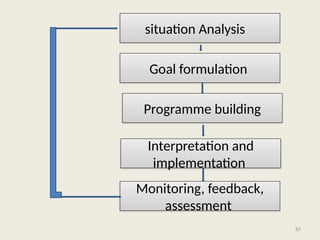
Skilbeck’s model consists of five phases as
follows:
1. Situation analysis
2. Goal formulation
3. Programme building
3. Interpretation and implementation
4. Monitoring, feedback, assessment and
reconstruction
87
situation Analysis
Goal formulation
Programme building
Interpretation and
implementation
Monitoring, feedback,
assessment
88
EXPLANATION OF THE COMPONENTS OF SKILBECK’S MODEL
• The model has five components.
• Situation analysis: this component starts with a
systematic review of the situation and an analysis
of the interacting elements, contributing to it.
• This involves finding out the context in which the
curriculum development process is to take place
and the feasibility of it being successful.
• Two major situations are analyzed namely
external and internal factors.
89
• The internal factors include pupils and their attributes,
teachers and the knowledge, skills and interests,
school ethos and political structure materials,
resources and other perceived problems
• The external factors are parental and community
expectations, the changing nature of subjects
disciplines and the potential contribution of teacher-
support systems such as colleges and Universities and
the entire political climate.
• Goal formulation: the statement of goals embraces
teacher and pupil’s actions and the kinds of learning
outcomes preference, values, judgment, priorities and
emphasis.
90
• Programme building: it comprises the
following;
– design teaching, teaching-learning activities such
as content, methods scope and sequence
– Means; instructional materials of all kinds.
– Design of appropriate institutional settings i.e
Laboratories, workshops and fieldwork.
– Personnel, development and role definitions
– Time tables.
91
• Interpretation and implementation. This is
where practical problems involved in the
introduction of a modified curriculum are
anticipated and then hopefully overcome as the
installation proceeds.
• Monitoring, feedback, assessment and
reconstruction. This step consists of the
following:
– Design of monitoring
– Preparation of assessment instruments
– Problems of continuous assessment
– Reconstruction: ensuring continuity in the process
92
KERR’S MODEL
• Most of the features in Kerr’s model resemble
those in Wheeler’s and Tyler’s models.
• However, Kerr divided the domains into four
areas. Kerr’s model demonstrates the dynamism
of the curriculum. The stages are not linear but
interactive.
• The idea of cross-checking to ensure that one is
on the right path is portrayed
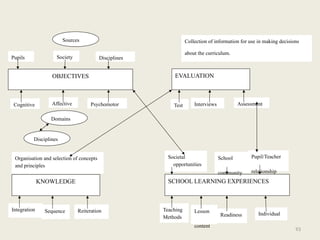
• A simplified version of Kerr’s model of
curriculum design is shown below.
93
OBJECTIVES
KNOWLEDGE
EVALUATION
SCHOOL LEARNING EXPERIENCES
Pupils Society Disciplines
Cognitive Affective Psychomotor
Sources Collection of information for use in making decisions
about the curriculum.
Test Interviews Assessment
Domains
Disciplines
Organisation and selection of concepts
and principles
Societal
opportunities
School
community
Pupil/Teacher
relationship
Integration Sequence Reiteration Teaching
Methods
Lesson
content
Readiness Individual
94
• What you should note about the model is that:
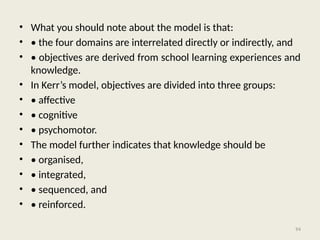
• • the four domains are interrelated directly or indirectly, and
• • objectives are derived from school learning experiences and
knowledge.
• In Kerr’s model, objectives are divided into three groups:
• • affective
• • cognitive
• • psychomotor.
• The model further indicates that knowledge should be
• • organised,
• • integrated,
• • sequenced, and
• • reinforced.
95
• Evaluation in Kerr’s model is the collection of information
for use in making decisions about the curriculum.
• School learning experiences are influenced by societal
opportunities, the school community, pupil and teacher
relationships, individual differences, teaching methods,
content and the maturity of the learners.
• These experiences are evaluated through tests,
interviews, assessments and other reasonable methods.
• In his model, Kerr asserts that everything influences
everything else and that it is possible to start an analysis
at any point
• There are many curriculum design models. The models
discussed in this unit are meant to give you an idea of how
they are used to develop a curriculum
96
In designing a curriculum, you need to:
• Establish or obtain general goals of education.
• Reduce the general goals to specific instructional objectives,
including objectives that cover different domains and levels.
• Assess prior student knowledge and/or abilities.
• Break learning into small, sequential steps.
• Identify teacher behaviour.
• Identify student behaviour.
• Write a description of the lesson.
• Evaluate to see if the intended outcomes have been
achieved.
• If you complete these eight stages, you would have
conducted what is generally referred to as the task analysis
process.
97
THE NEED FOR CURRICULUM PLANNING
• It directs the teacher on what to teach at what level and the type of
teaching and learning materials to select and use.
• The teacher is also guided on what to teach first and how to sequence
the topics into units and courses.
• It enables the teacher to make appropriate selection of methods for the
teaching of a particular course or subject at a particular level
• It enables the teacher to identify the objectives, content, activities etc. in
order to guide pupils to acquire those skills, knowledge, and attitudes
which are relevant to the needs of society.
• It enables the teacher to interpret the implement curriculum
objectives ,it assists the state to plan and the budget adequately for the
education of its citizens.
• It determines the kind of educational system the country wants to
implement and determines the kind of training that teachers will be
given to make them competent to teach.
98
WEEK 5
99
MEANING AND TYPES OF OBJECTIVES
• The purpose of Education is to enable certain
“goals”, “aims” and “objectives” to be
achieved.
• This implies that the terms “goals”, “aims” and
“objectives” are associated with curriculum
development.
100
Goal
• A goal is a target to be achieved.
• According to Oliva (1992), goals “are timeless in the sense
that no time is specified by which the goals must be
reached”, and at the same time they “are not
permanent,” in the sense that they “may be modified
wherever necessary or desirable.”
• A goal is a long-term objective, for example, we may have
a national goal for education in a country.
• Goals provide direction for education, but they do not
specify achievement levels or proficiency levels.
• Examples of goals are “Development of moral
competencies”, “Understanding of religious concepts”.
101
Aim
• An aim is an important statement that guides the
school and gives educators a sense of direction.
• For example the goal of education may be to make
people responsible citizens in the society.
• The aim to achieve this goal may be through
teaching people to read and write.
• The aim therefore is a narrow and more specific
goal.
• It is a medium-term. Aims express goals in narrower
and more specific terms (Farrant, 1980:21). They are
mediate goals
102
Objective
• An Objective describes the specific activities
that are to take place in the classroom.
• They specify the content or subject matter to be
taught, the skills to be developed and the
standard to be used in measuring the change in
behaviour among the learner.
• Objectives are set for the day-to-day activities in
the classroom and for that matter, they are
short-term. These are proximate goals.
103
Types of Objectives
• Objectives can be “Behavioural” or “Expressive”.
• Some people were of the view that Educational
Objectives should attempt to measure a change in
what pupils can do or a change in their behaviour.
• Examples of such advocates were Benjamin S.
Bloom (1956) and Robert F. Marger (1984).
• There were others who opposed this view of
stating objectives in behavioural terms.
• They based their argument on the grounds that
not all learning processes could be measured.
104
• In this regard, they advocate for expressive
objectives or expressive outcomes, which were
more difficult to measure, for example Literary
Appreciation.
• In poetry appreciation, one would identify the
title of the poem, the theme, ideas expressed,
poetic devices like simile, metaphor,
personification, et cetera.
• In dealing with such an issue, it would be very
difficult to state behavioural objectives. Advocates
of expressive objectives were Eisner (1975),
Stenhouse (1970) and Hirst (1975).
105
STATEMENT OF BEHAVIOURAL OBJECTIVES
• According to Marger (1984), there are four
essential parts of Instructional Objectives. These
are:
• The one to perform the behaviour
• The measurable student terminal behaviour
• The standard of performance expected of the
students
• The conditions under which learning will take
place
106
• The learner is the one who performs the activity
or puts up the behaviour.
• This is the reason why instructional objectives
are stated in terms of what the learner can do,
rather than what the teacher can do.
• The measurable student terminal behaviour is
usually indicated by action verbs.
• This enables the teacher to measure any change
in behaviour that could occur in the learner.
• Some of these action verbs are: state, list, recite,
dramatize, discuss and define.
107
• The condition under which the learning would
take place is usually indicated by the phrase
“By the end of the lesson …”
• These can be summed up as follows:
• By the end of the lesson, (condition)
• the student will be able to (performer)
state (behaviour)
• three (criteria) advantages of behavioural
objectives (content).
SOURCES OF OBJECTIVES
• Tyler (1949) has identified five main sources
where one can select educational objectives.
• These are
• the learners
• the needs of contemporary society
• the nature of the subject matter
• philosophy, i.e. our set of values, etc.
• psychology, i.e. the way children learn.
108
109
The Learner
• At the centre of every Curriculum is the learner.
• This implies that in curriculum development,
one must take into consideration the needs and
interests of the child or the learner.
• Whatever the learner is to study should be of
relevance to him or her.
• The Society
• The School is a micro community, which is
situated within the larger community.
110
• The wider community may have its own goals,
values and aspirations.
• It may also have its own needs, which may be
political, economic or social.
• The school should therefore identify such needs,
goals, values and aspirations, and design a
curriculum, which should aim at helping the
society to inculcate the type of moral values that
they cherish.
• Education must be linked to national development
and cultural renewal (Bishop, 1985:15).
111
• The Nature of the Subject
• The nature of the subjects to be studies
provides a source of objective for the
curriculum.
• Subject prepares learners by equipping them
with the necessary skills, knowledge and moral
competencies for useful role in the society.
• The subject specialists, subject associations and
the various textbooks on the subject serve as
sources of information to the curriculum
developer.
112
• Philosophy of Education
• Educational Philosophy or ideology has a strong
influence on curriculum development.
• The aims and purposes of Education will determine
the nature of the curriculum to be used in the country.
• For example the need to fight against moral
decadence in society and to inculcate in people good
moral values among others, have led to the
introduction of the Religious and Moral Education
(RME) curriculum in Ghanaian schools.
• This philosophy of Education has influenced the aims
and objectives of the curriculum.
113
• Psychology of Learning
• Another major determinant of curriculum is the
Psychology of Learning and it serves as a source of
objective.
• According to Piaget’s Theory of Moral Development,
children’s moral judgment proceeds through invariant
sequence of stages, namely Sensori-motor (from birth
to 2 years); Pre-Operational (2 - 5 years); Intuitive (5 –
7 years); Concrete Operational (7 – 11 years) and
Formal Operational (11 – 12 years and above).
• Thus in the selection of objectives, the cognitive
developmental levels of the learners are seriously
taken into consideration
114
Approaches To Curriculum Design
The aim and purpose of education and psychology of
learning usually determine, to large extent, the kind of
knowledge, skills and attitudes to be acquired,
and how these are to be organized and transmitted to
learners.
There has always been a continuous search by
educators for ways in which learning experiences can
best be organized and transmitted in order to make
the learners function better in their environment (i.e.
contribute meaningfully to national development).
115
Consistent with the above objectives, the various
programmes in our schools and colleges reflect a mixture
of different curriculum patterns.
Curriculum pattern refers to the unique features/qualities
in which educational intentions, subject matter, learning
experiences, methods of teaching among others are
woven together in an attempt to bringing out different
educational goals
These include:
Subject Curriculum
Braodfield's/ Integrated Curriculum
Activity/ Experience Curriculum
Core approach
116
Subject Curriculum
The subject curriculum or design is probably the oldest
and most widely used form of curriculum organization.
The subject curriculum organizes the curriculum into a
number of subjects each of which represents a
specialized and homogenous body of content.
The basis of this organization is the grouping of
knowledge of similar nature in such traditional subjects
as Economics, Geography, History, Physics Chemistry,
Biology, Mathematics or Music.
117
• This type of pattern of curriculum organisation
breaks knowledge into discrete subjects or
disciplines. Each subject has its own logical
order and teaching and learning take place
according to a specified sequence decided on
by the content specialist
118
In Ghana, this type of curriculum was use
prior to the Education Sector Reforms of 1987.
In other words, the subject matter was
classified and organized into watertight
compartments for easy identification and
learning.
In this way the study areas or syllabus are
established and teachers specialize in these
areas and develop suitable ways of teaching
the content.
119
Characteristics of subject curriculum
The subject curriculum is an organisation of the
content of education into subjects of instruction.
 Subjects are compartmentalised bodies of
knowledge taught in complete isolation from one
another, even from those to whom they are related.
 It permits a certain degree of interrelation
among the subjects.
120
It lays emphasis on sharply defined subject divisions
( i.e. the content and skills to be taught are divided into
distinct subject areas such as Mathematics or Geography
 Each subject is taught separately within a
prescribed time limit.
 The understanding of key concepts in each subject
area i.e. mastery of each subject is the main concern of
the subject teacher.
 The teacher is the dominant figure in the teaching
and learning process.
121
Merits of the Subject Curriculum
The chief arguments in favour of the subject design or
curriculum include the following:
 It makes room for in depth study and acquisition of
knowledge in particular subject/discipline leading to broading
of outlook and expertise in that particular subject matter.
 Most of our teachers especially secondary school teachers
were beneficiaries of this design and therefore have
experience that orient them towards this design. Teachers
therefore feel more comfortable with this type of design
allows them to use their school experience directly in
teaching and thus makes them feel more competent in their
teaching
122
The specialisation that goes with subject-based
teaching enhances the career development
opportunities of both teachers and students. By
specialising in these subjects, teachers become
subject specialists..
Textbooks and other teaching materials are
generally organized along the lines of subject
matter curriculum, hence teachers as well as
leaners can easily lay hands on materials to study.
123
Again the subject matter curriculum tends to
reflect division of labour in research and
therefore makes the most logical economic
and intellectually appealing presentation of
subject matter ( Edention, 2000).
It is economical to use since it trains teachers
for blocks of subjects.
124
Demerits of Subjects Curriculum
1. Concept and facts which the design emphasize, are
learned in isolation since subjects are in pure
compartments.
2. It fails to effect transfer of learning and the
interconnection of ideas, concepts and facts in
different disciplines. This happens as the subject may
be taught without reference to other subjects
3. There is lack of integration in the subject
curriculum. In other words it is a collection of
fragment of information selected for the learner.
125
4. It is detached from the concerns and events of
the real world.
For example such important aspects of life as
poverty, racism, war, pollution, conservation of
resources, urbanization and energy are no
respecter of subject matter boundaries.
5. There is little room for the learner to question,
explore and discover things for himself thus, it
makes transfer of learning difficult.
126
6. It gives inadequate attention to the needs,
interest, and experience of the learner.
7. Since mastery of the subjects is the central aim of the
design, only learners whose experience and interest
coincide with the subjects as presented tend to profit
meaningfully from the curriculum.
8. It is an inefficient arrangement of the
curriculum for learning and for use.
Because its organization is often alien to the
centre of interest which the experiences of the
learner crystallize.
127
BROAD FIELDS/INTEGRATED
CURRICULUM
This curriculum design first appeared in the 1920s as a
reaction or an attempt to overcome the defects of the
subject – curriculum (i.e. the fragmentation of subjects)
which is of very little practical value.
As an improvement over the subject – curriculum, it
integrates or combines two or more related subjects into a
single broad field of study.
Bishop (1985) explains curriculum integration as
regrouping of ideas and knowledge between subjects and
disciplines so as to provide a new intellectually reputable
curriculum.
128
It does not merely mean fitting together of bits and
pieces from different subjects but rather making use of
unique contribution of the individual subjects in ways
that are practically useful.
For example, at the Basic School level, subjects like
Geography, History, and Civics which hitherto were
studied separately are now integrated to form Social
Studies.
Similarly, reading writing, spelling, speaking and
composition are combined as Language Arts.
Also at the Senior Secondary School level, Physics
Chemistry, Biology are combined as general/
Integrated Science.
129
Characteristics of Broad Fields
Curriculum
It involves a combination of two or more
subjects
It represents a broad spectrum of ideas
Subjects merged are related in one way or the
other
130
Merits of the Broad Field Curriculum
Integration breaks artificial boundaries that the single subjects present and
reinforces the principle of unity and continuity of knowledge.
The curriculum is ultimately based on the combination of separate subjects and
for this reason it provides an orderly and systematic exposure to our cultural
heritage.
For example, through the study of religion, music, dance and drama which
combine to form cultural studies, children become enlightened on the fact that
these are part and parcel of our culture.
It may also be said that by integrating separate subjects as in social studies, it
enables learners to see the relationship among the various elements in the
curriculum.
Again by having several subject blended together, the student get a better
picture of the scope of man’s knowledge and this helps broadens his
perspectives and outlook on issues (Oliva, 1965).It broadens the scope of
knowledge of the pupils and it is given a practical approach to make it both
meaningful and useful
131
Demerits of Broad Fields Curriculum
• Such knowledge is shallow in depth. In other
words, it does not lend itself to the deeper
coverage of the subject centred approach and
therefore students are in danger of acquiring a
superficial knowledge of many topics and no
deep understanding of anything.
132
• There is a dearth of personnel to implement
this type of curriculum since most teachers
were trained to implement the subject
curriculum.
• They therefore tend to emphasize their special
areas to the detriment of the other component
parts.
• It tends to stress the goals of content coverage
and the acquisition of information and thus
offers little opportunity for the achievement of
either cognitive or affective goals
133
The Core Pattern design
The term “ core” has come to be used in variety of ways. Two
of these will be discussed here
Core curriculum refers to the portion of the curriculum which
all students are required to study in any institution as directed
by the curriculum planners.
For example, all Senior High Schools in Ghana offer
Mathematics, Integrated Science, English Language and
Social Studies, currently ICT has been added.
It also consist of fundamental knowledge and skills, which are
considered to be so basic to the culture and civilisation that
they must necessarily be exposed to everybody.
The core curriculum is therefore offered as liberal education
for all.
134
Characteristics of Core Curriculum
• The subject matter for study is organized around broad
current social problem areas, for example making a living.
• The subjects selected retain their identity but the content is
selected and taught with special reference to the unit or
problem.
• It emphasizes social values such as hand work, honesty,
skills, security or faithfulness.
• It is intended to make what is relevant to the learner’s
personal life.
• Issues which are central to everyday living such as the rules,
beliefs, facts and method of thinking which are shared by
the society of which the school forms a part are studied.
135
• Richmond (1971) stresses that the main facts,
values skills and attitudes to be learnt are
determined and arranged in advance by the
teacher
• but the actual problems studied and the
manner of their study are decided by the joint
planning between the teachers and the pupils
• taking into account the present needs and
interest of the pupils by cutting across subject
matter lines.
136
It reflects the compulsory subjects which are to be
studied by all at the various levels of the educational
system since such a body of knowledge is seen as
fundamental in the learner’s development.
In other words, it is the general education required
of all learners.
It is a form of integrated, fused or broad fields
curriculum whose subject matter is directed towards
the improvement of society’s beliefs, methods of
thinking etc.
It emphasizes the practical use of the knowledge
acquired by learners.
137
Merit of Core Curriculum
• It aims at ensuring the overall growth of the
child.
• It is more ambitious attempt to provide for
integration, to serve the needs of the learner and
to provide active learning and more significant
relationship between school and real life
situations.
• There is an effort to relate the programmes of
learning to the problems of life and the learners’
interest.
138
Demerit of Core Curriculum
• The Core Curriculum does not offer significant
and systematic body of knowledge.
• The core curriculum imposes courses on
learners even without their desire to offer it.
• It is difficult for teachers to form a
collaborative team teaching due to differences
in their academic background.
139
THE ACTIVITY/EXPERIENCE CURRICULUM
The activity or experience curriculum also known as
the learner or child centred curriculum is designed to
ensure that the methods of teaching and learning
focus on the activities and experience of the learner.
That is, the learner’s own interests and the activities
to be learned.
This design was meant to counteract the passivity
and sterility of learning and isolation from the
interests and needs of children in the other
curriculum designs.
140
• The activity curriculum originated from the
works of Rousseau and Pestalozzi but was
greatly influenced by John Dewey.
• Dewey based this curriculum on the child’s
desire to be sociable (i.e to associate and share
things with other people).
• He also based it on the child’s inherent desire
to construct, investigate, and express ideas
verbally and non-verbally.
141
Characteristics of Activity/Experience
Curriculum
The structure of the curriculum is determined by
learners’ needs and interest (i.e the learners’ own
immediate felt needs and interest and not the
teachers conception of what the learners’ needs or
interest ought to be).
The most important task of the teachers is to:
discover what the interest of the learners are and
to help them select the most significant of these
for study.
142
– The teacher’s task requires extensive planning: they
must prepare in advance to help learners decide what
to do, how to do it, and how to evaluate the result.
– The design focuses on problem-solving procedures
for learning.
– In the process of pursuing their interest, learners
encounter certain difficulties, which they must
overcome.
– These difficulties constitute problems, which the
learners see as challenges.
– In their attempt to find solution to these problems
“they achieve the learning which represent the major
values of this curriculum”.
143
Merit of Activity/Experience Curriculum
School activities are based on the interests and
needs of the learner and therefore are intrinsic
and do not need to be externally induced.
In other words, the facts, concepts, skills and
processes of the learning activities are
considered important by the learner and not
because they are needed by the school for
examination purpose.
144
• It makes learning experience more related,
real, meaningful and relevant to the needs and
interests of the learner
• It provide for the individual differences of the
learners.
• In other words, learners may join a class group
where its interest coincide with his own; on the
other hand, he may decide to purse an
individual project if his needs and interests are
unique.
145
Demerit of Activity Curriculum
A curriculum based on the learners’ felt needs and interest cannot
possibly provide an adequate preparation for life.
It has been argued that children will miss a lot of valuable skills,
concept etc for effective functioning in the modern world if
learners are allowed to exclude from the curriculum things that do
not interest them.
It is extremely difficult to design a curriculum that meets the
interest and experiences of all learners. This is because learners
come from different background with different expectation.
The activity curriculum requires for its success resources and
facilities to meet diverse individual needs in the classroom. It
thus puts stress on the limited resources in the school.
146
Designer of the Curriculum
You should be aware that the process of curriculum
designing and development differs from country to
country.
In Ghana, for example, the curriculum is centrally
developed.
In some developed countries such as Britain, the United
States of America and Australia, local authorities or
individual states develop their curriculum.
The manner in which the curriculum is designed
determines who designs the curriculum in that country.
147
Patterns of Curriculum Designing
There are three patterns of curriculum
designing:
centralised curriculum designing
decentralised curriculum designing
flexible curriculum designing
148
Centralised Pattern of Curriculum
Designing
A centralised curriculum designing pattern is
one in which the content is decided upon by a
national office.
The actual work in designing the curriculum
may be completed by a contracted consulting
company, a parastatal organisation or a
division of the Ministry of Education
149
Characteristics of Centralised Curriculum
The national goals and philosophies as well as
the subject content is decided upon centrally.
National syllabuses are produced with
suggested general learning objectives.
• Subject content and evaluation instruments
are developed centrally and decisions on when
and how to administer these instruments rest
with the Ministry of Education or the
Examination Board.
150
Subjects to be offered by schools are
determined centrally. Schools choose their
subjects from a given list.
All learners taking the same subject write the
same examination and are assessed in the same
skills.
However, adjustments in testing are made for
students who may have certain disabilities.
Certification is centrally controlled.
151
Generally, textbooks must be approved by the
Ministry of Education before any school uses
these books.
• Normally, there are curriculum development
teams at different levels.
• An inspectorate or standards control division
is put in place to monitor the learning and
teaching activities.
• It takes a long time to write and approve the
final curriculum document
152
WEEK 6
153
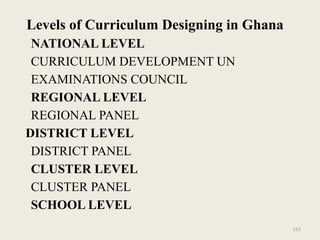
Levels of Curriculum Designing in Ghana
NATIONAL LEVEL
CURRICULUM DEVELOPMENT UN
EXAMINATIONS COUNCIL
REGIONAL LEVEL
REGIONAL PANEL
DISTRICT LEVEL
DISTRICT PANEL
CLUSTER LEVEL
CLUSTER PANEL
SCHOOL LEVEL
154
School Level. The teachers note concerns about the
subjects they are teaching in terms of content,
methodology and materials in use.
They also note problems faced by learners and at times
local needs. These are taken to cluster meetings by a
school representative-Curriculum Leader.
Cluster Level. This is a group of three to five schools
that are either close geographically or offer similar
subjects.
A chairperson, normally a head of a school, is selected.
He or she becomes the subject coordinator at this level.
Representatives from schools meet and review common
concerns, which are then forwarded to the district level
155
District Level.
Teachers’ representatives from each of the
clusters under one district meet.
The chairpersons at this level are District
Directors of Education or their
representatives.
Concerns are discussed and pressing and
common issues are forwarded to the regional
level
156
Regional Level. In some countries, the regional
level may be referred to as the provincial level.
All concerns from districts are brought by a
team of three from each district.
Ideally, the deputy Regional Director chairs
sessions at this level.
However, the subject specialist officers are
usually tasked to chair and compile the
concerns for submission to the national level.
157
National Level. In Ghana, Curriculum Research
Development Division (CRDD) is a section in the
Ministry of Education that coordinates curriculum
development.
In countries like Malawi and Tanzania, the
function is performed by a parastatal. Depending
on the country, the following people could be on
the national panel.
• Subject Education Officers from headquarters
• Subject teachers from each region
• One representative from the particular subject
association
158
Tutors from teacher training colleges; one secondary and
one primary teacher’s college
• Representatives from local universities
• Representatives from local technical colleges
• Representatives from the Examining Board if it is not
the Ministry of Education that is developing the standard
examination.
• Representatives from professional associations related
to the subject under design or review.
• Representatives from industry and commerce.
• Researchers.
• Representatives from ministry departments related to
the subject under design or review.
159
Advantages of the Centralised Pattern of
Curriculum Design
It makes it easy to achieve national goals, since all
schools use the same documents.
• Learners can transfer from one school to another
without being disadvantaged.
• Entry requirements for universities and colleges can
be centrally determined and parity can be ensured.
• Communication to schools regarding academic
requirements is easy, since the Ministry of Education
is directly involved
160
Disadvantages of the Centralised Pattern
of Curriculum Design
The process takes a long time before the final
document is produced.
• The design is insensitive to the needs of
some groups within the country.
• There are coordination and communication
problems when parastatals are involved in
curriculum design.
161
There is limited participation by various
members of the community, resulting in little
commitment during the implementation stage.
• It stifles creativity and initiative on the part
of the teacher and other community members.
• Generally, the centralised pattern stresses
content, mainly knowledge, at the expense of
the development of attitudes and skills.
There is a scramble for certificates, with little
regard for the development and demonstration
of productive skills.
162
Decentralised Pattern of Curriculum Design
The decentralised pattern of curriculum design
occurs when the local authorities or individual
states draft their own curriculum.
This type of designing is common in developed
countries.
However, some developing countries with large
populations and states, such as Nigeria, use the
decentralised pattern of curriculum design.
163
Characteristics of Decentralised Pattern
Local communities initiate the changes to suit their local needs.
• Teachers work with the parents to determine the content. The
learning experiences are based on what is available.
• Subjects in schools could be the same, but the content will
vary from school to school, state to state, or district to district.
• Each school, state or district has its own syllabus that is
produced locally.
• Generally, the textbooks may not have been centrally
approved.
• Each school, state or district has its own form of evaluation.
• Very few people are involved in curriculum designing
164
Institutions that are involved in designing
the curriculum
State or District Based Curriculum Designing
In principle, these have the same structure as the centralised
structure that was discussed earlier in this section.
The only difference is that each district or state will have
the final approval on content.
However, each curriculum produced should meet the
national goals.
In general, the same type of people involved in the
centralised pattern are also involved at the state or district
level.
165
Local Authorities
Institutions and responsible authorities such as
town boards and churches may be involved in
curriculum development.
Normally, they would depend on the teachers,
heads of schools, subject specialists, industry
representatives, researchers and consultants to
draft the curriculum.
Consultants and teachers usually outline the
content and learning experiences.
166
Advantages of the Decentralised Pattern
The curriculum addresses local needs.
• The local community is directly involved and is
committed to its implementation.
• The system encourages creativity and initiative
on the part of the teacher.
• It takes less time to produce the curriculum than
it would take when a centralised pattern is used.
• Students learn what is relevant to the local
community.
167
Disadvantages of the Decentralised Pattern
There is no guarantee that national goals will be
achieved.
• Learners cannot easily transfer from one school
to another when their families move.
• There is generally a problem in developing or
accessing teaching materials which, if available,
are expensive to produce.
• There may not be adequate expertise in the local
community to develop part of the curriculum
168
Curriculum Implementation
• Curriculum implementation entails putting into practice the
officially prescribed courses of study, syllabuses and subjects.
• The process involves helping the learner acquire knowledge or
experience.
• The learner is therefore the central figure in the curriculum
implementation process.
• Implementation takes place as the learner acquires the planned
or intended experiences, knowledge, skills, ideas and attitudes
that are aimed at enabling the same learner to function
effectively in a society
• Viewed from this perspective, curriculum implementation also
refers to the stage when the curriculum itself, as an educational
programme, is put into effect.
169
• Implementation takes place when the teacher-
constructed syllabus, the teacher’s personality, the
teaching materials and the teaching environment
interact with the learner.
• Curriculum implementation therefore refers to how
the planned or officially designed course of study is
translated by the teacher into syllabuses, schemes of
work and lessons to be delivered to students.
• In a centralized educational system such as France and
Ghana, curriculum development and implementation
is effectively and predominantly initiated and
controlled centrally by the Ministry of Education
(MOE).
170
• In Ghana, the MOE is charged with the responsibility of all aspects
of education.
• However, in practical terms, the MOE concerns itself with policy
formulation and leaves actual implementation of the policies to
some agencies set up by the Government for that purpose.
• These agencies include the Ghana Education Service (GES), the
Arts Council of Ghana, the Ghana Library Board, the Bureau of
Ghana Languages, the Ghana Book Development Council, the
National Council for Tertiary Education and The Institute of
Professional Studies.
• The GES has responsibility for implementing pre-university
educational policies formulated by the MOE as well as the overall
administration of the schools.
• The development of curriculum for all pre-university institutions is
the responsibility of the Curriculum Research and Development
Division (CRDD) which is one of the divisions of the GES.
171
Stages/process of Curriculum Implementation
• Curriculum implementation, as already explained is
always an attempt to introduce certain desirable
changes in the curriculum to make it better.
• It often involves the spread of curriculum ideas,
values, materials and activities from one location to
another.
• A fairly logical sequence of steps which have
resulted in successful implementation in many
educational systems is as follows: a) Design, b)
Tryout, c) Field Trial, d) Dissemination
172
Design
• This is the stage where important decisions are made
concerning the objectives of a particular programme or course
of study, the course content, the teaching-learning strategies,
the resources to be used and the assessment techniques to be
employed in evaluating learning outcomes and other aspects
of the curriculum.
• Here curricula experts decide whether programme or course
objectives need to be revised in the light of the changes being
introduced, whether the time table arrangements need to be
maintained or changed;
• whether the content of the syllabuses, textbooks, teacher
support materials, and the like need to be revised, whether the
methods of teaching are adequate and effective.
173
• At this planning stage, the likelihood that students will
be able to learn the materials, master the skills, and
acquire the competencies aimed at in the programmed
is assessed.
• This implies examination of the existing cognitive and
affective characteristics of both teachers and students.
• Other considerations at this stage may include
specification of the scope and sequence of the content,
selection of teaching-learning strategies and
assessment of cost of implementation.
• Thorough examination of various aspects of proposed
changes at this stage is an essential first step to
increased efficiency of implementation.
174
Tryout
• Here syllabuses, textbooks, teacher support materials and other teaching
and learning resources are put to use on a small scale in order to assess
their strengths and weaknesses.
• The essence of the tryout is that it makes it possible to combine
professional wisdom of curriculum experts with hard empirical evidence
for the job of curriculum implementation to be effectively carried out.
• The tryout is usually done in between two to six schools selected
according to the principles of judgment sampling to reflect the
characteristics of the different subgroups of the population for whom the
programme has been designed.
• The teachers of these schools are taken through a prescribe training
programme designed to go with the changes being introduced.
• It is the responsibility of the curriculum implementation team to
carefully observe teaching – learning processes in the classrooms at this
stage
175
Field trial
• At the tryout stage emphasis is laid on ways of
improving upon the curriculum package being
introduced.
• Due consideration is, therefore, given to the
practical problems on the ground in the classrooms
which are likely to effect the implementation.
• Field trial of a curriculum package is usually based on
a representative sample of schools and classrooms.
• Thus, unlike the tryout stage where only a few
schools (2-6 schools) are used with the field trial as
many as 30-60 classes or schools may be used.
176
• At the field trial stage, the difficulties that are associated
with large-scale implementation of the programme or
curriculum package are particularly noted.
• The goal of evaluation activities at the tryout stage is to
detect flaws in the programme, while at the field trial
stage evaluation seeks to mainly specify how the
programme is to be used.
• Questions that call for attention at the field trial stage
include the following: is the programme equally suited to
the needs of both urban and rural schools? Are teachers
who did not go through special training able to teach the
new programme? Can the programme be used in schools
where the average number of learners per class exceeds
the recommended 35_40 students
177
Dissemination
• According to Rudduck and Kelly (1976) the components of the
dissemination process are translocation, animation and re-
education.
• Translocation refers to the movement of people and materials
required to implement a new curriculum or the changes being
introduced.
• In a more comprehensive sense, it has to do with all the
administrative arrangements necessary to put in place to assure
the effective dissemination of the curriculum programme,
materials and personnel throughout the entire school system.
• Issues such as supply of teachers, textbooks, teaching aids,
machines, tool and equipment as well as the provision of school
accommodation and other infrastructure come into play at this
stage.
178
• Communication refers to the transfer of information about
the curriculum being implemented across persons
interested in the implementation process.
• The purpose of the communication process is to make
people have a favourable attitude towards the changes
being introduced so that they will be received with
enthusiastic support.
• Information about the curriculum being introduced are
targeted at teachers, students, parents and other
stakeholders.
• Here letters, handouts, mobile vans, cinema shows,
personal contacts, newspapers and other print and
electronic media may be used to create awareness about
the curriculum.
179
• Animation also has to do with the process of
providing a stimulating and enabling
environment for curriculum implementation
to take place smoothly.
• In this regard, we are concerned with
incentive schemes for students, teachers and
other personnel, obtaining the support and
cooperation of the supervisory staff
180
• Re-education entails ensuring that there is widespread
understanding of the changes being introduced and a more serious
commitment on the part of all concerned with the implementation
process for it to succeed.
• Re-education requires a depth of experience beyond that provided
by the other three components of the dissemination process.
• The importance of continuity of training, cooperative experience in
trying out the new programme, the establishment of rapport
between innovators and implementers are among the issues
stressed under re-education
• Classroom teachers need to be properly equipped and prepared to
undertake actual implementation at the chalkboard phase of
school work.
• This calls for intensive in-service courses to update the knowledge,
skills, and attitudes of existing teachers and resource persons.
181
Factors That Influence Curriculum Implementation
• The Teacher
• Since implementation takes place through the interaction of
the learner and the planned learning opportunities, the role
and influence of the teacher in the process is indisputable.
• Teachers are pivotal in the curriculum implementation
process, but what is their role in the curriculum planning
process?”
• If the teacher is to be able to translate curriculum intentions
into reality, it is imperative that the teacher understand the
curriculum document or syllabus well in order to implement
it effectively.
182
• The Learner
• Learners are also a critical element in curriculum
implementation.
• While teachers are the arbiters of the classroom practice,
the learners hold the key to what is actually transmitted and
adopted from the official curriculum.
• The official curriculum can be quite different from the
curriculum that is actually implemented.
• The learner factor influences teachers in their selection of
learning experiences, hence the need to consider the
diverse characteristics of learners in curriculum
implementation.
• For example, home background and learner ability can
determine what is actually achieved in the classroom.
183
• Resource Materials and Facilities
• No meaningful teaching and learning can take
place without adequate resource materials.
• In Curriculum Implementation, it is suggested that
the central government must also provide
physical facilities such as classrooms, laboratories,
workshops, libraries and sports fields in order to
create an environment in which implementation
can take place.
• The availability and quality of resource material
and the availability of appropriate facilities have a
great influence on curriculum implementation.
184
• Interest Groups
• These include parents, parents’ and teachers’
associations, School Management Committee
(SMC), School Development Committees (SDCs) and
religious organisations, local authorities, companies
and private school proprietors. They:
• • Provide schools with financial resources to
purchase required materials.
• • Demand the inclusion of certain subjects in the
curriculum.
• • Influence learners to reject courses they consider
detrimental to the interests of the group.
185
• The School Environment
• Schools located in rich socio-economic environments and those that
have adequate human and material resources can implement the
curriculum to an extent that would be difficult or impossible for
schools in poor economic environments.
• Culture and Ideology
• Some communities may resist a domineering culture or government
ideology and hence affect the implementation of the centrally planned
curriculum.
• Instructional Supervision
• Curriculum implementation cannot be achieved unless it has been
made possible through the supervisory function of the school head.
The head does this through:
• • deploying staff,
• • allocating time to subjects taught at the school,
• • providing teaching and learning materials, and
186

CURRICULUM STUDIES COURSE OVERVIEW AND EXAMPLE.pptx

  • 1.
    1 EDU 106: CURRICULUMSTUDIES (2 CREDITS) HAJIA NIAMATULAI ABDULAI
  • 2.
    2 COURSE DESCRIPTION • Thecourse is EDU 106: Curriculum Studies (2 Credits) • Everybody in this class should go for the course outline/description. • The course description will help students to know the Consultation hours, the topics, the objectives and other vital information about the course • The course will have one take-home assignment (10 marks), two quizzes (30 marks) and one end of semester examination (60 marks. • The topical areas for each of the quizzes and the end of semester examination will be communicated to students in due course.
  • 3.
    3 COURSE OBJECTIVES • Themain objective of the course is to introduce students to the basics of curriculum studies. • Specifically, the course will expose students to: 1. Definitions of curriculum 2. Curriculum types 3. Curriculum models 4. Curriculum design, processes and principles 5. Factors that affect curriculum development 6. Mainstreaming gender, special needs, ethnicity and religion in curriculum development 7. Some curriculum materials (syllabus, scheme of work, lesson notes and timetables) 8. Lesson preparation and lesson patterns • Students should refer to the course description for the topics to be dealt with in this course.
  • 4.
    4 Meaning of theWord Curriculum • There is no universally accepted meaning of the term curriculum. • This is because experts define curriculum differently. • It follows that experts have different meanings for the word “Curriculum” • However, in this Course, let us conceptualize curriculum as “a course of study”. • Therefore this course is meant for students to learn about “how we get the courses we study” • Or, how the courses that are studied are obtained and implemented.
  • 5.
    5 Some Definitions ofCurriculum • According to Hirst (1968), The term curriculum is excessively broad. It can mean a programme of activities designed so that pupils will attain as far as possible, certain educational ends or objectives. • According to Stenhouse (1976), curriculum is an attempt to communicate the essential principles and features of an educational proposal in such a form that it is opened to critical scrutiny and capable of effective translation into practice.
  • 6.
    6 • Taba (1962)says: Curriculum is a way of preparing young people to participate as productive members of our culture (p. 10) • Tamakloe (1992) describes curriculum as a selection of socially valued knowledge, skills and attitudes which an educand is made to acquire through various forms of planning. • Kerr (1968) defines curriculum as .....all the learning which is planned and guided by the school, whether it is carried on in groups or individually, inside or outside the school. (p.16) Definitions of Curriculum (Cont’d)
  • 7.
    7 The “Process” or“Static” Natures of Curriculum Curriculum is a process when it allows for changes to be made whenever possible. Curriculum is regarded as “static” when the curriculum is documented (completed) and therefore does not allow for changes to be made to the document.
  • 8.
    8 The Static andProcess Natures Curriculum (Cont’d) Now let us see whether the definitions provided above are, “process” and / or “static” in nature. Hirst’s definition of curriculum seems to portray that the curriculum is a process and at the same time static (documented) in nature. • For instance, the terms “activities designed” in this definition suggests “static” curriculum as it is already documented.
  • 9.
    9 • In thesame definition of Hirst, it can be seen as a process because of the phrase “so that” (it is a way of implementing it) • Stenhouse’s definition of curriculum, can be regarded as a process because of the phrase “an attempt to communicate”. The Static and Process Natures Curriculum (Cont’d)
  • 10.
    10 • Taba’s definitionon curriculum suggests a “process” (ongoing) because of the phrase “a way of preparing”. • Tamakloe’s (1982) definition is seen to be static because of “selection of socially valued” and a process because of what “the educand is made to acquire through various forms of planning”. The Static and Process Natures Curriculum (Cont’d)
  • 11.
    11 A curriculum ofan institution may be regarded as either a process or static. • The activities at the stages of the development of a curriculum and its implementation constitute its process. • In the static form, it is the documented state of the development of the curriculum, its implementation and / or evaluation. The Static and Process Natures Curriculum (Cont’d)
  • 12.
    12 Content of aGood Definition of Curriculum • Finally, in an attempt to come out with a worthwhile definition, Yakubu (2000) says curriculum in whatever form should contain: 1. Content: activities, knowledge; 2. The student: student, pupil; 3. The learning experiences: the teacher and his methods, methods of learning 4. Objectives: ends-in-view
  • 13.
    13 TYPES OF CURRICULUM 1.Overt (rational) 2. Covert (hidden), 3. Official (formal and informal).
  • 14.
    14 Overt Curriculum The overt(or rational) type of curriculum is well structured and followed in the institutions. It is explicitly and rationally designed. spells out the expectations of learners having gone through the course of study.  Its subject matter includes subjects such as social studies, Religious and Moral Education, Economics and Geography.
  • 15.
    15 Covert Curriculum • Covert(hidden) curriculum is an unstructured set of attitudes, values and practices that come out spontaneously or unconsciously, such attitudes and practices are not necessarily written down but understood or taken for granted. e.g. teachers utterances, dressing, among others which learners unconsciously copy.
  • 16.
    16 • Urevbu (1985:3) describes the hidden curriculum as the non-academic but educationally significant component of schooling. • Tanner and Tanner (1995) prefer to call it the ‘collateral curriculum’. They argue that the word ‘hidden’ implies deliberately concealing some learning experiences from students. • Since this is not written or officially recognised, its influence on learning can manifest itself in students’ attitudes and behaviour, both during and after completing their studies.
  • 17.
    17 • What isacquired or learned from hidden curriculum is usually remembered longer than information learned at school. • Tanner and Tanner (1975) recommend that positive learning from the hidden curriculum should be acknowledged and treated as an integral part of the planned and guided learning experiences. • As already implied, the hidden or collateral curriculum is often responsible for the values students may exhibit later in life.
  • 18.
  • 19.
    19 Formal and informalCurriculum The curriculum may also be analysed from the formal (narrow) sense or informal sense.  In the formal sense, the curriculum is described as the syllabus used in schools.  In a informal sense, a curriculum goes beyond the knowledge taught in schools. This include activities that go on in schools usually on, voluntary basis as church meetings, club meeting, kitchen and dinning activities.
  • 20.
    20 FORMAL CURRICULUM Refers toactivities which are laid down as the syllabus or that which is to be learnt by students.  It is the officially selected body of knowledge which government, through the Ministry of Education or anybody offering education, wants students to learn.  This curriculum meets specified objectives of educating identified groups of learners or students in their varying settings.  In other words, formal curriculum is the selected written programmes or courses students go through.
  • 21.
    21 INFORMAL CURRICULUM • Urevbu(1985: 3) refers to informal curriculum as the curriculum in use. • Teachers or instructors may not adhere to the presented formal curriculum but can include other aspects of knowledge derived from other sources. • This additional material is called the ‘informal curriculum’.
  • 22.
    22 ACTUAL CURRICULUM Actual Curriculumrefers to both written and unwritten syllabuses from which students encounter learning experiences (Tanner and Tanner 1975). Learning experiences can be selected from other sources rather than the prescribed, official and formal syllabuses. The actual curriculum is the total sum of what students learn and what teachers teach from both formal and informal curricula.
  • 23.
    23 Elements/Components of Curriculum •The curriculum has four elements that are in constant interaction: 1. purpose (goals and objectives) 2. content or subject matter 3. methods or learning experiences 4. evaluation
  • 24.
    24 1. PURPOSE • Thepurpose of a curriculum is based on the social aspirations of society and outlines the goals and aims of the programme. • Aims/goals are broad or general statements of the purposes of education supposed to give general direction or orientation to education in an entire country. • They refer to educational intentions or outcomes of the entire institutional level or a particular school(s).
  • 25.
    25 Objectives are alsostatements of intent or outcomes which specify the kind of changes in behaviour of a learner after undergoing an educational experience or programme. • There are three categories of goals and objectives: 1. Cognitive: referring to intellectual tasks, 2. Psychomotor: referring to muscular skills, and 3. Affective: referring to feeling and emotions.
  • 26.
    26 2. Content/Subject matter Thecontent of the curriculum consists of those aspects of the culture of a given people which are considered to be important enough to be passed on to the younger generation. Content encompasses knowledge, skills, attitudes and values to be learned.
  • 27.
    27  is dividedinto bodies of knowledge, for example, mathematics, English and science;  outlines the desired attitudes and values;  includes cherished skills;  is determined by prevailing theories of knowledge; and  caters for ideological, vocational and technical considerations.
  • 28.
    28 3. Methods The methodsoutlined in a curriculum:  deal with teaching and learning experiences,  involve organisational strategies. Flexible teaching methods to facilitate learning.
  • 29.
    29 4. Evaluation Evaluation isused to: • select appropriate content based on the aims and objectives of the curriculum; • select appropriate methods to address the content and purpose; • check the effectiveness of methods and learning experiences used;
  • 30.
    30  check onthe suitability and the appropriateness of the curriculum in answering social needs;  give feedback to the planners, learners, teachers, industry and society; and provide a rationale for making changes.
  • 31.
    31 DETERMINANTS OF CURRICULUM •By “determinants of curriculum”, we mean ingredients or factors which influence the curriculum, or how the curriculum should be designed. • Bishop (1985) stresses that the determinants of curriculum are those factors, which affect or influence the curriculum.
  • 32.
    32 • Factors oragents that serves as a basis for the curriculum and influence its development include 1.Society/ culture, 2. Philosophy, 3.finance, 4.knowledge, 5.teacher and 6.the learner.
  • 33.
    33 1. SOCIETY/CULTURE • Acurriculum to be developed depends to a large extent on the society where it will be used. • Tyler (1949) identifies the society as having a major role as a curriculum source and influence. • Bishop (1985) supports this view when he says that curriculum does not develop in a vacuum, but, values, tradition, and beliefs of society play a role in its formulation.
  • 34.
    34 • The needs,aspirations and problems of society would go a long way to fashion out the type of curriculum the society should have that would meet societal needs, aspirations as well as address its problems. • Let me tell you that if for instance Ghana wants to build a democratic society, then the programmes offered should concentrate on democratic issues.
  • 35.
    35 2. PHILOSOPHY • Thecurriculum is also influenced by the philosophy that underpins a country’s educational set-up. • The Longman Dictionary of the Contemporary English defines philosophy as the study and meaning of existence, reality, knowledge, goodness etc. • Aboagye (2002) says philosophy can be described as rational investigation into certain fundamental problems about the nature of human beings and the way they live.
  • 36.
    36 • Wiles andBondi (1993) say that an educational philosophy a. assists in answering value laden questions and making decisions from among the many choices. b. It’s intention or rationale underpins the education set-up of a country that should be considered. Eg. If the rationale of education of Ghana is that every student should become computer literate or vocational –oriented, the curriculum should be designed to make provision for that intention.
  • 37.
    37 3. Finance • Anotherdeterminant of curriculum development is finance. • Finance includes both material and human resources. • It is worthy to note that one may have a laudable idea on what type of curriculum to develop, but if there is unavailability of resources, the plan will not see the light of the day. • Bishop (1985) stresses that lack of money can be a complete barrier to educational progress as lack of ideas or initiatives. • Most curricula in the developing countries have not been implemented as expected because of financial priorities.
  • 38.
    38 4. Knowledge • Knowledgeis yet another factor that influences curriculum development. • Knowledge plays a major role in determining the type of curriculum matter, concepts, and mental processes that must be acquired in each subject area. • In other words, the type of knowledge that is worthwhile in social studies, history, economics, science among others inform the curriculum to be designed.
  • 39.
    39 5. Learner • Thelearner also plays a vital role in the curriculum development. 1. The nature of the learner, 2. learning process 3. the conditions facilitating optimum learning, constitute essential factors before taking a worthwhile curriculum decision. • What to teach at a given level cannot be answered without relevant knowledge about the child’s development.
  • 40.
    40 • Time toteach any particular subject, the order in which it is to be organized and the teaching and learning strategies to be adopted for teaching cannot be decided without reference to the thought processes at the various age levels. • In other words, the way the learning process is explained, the processes of human development and transfer of learning, have a unique contribution to curriculum.
  • 41.
    41 6. The teacher Itis common knowledge that whether a curriculum will achieve its intended purpose or not, depends to a large extent on, the teacher specialist. A curriculum expert may select the objectives and plan in an advance but it is the teachers who are the attacking troops on the field to make things happen (Bishop, 1985).
  • 42.
    42 To proceed withthe curriculum design one needs the full co-operation of teachers for they know the local situation and dynamics in the school environment. Positively, the curriculum is enriched by the creativity and imagination of the best teachers Negatively it is affected by the limitations of the poor teachers and poor teacher training institution.
  • 43.
    43 7.EDUCATIONAL PHILOSOPHY AND CURRICULUM DEVELOPMENT. •Knowledge of philosophy will speed up the efficiency of the teacher in the teaching of his/her subjects • Aboagye (2002) stresses that with equipped knowledge of philosophy a teacher will ask fundamental philosophical questions about his/her area of specialization. • With this in mind, it is worth studying the various philosophies guiding the development of curriculum.
  • 44.
    44 The under listededucational philosophies will be discussed. 1. perennialism, 2. progressivism, 3. experimentalism, and 4. Essentialism
  • 45.
  • 46.
    46 1. Perennialism • Itis the most conservative, inflexible and traditional among the educational philosophies to be discussed. 1. They see the aims of education as the disciplining of the mind, the development of the ability to reason and the pursuit of truth. 2. They believe that truth is eternal, everlasting and unchanging.
  • 47.
    47 3. They advocatefor a high academic curriculum with emphasis on grammar, rhetoric, logic classical and modern languages as well as mathematics. 4. They favour the study of the Bible and theological writings, which to them contain truths, which are unchangeable. • According to the perennialists, some ideas have lasted over centuries and are as relevant today as when they first thought of. • In the great books of past, one could find truth, which in perennialist thinking is the same today as it was then and always shall be (Oliva,1992).
  • 48.
    48 2. Progressivists • Progressivistsbelieve that people learn best from what they consider most relevant to their lives.
  • 49.
    49 • They centerthe curriculum around the experiences, interests, and abilities of the students. • Students are encouraged to interact with one another and to develop social virtues such as cooperation and tolerance from different point of views (Aboagye 2002).
  • 50.
    50 3. Existentialist • Tothe existentialist, the world is seen as one’s personal subjectivity where goodness, truth and reality depend on one’s opinion. • In other words, individuals are responsible to determine for themselves what is “true” or “false” “right” or “wrong” handsome or “ugly”. • The existentialist hold the view that the learner is more important than the content to teach.
  • 51.
    51 • The teacher’srole is to help students chart their own course by directing them to various ways as well as creating a conducive environment to decide on his own. • In line with existentialist curriculum, learners are provided with array of alternatives from which to choose.
  • 52.
    52 4. Essentialism • Accordingto the essentialists, what is paramount or core interest is the transmission of cultural heritage. • The essentialists seek to adjust men and women to society. • The goals of the essentialist are basically cognitive and intellectual. • The essentialist plan for curriculum organization is the subject matter curriculum.
  • 53.
    53 5. Experimentalism • Theexperimentalists encourage the active involvement of the learner in all activities. • They are of the view that the world is an ever changing place. • To them, truth is what presently functions. • They favour a school with heavy reliance on social subjects and experiences. • In their view, learning occurs through a problem – solving format.
  • 54.
    54 6. Behaviourism • Behaviouristsbelieve that the only reality is the physical world that we see through scientific observation. • Behaviourism places the learner in a passive role as the recipient of the many stimuli to which he or she must respond. • Under this philosophy, teachers begin instruction by giving the learners a rule concept, or model and then provide them with many opportunities to practise using this guide. • Behaviourism urges teachers to use a system of motivation to prop desired behaviours to correct learning with pressure and reward.
  • 55.
    55 THE MEANING OFSITUATIONAL ANALYSIS • Situational analysis is the first step in designing a curriculum whereby the need, problems and aspirations of a particular society are identified and possible educational solutions are identified through feasibility studies. • In actual fact, effective curriculum design must be based on a thorough assessment of needs, purposes, resources available, the previous historical underpins of the schools and other peculiar situations in the school. • It is conducted to prepare the grounds for the next stage in the process of curriculum development. • In other words it entails the collection of basic information about the educational system, the learners and the teachers.
  • 56.
    56 • Besides thecollection of this information, it involves identifying tasks and problems, seeking possible solution, anticipating the difficulties and possible areas of planning the resources and organizing changes that will be needed. • Simply put, situational analysis may be understood as a crucial study or examination of the society for which an educational proposal is being designed in order to identify the problems, needs and aspirations, resources available and feasible solution.
  • 57.
    57 STEPS TO FOLLOWWHEN CONSIDERING SITUATIONAL ANALYSIS. 1. Needs assessment: including decisions about time assigned, resources to be used, those who will be participants, focused group among others. eg. in analyzing a New Educational Reform Programme attempts need to be made to find out the time frame, resources in terms of material and human, the implementers as well as those who are to benefit from the programme. 2. An attempt to get knowledgeable personalities (consultants) to be consulted to state the outcomes of education that they consider to be worth while or desirable.
  • 58.
    58 3. Validation ofthe goals. This can be done by asking citizens (both educators and non- educators) whether the goals spelt out will meet their needs and aspirations. 4. Try to translate the goals into objectives that are measurable and achievable. 5. The groups that validated the goals should be consulted again to also check on the performance objectives for their acceptability. 6. Selection of testing instruments or evaluative strategies for accessing the current state.
  • 59.
    59 • Testing instrumentsselected are administered to find out current level of students’ performance to ascertain whether students achievement meet the desired defined levels. 7. Data analysis: The data gathered must be analyzed by putting them into tables, graphs charts among others, for easy understanding. 8. Develop the gap or need statements to indicate “what is there” and “what ought to be there” 9. Publish the gap statements so that it comes to the domain of the general public. This then completes the situational analysis exercise.
  • 60.
    60 INTERNAL CONDITIONS OFSITUATIONAL ANALYSIS • The first factor/condition in analyzing the situation in the school is the condition of the learners. • Here, we consider their aptitudes, abilities, values and defined educational needs. • In other words, we need to find out the ability of the learner in coping with the demands of the curriculum. • This can be achieved through interviews, responding to questionnaire as well as taking a critical observation of the exercise conducted.
  • 61.
    61 • The secondconsideration has to be focused on the teachers in the schools. • Teachers are said to know the dynamics of the classroom environment. Therefore their skills, knowledge and experience can promote the implementation of the programme. • If the teachers do not welcome a particular curriculum, it will not see the light of the day. • The next area of consideration is the school ethos and structure. • Here, we will consider the characteristics of a school or the school culture; code of values by which the people in the school live. • Bishop (1985) mentions common assumptions and expectations including traditions, authority relationships among others which should be analyzed.
  • 62.
    62 • Material resourcesincluding building, equipment, learning materials and possibilities for enhancing them can be looked at. • Often times the curriculum designer thinks of laudable curriculum but because of lack or inadequate infrastructure the full benefit of the curriculum will not be felt. • The last consideration before one can begin effective curriculum design and planning is to consider the perceive and felt problems and the shortcomings in the existing curriculum. • We need to find out difficulties with regard to the existing curriculum so that those difficulties or shortcomings will not be repeated in the new one.
  • 63.
    63 EXTERNAL FACTORS OFSITUATIONAL ANAYSIS • The first factor is the analysis of changes and trends in society, which indicate tasks for schools. • That is, industrial and economic development, political directives, cultural movements, ideological change among others. • Since the curriculum is essentially meant to prepare the young ones to meet challenges in the society, you need to find out changes that are taking place in the society. • This will enable you design a curriculum that meet societal needs.
  • 64.
    64 • The nextexternal factor is the expectations, and requirements of parents, employers and taxpayers. • In this way, employers demands must be analyzed and the curriculum will produce people who will have employable skills. • Education is financed by the taxpayers contribution and therefore their expectations must be analyzed. • Community assumptions and values including, patterns of adult-child relationship, Every society/community has its philosophical underpins that direct the type of people it wants the curriculum to prepare. • For instance the assumptions and values of the community like respect for authority, honesty, diligence and we-feeling are desired by communities. • In this direction such values need to be found out and incorporated into the curriculum.
  • 65.
    65 • The curriculumdesigner needs to consider the education system requirements and challenges. • Here, information will be sought on policy directives, local authority, pressures of expectations curriculum projects, examinations, and educational research among others. • The next line of action is to analyze the changing nature of the subject matter to be taught. • The fact, that information keeps on changing and knowledge also grows, it dawns on curriculum experts to be kept abreast with time so that they provide up-to date content to be learnt in schools. • Externally, we can also analyze the potential contribution of teacher support systems. • That is, teacher’s centres, teacher training colleges, universities and research institutions..
  • 66.
    66 IMPORTANCE OF SITUATIONALANALYSIS • The first point is that, situational analysis aids in the selection and organization of appropriate methods in imparting knowledge, skills and worthwhile attitude in class. • It provides the needed information for formulating realistic objectives policies and programmes. • This is why Bishop (1985) asserts that having carried a thorough analysis of one’s situations, one is now in a position to proceed to the next stage on the process /state of curriculum development --- the stage of realistic objectives (p.15). • Additionally, it assists in coming out to identify problems, needs, aspirations, available resources, and climatic conditions among others in a given society so that curriculum designed will suit those circumstances.
  • 67.
    67 • It hasrelevance for the evaluation of the curriculum. An analysis of all the factors which make up the total situation, provides these necessary feedback in ensuring that steps are taken to enhance the attainment of the stated objectives. • It is through situational analysis that conditions in our schools are identified so that the best of curriculum will be designed to meet those need. • For instance, before, the 1987 reform programme, the old system of education was found to be de- emphasizing the technical and vocational education thereby creating unemployment in the system.
  • 68.
    68 • Another benefitis the teacher’s attitude to the programme to be designed. • It is the teachers who are the final implementers of the curriculum and that their needs should be addressed, so they give their blessings to the programme. • Again, it is through situational analysis that learners; attitude, values abilities and other educational needs are identified before realistic curriculum is put in place.
  • 69.
  • 70.
    70 Models of Curriculum •A curriculum model may be explained as the proposal of the various proponents of curriculum and what form a curriculum takes. • In other words, it is a conceptional framework of what the real curriculum should be.
  • 71.
    71 Tyler’s Model • FUNDAMENTALQUESTION RAISED BY TYLER Tyler (1946) has come out with four fundamental questions, which must be answered in designing any worthwhile curriculum. Tyler’s model therefore dwells on these questions: 1. what educational purpose should the school seek to attain? 2. What educational experiences can be provided that are likely to attain these purposes? 3. How can these learning experiences be effectively organised? 4. How can we determine whether these purposes are being attained?
  • 72.
    72 • These fourbasic questions may be reformulated in to a simple four step process as follows: • Statement of objectives • Selection of learning experiences • Organizations of learning experience • Evaluation
  • 73.
    73 • It canbe inferred from the Tylerian module that it is linear or straight line in nature. • It consists of four elements such us objectives, learning activities, organisation of activities and evaluation. • Tyler proposes that objectives should be selected and screened through philosophy and psychology of education. • The objective in turn becomes the basis for selecting learning experiences. • The activities are to be organized sequentially and to be inter-related. • Lastly, evaluation is to used to determine whether the objectives have been achieved.
  • 74.
    74 TABA’S MODEL • HildaTaba draws widely accepted distinction between aims and objectives. • In Taba’s view, the general aims are satisfied only if learners acquire certain knowledge, skills techniques and attitudes. • They represent more specific platform of goals, the outcomes of which are referred to as educational objectives (Taba, 1962) • The model suggests an orderly procedure aimed at a more thoughtfully planned and more dynamically conceived curriculum.
  • 75.
    75 • Hilda Tabahas proposed a seven-phase model for curriculum development. • Step 1: Diagnosis of needs • Step 2: Formulation of objectives • Step 3: Selection of content • Step 4: Organization of content • Step 5: Selection of learning experience • Step 6: Organization of learning experience • Step 7: Determination of what to evaluate and the ways of doing it.
  • 76.
    76 • Taba holdsthe view that a curriculum development should be preceded by a situation analysis in order to determine learning needs. • A learning need is the difference between what a learner has and what he should have in terms of knowledge, interests, attitudes, skills and insights.
  • 77.
    77 Differences between Tyler’sand Taba’s Model • Taba has seven distinct phases instead of only four for Tyler. Thus Taba’s model is more comprehensive than that of Tyler. • Tyler indicates where objectives have been derived from which is not in the case of Taba. • Taba’s model start with a needs assessment phase instead of starting with a specification of objectives spelt out by Tyler.
  • 78.
    78 WHEELER’S MODEL • Itis argued that wheeler’s cyclic model is an offshoot of Tyler’s model. • For it is said that the criticisms put against Tyler that his model is too simplistic among others is what, wheeler capitalizes to build his model. • According to Wheeler (1983) the basic assumption of which his model thrives is that, the end of education should bring about a change in behaviour. • The change should be positive to prompt improvement in behaviour and experiences for the better.
  • 79.
    79 • There arefive phases (steps) that constitute wheeler’s model of curriculum design. These are: • Phase I: aims, goal and objectives • Phase II: selection of learning experiences • Phase II. Selection of content • Phase IV: organization of content • Phase V: evaluation
  • 80.
    80 Aims, Goals andObjectives Organisation and Integration of Experiences Evaluation Selection of Learning Objectives Selection of Content Wheeler’s Model
  • 81.
    81 • The firststage is extremely complex, as general aims, embodying broad conceptions of education are analyzed into ultimate goals, immediate goals, proximate goals and specific classroom objectives. • These provide the directions required for the selection of learning experiences, the selection of content, the organization and integration of learning experiences and content, and the final evaluation, which enables the designer to determine the effectiveness of the curriculum.
  • 82.
    82 • The cycliccharacter of the model further suggests that each phase is a logical development from preceding one, and work in one phase cannot be attempted until work has been attempted in the preceding phase. • Wheeler (1983) stresses the five phases are interdependent and combine to form a cyclic process so that over time the final phase affects the initial one.
  • 83.
    83 Differences Between Wheeler’sand Tyler’s Model. • The following have been identified as some of the differences between Wheeler and Tyler in their models. • Wheeler has five phases instead of Four phases provided by Tyler. • Wheeler’s model is cyclical in nature, whereas Tyler’s model is linear. • Wheeler’s model provides interrelatedness among the various components, unlike Tyler’s model where the various components are not interrelated in any way.
  • 84.
    84 SKILBECK MODEL • ProfessorSkilbeck proposed the situational analysis model. • This model puts curriculum design and development firmly within a cultural frame- work • Teachers are in a position to modify and transform pupils experience by providing insight into cultural values, interpretative frame-works and symbolic system.
  • 85.
    85 • The modelis based on the assumption that the focus of curriculum development must be the individual. • School and its teachers. i.e school-based curriculum development is the most effective way of promoting genuine change at school level.
  • 86.
    86 Skilbeck’s model consistsof five phases as follows: 1. Situation analysis 2. Goal formulation 3. Programme building 3. Interpretation and implementation 4. Monitoring, feedback, assessment and reconstruction
  • 87.
    87 situation Analysis Goal formulation Programmebuilding Interpretation and implementation Monitoring, feedback, assessment
  • 88.
    88 EXPLANATION OF THECOMPONENTS OF SKILBECK’S MODEL • The model has five components. • Situation analysis: this component starts with a systematic review of the situation and an analysis of the interacting elements, contributing to it. • This involves finding out the context in which the curriculum development process is to take place and the feasibility of it being successful. • Two major situations are analyzed namely external and internal factors.
  • 89.
    89 • The internalfactors include pupils and their attributes, teachers and the knowledge, skills and interests, school ethos and political structure materials, resources and other perceived problems • The external factors are parental and community expectations, the changing nature of subjects disciplines and the potential contribution of teacher- support systems such as colleges and Universities and the entire political climate. • Goal formulation: the statement of goals embraces teacher and pupil’s actions and the kinds of learning outcomes preference, values, judgment, priorities and emphasis.
  • 90.
    90 • Programme building:it comprises the following; – design teaching, teaching-learning activities such as content, methods scope and sequence – Means; instructional materials of all kinds. – Design of appropriate institutional settings i.e Laboratories, workshops and fieldwork. – Personnel, development and role definitions – Time tables.
  • 91.
    91 • Interpretation andimplementation. This is where practical problems involved in the introduction of a modified curriculum are anticipated and then hopefully overcome as the installation proceeds. • Monitoring, feedback, assessment and reconstruction. This step consists of the following: – Design of monitoring – Preparation of assessment instruments – Problems of continuous assessment – Reconstruction: ensuring continuity in the process
  • 92.
    92 KERR’S MODEL • Mostof the features in Kerr’s model resemble those in Wheeler’s and Tyler’s models. • However, Kerr divided the domains into four areas. Kerr’s model demonstrates the dynamism of the curriculum. The stages are not linear but interactive. • The idea of cross-checking to ensure that one is on the right path is portrayed • A simplified version of Kerr’s model of curriculum design is shown below.
  • 93.
    93 OBJECTIVES KNOWLEDGE EVALUATION SCHOOL LEARNING EXPERIENCES PupilsSociety Disciplines Cognitive Affective Psychomotor Sources Collection of information for use in making decisions about the curriculum. Test Interviews Assessment Domains Disciplines Organisation and selection of concepts and principles Societal opportunities School community Pupil/Teacher relationship Integration Sequence Reiteration Teaching Methods Lesson content Readiness Individual
  • 94.
    94 • What youshould note about the model is that: • • the four domains are interrelated directly or indirectly, and • • objectives are derived from school learning experiences and knowledge. • In Kerr’s model, objectives are divided into three groups: • • affective • • cognitive • • psychomotor. • The model further indicates that knowledge should be • • organised, • • integrated, • • sequenced, and • • reinforced.
  • 95.
    95 • Evaluation inKerr’s model is the collection of information for use in making decisions about the curriculum. • School learning experiences are influenced by societal opportunities, the school community, pupil and teacher relationships, individual differences, teaching methods, content and the maturity of the learners. • These experiences are evaluated through tests, interviews, assessments and other reasonable methods. • In his model, Kerr asserts that everything influences everything else and that it is possible to start an analysis at any point • There are many curriculum design models. The models discussed in this unit are meant to give you an idea of how they are used to develop a curriculum
  • 96.
    96 In designing acurriculum, you need to: • Establish or obtain general goals of education. • Reduce the general goals to specific instructional objectives, including objectives that cover different domains and levels. • Assess prior student knowledge and/or abilities. • Break learning into small, sequential steps. • Identify teacher behaviour. • Identify student behaviour. • Write a description of the lesson. • Evaluate to see if the intended outcomes have been achieved. • If you complete these eight stages, you would have conducted what is generally referred to as the task analysis process.
  • 97.
    97 THE NEED FORCURRICULUM PLANNING • It directs the teacher on what to teach at what level and the type of teaching and learning materials to select and use. • The teacher is also guided on what to teach first and how to sequence the topics into units and courses. • It enables the teacher to make appropriate selection of methods for the teaching of a particular course or subject at a particular level • It enables the teacher to identify the objectives, content, activities etc. in order to guide pupils to acquire those skills, knowledge, and attitudes which are relevant to the needs of society. • It enables the teacher to interpret the implement curriculum objectives ,it assists the state to plan and the budget adequately for the education of its citizens. • It determines the kind of educational system the country wants to implement and determines the kind of training that teachers will be given to make them competent to teach.
  • 98.
  • 99.
    99 MEANING AND TYPESOF OBJECTIVES • The purpose of Education is to enable certain “goals”, “aims” and “objectives” to be achieved. • This implies that the terms “goals”, “aims” and “objectives” are associated with curriculum development.
  • 100.
    100 Goal • A goalis a target to be achieved. • According to Oliva (1992), goals “are timeless in the sense that no time is specified by which the goals must be reached”, and at the same time they “are not permanent,” in the sense that they “may be modified wherever necessary or desirable.” • A goal is a long-term objective, for example, we may have a national goal for education in a country. • Goals provide direction for education, but they do not specify achievement levels or proficiency levels. • Examples of goals are “Development of moral competencies”, “Understanding of religious concepts”.
  • 101.
    101 Aim • An aimis an important statement that guides the school and gives educators a sense of direction. • For example the goal of education may be to make people responsible citizens in the society. • The aim to achieve this goal may be through teaching people to read and write. • The aim therefore is a narrow and more specific goal. • It is a medium-term. Aims express goals in narrower and more specific terms (Farrant, 1980:21). They are mediate goals
  • 102.
    102 Objective • An Objectivedescribes the specific activities that are to take place in the classroom. • They specify the content or subject matter to be taught, the skills to be developed and the standard to be used in measuring the change in behaviour among the learner. • Objectives are set for the day-to-day activities in the classroom and for that matter, they are short-term. These are proximate goals.
  • 103.
    103 Types of Objectives •Objectives can be “Behavioural” or “Expressive”. • Some people were of the view that Educational Objectives should attempt to measure a change in what pupils can do or a change in their behaviour. • Examples of such advocates were Benjamin S. Bloom (1956) and Robert F. Marger (1984). • There were others who opposed this view of stating objectives in behavioural terms. • They based their argument on the grounds that not all learning processes could be measured.
  • 104.
    104 • In thisregard, they advocate for expressive objectives or expressive outcomes, which were more difficult to measure, for example Literary Appreciation. • In poetry appreciation, one would identify the title of the poem, the theme, ideas expressed, poetic devices like simile, metaphor, personification, et cetera. • In dealing with such an issue, it would be very difficult to state behavioural objectives. Advocates of expressive objectives were Eisner (1975), Stenhouse (1970) and Hirst (1975).
  • 105.
    105 STATEMENT OF BEHAVIOURALOBJECTIVES • According to Marger (1984), there are four essential parts of Instructional Objectives. These are: • The one to perform the behaviour • The measurable student terminal behaviour • The standard of performance expected of the students • The conditions under which learning will take place
  • 106.
    106 • The learneris the one who performs the activity or puts up the behaviour. • This is the reason why instructional objectives are stated in terms of what the learner can do, rather than what the teacher can do. • The measurable student terminal behaviour is usually indicated by action verbs. • This enables the teacher to measure any change in behaviour that could occur in the learner. • Some of these action verbs are: state, list, recite, dramatize, discuss and define.
  • 107.
    107 • The conditionunder which the learning would take place is usually indicated by the phrase “By the end of the lesson …” • These can be summed up as follows: • By the end of the lesson, (condition) • the student will be able to (performer) state (behaviour) • three (criteria) advantages of behavioural objectives (content).
  • 108.
    SOURCES OF OBJECTIVES •Tyler (1949) has identified five main sources where one can select educational objectives. • These are • the learners • the needs of contemporary society • the nature of the subject matter • philosophy, i.e. our set of values, etc. • psychology, i.e. the way children learn. 108
  • 109.
    109 The Learner • Atthe centre of every Curriculum is the learner. • This implies that in curriculum development, one must take into consideration the needs and interests of the child or the learner. • Whatever the learner is to study should be of relevance to him or her. • The Society • The School is a micro community, which is situated within the larger community.
  • 110.
    110 • The widercommunity may have its own goals, values and aspirations. • It may also have its own needs, which may be political, economic or social. • The school should therefore identify such needs, goals, values and aspirations, and design a curriculum, which should aim at helping the society to inculcate the type of moral values that they cherish. • Education must be linked to national development and cultural renewal (Bishop, 1985:15).
  • 111.
    111 • The Natureof the Subject • The nature of the subjects to be studies provides a source of objective for the curriculum. • Subject prepares learners by equipping them with the necessary skills, knowledge and moral competencies for useful role in the society. • The subject specialists, subject associations and the various textbooks on the subject serve as sources of information to the curriculum developer.
  • 112.
    112 • Philosophy ofEducation • Educational Philosophy or ideology has a strong influence on curriculum development. • The aims and purposes of Education will determine the nature of the curriculum to be used in the country. • For example the need to fight against moral decadence in society and to inculcate in people good moral values among others, have led to the introduction of the Religious and Moral Education (RME) curriculum in Ghanaian schools. • This philosophy of Education has influenced the aims and objectives of the curriculum.
  • 113.
    113 • Psychology ofLearning • Another major determinant of curriculum is the Psychology of Learning and it serves as a source of objective. • According to Piaget’s Theory of Moral Development, children’s moral judgment proceeds through invariant sequence of stages, namely Sensori-motor (from birth to 2 years); Pre-Operational (2 - 5 years); Intuitive (5 – 7 years); Concrete Operational (7 – 11 years) and Formal Operational (11 – 12 years and above). • Thus in the selection of objectives, the cognitive developmental levels of the learners are seriously taken into consideration
  • 114.
    114 Approaches To CurriculumDesign The aim and purpose of education and psychology of learning usually determine, to large extent, the kind of knowledge, skills and attitudes to be acquired, and how these are to be organized and transmitted to learners. There has always been a continuous search by educators for ways in which learning experiences can best be organized and transmitted in order to make the learners function better in their environment (i.e. contribute meaningfully to national development).
  • 115.
    115 Consistent with theabove objectives, the various programmes in our schools and colleges reflect a mixture of different curriculum patterns. Curriculum pattern refers to the unique features/qualities in which educational intentions, subject matter, learning experiences, methods of teaching among others are woven together in an attempt to bringing out different educational goals These include: Subject Curriculum Braodfield's/ Integrated Curriculum Activity/ Experience Curriculum Core approach
  • 116.
    116 Subject Curriculum The subjectcurriculum or design is probably the oldest and most widely used form of curriculum organization. The subject curriculum organizes the curriculum into a number of subjects each of which represents a specialized and homogenous body of content. The basis of this organization is the grouping of knowledge of similar nature in such traditional subjects as Economics, Geography, History, Physics Chemistry, Biology, Mathematics or Music.
  • 117.
    117 • This typeof pattern of curriculum organisation breaks knowledge into discrete subjects or disciplines. Each subject has its own logical order and teaching and learning take place according to a specified sequence decided on by the content specialist
  • 118.
    118 In Ghana, thistype of curriculum was use prior to the Education Sector Reforms of 1987. In other words, the subject matter was classified and organized into watertight compartments for easy identification and learning. In this way the study areas or syllabus are established and teachers specialize in these areas and develop suitable ways of teaching the content.
  • 119.
    119 Characteristics of subjectcurriculum The subject curriculum is an organisation of the content of education into subjects of instruction.  Subjects are compartmentalised bodies of knowledge taught in complete isolation from one another, even from those to whom they are related.  It permits a certain degree of interrelation among the subjects.
  • 120.
    120 It lays emphasison sharply defined subject divisions ( i.e. the content and skills to be taught are divided into distinct subject areas such as Mathematics or Geography  Each subject is taught separately within a prescribed time limit.  The understanding of key concepts in each subject area i.e. mastery of each subject is the main concern of the subject teacher.  The teacher is the dominant figure in the teaching and learning process.
  • 121.
    121 Merits of theSubject Curriculum The chief arguments in favour of the subject design or curriculum include the following:  It makes room for in depth study and acquisition of knowledge in particular subject/discipline leading to broading of outlook and expertise in that particular subject matter.  Most of our teachers especially secondary school teachers were beneficiaries of this design and therefore have experience that orient them towards this design. Teachers therefore feel more comfortable with this type of design allows them to use their school experience directly in teaching and thus makes them feel more competent in their teaching
  • 122.
    122 The specialisation thatgoes with subject-based teaching enhances the career development opportunities of both teachers and students. By specialising in these subjects, teachers become subject specialists.. Textbooks and other teaching materials are generally organized along the lines of subject matter curriculum, hence teachers as well as leaners can easily lay hands on materials to study.
  • 123.
    123 Again the subjectmatter curriculum tends to reflect division of labour in research and therefore makes the most logical economic and intellectually appealing presentation of subject matter ( Edention, 2000). It is economical to use since it trains teachers for blocks of subjects.
  • 124.
    124 Demerits of SubjectsCurriculum 1. Concept and facts which the design emphasize, are learned in isolation since subjects are in pure compartments. 2. It fails to effect transfer of learning and the interconnection of ideas, concepts and facts in different disciplines. This happens as the subject may be taught without reference to other subjects 3. There is lack of integration in the subject curriculum. In other words it is a collection of fragment of information selected for the learner.
  • 125.
    125 4. It isdetached from the concerns and events of the real world. For example such important aspects of life as poverty, racism, war, pollution, conservation of resources, urbanization and energy are no respecter of subject matter boundaries. 5. There is little room for the learner to question, explore and discover things for himself thus, it makes transfer of learning difficult.
  • 126.
    126 6. It givesinadequate attention to the needs, interest, and experience of the learner. 7. Since mastery of the subjects is the central aim of the design, only learners whose experience and interest coincide with the subjects as presented tend to profit meaningfully from the curriculum. 8. It is an inefficient arrangement of the curriculum for learning and for use. Because its organization is often alien to the centre of interest which the experiences of the learner crystallize.
  • 127.
    127 BROAD FIELDS/INTEGRATED CURRICULUM This curriculumdesign first appeared in the 1920s as a reaction or an attempt to overcome the defects of the subject – curriculum (i.e. the fragmentation of subjects) which is of very little practical value. As an improvement over the subject – curriculum, it integrates or combines two or more related subjects into a single broad field of study. Bishop (1985) explains curriculum integration as regrouping of ideas and knowledge between subjects and disciplines so as to provide a new intellectually reputable curriculum.
  • 128.
    128 It does notmerely mean fitting together of bits and pieces from different subjects but rather making use of unique contribution of the individual subjects in ways that are practically useful. For example, at the Basic School level, subjects like Geography, History, and Civics which hitherto were studied separately are now integrated to form Social Studies. Similarly, reading writing, spelling, speaking and composition are combined as Language Arts. Also at the Senior Secondary School level, Physics Chemistry, Biology are combined as general/ Integrated Science.
  • 129.
    129 Characteristics of BroadFields Curriculum It involves a combination of two or more subjects It represents a broad spectrum of ideas Subjects merged are related in one way or the other
  • 130.
    130 Merits of theBroad Field Curriculum Integration breaks artificial boundaries that the single subjects present and reinforces the principle of unity and continuity of knowledge. The curriculum is ultimately based on the combination of separate subjects and for this reason it provides an orderly and systematic exposure to our cultural heritage. For example, through the study of religion, music, dance and drama which combine to form cultural studies, children become enlightened on the fact that these are part and parcel of our culture. It may also be said that by integrating separate subjects as in social studies, it enables learners to see the relationship among the various elements in the curriculum. Again by having several subject blended together, the student get a better picture of the scope of man’s knowledge and this helps broadens his perspectives and outlook on issues (Oliva, 1965).It broadens the scope of knowledge of the pupils and it is given a practical approach to make it both meaningful and useful
  • 131.
    131 Demerits of BroadFields Curriculum • Such knowledge is shallow in depth. In other words, it does not lend itself to the deeper coverage of the subject centred approach and therefore students are in danger of acquiring a superficial knowledge of many topics and no deep understanding of anything.
  • 132.
    132 • There isa dearth of personnel to implement this type of curriculum since most teachers were trained to implement the subject curriculum. • They therefore tend to emphasize their special areas to the detriment of the other component parts. • It tends to stress the goals of content coverage and the acquisition of information and thus offers little opportunity for the achievement of either cognitive or affective goals
  • 133.
    133 The Core Patterndesign The term “ core” has come to be used in variety of ways. Two of these will be discussed here Core curriculum refers to the portion of the curriculum which all students are required to study in any institution as directed by the curriculum planners. For example, all Senior High Schools in Ghana offer Mathematics, Integrated Science, English Language and Social Studies, currently ICT has been added. It also consist of fundamental knowledge and skills, which are considered to be so basic to the culture and civilisation that they must necessarily be exposed to everybody. The core curriculum is therefore offered as liberal education for all.
  • 134.
    134 Characteristics of CoreCurriculum • The subject matter for study is organized around broad current social problem areas, for example making a living. • The subjects selected retain their identity but the content is selected and taught with special reference to the unit or problem. • It emphasizes social values such as hand work, honesty, skills, security or faithfulness. • It is intended to make what is relevant to the learner’s personal life. • Issues which are central to everyday living such as the rules, beliefs, facts and method of thinking which are shared by the society of which the school forms a part are studied.
  • 135.
    135 • Richmond (1971)stresses that the main facts, values skills and attitudes to be learnt are determined and arranged in advance by the teacher • but the actual problems studied and the manner of their study are decided by the joint planning between the teachers and the pupils • taking into account the present needs and interest of the pupils by cutting across subject matter lines.
  • 136.
    136 It reflects thecompulsory subjects which are to be studied by all at the various levels of the educational system since such a body of knowledge is seen as fundamental in the learner’s development. In other words, it is the general education required of all learners. It is a form of integrated, fused or broad fields curriculum whose subject matter is directed towards the improvement of society’s beliefs, methods of thinking etc. It emphasizes the practical use of the knowledge acquired by learners.
  • 137.
    137 Merit of CoreCurriculum • It aims at ensuring the overall growth of the child. • It is more ambitious attempt to provide for integration, to serve the needs of the learner and to provide active learning and more significant relationship between school and real life situations. • There is an effort to relate the programmes of learning to the problems of life and the learners’ interest.
  • 138.
    138 Demerit of CoreCurriculum • The Core Curriculum does not offer significant and systematic body of knowledge. • The core curriculum imposes courses on learners even without their desire to offer it. • It is difficult for teachers to form a collaborative team teaching due to differences in their academic background.
  • 139.
    139 THE ACTIVITY/EXPERIENCE CURRICULUM Theactivity or experience curriculum also known as the learner or child centred curriculum is designed to ensure that the methods of teaching and learning focus on the activities and experience of the learner. That is, the learner’s own interests and the activities to be learned. This design was meant to counteract the passivity and sterility of learning and isolation from the interests and needs of children in the other curriculum designs.
  • 140.
    140 • The activitycurriculum originated from the works of Rousseau and Pestalozzi but was greatly influenced by John Dewey. • Dewey based this curriculum on the child’s desire to be sociable (i.e to associate and share things with other people). • He also based it on the child’s inherent desire to construct, investigate, and express ideas verbally and non-verbally.
  • 141.
    141 Characteristics of Activity/Experience Curriculum Thestructure of the curriculum is determined by learners’ needs and interest (i.e the learners’ own immediate felt needs and interest and not the teachers conception of what the learners’ needs or interest ought to be). The most important task of the teachers is to: discover what the interest of the learners are and to help them select the most significant of these for study.
  • 142.
    142 – The teacher’stask requires extensive planning: they must prepare in advance to help learners decide what to do, how to do it, and how to evaluate the result. – The design focuses on problem-solving procedures for learning. – In the process of pursuing their interest, learners encounter certain difficulties, which they must overcome. – These difficulties constitute problems, which the learners see as challenges. – In their attempt to find solution to these problems “they achieve the learning which represent the major values of this curriculum”.
  • 143.
    143 Merit of Activity/ExperienceCurriculum School activities are based on the interests and needs of the learner and therefore are intrinsic and do not need to be externally induced. In other words, the facts, concepts, skills and processes of the learning activities are considered important by the learner and not because they are needed by the school for examination purpose.
  • 144.
    144 • It makeslearning experience more related, real, meaningful and relevant to the needs and interests of the learner • It provide for the individual differences of the learners. • In other words, learners may join a class group where its interest coincide with his own; on the other hand, he may decide to purse an individual project if his needs and interests are unique.
  • 145.
    145 Demerit of ActivityCurriculum A curriculum based on the learners’ felt needs and interest cannot possibly provide an adequate preparation for life. It has been argued that children will miss a lot of valuable skills, concept etc for effective functioning in the modern world if learners are allowed to exclude from the curriculum things that do not interest them. It is extremely difficult to design a curriculum that meets the interest and experiences of all learners. This is because learners come from different background with different expectation. The activity curriculum requires for its success resources and facilities to meet diverse individual needs in the classroom. It thus puts stress on the limited resources in the school.
  • 146.
    146 Designer of theCurriculum You should be aware that the process of curriculum designing and development differs from country to country. In Ghana, for example, the curriculum is centrally developed. In some developed countries such as Britain, the United States of America and Australia, local authorities or individual states develop their curriculum. The manner in which the curriculum is designed determines who designs the curriculum in that country.
  • 147.
    147 Patterns of CurriculumDesigning There are three patterns of curriculum designing: centralised curriculum designing decentralised curriculum designing flexible curriculum designing
  • 148.
    148 Centralised Pattern ofCurriculum Designing A centralised curriculum designing pattern is one in which the content is decided upon by a national office. The actual work in designing the curriculum may be completed by a contracted consulting company, a parastatal organisation or a division of the Ministry of Education
  • 149.
    149 Characteristics of CentralisedCurriculum The national goals and philosophies as well as the subject content is decided upon centrally. National syllabuses are produced with suggested general learning objectives. • Subject content and evaluation instruments are developed centrally and decisions on when and how to administer these instruments rest with the Ministry of Education or the Examination Board.
  • 150.
    150 Subjects to beoffered by schools are determined centrally. Schools choose their subjects from a given list. All learners taking the same subject write the same examination and are assessed in the same skills. However, adjustments in testing are made for students who may have certain disabilities. Certification is centrally controlled.
  • 151.
    151 Generally, textbooks mustbe approved by the Ministry of Education before any school uses these books. • Normally, there are curriculum development teams at different levels. • An inspectorate or standards control division is put in place to monitor the learning and teaching activities. • It takes a long time to write and approve the final curriculum document
  • 152.
  • 153.
    153 Levels of CurriculumDesigning in Ghana NATIONAL LEVEL CURRICULUM DEVELOPMENT UN EXAMINATIONS COUNCIL REGIONAL LEVEL REGIONAL PANEL DISTRICT LEVEL DISTRICT PANEL CLUSTER LEVEL CLUSTER PANEL SCHOOL LEVEL
  • 154.
    154 School Level. Theteachers note concerns about the subjects they are teaching in terms of content, methodology and materials in use. They also note problems faced by learners and at times local needs. These are taken to cluster meetings by a school representative-Curriculum Leader. Cluster Level. This is a group of three to five schools that are either close geographically or offer similar subjects. A chairperson, normally a head of a school, is selected. He or she becomes the subject coordinator at this level. Representatives from schools meet and review common concerns, which are then forwarded to the district level
  • 155.
    155 District Level. Teachers’ representativesfrom each of the clusters under one district meet. The chairpersons at this level are District Directors of Education or their representatives. Concerns are discussed and pressing and common issues are forwarded to the regional level
  • 156.
    156 Regional Level. Insome countries, the regional level may be referred to as the provincial level. All concerns from districts are brought by a team of three from each district. Ideally, the deputy Regional Director chairs sessions at this level. However, the subject specialist officers are usually tasked to chair and compile the concerns for submission to the national level.
  • 157.
    157 National Level. InGhana, Curriculum Research Development Division (CRDD) is a section in the Ministry of Education that coordinates curriculum development. In countries like Malawi and Tanzania, the function is performed by a parastatal. Depending on the country, the following people could be on the national panel. • Subject Education Officers from headquarters • Subject teachers from each region • One representative from the particular subject association
  • 158.
    158 Tutors from teachertraining colleges; one secondary and one primary teacher’s college • Representatives from local universities • Representatives from local technical colleges • Representatives from the Examining Board if it is not the Ministry of Education that is developing the standard examination. • Representatives from professional associations related to the subject under design or review. • Representatives from industry and commerce. • Researchers. • Representatives from ministry departments related to the subject under design or review.
  • 159.
    159 Advantages of theCentralised Pattern of Curriculum Design It makes it easy to achieve national goals, since all schools use the same documents. • Learners can transfer from one school to another without being disadvantaged. • Entry requirements for universities and colleges can be centrally determined and parity can be ensured. • Communication to schools regarding academic requirements is easy, since the Ministry of Education is directly involved
  • 160.
    160 Disadvantages of theCentralised Pattern of Curriculum Design The process takes a long time before the final document is produced. • The design is insensitive to the needs of some groups within the country. • There are coordination and communication problems when parastatals are involved in curriculum design.
  • 161.
    161 There is limitedparticipation by various members of the community, resulting in little commitment during the implementation stage. • It stifles creativity and initiative on the part of the teacher and other community members. • Generally, the centralised pattern stresses content, mainly knowledge, at the expense of the development of attitudes and skills. There is a scramble for certificates, with little regard for the development and demonstration of productive skills.
  • 162.
    162 Decentralised Pattern ofCurriculum Design The decentralised pattern of curriculum design occurs when the local authorities or individual states draft their own curriculum. This type of designing is common in developed countries. However, some developing countries with large populations and states, such as Nigeria, use the decentralised pattern of curriculum design.
  • 163.
    163 Characteristics of DecentralisedPattern Local communities initiate the changes to suit their local needs. • Teachers work with the parents to determine the content. The learning experiences are based on what is available. • Subjects in schools could be the same, but the content will vary from school to school, state to state, or district to district. • Each school, state or district has its own syllabus that is produced locally. • Generally, the textbooks may not have been centrally approved. • Each school, state or district has its own form of evaluation. • Very few people are involved in curriculum designing
  • 164.
    164 Institutions that areinvolved in designing the curriculum State or District Based Curriculum Designing In principle, these have the same structure as the centralised structure that was discussed earlier in this section. The only difference is that each district or state will have the final approval on content. However, each curriculum produced should meet the national goals. In general, the same type of people involved in the centralised pattern are also involved at the state or district level.
  • 165.
    165 Local Authorities Institutions andresponsible authorities such as town boards and churches may be involved in curriculum development. Normally, they would depend on the teachers, heads of schools, subject specialists, industry representatives, researchers and consultants to draft the curriculum. Consultants and teachers usually outline the content and learning experiences.
  • 166.
    166 Advantages of theDecentralised Pattern The curriculum addresses local needs. • The local community is directly involved and is committed to its implementation. • The system encourages creativity and initiative on the part of the teacher. • It takes less time to produce the curriculum than it would take when a centralised pattern is used. • Students learn what is relevant to the local community.
  • 167.
    167 Disadvantages of theDecentralised Pattern There is no guarantee that national goals will be achieved. • Learners cannot easily transfer from one school to another when their families move. • There is generally a problem in developing or accessing teaching materials which, if available, are expensive to produce. • There may not be adequate expertise in the local community to develop part of the curriculum
  • 168.
    168 Curriculum Implementation • Curriculumimplementation entails putting into practice the officially prescribed courses of study, syllabuses and subjects. • The process involves helping the learner acquire knowledge or experience. • The learner is therefore the central figure in the curriculum implementation process. • Implementation takes place as the learner acquires the planned or intended experiences, knowledge, skills, ideas and attitudes that are aimed at enabling the same learner to function effectively in a society • Viewed from this perspective, curriculum implementation also refers to the stage when the curriculum itself, as an educational programme, is put into effect.
  • 169.
    169 • Implementation takesplace when the teacher- constructed syllabus, the teacher’s personality, the teaching materials and the teaching environment interact with the learner. • Curriculum implementation therefore refers to how the planned or officially designed course of study is translated by the teacher into syllabuses, schemes of work and lessons to be delivered to students. • In a centralized educational system such as France and Ghana, curriculum development and implementation is effectively and predominantly initiated and controlled centrally by the Ministry of Education (MOE).
  • 170.
    170 • In Ghana,the MOE is charged with the responsibility of all aspects of education. • However, in practical terms, the MOE concerns itself with policy formulation and leaves actual implementation of the policies to some agencies set up by the Government for that purpose. • These agencies include the Ghana Education Service (GES), the Arts Council of Ghana, the Ghana Library Board, the Bureau of Ghana Languages, the Ghana Book Development Council, the National Council for Tertiary Education and The Institute of Professional Studies. • The GES has responsibility for implementing pre-university educational policies formulated by the MOE as well as the overall administration of the schools. • The development of curriculum for all pre-university institutions is the responsibility of the Curriculum Research and Development Division (CRDD) which is one of the divisions of the GES.
  • 171.
    171 Stages/process of CurriculumImplementation • Curriculum implementation, as already explained is always an attempt to introduce certain desirable changes in the curriculum to make it better. • It often involves the spread of curriculum ideas, values, materials and activities from one location to another. • A fairly logical sequence of steps which have resulted in successful implementation in many educational systems is as follows: a) Design, b) Tryout, c) Field Trial, d) Dissemination
  • 172.
    172 Design • This isthe stage where important decisions are made concerning the objectives of a particular programme or course of study, the course content, the teaching-learning strategies, the resources to be used and the assessment techniques to be employed in evaluating learning outcomes and other aspects of the curriculum. • Here curricula experts decide whether programme or course objectives need to be revised in the light of the changes being introduced, whether the time table arrangements need to be maintained or changed; • whether the content of the syllabuses, textbooks, teacher support materials, and the like need to be revised, whether the methods of teaching are adequate and effective.
  • 173.
    173 • At thisplanning stage, the likelihood that students will be able to learn the materials, master the skills, and acquire the competencies aimed at in the programmed is assessed. • This implies examination of the existing cognitive and affective characteristics of both teachers and students. • Other considerations at this stage may include specification of the scope and sequence of the content, selection of teaching-learning strategies and assessment of cost of implementation. • Thorough examination of various aspects of proposed changes at this stage is an essential first step to increased efficiency of implementation.
  • 174.
    174 Tryout • Here syllabuses,textbooks, teacher support materials and other teaching and learning resources are put to use on a small scale in order to assess their strengths and weaknesses. • The essence of the tryout is that it makes it possible to combine professional wisdom of curriculum experts with hard empirical evidence for the job of curriculum implementation to be effectively carried out. • The tryout is usually done in between two to six schools selected according to the principles of judgment sampling to reflect the characteristics of the different subgroups of the population for whom the programme has been designed. • The teachers of these schools are taken through a prescribe training programme designed to go with the changes being introduced. • It is the responsibility of the curriculum implementation team to carefully observe teaching – learning processes in the classrooms at this stage
  • 175.
    175 Field trial • Atthe tryout stage emphasis is laid on ways of improving upon the curriculum package being introduced. • Due consideration is, therefore, given to the practical problems on the ground in the classrooms which are likely to effect the implementation. • Field trial of a curriculum package is usually based on a representative sample of schools and classrooms. • Thus, unlike the tryout stage where only a few schools (2-6 schools) are used with the field trial as many as 30-60 classes or schools may be used.
  • 176.
    176 • At thefield trial stage, the difficulties that are associated with large-scale implementation of the programme or curriculum package are particularly noted. • The goal of evaluation activities at the tryout stage is to detect flaws in the programme, while at the field trial stage evaluation seeks to mainly specify how the programme is to be used. • Questions that call for attention at the field trial stage include the following: is the programme equally suited to the needs of both urban and rural schools? Are teachers who did not go through special training able to teach the new programme? Can the programme be used in schools where the average number of learners per class exceeds the recommended 35_40 students
  • 177.
    177 Dissemination • According toRudduck and Kelly (1976) the components of the dissemination process are translocation, animation and re- education. • Translocation refers to the movement of people and materials required to implement a new curriculum or the changes being introduced. • In a more comprehensive sense, it has to do with all the administrative arrangements necessary to put in place to assure the effective dissemination of the curriculum programme, materials and personnel throughout the entire school system. • Issues such as supply of teachers, textbooks, teaching aids, machines, tool and equipment as well as the provision of school accommodation and other infrastructure come into play at this stage.
  • 178.
    178 • Communication refersto the transfer of information about the curriculum being implemented across persons interested in the implementation process. • The purpose of the communication process is to make people have a favourable attitude towards the changes being introduced so that they will be received with enthusiastic support. • Information about the curriculum being introduced are targeted at teachers, students, parents and other stakeholders. • Here letters, handouts, mobile vans, cinema shows, personal contacts, newspapers and other print and electronic media may be used to create awareness about the curriculum.
  • 179.
    179 • Animation alsohas to do with the process of providing a stimulating and enabling environment for curriculum implementation to take place smoothly. • In this regard, we are concerned with incentive schemes for students, teachers and other personnel, obtaining the support and cooperation of the supervisory staff
  • 180.
    180 • Re-education entailsensuring that there is widespread understanding of the changes being introduced and a more serious commitment on the part of all concerned with the implementation process for it to succeed. • Re-education requires a depth of experience beyond that provided by the other three components of the dissemination process. • The importance of continuity of training, cooperative experience in trying out the new programme, the establishment of rapport between innovators and implementers are among the issues stressed under re-education • Classroom teachers need to be properly equipped and prepared to undertake actual implementation at the chalkboard phase of school work. • This calls for intensive in-service courses to update the knowledge, skills, and attitudes of existing teachers and resource persons.
  • 181.
    181 Factors That InfluenceCurriculum Implementation • The Teacher • Since implementation takes place through the interaction of the learner and the planned learning opportunities, the role and influence of the teacher in the process is indisputable. • Teachers are pivotal in the curriculum implementation process, but what is their role in the curriculum planning process?” • If the teacher is to be able to translate curriculum intentions into reality, it is imperative that the teacher understand the curriculum document or syllabus well in order to implement it effectively.
  • 182.
    182 • The Learner •Learners are also a critical element in curriculum implementation. • While teachers are the arbiters of the classroom practice, the learners hold the key to what is actually transmitted and adopted from the official curriculum. • The official curriculum can be quite different from the curriculum that is actually implemented. • The learner factor influences teachers in their selection of learning experiences, hence the need to consider the diverse characteristics of learners in curriculum implementation. • For example, home background and learner ability can determine what is actually achieved in the classroom.
  • 183.
    183 • Resource Materialsand Facilities • No meaningful teaching and learning can take place without adequate resource materials. • In Curriculum Implementation, it is suggested that the central government must also provide physical facilities such as classrooms, laboratories, workshops, libraries and sports fields in order to create an environment in which implementation can take place. • The availability and quality of resource material and the availability of appropriate facilities have a great influence on curriculum implementation.
  • 184.
    184 • Interest Groups •These include parents, parents’ and teachers’ associations, School Management Committee (SMC), School Development Committees (SDCs) and religious organisations, local authorities, companies and private school proprietors. They: • • Provide schools with financial resources to purchase required materials. • • Demand the inclusion of certain subjects in the curriculum. • • Influence learners to reject courses they consider detrimental to the interests of the group.
  • 185.
    185 • The SchoolEnvironment • Schools located in rich socio-economic environments and those that have adequate human and material resources can implement the curriculum to an extent that would be difficult or impossible for schools in poor economic environments. • Culture and Ideology • Some communities may resist a domineering culture or government ideology and hence affect the implementation of the centrally planned curriculum. • Instructional Supervision • Curriculum implementation cannot be achieved unless it has been made possible through the supervisory function of the school head. The head does this through: • • deploying staff, • • allocating time to subjects taught at the school, • • providing teaching and learning materials, and
  • 186.