SOCIOLOGY
SOCIOLOGY
MAN ENVIRONMENT AND SOCIETY
HUMAN BEINGS, HUMANS OR MAN

Humans are bipedal primates in the family HOMINIDAE

Have highly developed brain capable of abstract reasoning, language,
introspection, problem solving and emotion and this mental capability
combined with an erect body carriage allows humans to make far greater
use of tools than any other species

They are well spread across the globe holding a population of 6.7 billion
as of July 2008
as of July 2008

Like most higher primates humans are social by nature, adapt systems of
communication for self expression exchange of ideas and organization

Social interactions between humans establish an extremely wide variety
of traditions, rituals, ethics, values, social norms and laws, which
together forms the basis of human society
HUMAN BEINGS, HUMANS OR MAN

Humans marked appreciation for beauty and aesthetics which
combined with the desire of self expression which led to cultural
innovation such as art, literature and music

Humans are notable for their desire to understand and influence
the world around them, seeking to explain and manipulate natural
phenomena through philosophy, art, science, methodology and
religion. This natural curiosity led to the development of
advanced tools and skills as by far is the only species to have
discovered fire, cook their food, clothe themselves and also
manipulate and develop numerous technologies

Humans pass down their skills and knowledge to the next
generation through education
ENVIRONMENT
ENVIRONMENT
The natural environment, commonly referred to as the
environment, is a terminology that is comprised of all living
and non-living things that occur naturally on earth or some
region thereof. The terminology and concept of what
comprises the natural environment includes a few key
components-
components-

Complete ecological unit that function as natural systems
without massive human intervention, including vegetation,
animals, microorganisms, rocks, atmosphere and natural
phenomena that occur within their boundaries

Universal natural resources and physical phenomena that lack
clear cut boundaries such as air, water and climate as well as
energy, radiation, electric charge and magnetism, not
originating from human activity
LIFE
LIFE

Although there is no universal agreement on the definition of
life, scientist generally accept that the biological manifestation
of life is characterized by organization, metabolism, growth,
adaptation, response to stimuli and reproduction.

Life may also be said to be simply the characteristic state of
organism
organism
CHALLENGES
CHALLENGES
It’s the common understanding of natural environment that
underlies environmentalism-a broad political, social and
philosophical movement that advocates various actions and
policies in the interest of protecting what nature remains in the
natural environment, or restoring or expanding the role of
nature in this environment.
SOCIETY
SOCIETY
o Population of humans characterized by patterns of relationships between
Population of humans characterized by patterns of relationships between
individuals that share a distinctive culture and institutions
o An economic, social and industrial infrastructure in which a varied
An economic, social and industrial infrastructure in which a varied
multitude of people are a part. They belong to different ethnic groups.
The word society may also refer to an organized voluntary association of
people for religious, benevolent, cultural, scientific, political, patriotic or
other purposes.
other purposes.
ORIGIN AND USAGE
ORIGIN AND USAGE
The English word "society" emerged in the 15th century and is derived
from the French
from the French société
société. The French word, in turn, had its origin in the
. The French word, in turn, had its origin in the
Latn
Latn societas
societas, a "friendly association with others," from
, a "friendly association with others," from socius
socius meaning
meaning
"companion, associate, comrade or business partner." The Latin word is
probably related to the verb
probably related to the verb sequi
sequi, "to follow", and thus originally may
, "to follow", and thus originally may
have meant "follower".
 In the social sciences such as SOCIOLOGY,
In the social sciences such as SOCIOLOGY, society
society has been
has been
used to mean a group of people that form a semi-closed social
system, in which most interactions are with other individuals
belonging to the group.
belonging to the group. Society
Society is sometimes contrasted with
is sometimes contrasted with
culture.
culture.
 For example, Clifford Geertz has suggested that
For example, Clifford Geertz has suggested that society
society is the
is the
actual arrangement of social relations while
actual arrangement of social relations while culture
culture is made up
is made up
of beliefs and symbolic forms.
 According to sociologist Richard Jenkins, the term addresses a
According to sociologist Richard Jenkins, the term addresses a
number of important existential issues facing people:
 Many phenomena cannot be reduced to individual behaviour.
Many phenomena cannot be reduced to individual behaviour.
 Collectives often endure beyond the lifespan of individual
Collectives often endure beyond the lifespan of individual
members.
members.
 The human condition has always meant going beyond the
The human condition has always meant going beyond the
evidence of our senses; every aspect of our lives is tied to the
collective
collective
SOCIAL ENVIRONMENT
SOCIAL ENVIRONMENT

The
The social environment (context)
social environment (context), also known as the
, also known as the
MILIEU, is the identical or similar social positions and social
roles as a whole that influence the individuals of a group.

The social environment of an individual is the culture that he
or she was educated and/or lives in, and the people and
institutions with whom the person interacts.

A given social environment is likely to create a feeling of
solidarity amongst its members, who are more likely to keep
together, trust and help one another.

Members of the same social environment will often think in
similar styles and patterns even when their conclusions differ.
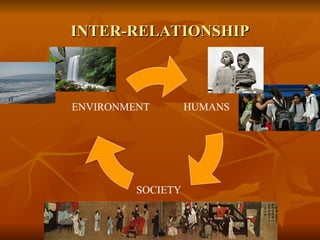
INTER-RELATIONSHIP
INTER-RELATIONSHIP
HUMANS
SOCIETY
ENVIRONMENT
All the three that is human, environment and society are
interrelated to each other as :

Humans are a part of the environment

Humans form the society

Society in turn becomes the part of the environment
Thus as we know that humans are the only species with developed
brains and skills which makes communication an indispensable
need for them to discover, evolve, create, manifest and
manipulate the rules, regulations and forums for a society
whose diversity, stratification and development directly or
indirectly affects the environment at large.

Relation-Between-Man-Society-and-Environment.ppt

  • 1.
    SOCIOLOGY SOCIOLOGY MAN ENVIRONMENT ANDSOCIETY MAN ENVIRONMENT AND SOCIETY
  • 2.
    HUMAN BEINGS, HUMANSOR MAN HUMAN BEINGS, HUMANS OR MAN  Humans are bipedal primates in the family HOMINIDAE Humans are bipedal primates in the family HOMINIDAE  Have highly developed brain capable of abstract reasoning, language, Have highly developed brain capable of abstract reasoning, language, introspection, problem solving and emotion and this mental capability introspection, problem solving and emotion and this mental capability combined with an erect body carriage allows humans to make far greater combined with an erect body carriage allows humans to make far greater use of tools than any other species use of tools than any other species  They are well spread across the globe holding a population of 6.7 billion They are well spread across the globe holding a population of 6.7 billion as of July 2008 as of July 2008  Like most higher primates humans are social by nature, adapt systems of Like most higher primates humans are social by nature, adapt systems of communication for self expression exchange of ideas and organization communication for self expression exchange of ideas and organization  Social interactions between humans establish an extremely wide variety Social interactions between humans establish an extremely wide variety of traditions, rituals, ethics, values, social norms and laws, which of traditions, rituals, ethics, values, social norms and laws, which together forms the basis of human society together forms the basis of human society
  • 3.
    HUMAN BEINGS, HUMANSOR MAN HUMAN BEINGS, HUMANS OR MAN  Humans marked appreciation for beauty and aesthetics which Humans marked appreciation for beauty and aesthetics which combined with the desire of self expression which led to cultural combined with the desire of self expression which led to cultural innovation such as art, literature and music innovation such as art, literature and music  Humans are notable for their desire to understand and influence Humans are notable for their desire to understand and influence the world around them, seeking to explain and manipulate natural the world around them, seeking to explain and manipulate natural phenomena through philosophy, art, science, methodology and phenomena through philosophy, art, science, methodology and religion. This natural curiosity led to the development of religion. This natural curiosity led to the development of advanced tools and skills as by far is the only species to have advanced tools and skills as by far is the only species to have discovered fire, cook their food, clothe themselves and also discovered fire, cook their food, clothe themselves and also manipulate and develop numerous technologies manipulate and develop numerous technologies  Humans pass down their skills and knowledge to the next Humans pass down their skills and knowledge to the next generation through education generation through education
  • 4.
    ENVIRONMENT ENVIRONMENT The natural environment,commonly referred to as the The natural environment, commonly referred to as the environment, is a terminology that is comprised of all living environment, is a terminology that is comprised of all living and non-living things that occur naturally on earth or some and non-living things that occur naturally on earth or some region thereof. The terminology and concept of what region thereof. The terminology and concept of what comprises the natural environment includes a few key comprises the natural environment includes a few key components- components-  Complete ecological unit that function as natural systems Complete ecological unit that function as natural systems without massive human intervention, including vegetation, without massive human intervention, including vegetation, animals, microorganisms, rocks, atmosphere and natural animals, microorganisms, rocks, atmosphere and natural phenomena that occur within their boundaries phenomena that occur within their boundaries  Universal natural resources and physical phenomena that lack Universal natural resources and physical phenomena that lack clear cut boundaries such as air, water and climate as well as clear cut boundaries such as air, water and climate as well as energy, radiation, electric charge and magnetism, not energy, radiation, electric charge and magnetism, not originating from human activity originating from human activity
  • 5.
    LIFE LIFE  Although there isno universal agreement on the definition of Although there is no universal agreement on the definition of life, scientist generally accept that the biological manifestation life, scientist generally accept that the biological manifestation of life is characterized by organization, metabolism, growth, of life is characterized by organization, metabolism, growth, adaptation, response to stimuli and reproduction. adaptation, response to stimuli and reproduction.  Life may also be said to be simply the characteristic state of Life may also be said to be simply the characteristic state of organism organism CHALLENGES CHALLENGES It’s the common understanding of natural environment that It’s the common understanding of natural environment that underlies environmentalism-a broad political, social and underlies environmentalism-a broad political, social and philosophical movement that advocates various actions and philosophical movement that advocates various actions and policies in the interest of protecting what nature remains in the policies in the interest of protecting what nature remains in the natural environment, or restoring or expanding the role of natural environment, or restoring or expanding the role of nature in this environment. nature in this environment.
  • 6.
    SOCIETY SOCIETY o Population ofhumans characterized by patterns of relationships between Population of humans characterized by patterns of relationships between individuals that share a distinctive culture and institutions individuals that share a distinctive culture and institutions o An economic, social and industrial infrastructure in which a varied An economic, social and industrial infrastructure in which a varied multitude of people are a part. They belong to different ethnic groups. multitude of people are a part. They belong to different ethnic groups. The word society may also refer to an organized voluntary association of The word society may also refer to an organized voluntary association of people for religious, benevolent, cultural, scientific, political, patriotic or people for religious, benevolent, cultural, scientific, political, patriotic or other purposes. other purposes. ORIGIN AND USAGE ORIGIN AND USAGE The English word "society" emerged in the 15th century and is derived The English word "society" emerged in the 15th century and is derived from the French from the French société société. The French word, in turn, had its origin in the . The French word, in turn, had its origin in the Latn Latn societas societas, a "friendly association with others," from , a "friendly association with others," from socius socius meaning meaning "companion, associate, comrade or business partner." The Latin word is "companion, associate, comrade or business partner." The Latin word is probably related to the verb probably related to the verb sequi sequi, "to follow", and thus originally may , "to follow", and thus originally may have meant "follower". have meant "follower".
  • 7.
     In thesocial sciences such as SOCIOLOGY, In the social sciences such as SOCIOLOGY, society society has been has been used to mean a group of people that form a semi-closed social used to mean a group of people that form a semi-closed social system, in which most interactions are with other individuals system, in which most interactions are with other individuals belonging to the group. belonging to the group. Society Society is sometimes contrasted with is sometimes contrasted with culture. culture.  For example, Clifford Geertz has suggested that For example, Clifford Geertz has suggested that society society is the is the actual arrangement of social relations while actual arrangement of social relations while culture culture is made up is made up of beliefs and symbolic forms. of beliefs and symbolic forms.  According to sociologist Richard Jenkins, the term addresses a According to sociologist Richard Jenkins, the term addresses a number of important existential issues facing people: number of important existential issues facing people:  Many phenomena cannot be reduced to individual behaviour. Many phenomena cannot be reduced to individual behaviour.  Collectives often endure beyond the lifespan of individual Collectives often endure beyond the lifespan of individual members. members.  The human condition has always meant going beyond the The human condition has always meant going beyond the evidence of our senses; every aspect of our lives is tied to the evidence of our senses; every aspect of our lives is tied to the collective collective
  • 8.
    SOCIAL ENVIRONMENT SOCIAL ENVIRONMENT  The Thesocial environment (context) social environment (context), also known as the , also known as the MILIEU, is the identical or similar social positions and social MILIEU, is the identical or similar social positions and social roles as a whole that influence the individuals of a group. roles as a whole that influence the individuals of a group.  The social environment of an individual is the culture that he The social environment of an individual is the culture that he or she was educated and/or lives in, and the people and or she was educated and/or lives in, and the people and institutions with whom the person interacts. institutions with whom the person interacts.  A given social environment is likely to create a feeling of A given social environment is likely to create a feeling of solidarity amongst its members, who are more likely to keep solidarity amongst its members, who are more likely to keep together, trust and help one another. together, trust and help one another.  Members of the same social environment will often think in Members of the same social environment will often think in similar styles and patterns even when their conclusions differ. similar styles and patterns even when their conclusions differ.
  • 9.
  • 10.
    All the threethat is human, environment and society are All the three that is human, environment and society are interrelated to each other as : interrelated to each other as :  Humans are a part of the environment Humans are a part of the environment  Humans form the society Humans form the society  Society in turn becomes the part of the environment Society in turn becomes the part of the environment Thus as we know that humans are the only species with developed Thus as we know that humans are the only species with developed brains and skills which makes communication an indispensable brains and skills which makes communication an indispensable need for them to discover, evolve, create, manifest and need for them to discover, evolve, create, manifest and manipulate the rules, regulations and forums for a society manipulate the rules, regulations and forums for a society whose diversity, stratification and development directly or whose diversity, stratification and development directly or indirectly affects the environment at large. indirectly affects the environment at large.