Curriculum Approaches 
Group 5 
EDMS 102: Curriculum Development
What is an APPROACH? 
It is a way of dealing with 
something, a way of doing or 
thinking about something 
(Merriam-Webster).
What then is a CURRICULUM 
APPROACH? 
It is a way of dealing with a 
curriculum, a way of 
doing/creating/designing/ 
thinking about a curriculum.
Curriculum Approaches 
There are four curriculum 
approaches: 
◦ BEHAVIORAL APPROACH 
◦ MANAGERIAL APPROACH 
◦ SYSTEMS APPROACH 
◦ HUMANISTIC APPROACH
Curriculum Approaches 
Curriculum practitioners and 
implementers may use one or more 
approaches in planning, 
implementing, and evaluating the 
curriculum.
Curriculum Approaches 
Textbook writers or instructional 
material producers also have 
different curricular approaches.
Behavioral Approach 
Anchored on the behaviorist 
principle. 
Based on a blueprint – goals and 
objectives are specified, contents 
and activities are also arranged to 
match with the learning 
objectives.
Behavioral Approach 
Learning outcomes are evaluated 
in terms of goals and objectives 
set at the beginning.
Behavioral Approach 
AIM – to achieve efficiency 
PROPONENT – Frederick Taylor 
In education, behavioral approach 
begins with educational plans 
that start with the setting of goals 
and objectives.
Behavioral Approach 
These are important ingredients in 
curriculum implementation as 
evaluating the learning outcomes as 
a change in behavior.
Behavioral Approach 
CHANGE IN BEHAVIOR 
indicates the measure of 
the accomplishments.
Managerial Approach 
Became dominant in the 1950’s and 
1960’s. 
Principal = Curriculum leader 
= Instructional leader 
= General manager
Managerial Approach 
General Manager – sets the 
policies and priorities, establishes 
the direction of change and 
innovation, and planning and 
organizing curriculum and 
instruction.
Managerial Approach 
School Administration – less 
concerned about the content than 
about organization and 
implementation; less concerned 
about subject matter, methods, and 
materials than improving the 
curriculum.
Managerial Approach 
Curriculum Managers – look at the 
curriculum changes and 
innovations as they administer 
the resources and restructure the 
schools.
Managerial Approach 
Roles of the Curriculum Supervisors 
(Ornstein and Hunkins, 2004) 
1. Help develop the school’s educational 
goals. 
2. Plan curriculum with students, parents, 
teachers, and other stakeholders.
Managerial Approach 
Roles of the Curriculum Supervisors 
(Ornstein and Hunkins, 2004) 
3. Design programs of study by grade 
levels. 
4. Plan or schedule classes or school 
calendar.
Managerial Approach 
Roles of the Curriculum Supervisors 
(Ornstein and Hunkins, 2004) 
5. Prepare curriculum guides or teacher 
guides by grade level or subject area. 
6. Help in the evaluation and selection of 
textbooks.
Managerial Approach 
Roles of the Curriculum Supervisors 
(Ornstein and Hunkins, 2004) 
7. Observe teachers. 
8. Assist teachers in the implementation 
of the curriculum. 
9. Encourage curriculum innovation and 
change.
Managerial Approach 
Roles of the Curriculum Supervisors 
(Ornstein and Hunkins, 2004) 
10. Develop standards for curriculum and 
instructional evaluation.
Systems Approach 
Influenced by systems theory. 
The parts of the total school district 
or school are examined in terms 
of how they relate to each other.
Systems Approach 
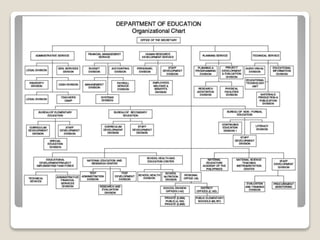
Organizational chart – represents 
a systems approach; shows the 
line-staff relationships of 
personnel and how decisions are 
made.
Systems Approach 
George Beauchamp: the systems 
theory of education see the 
following to be of equal 
importance: 
1. ADMINISTRATION 
2. COUNSELING 
3. CURRICULUM 
4. INSTRUCTION 
5. EVALUATION
Humanistic Approach 
Rooted in the progressive 
philosophy and child-centered 
movement 
Considers the formal or planned 
curriculum and the informal or 
hidden curriculum.
Humanistic Approach 
Considers the whole child and 
believes that in curriculum the total 
development of the individual is 
the prime consideration.
Humanistic Approach 
The LEARNER is at the 
CENTER of the curriculum.
References: 
http://www.merriam-webster. 
com/dictionary/approach Accessed 
02 July 2014 
http://www.affordablecebu.com/load/scho 
ols_universities/organizational_structure_c 
hart_of_deped/23-1-0-8418 Accessed 02 
July 2014 
Bilbao, Purita P. et al. (2008). Curriculum 
Development. Quezon City: Lorimar 
Publishing.
THANK YOU VERY MUCH 
FOR LISTENING.