DIFFERENTIATED
LEARNING
What is differentiated learning?
• Differentiated learning also known as differentiated
Instruction
• Differentiated instruction is a teaching approach
that tailors instruction to students’ different learning
needs.
• It lets students show what they know in different ways.
Differentiated Learning
• Differentiated instruction means using different tools, content, and
due process in order to successfully reach all individuals.
• Differentiated instruction, according to Carol Ann Tomlinson, is the
process of "ensuring that what a student learns, how he or she learns
it, and how the student demonstrates what he or she has learned is a
match for that student's readiness level, interests, and preferred
mode of learning.
• The goal of differentiated instruction is to develop engaging tasks
that challenge and enhance learning for each student. Instructional
activities are flexible and based and evaluated on content, process,
product, and learning environment.
Four ways to differentiate
instruction
• 1.Content: Figuring out what a student needs to learn and which
resources will help.
• Examples of differentiating activities:
 Match vocabulary words to definitions.
 Read a passage of text and answer related questions.
 Think of a situation that happened to a character in the story and a
different outcome.
 Differentiate fact from opinion in the story.
 Identify an author’s position and provide evidence to support this
viewpoint.
 Create a PowerPoint presentation summarizing the lesson.
2. Process: Activities that help students make sense
of what they learn
• Examples of differentiating the process:
 Provide textbooks for visual and word learners.
 Allow auditory learners to listen to audio books.
 Give kinesthetic learners the opportunity to complete an
interactive assignment online.
3. Product: Ways for students to “show what they
know”
• Examples of differentiating the end product:
 Read and write learners write a book report.
 Visual learners create a graphic organizer of the story.
 Auditory learners give an oral report.
 Kinesthetic learners build a diorama illustrating the story
4. Learning environment: How the classroom “feels” and
how the class works together
• Examples of differentiating the environment:
 Break some students into reading groups to discuss the assignment.
 Allow students to read individually if preferred.
 Create quiet spaces where there are no distractions.
Strategies for Differentiation
• Differentiation can include complex strategies, like writing tiered lesson plans, or it can take a
more simplistic form, such as using reading buddies or think-pair-share strategies. Here is a
condensed list of the continuum of differentiated strategies
• Higher Prep Strategies
• Tiered Lessons
• Flexible Grouping
• Think-Tac-Toe
• Multiple Intelligence
• Options
• Graphic Organizers
• Response/Exit Cards
• Multiple Texts
TIERED INSTRUCTION
• Provides teachers with a means of assigning different tasks within the
same lesson or unit.
• The tasks will vary according to the students’:
• Readiness
• Interest
• Learning Profile
ACCORDINGTO STUDENTS
READINESS-refers to readiness for a given skill, concept, or way of thinking.
INTEREST- have to do with those things that learners find relevant,
fascinating, or worthy of their time.
LEARNING PROFILE- refer to things such as learning style, intelligence
preferences and how the students processes information, and how the learner
sees himself in relation to the rest of the world.
WHAT CAN BETIERED?
• Content
• Process
• Product
ASSIGNMENTS
• ACTIVITIES
• HOMEWORK
• CENTERS
• EXPERIMENTS
• MATERIALS
• ASSESSMENTS
• WRITING PROMPTS
FLEXIBLE GROUPING
• Flexible grouping is an opportunity for students to work with a variety of students,
through whole group
or in many different forms of small groups. The key to flexible grouping is in the
name…FLEXIBLE.
Students have an opportunity to be in different groups depending on the activity.
• Initially use whole group for instruction
• Divide group for practice or enrichment
• Not used as a permanent arrangement
• Use groups for one activity, a day, a week, etc.
How does Flexible grouping benefit students?
• Gives students and teachers a voice in work arrangements.
• Allows students to work with a variety of peers.
• Keeps students from being “pegged” as advanced or
struggling.
GROUP MEMBERSHIP
• Can be determined by:
• Readiness
• Interest
• Reading level
• Skill level
• Background knowledge
• Social skills
ANCHOR ACTIVITIES
• Anchor activities are ongoing assignments that students can work on
independently throughout a unit, a grading period, or longer.
The purpose of an Anchor activity:
• Provide meaningful work for students when they finish an assignment
or project, when they first enter the class, or when they are “stumped.”
• Provide ongoing tasks that tie to the content and instruction
• Free up the classroom teacher to work with other groups of students
or individuals
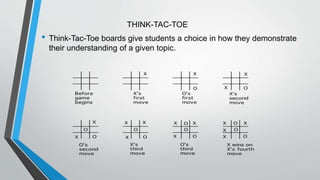
THINK-TAC-TOE
• Think-Tac-Toe boards give students a choice in how they demonstrate
their understanding of a given topic.
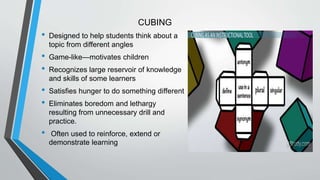
CUBING
• Designed to help students think about a
topic from different angles
• Game-like—motivates children
• Recognizes large reservoir of knowledge
and skills of some learners
• Satisfies hunger to do something different
• Eliminates boredom and lethargy
resulting from unnecessary drill and
practice.
• Often used to reinforce, extend or
demonstrate learning
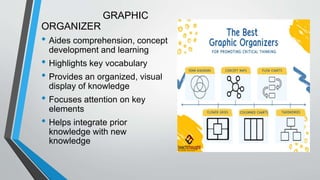
GRAPHIC
ORGANIZER
• Aides comprehension, concept
development and learning
• Highlights key vocabulary
• Provides an organized, visual
display of knowledge
• Focuses attention on key
elements
• Helps integrate prior
knowledge with new
knowledge
PROS AND CONS OF DIFFERNTIATED
LEARNING
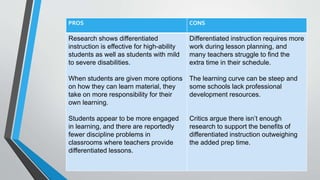
PROS CONS
Research shows differentiated
instruction is effective for high-ability
students as well as students with mild
to severe disabilities.
When students are given more options
on how they can learn material, they
take on more responsibility for their
own learning.
Students appear to be more engaged
in learning, and there are reportedly
fewer discipline problems in
classrooms where teachers provide
differentiated lessons.
Differentiated instruction requires more
work during lesson planning, and
many teachers struggle to find the
extra time in their schedule.
The learning curve can be steep and
some schools lack professional
development resources.
Critics argue there isn’t enough
research to support the benefits of
differentiated instruction outweighing
the added prep time.
How differentiated instruction works
• Small work groups: The students in each group rotate in and
out. This gives them a chance to participate in many different
groups. A group can include a pair of students or a larger group.
In all cases, it’s an opportunity for students to learn from each
other.
• Reciprocal learning: Sometimes students become teachers,
sharing what they’ve learned and asking classmates questions.
• Continual assessment: Teachers regularly monitor students’
strengths and weaknesses (in both formal and informal ways) to
make sure they’re progressing in their knowledge and mastery of
schoolwork.
THE END!!!!
ROMELA CATIN
BEED 1-A

Differentiated Learning.pptx

  • 1.
  • 2.
    What is differentiatedlearning? • Differentiated learning also known as differentiated Instruction • Differentiated instruction is a teaching approach that tailors instruction to students’ different learning needs. • It lets students show what they know in different ways.
  • 3.
    Differentiated Learning • Differentiatedinstruction means using different tools, content, and due process in order to successfully reach all individuals. • Differentiated instruction, according to Carol Ann Tomlinson, is the process of "ensuring that what a student learns, how he or she learns it, and how the student demonstrates what he or she has learned is a match for that student's readiness level, interests, and preferred mode of learning. • The goal of differentiated instruction is to develop engaging tasks that challenge and enhance learning for each student. Instructional activities are flexible and based and evaluated on content, process, product, and learning environment.
  • 4.
    Four ways todifferentiate instruction
  • 5.
    • 1.Content: Figuringout what a student needs to learn and which resources will help. • Examples of differentiating activities:  Match vocabulary words to definitions.  Read a passage of text and answer related questions.  Think of a situation that happened to a character in the story and a different outcome.  Differentiate fact from opinion in the story.  Identify an author’s position and provide evidence to support this viewpoint.  Create a PowerPoint presentation summarizing the lesson.
  • 6.
    2. Process: Activitiesthat help students make sense of what they learn • Examples of differentiating the process:  Provide textbooks for visual and word learners.  Allow auditory learners to listen to audio books.  Give kinesthetic learners the opportunity to complete an interactive assignment online.
  • 7.
    3. Product: Waysfor students to “show what they know” • Examples of differentiating the end product:  Read and write learners write a book report.  Visual learners create a graphic organizer of the story.  Auditory learners give an oral report.  Kinesthetic learners build a diorama illustrating the story
  • 8.
    4. Learning environment:How the classroom “feels” and how the class works together • Examples of differentiating the environment:  Break some students into reading groups to discuss the assignment.  Allow students to read individually if preferred.  Create quiet spaces where there are no distractions.
  • 9.
    Strategies for Differentiation •Differentiation can include complex strategies, like writing tiered lesson plans, or it can take a more simplistic form, such as using reading buddies or think-pair-share strategies. Here is a condensed list of the continuum of differentiated strategies • Higher Prep Strategies • Tiered Lessons • Flexible Grouping • Think-Tac-Toe • Multiple Intelligence • Options • Graphic Organizers • Response/Exit Cards • Multiple Texts
  • 10.
    TIERED INSTRUCTION • Providesteachers with a means of assigning different tasks within the same lesson or unit. • The tasks will vary according to the students’: • Readiness • Interest • Learning Profile
  • 11.
    ACCORDINGTO STUDENTS READINESS-refers toreadiness for a given skill, concept, or way of thinking. INTEREST- have to do with those things that learners find relevant, fascinating, or worthy of their time. LEARNING PROFILE- refer to things such as learning style, intelligence preferences and how the students processes information, and how the learner sees himself in relation to the rest of the world.
  • 12.
    WHAT CAN BETIERED? •Content • Process • Product ASSIGNMENTS • ACTIVITIES • HOMEWORK • CENTERS • EXPERIMENTS • MATERIALS • ASSESSMENTS • WRITING PROMPTS
  • 13.
    FLEXIBLE GROUPING • Flexiblegrouping is an opportunity for students to work with a variety of students, through whole group or in many different forms of small groups. The key to flexible grouping is in the name…FLEXIBLE. Students have an opportunity to be in different groups depending on the activity. • Initially use whole group for instruction • Divide group for practice or enrichment • Not used as a permanent arrangement • Use groups for one activity, a day, a week, etc.
  • 14.
    How does Flexiblegrouping benefit students? • Gives students and teachers a voice in work arrangements. • Allows students to work with a variety of peers. • Keeps students from being “pegged” as advanced or struggling.
  • 15.
    GROUP MEMBERSHIP • Canbe determined by: • Readiness • Interest • Reading level • Skill level • Background knowledge • Social skills
  • 16.
    ANCHOR ACTIVITIES • Anchoractivities are ongoing assignments that students can work on independently throughout a unit, a grading period, or longer. The purpose of an Anchor activity: • Provide meaningful work for students when they finish an assignment or project, when they first enter the class, or when they are “stumped.” • Provide ongoing tasks that tie to the content and instruction • Free up the classroom teacher to work with other groups of students or individuals
  • 17.
    THINK-TAC-TOE • Think-Tac-Toe boardsgive students a choice in how they demonstrate their understanding of a given topic.
  • 18.
    CUBING • Designed tohelp students think about a topic from different angles • Game-like—motivates children • Recognizes large reservoir of knowledge and skills of some learners • Satisfies hunger to do something different • Eliminates boredom and lethargy resulting from unnecessary drill and practice. • Often used to reinforce, extend or demonstrate learning
  • 19.
    GRAPHIC ORGANIZER • Aides comprehension,concept development and learning • Highlights key vocabulary • Provides an organized, visual display of knowledge • Focuses attention on key elements • Helps integrate prior knowledge with new knowledge
  • 20.
    PROS AND CONSOF DIFFERNTIATED LEARNING
  • 21.
    PROS CONS Research showsdifferentiated instruction is effective for high-ability students as well as students with mild to severe disabilities. When students are given more options on how they can learn material, they take on more responsibility for their own learning. Students appear to be more engaged in learning, and there are reportedly fewer discipline problems in classrooms where teachers provide differentiated lessons. Differentiated instruction requires more work during lesson planning, and many teachers struggle to find the extra time in their schedule. The learning curve can be steep and some schools lack professional development resources. Critics argue there isn’t enough research to support the benefits of differentiated instruction outweighing the added prep time.
  • 22.
    How differentiated instructionworks • Small work groups: The students in each group rotate in and out. This gives them a chance to participate in many different groups. A group can include a pair of students or a larger group. In all cases, it’s an opportunity for students to learn from each other. • Reciprocal learning: Sometimes students become teachers, sharing what they’ve learned and asking classmates questions. • Continual assessment: Teachers regularly monitor students’ strengths and weaknesses (in both formal and informal ways) to make sure they’re progressing in their knowledge and mastery of schoolwork.
  • 23.