
CURRICULUM CONCEPT &
MEANING
Dr.Jaganmohana Rao
Faculty of Education
MITE, Khima, Nagaland
Introduction:
The concept of curriculum is as dynamic as the
changes that occur in society. In its narrow
sense, curriculum is viewed merely as a listing
of subject to be taught in school. In a broader
sense, it refers to the total learning experiences
of individuals not only in schools but also in
society.
Meaning & Definition of Curriculum:
The term curriculum has been derived from a Latin
word “Currere” which means a „race course‟ or a runway on
which one runs to reach a goal. If the teacher is the guide,
the curriculum is the path. Curriculum is the total structure of
ideas and activities.
Curriculum is the instructional and the educative
programme by following which the pupils achieve their goals,
ideals and aspirations of life. It is curriculum through which
the general aims of a school education receive concrete
expression.
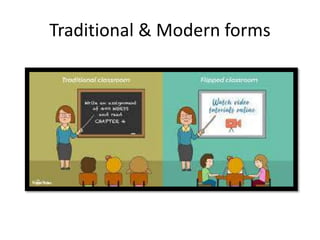
The traditional curriculum was subject-
centered while the modern curriculum is child and
life-centered. (education is uni-polar, bipolar and tri-
polar)
Aims of education (Dr.B.S.Blooms-1956) are
reflected in the curriculum. In other words, the
curriculum is determined by the aims of life and
society.
Traditional & Modern forms
Definitions:
Curriculum is tool in the hand of the artist
(teacher) to mould his material in accordance with
his ideals in the school – Cunningham
The curriculum includes all the learners’
experience in or outside school that are included in
a programme which has been devised to help him
developmentally, emotionally, socially, spiritually and
morally”.- Crow and Crow
All the learning which is planned and guided
by the school, whether it is carried on in groups or
individually, inside or outside the school- Kerr…
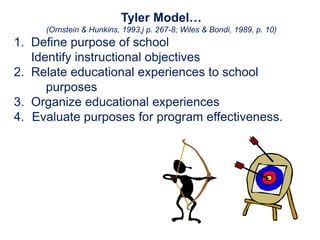
Tyler Model…
(Ornstein & Hunkins, 1993,j p. 267-8; Wiles & Bondi, 1989, p. 10)
1. Define purpose of school
Identify instructional objectives
2. Relate educational experiences to school
purposes
3. Organize educational experiences
4. Evaluate purposes for program effectiveness.
Hass & Parkay Model
(Hass & Parkay, 1993, p. 294)
1. Identify context (gather data about intended
learners and the human, social, and
environmental variables within which learners
interact)
2. Determine objectives & Set goals
3. Select , Prepare, & Implement Strategies and
Alternatives
4. Evaluate
Taba Pilot Unit Development Model
1. Diagnose needs - what are current gaps in student
learning
2. Formulate objectives
3. Select content
4. Organize content
5. Select learning experiences
6. Organize learning activites
7. Determine what to evaluate and ways and means
of evaluation
8. Check for balance and sequence
ELEMENTS/COMPONENTS OF THE CURRICULUM
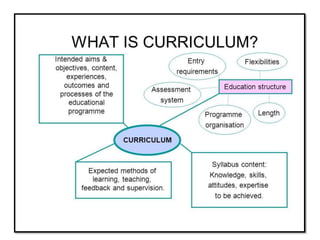
The major components or elements in Curriculum
are:
1. Aims, Goals and Objectives (which should be fulfill)
2. Subject Matter/Content (What Syllabi to be covered)
3. Learning Experiences (What type of Activities to be performed)
4. Evaluation Approaches (Strategies & Techniques)
Types of Curriculum Operating in Schools
Allan Glatthorn (2000) describes seven types of curriculum
operating in the schools.
Recommended curriculum- proposed by scholars and professional
organizations.
Written curriculum- appears in school, district, division or country
documents.
Taught curriculum- what teachers implement or deliver in the classrooms
and schools
Supported curriculum- resources textbook computers, audio visual
materials which support and help in the implementation of the curriculum.
Assessed curriculum- that which is tested and evaluated.
Learned curriculum-what the students actually learn and what is
measured
Hidden curriculum- the unintended curriculum.
Need and importance of curriculum development
(or construction)
Well planned & Developed Curriculum should be fulfill
the gapes like…
Clear purpose and goals
Continuous assessment and improvement of quality
A rational sequence
Making strategy in teaching and learning
Helps in the selection of learning experiences
Curriculum Concept & Meaning

Curriculum Concept & Meaning

  • 1.
    CURRICULUM CONCEPT & MEANING Dr.JaganmohanaRao Faculty of Education MITE, Khima, Nagaland
  • 2.
    Introduction: The concept ofcurriculum is as dynamic as the changes that occur in society. In its narrow sense, curriculum is viewed merely as a listing of subject to be taught in school. In a broader sense, it refers to the total learning experiences of individuals not only in schools but also in society.
  • 4.
    Meaning & Definitionof Curriculum: The term curriculum has been derived from a Latin word “Currere” which means a „race course‟ or a runway on which one runs to reach a goal. If the teacher is the guide, the curriculum is the path. Curriculum is the total structure of ideas and activities. Curriculum is the instructional and the educative programme by following which the pupils achieve their goals, ideals and aspirations of life. It is curriculum through which the general aims of a school education receive concrete expression.
  • 5.
    The traditional curriculumwas subject- centered while the modern curriculum is child and life-centered. (education is uni-polar, bipolar and tri- polar) Aims of education (Dr.B.S.Blooms-1956) are reflected in the curriculum. In other words, the curriculum is determined by the aims of life and society.
  • 6.
  • 7.
    Definitions: Curriculum is toolin the hand of the artist (teacher) to mould his material in accordance with his ideals in the school – Cunningham The curriculum includes all the learners’ experience in or outside school that are included in a programme which has been devised to help him developmentally, emotionally, socially, spiritually and morally”.- Crow and Crow All the learning which is planned and guided by the school, whether it is carried on in groups or individually, inside or outside the school- Kerr…
  • 8.
    Tyler Model… (Ornstein &Hunkins, 1993,j p. 267-8; Wiles & Bondi, 1989, p. 10) 1. Define purpose of school Identify instructional objectives 2. Relate educational experiences to school purposes 3. Organize educational experiences 4. Evaluate purposes for program effectiveness.
  • 9.
    Hass & ParkayModel (Hass & Parkay, 1993, p. 294) 1. Identify context (gather data about intended learners and the human, social, and environmental variables within which learners interact) 2. Determine objectives & Set goals 3. Select , Prepare, & Implement Strategies and Alternatives 4. Evaluate
  • 10.
    Taba Pilot UnitDevelopment Model 1. Diagnose needs - what are current gaps in student learning 2. Formulate objectives 3. Select content 4. Organize content 5. Select learning experiences 6. Organize learning activites 7. Determine what to evaluate and ways and means of evaluation 8. Check for balance and sequence
  • 11.
    ELEMENTS/COMPONENTS OF THECURRICULUM The major components or elements in Curriculum are: 1. Aims, Goals and Objectives (which should be fulfill) 2. Subject Matter/Content (What Syllabi to be covered) 3. Learning Experiences (What type of Activities to be performed) 4. Evaluation Approaches (Strategies & Techniques)
  • 12.
    Types of CurriculumOperating in Schools Allan Glatthorn (2000) describes seven types of curriculum operating in the schools. Recommended curriculum- proposed by scholars and professional organizations. Written curriculum- appears in school, district, division or country documents. Taught curriculum- what teachers implement or deliver in the classrooms and schools Supported curriculum- resources textbook computers, audio visual materials which support and help in the implementation of the curriculum. Assessed curriculum- that which is tested and evaluated. Learned curriculum-what the students actually learn and what is measured Hidden curriculum- the unintended curriculum.
  • 13.
    Need and importanceof curriculum development (or construction) Well planned & Developed Curriculum should be fulfill the gapes like… Clear purpose and goals Continuous assessment and improvement of quality A rational sequence Making strategy in teaching and learning Helps in the selection of learning experiences