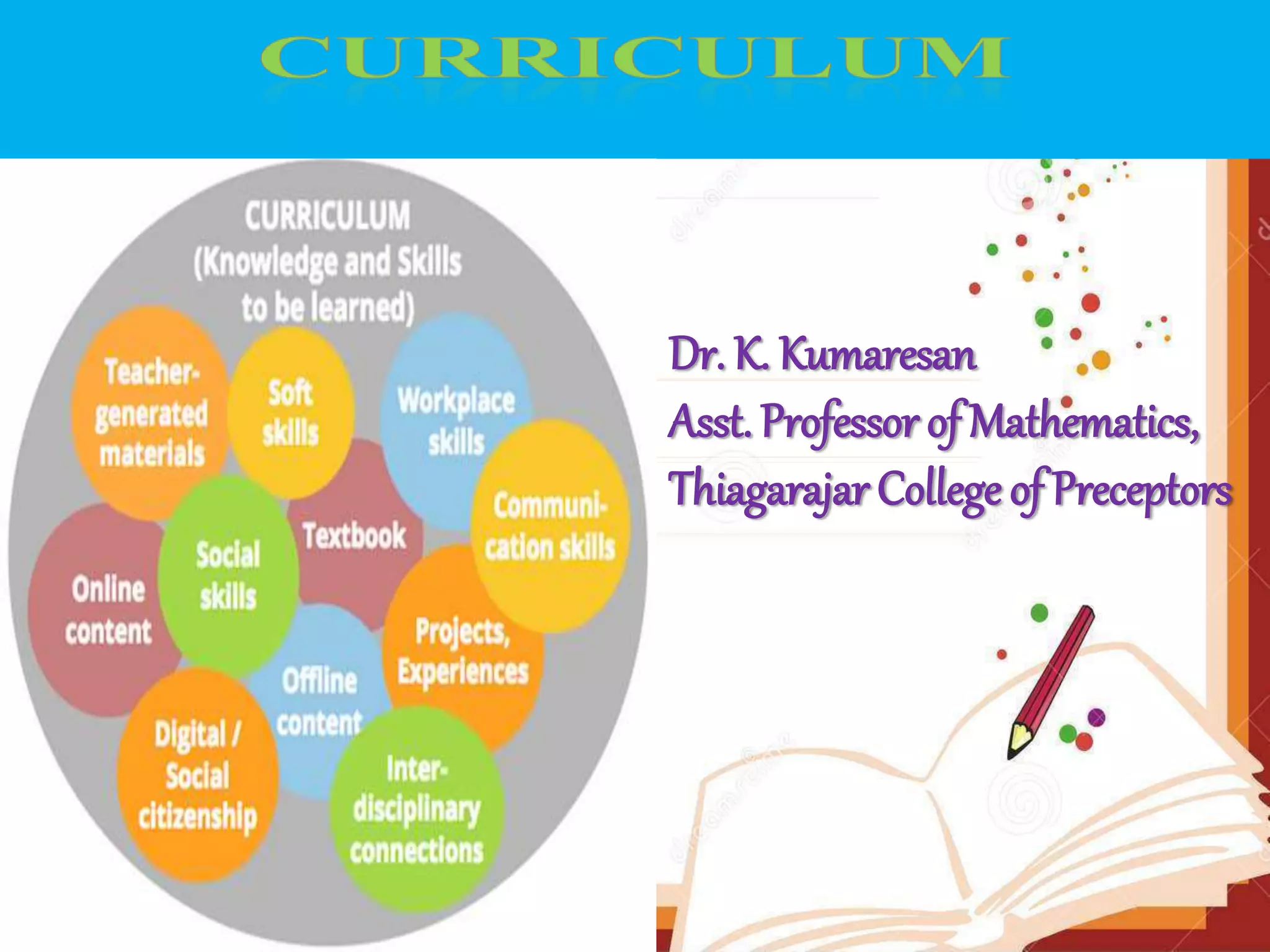
Dr. K. Kumaresan
Asst. Professor of Mathematics,
Thiagarajar College of Preceptors
INTRODUCTION
Education aims the behavior modification of
learners.
Behavior modification is achieved through a
series of activities of a curriculum, concerned with
guiding the teachers and students in the educative
process.
Therefore curriculum for the preparation of a
teacher and student who can carryout these
professional functions humanely and competently
must be developed.
MEANING AND DEFINITION OF
CURRICULUM
The term curriculum is derived from the
Latin word “currere” which means,
“run”.
Thus, curriculum is a runway of attaining
the goal of education.
Curriculum may be considered as a
blueprint of an educational program.
Definitions
According to Cunningham, “Curriculum is
the tool in the hands of an artist to mould
his material, according to his ideals in his
studio”.
In this definition, artist is the teacher,
material is the student ideals are objectives
and studio is the educational institute.
Definitions...
• The multiple definitions of curriculum, from
Oliva (1997) for Curriculum is:
 A set of subjects.
A program of studies.
A set of materials
A sequence of courses.
 A set of performance objectives
A course of study
Definitions...
• “Curriculum is the totality of experiences
that pupils receive through the manifold
activities that go in the school, in the
classroom, library, laboratory, workshop,
play ground and in the numerous informal
contacts between the teachers and pupils.” -
The Secondary Education Commission
(1952-1953)
Definitions...
• Tyler and Hilda Taba (1962) defined
curriculum as “A plan for action, or a
written document, which includes strategies
for achieving desired goals or ends.”
Purposes of curriculum
• Curriculum is an essential tool in the hands of
educators to guide a course of study that has the
following purposes:
• It communicates to the students in advance what
they are expected to learn in the specified time
duration to accomplish their educational goals.
• It introduces the criteria of examination or
evaluation to the students so that they can prepare
for exams accordingly.
Purposes of curriculum…
• It describes to the teachers the course, unit and
lesson objectives as well as required teaching
learning methods, which assists the teachers to
plan their lesson accordingly.
• It communicates to the policy makers about the
competencies and expertise of a particular group
of students the positions and roles they can
perform.
Characteristics
• Fulfillment of objectives
• Determined by factors - social, human
development, nature of learning and nature of
knowledge
• Cater individual differences.
• Pre- planned but can be changed .
• It is a blue print.
• It is a tool in hands of a teacher.
• More than teaching and learning.
• Describe environment in motion.
• All learning inside and outside school
Concepts of curriculum
• Curriculum is a set of planned activities which are
designed to implement a particular set of educational
aims.
• The concept of curriculum is as dynamic as the
changes that occur in society.
• In a narrow sense, curriculum is viewed merely as a
listing of subject to be taught in school.
• In a broader sense, it refers to the total learning
experiences of individuals not only in schools, but in
society as well.
Concepts of curriculum…
• According to Hamid Hasan (1988) curriculum
concept can be evaluated in four dimension:
• 1. Curriculum is an idea, especially in the field of
education and curriculum
• 2. Curriculum is plan written using that idea about
aims, methods, materials, activity and time.
• 3. Curriculum is an activity using the plan written
• 4. Curriculum is the change of behavior from all
educative participants.
Common concepts of a curriculum
• Scope and sequence
• Syllabus
• Content outline
• Textbooks
• Course of study
• Planned experiences.
STRUCTURE OR COMPONENTS OF
CURRICULUM
Curriculum invariably contains
• The statement of philosophy of the educational
program
• The statement of the objectives of educational
program
• Total duration of educational programme
• Detailed course plan for each course.
• Program of evaluation such as type of
examinations, various grades according to results,
percentage meant for internal assessment in
university examinations etc.
Structure/Components of the
Curriculum
• In most curricula, major structure
or components or elements are :
• 1.Need of the learner and society
• 2.Goals, aims and objectives
• 3.Subject matter or content
• 4.Learning experiences and
• 5.Evaluation approaches
Component 1: Need of the learner and society
• Curriculum should address the needs and
aspirations of students.
• It should also bring a revolution in the
society.
• Concern the needs of both the students and
the society.
Component 2: Curriculum Aims, Goals and
Objectives
Goals: School Vision and Mission
Aims: Elementary, Secondary, and Tertiary
Objectives: educational objectives
The educational system is divided in three
educational levels : primary , secondary ,
and tertiary levels. All schools shall aim to :
Inculcate patriotism and nationalism
Foster love of humanity
Promote respect for human rights
Appreciate the role of national heroes in the
historical development of the country
Teach the rights and duties of
citizenship
Strengthen ethical and spiritual
values
Develop moral character and
personal discipline
Encourage critical and creative
thinking
Broaden scientific and technological
knowledge and promote vocational
efficiency
Component 2: Curriculum Content or
Subject Matter
• Information to be learned in school,
another term for knowledge
• Consists of facts, concepts,
generalization, principles, theories.
• Chosen to fulfil the needs of the
learners and the society.
Component 3 – Curriculum Experience
• Instructional strategies and methods that
link the curriculum experiences.
• It is the core and heart of the curriculum.
• 1. Teaching methods are the means to
achieve the aims.
• 2. Teaching methods should stimulate the
learner’s desire to develop the cognitive,
affective, psychomotor, social and
spiritual domain of the individual.
Curriculum Experience…
3. In the choice of teaching methods,
learning styles of the students
should be considered
4. Flexibility should be a consideration
in the use of teaching methods
Component 4 – Curriculum Evaluation
To be effective, all curricula must have an
element of evaluation. Curriculum evaluation
refers to the formal determination of the quality,
effectiveness or value of the program, process
and product of the curriculum.
Dynamics of curriculum
• It is the changes in curriculum according to the
needs of the society.
• The curriculum is designed to realise the objectives
in terms of changing of behaviours.
• Dynamics of curriculum has the following
dimensions:
• 1. Teaching objectives, 2.Methods of teaching
3. Process of evaluation and 4. Feed back.
Dynamics of curriculum…
• 1. Teaching objectives
• Three types of teaching objectives viz.,
cognitive, affective and psycho-motor are
identified in view of subject content to be taught.
• These objectives are written in behavioural
terms.
• All learning experiences are organised to
achieve these objectives.
Dynamics of curriculum…
• 2.Methods of teaching
• These are the teaching strategies which
provide learning experiences.
• The objectives are realised in terms of
behavioural of the learners.
• The content is selected according to the
method of teaching and level of the pupil
understanding.
Dynamics of curriculum…
• 3. Process of evaluation
• The evaluation of change in behaviour is
done to ascertain about the realisation of the
teaching learning objectives.
• The level of the pupil performance indicates
the effectiveness of method of teaching and
learning experiences.
Dynamics of curriculum…
• 4. Feed back
• The interpretation of performance provides the
teacher to improve and modify the form of the
curriculum.
• The curriculum is developed and teaching
objectives are also revised.
• The methodology of teaching is changed in view
of the curriculum and objectives are to be
achieved.
Changing concepts of curriculum
• Curriculum is a way to achieve the aims of
education which are dynamic and go on
changing with the changing social
requirements.
• Naturally, the curriculum will reflect the
trends in education.
Changing concepts of curriculum…
• It includes well selected activities and
experiences needed for the development of
pupils according to social requirements
• It should provide wholesome school
programme to develop the desirable
behaviour patterns in the pupils.
Changing concepts of curriculum…
• The major dimensions of changing concepts
of curriculum:
• i) Curriculum as a Plan ii) Curriculum as an
experience iii) Curriculum as a subject
matter iv)Curriculum as an objective
vi) Curriculum as a system vii) Curriculum
as a field of study
CURRICULUM PLANNING AND
DEVELOPMENT
• A process in which participants at many
levels make decisions about the purposes of
leaning-teaching situation.
• It is the process of gathering, starting, selecting
balancing and synthesizing relevant
information from many resources in order to
design those experiences that will assist
learners in attaining the goals of curriculum.
• It is the orderly study and improvement of
schooling in light of stated objectives.
CHARACTERISTICS
• It is a continuous process
• It takes place at many levels
• It involves many groups, decisions about a
variety of planning and issues.
• It is ultimately concerned with the experiences
of learners
BASIC PRINCIPLES OF CURRICULUM CONSTRUCTION
• Principle of activity and experience
• Principle of preparation of life
• Principle of linking with life
• Principle child centered
• Principle of individual difference
• Principle of flexibility
• Principle of leisure
• Principle of disciplinary value
• Principle of cultural value
• Principle of modernization
• Principle related to the need of society
CURRICULUM COMMITTEE
It is a committee consisting of members who actively
participate in the development or construction of curriculum for
their school/college.
• Curriculum administrator
• Principal
• School boards
• Communities
• Law makers
• Educational researchers
• Teacher educators
• Publishers contd….
• State department of education
• Parents
• Students
• Non school educators
• Project directors
• Authors
• Testers
STEPS IN CURRICULUM
DEVELOPMENT
According to Ralph Tyler, there are four
main steps or tasks in curriculum development
• Formation of educational objectives
• Selection of learning experiences
• Effective and efficient organization of leaning
experiences
• Evaluation of the curriculum
A). Formation of Educational Objectives
Educational objectives are the statements
of those desired changes in behavior as a
result of specific teaching learning activities
or specific teacher-learner activity.
• Philosophical statement of the institute
• Needs of the students
• Resources available in the society
• Entry criteria or level of students
• Future trends in curriculum
Steps in the formulation of educational
objectives
According to Ralph Tyler there are nine
essential tasks or steps in the formulation of
education objectives
 Identify the needs of society
 Study the suggestions of experts
 Formulate the philosophy
 State the objectives gathered from various
sources
• Formulate a theory of learning
• Screen the objectives through educational
philosophy and educational psychology helps
to determine the methods of teaching,
principles of teaching, methods of learning etc.
• Define the objectives clearly in terms of
content
• State the educational objectives in terms of
behavioral outcomes or changes.
2. Selection of Learning Experiences
Learning experience
It is defined as deliberately planned
experiences in selected situations where
students’ activity participate, interact and
which results in desirable changes of behavior
in the students.
Characteristics of good learning experiences
 Learning experiences should allow the student learning
by doing
 Learning experience should create motivation and
interest among students.
 Learning experiences should be challenging to the
students
 Should satisfy the needs of the time
 Should bring out multiple outcomes in students
 Should help students to acquire needed knowledge skill
and attitude
 Should be helpful in hunting or gathering information
 Should be helpful to the students in attaining the
educational objectives
Criteria for the selection of learning
experiences
Learning experiences selected should be
 Consistent with the philosophy of the institute & lead
to attainment of objectives of objectives of program
 Varied and flexible enough
 Given opportunity to practice the kind of behavior
implied in the objectives
 Provide opportunity for the development of
independent thinking and decision making sound
judgmental, intellectual resourcefulness, self
discipline and sound integrity of purpose.

• Adapted to the needs of students
• Arranged in manner that provide, continuity,
correlation and integration of theory and
proactive
• Planned and evaluated co-operatively by
teacher & students
• Selected and arranged to give appropriate and
emphasis and weightage according to the
relative importance of various learning
experiences and contents.
3). Organization of Learning Experiences
Continuity, sequence and integration has to be
followed while organizing the learning
experiences.
Continuity is achieved through building each
experience one after another.
Sequence refers to building of learning
experience are over another more deeply and
broadly.
Integration is relating the learning experiences
in such a way that the learner gets a unified
view of while learning
Elements of organizing the learning
experiences
Elements to be considered while organizing the
learning experiences are,
 Grouping learning under subject headings
 Preparation of master plan for curriculum
 Placement of learning experiences in the total
curriculum
 Preparation of correlation chart
 Teaching practice systems have to be followed
4). Evaluation of the Curriculum
Curriculum evaluation involves
 An assessment of the philosophy of the
institution
 Program goals of the institution
 Content taught in each course
 Course objectives
 Teaching learning methods
 Course evaluation methods and
 A. Men whether curriculum has been organized and
implemented properly by the faculty members and
other personnel involved
 B. Money whether money meant for curriculum
development is utilized properly
 C. Materials evaluation of text books, literature and
the like used for the development and implementation
of curriculum
 D. Methods whether teaching learning methods which
are planned in curriculum are appropriate
 E. Minutes whether adequate time is given for theory
and practical in each course
TYPES OF CURRICULUM ORGANIZATION
1. Student centered curriculum
 Co-operation, common interests, working together are
under lying elements brings about growth in life related
skills.
 Learners are active partners in the curriculum pupil’s
interest individual’s needs are essential ingredients of
curriculum
 Flexibility should be brought in the content, areas of
learning use of instructional materials.
 Suitable resources have to be collected reference
books, newspapers, journals, excursions, libraries,
films, audiotapes and TV etc.
2. Correlated curriculum
Two or more subjects often exists in a
school side by side with no apparent
connection. In some cases, these points are
‘natural’. For example, mathematical
formulate needed for solving problems in
physics or chemistry.
3. Integrated or fused curriculum
It means ‘blended together’.
Making together of subjects and students
might provide a stronger base for learning
 For example, all the subjects which basic
students learned in ten years, will be studied
with in two years
4. Core curriculum
According to John Dewey’s “philosophy of
experimentalism gave concepts of core
curriculum
 Focus of learning upon fundamental human
activities
 Learning viewed of continuous reconstruction of
experience
 Problem solving
 Basic democratic values and dynamic changes
in political and social ideas, cultural factors.
 Acceptance of cognitive theories of learning. It
is a dynamic, organic process
CURRICULUM