UNIT - II
PLANNING FOR INSTRUCTION
S.MUTHURANI
ASSISTANT PROFESSOR
MANGAYARKARASI COLLEGE
OF EDUCATION
MADURAI.
PLANNING FOR INSTRUCTION
 It refers to what the teacher does and prepares for presentation /
teaching of a lesson in class.
 Effective teaching depends on the effective planning of a lesson by the
teacher.
 It is much more difficult than delivering the instruction.
 It is defined as “Visualizing, Guidance, Managing & Decision Making”.
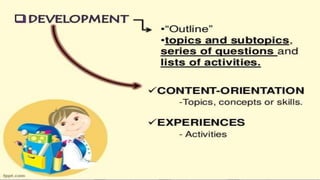
 The teacher develops lesson contents to match them with curriculum
standards.
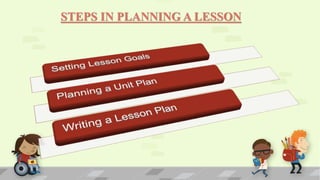
STEPS IN PLANNING A LESSON
SETTING LESSON GOALS
 Setting realistic goals.
Deciding how to incorporate course
textbooks and other supportive instructional
materials.
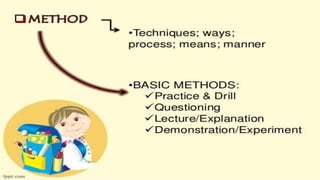
 Developing activities that will promote
learning.
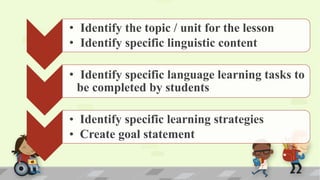
• Identify the topic / unit for the lesson
• Identify specific linguistic content
• Identify specific language learning tasks to
be completed by students
• Identify specific learning strategies
• Create goal statement
DESIGNING UNIT PLAN
A Unit plan is developed by the
teacher. It serves as a long-range plan. It
contains multiple lessons that are related in
curriculum or textbook. It is often part of a
larger thematic unit.
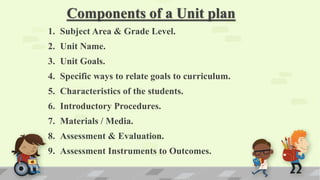
Components of a Unit plan
1. Subject Area & Grade Level.
2. Unit Name.
3. Unit Goals.
4. Specific ways to relate goals to curriculum.
5. Characteristics of the students.
6. Introductory Procedures.
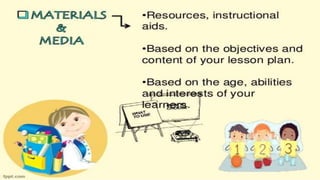
7. Materials / Media.
8. Assessment & Evaluation.
9. Assessment Instruments to Outcomes.
DESIGNING A LESSON PLAN
A Lesson Plan is a design that maps
out the teacher’s intentions about the
lesson. It reflects the teacher’s planning
decisions and understanding of the
principles of lesson design.
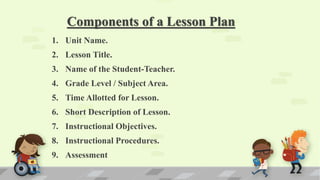
Components of a Lesson Plan
1. Unit Name.
2. Lesson Title.
3. Name of the Student-Teacher.
4. Grade Level / Subject Area.
5. Time Allotted for Lesson.
6. Short Description of Lesson.
7. Instructional Objectives.
8. Instructional Procedures.
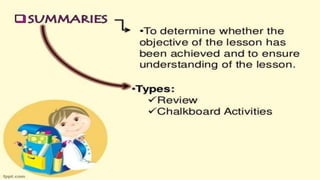
9. Assessment
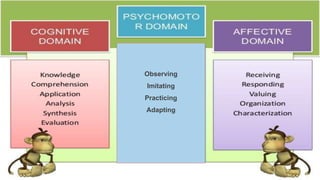
Observing
Imitating
Practicing
Adapting
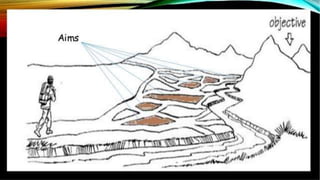
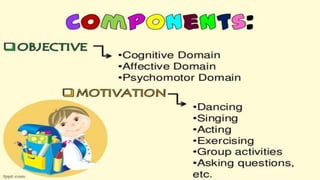
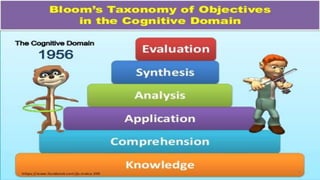
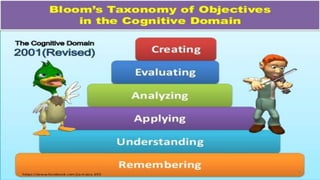
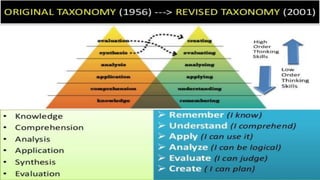
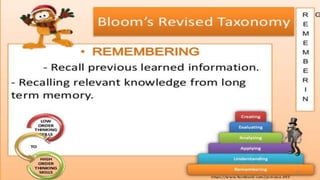
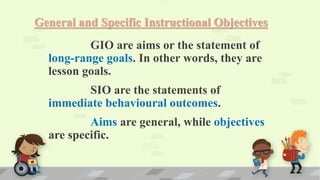
General and Specific Instructional Objectives
GIO are aims or the statement of
long-range goals. In other words, they are
lesson goals.
SIO are the statements of
immediate behavioural outcomes.
Aims are general, while objectives
are specific.
Planning for Instruction

Planning for Instruction

  • 1.
    UNIT - II PLANNINGFOR INSTRUCTION S.MUTHURANI ASSISTANT PROFESSOR MANGAYARKARASI COLLEGE OF EDUCATION MADURAI.
  • 2.
    PLANNING FOR INSTRUCTION It refers to what the teacher does and prepares for presentation / teaching of a lesson in class.  Effective teaching depends on the effective planning of a lesson by the teacher.  It is much more difficult than delivering the instruction.  It is defined as “Visualizing, Guidance, Managing & Decision Making”.  The teacher develops lesson contents to match them with curriculum standards.
  • 3.
  • 4.
    SETTING LESSON GOALS Setting realistic goals. Deciding how to incorporate course textbooks and other supportive instructional materials.  Developing activities that will promote learning.
  • 5.
    • Identify thetopic / unit for the lesson • Identify specific linguistic content • Identify specific language learning tasks to be completed by students • Identify specific learning strategies • Create goal statement
  • 7.
    DESIGNING UNIT PLAN AUnit plan is developed by the teacher. It serves as a long-range plan. It contains multiple lessons that are related in curriculum or textbook. It is often part of a larger thematic unit.
  • 8.
    Components of aUnit plan 1. Subject Area & Grade Level. 2. Unit Name. 3. Unit Goals. 4. Specific ways to relate goals to curriculum. 5. Characteristics of the students. 6. Introductory Procedures. 7. Materials / Media. 8. Assessment & Evaluation. 9. Assessment Instruments to Outcomes.
  • 10.
    DESIGNING A LESSONPLAN A Lesson Plan is a design that maps out the teacher’s intentions about the lesson. It reflects the teacher’s planning decisions and understanding of the principles of lesson design.
  • 13.
    Components of aLesson Plan 1. Unit Name. 2. Lesson Title. 3. Name of the Student-Teacher. 4. Grade Level / Subject Area. 5. Time Allotted for Lesson. 6. Short Description of Lesson. 7. Instructional Objectives. 8. Instructional Procedures. 9. Assessment
  • 31.
  • 41.
    General and SpecificInstructional Objectives GIO are aims or the statement of long-range goals. In other words, they are lesson goals. SIO are the statements of immediate behavioural outcomes. Aims are general, while objectives are specific.