Types of 
Evaluation
Evaluation – is classified 
according to the period in which 
it is conducted and whether or 
not the score of one student will 
affect the grade of other 
students.
A.) As to the period the evaluation 
is conducted in, there are three 
types: 
1.) Formative Evaluation 
2.) Summative Evaluation 
3.) Diagnostic Evaluation
1.) Formative Evaluation 
Is a type of evaluation used to 
monitor the learning progress of 
the students during or after 
instruction.
Purpose of Formative Evaluation: 
1.) to provide feedback immediately to 
both student and teacher regarding the 
success and failures of learning. 
2.) to identify the learning errors that is 
in need of correction; 
3.) to provide information to the teacher 
for modifying instruction and used for 
improving learning and instruction.
2.) Summative Evaluation 
Is a type of evaluation usually 
given at the end of a course or unit.
Purpose of Summative Evaluation: 
1.) to determine the extent to which the 
instructional objectives have been met; 
2.) to certify student mastery of the intended 
outcome and used for assigning grades; 
3.) to provide information for judging 
appropriateness of the instructional 
objectives; 
4.) to determine the effectiveness of 
instruction.
2.) Diagnostic Evaluation 
Is a type of evaluation given before 
instruction. It aims to identify the 
strengths and weaknesses of the 
students regarding the topics to be 
discussed.
Purpose of Diagnostic Evaluation: 
1.) to determine the level of competence 
of the students; 
2.) to identify the students who have 
already the knowledge about the lesson; 
3.) to determine the causes of learning 
problems and formulate a plan for 
remedial action.
B.) As to whether or not the score 
of one student will affect the grade 
of another student, there are two 
types: 
1.) Criterion-Referenced Test 
2.) Norm-Referenced Evaluation
1.) Criterion-Referenced Test 
Is a type of evaluation that 
describes what an examinee can do 
without reference to the 
performance of others.
2.) Norm-Referenced Evaluation 
Is a measure to find out how well a 
student performs on a defined set 
of tasks in relation with the 
performance of other students who 
take the same test.
Common Characteristics of 
Criterion-Referenced Test 
and 
Norm-Referenced Evaluation
Common Characteristics of Criterion-Referenced 
Test and 
Norm-Referenced Evaluation 
1.) Both require specification of the 
achievement domain to be measured. 
2.) Both require a relevant and 
representative sample of test items. 
3.) Both use the same types of test items.
Common Characteristics of Criterion-Referenced 
Test and 
Norm-Referenced Evaluation 
4.) Both used the same rules for item 
writing (except for item difficulty). 
5.) Both are judge with the same 
qualities of goodness (validity and 
reliability). 
6.) Both are useful in educational 
assessment.
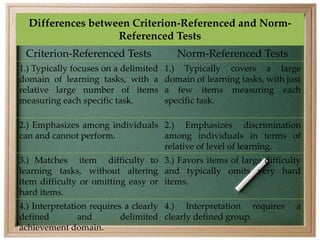
Differences between Criterion-Referenced and Norm- 
Referenced Tests 
Criterion-Referenced Tests Norm-Referenced Tests 
1.) Typically focuses on a delimited 
domain of learning tasks, with a 
relative large number of items 
measuring each specific task. 
1.) Typically covers a large 
domain of learning tasks, with just 
a few items measuring each 
specific task. 
2.) Emphasizes among individuals 
can and cannot perform. 
2.) Emphasizes discrimination 
among individuals in terms of 
relative of level of learning. 
3.) Matches item difficulty to 
learning tasks, without altering 
item difficulty or omitting easy or 
hard items. 
3.) Favors items of large difficulty 
and typically omits very hard 
items. 
4.) Interpretation requires a clearly 
defined and delimited 
achievement domain. 
4.) Interpretation requires a 
clearly defined group.
C.) Other Type of Evaluation 
Placement Evaluation – is concerned 
with the entry performance of the 
student. The purpose of placement 
evaluation is to determine the 
prerequisite skills, degree of mastery of 
the course objectives and the best mode 
of learning.

Types of Evaluation 1.2

  • 1.
  • 2.
    Evaluation – isclassified according to the period in which it is conducted and whether or not the score of one student will affect the grade of other students.
  • 3.
    A.) As tothe period the evaluation is conducted in, there are three types: 1.) Formative Evaluation 2.) Summative Evaluation 3.) Diagnostic Evaluation
  • 4.
    1.) Formative Evaluation Is a type of evaluation used to monitor the learning progress of the students during or after instruction.
  • 5.
    Purpose of FormativeEvaluation: 1.) to provide feedback immediately to both student and teacher regarding the success and failures of learning. 2.) to identify the learning errors that is in need of correction; 3.) to provide information to the teacher for modifying instruction and used for improving learning and instruction.
  • 6.
    2.) Summative Evaluation Is a type of evaluation usually given at the end of a course or unit.
  • 7.
    Purpose of SummativeEvaluation: 1.) to determine the extent to which the instructional objectives have been met; 2.) to certify student mastery of the intended outcome and used for assigning grades; 3.) to provide information for judging appropriateness of the instructional objectives; 4.) to determine the effectiveness of instruction.
  • 8.
    2.) Diagnostic Evaluation Is a type of evaluation given before instruction. It aims to identify the strengths and weaknesses of the students regarding the topics to be discussed.
  • 9.
    Purpose of DiagnosticEvaluation: 1.) to determine the level of competence of the students; 2.) to identify the students who have already the knowledge about the lesson; 3.) to determine the causes of learning problems and formulate a plan for remedial action.
  • 10.
    B.) As towhether or not the score of one student will affect the grade of another student, there are two types: 1.) Criterion-Referenced Test 2.) Norm-Referenced Evaluation
  • 11.
    1.) Criterion-Referenced Test Is a type of evaluation that describes what an examinee can do without reference to the performance of others.
  • 12.
    2.) Norm-Referenced Evaluation Is a measure to find out how well a student performs on a defined set of tasks in relation with the performance of other students who take the same test.
  • 13.
    Common Characteristics of Criterion-Referenced Test and Norm-Referenced Evaluation
  • 14.
    Common Characteristics ofCriterion-Referenced Test and Norm-Referenced Evaluation 1.) Both require specification of the achievement domain to be measured. 2.) Both require a relevant and representative sample of test items. 3.) Both use the same types of test items.
  • 15.
    Common Characteristics ofCriterion-Referenced Test and Norm-Referenced Evaluation 4.) Both used the same rules for item writing (except for item difficulty). 5.) Both are judge with the same qualities of goodness (validity and reliability). 6.) Both are useful in educational assessment.
  • 16.
    Differences between Criterion-Referencedand Norm- Referenced Tests Criterion-Referenced Tests Norm-Referenced Tests 1.) Typically focuses on a delimited domain of learning tasks, with a relative large number of items measuring each specific task. 1.) Typically covers a large domain of learning tasks, with just a few items measuring each specific task. 2.) Emphasizes among individuals can and cannot perform. 2.) Emphasizes discrimination among individuals in terms of relative of level of learning. 3.) Matches item difficulty to learning tasks, without altering item difficulty or omitting easy or hard items. 3.) Favors items of large difficulty and typically omits very hard items. 4.) Interpretation requires a clearly defined and delimited achievement domain. 4.) Interpretation requires a clearly defined group.
  • 17.
    C.) Other Typeof Evaluation Placement Evaluation – is concerned with the entry performance of the student. The purpose of placement evaluation is to determine the prerequisite skills, degree of mastery of the course objectives and the best mode of learning.