CURRICULUM
Prof (Dr) Rajesh G Konnur
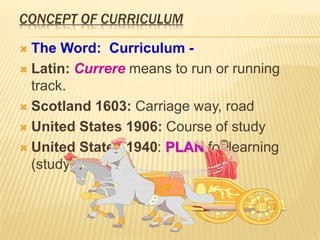
CONCEPT OF CURRICULUM
 The Word: Curriculum -
 Latin: Currere means to run or running
track.
 Scotland 1603: Carriage way, road
 United States 1906: Course of study
 United States 1940: PLAN for learning
(study)
WHAT IS CURRICULUM ?
 Curriculum is a design PLAN for learning that requires the
purposeful and proactive organization, sequencing, and
management of the interactions among the teacher, the
students, and the content knowledge we want students to
acquire.
 Curriculum – is a structured set of learning
outcomes or task that educators usually call
goals and objectives. (Howell & Evans 1995).
MEANING…..
 A document which describes a structured
series of learning objectives and outcomes for
a given subject matter area.
 Includes a specification of what should be
learned, how it should be taught, and the
plan for implementing/assessing the learning.
CURRICULUM PLANNING
 A curriculum Plan is the advance arrangement
of learning opportunities for a particular population of
learners.
• A Curriculum guide is a written curriculum.
 A Curriculum Planning is the process whereby
the arrangement of curriculum plans or learning
opportunities are created.
It is the process of preparing for the duties of teaching ,
deciding upon goals and emphases, determining
curriculum content , selecting learning resources &
classroom procedures, evaluating progress & looking
toward next steps.
CURRICULUM DEVELOPMENT
 It is defined as the process of
selecting, organizing , executing &
evaluating learning experiences on the
basis of the needs, abilities and
interests of the learners & the nature of
the society or community.
SCHOOLS OF THOUGHT ABOUT CURRICULUM
DEVELOPMENT
• The Essentialist School :
• The Progressive School :
ESSENTIALIST SCHOOL OF THOUGHT:
• It considers the curriculum as something rigid
consisting of discipline subjects.
• It considers all learners as much as the same &
it aims to fit the learner into the existing social
order & thereby maintain the status quo.
• Its major motivation is discipline and considers
freedom as an outcome & not a means of
education.
CONT….
 Its approach is authoritative and the teacher’s role
is to assign lessons & to recite recitations.
• It is book-centered and the methods recommended
are memory work, mastery of facts & skills &
development of abstract intelligence.
 It has no interest in social action and life activities.
• Its measurement of outcomes are standard tests
based on subject matter mastery.
THE PROGRESSIVE THOUGHT :
 It conceives of the curriculum as something
flexible based on areas of interest.
• It is learner-centered, having in mind that no two
persons are alike.
• Its factor of motivation is individual achievement
believing that persons are naturally good.
 The Role of the teacher is to stimulate direct
learning process.
CONT…
• It uses a life experience approach to fit the student
for future social life.
 Constant revision of aims and experimental
techniques of teaching & learning are imperatives in
curriculum development in order to create
independent thinking , initiative , self reliance ,
individuality , self- expression & activity in the
learner.
 Its measurement of outcomes are now devices
taking
into consideration subject matter & personality
values.
PROGRESSIVE POINTS OF VIEW OF
CURRICULUM
 Listing of subjects, syllabi, course of study and list of courses or
specific discipline can only be called curriculum if these
materials are actualized by the learner.
• Total learning experiences of the individual.
• All experiences children have under the guidance of teachers.
– Caswell & Campbell.
• Experiences in the classroom which are planned & enacted by
the teacher , & also learned by the students.
. – Marsh and Willis
MODELS OF CURRICULUM DEVELOPMENT
 Ralph Tyler Model: Four Basic Principle
1.Purposes of the school
2. Educational experiences related to the purpose.
3. Organization of the experiences.
4. Evaluation of the experiences.
HILDA TABA : GRASSROOTS APPROACH
1. Diagnosis of learners needs and expectations of the
larger society.
2. Formulation of learning objectives.
3. Selection of the learning content.
4. Organization of learning content.
5. Selection of the learning experiences.
6. Organization of learning activities.
7. Determination of what to evaluate and the means of
doing it.
STEPS IN CURRICULUM DEVELOPMENT
•Tyler’s Questions of Curriculum Development will
provide 4 steps:
•What educational purposes should the institution
seek to attain?
•What educational experiences can be provided that are likely to
attain these purposes ?
•How can these educational experiences be effectively
organized?
•How can we determine whether these purposes are being
attained ?
STEPS...
• In answering Tyler’s questions, we arrive the
following basic steps of curriculum development :
• Selection of aims, goals and objectives;
• Selection of learning experiences and content;
• Organisation of learning experiences; and
• Evaluation of the extent to which the objectives have
been achieved..
CURRICULUM DEVELOPMENT
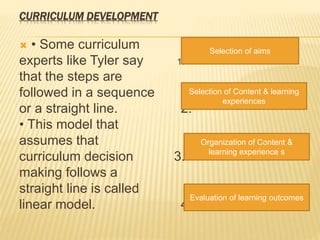
 • Some curriculum
experts like Tyler say 1.
that the steps are
followed in a sequence
or a straight line. 2.
• This model that
assumes that
curriculum decision 3.
making follows a
straight line is called
linear model. 4.
Selection of aims
Selection of Content & learning
experiences
Organization of Content &
learning experience s
Evaluation of learning outcomes
CURRICULUM DEVELOPMENT
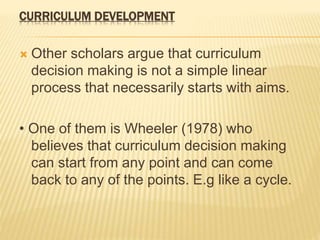
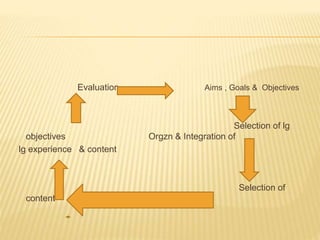
 Other scholars argue that curriculum
decision making is not a simple linear
process that necessarily starts with aims.
• One of them is Wheeler (1978) who
believes that curriculum decision making
can start from any point and can come
back to any of the points. E.g like a cycle.
Evaluation Aims , Goals & Objectives
Selection of lg
objectives Orgzn & Integration of
lg experience & content
Selection of
content
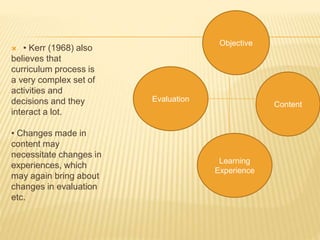
 • Kerr (1968) also
believes that
curriculum process is
a very complex set of
activities and
decisions and they
interact a lot.
• Changes made in
content may
necessitate changes in
experiences, which
may again bring about
changes in evaluation
etc.
Objective
Evaluation
Content
Learning
Experience
SELECTION OF AIMS AND OBJECTIVES
 Every curriculum is aimed at developing in the learners
certain competencies or abilities. The curriculum process
must therefore clearly identify the aims that the
curriculum is intended to achieve.
• Curriculum aims range from the very broad to the more
specific. In fact, that is why we use the terms aims, goals
and objectives to refer to them. Aims are broad
statements which cover all of the experiences provided in
the curriculum; goals are tied to specific subjects or group
of contents within the curriculum; while objectives
describe the more specific outcomes that can be attained
as a result of lessons or instruction delivered at the
classroom.
FACTORS IN SELECTING AIMS :
 Analysis of our culture: we should take into
account our cultural values, norms & expectations
when selecting aims.
• The present status of the learner: what has the
learner already known ? What are his / her
characteristics ? What is he / she ready for ?
• The state of our knowledge of the subject matter or
content: We should examine new developments
in knowledge to see if they contain things that are
of real value to the learner & society.
CONT….
• Relevance to school’s philosophy of education:
each nation has its own philosophy of
education which its schools try to implement.
 We should ask whether the objectives we
select are relevant to this philosophy.
• Consistency with our theory of learning: at any
time in any society, there is a dominant
conception of learning i.e. our Understanding
what learning is and how it takes place. For
instance, the National Policy on Education
anticipates that the Indian child is active ,
exploratory & imaginative.
SELECTION OF CONTENT & LEARNING EXPERIENCES
• Content is what we teach; learning experience is an activity
which the learner engages in which results in changes in his
behaviour;
• We should select those contents and learning experiences
that will in attaining the goals of the curriculum;
• There are some factors to consider in selecting both
learning
experiences and content.
• We shall first examine those criteria for selecting learning
experiences
SELECTION OF LEARNING EXPERIENCES…
 Cumulation: even though experiences
provided
may be different, they should all lead to the
attainment of the same goal; subsequent
experiences should build on earlier ones;
• Multiple Learning: a single learning
experience
may bring about multiple outcomes. Such
learning experiences are important because of
FACTORS IN SELECTING CONTENT :
 Validity: means two things, is the content related to
the
objectives, and is the content true or authentic.
• Significance: is the content significant or will lead it
to
the more mastery or more understanding of the
course
or subject;
• Utility: here the question is whether the content
selected is useful i.e. will lead to the acquisition of
skills
and knowledge that are considered useful by society?
• Interest: is the content interesting to the learner? Or
can the content be made interesting to learners?
CURRICULUM REVIEW & EVALUATION
a. Effectiveness of Curriculum in achieving the Learning
Outcomes.
b. Programs are at a Suitable Academic Level.
c. Curriculum facilitates Progress to Employment and/ or
Further Study.
d. How often the Curriculum is Reviewed by the Dept.?
e. How Student Feedback, Comments from Examiners and
Employer Views are taken into account in Reviewing
Curriculum?
Thanks

Curriculum aku

  • 1.
  • 2.
    CONCEPT OF CURRICULUM The Word: Curriculum -  Latin: Currere means to run or running track.  Scotland 1603: Carriage way, road  United States 1906: Course of study  United States 1940: PLAN for learning (study)
  • 3.
    WHAT IS CURRICULUM?  Curriculum is a design PLAN for learning that requires the purposeful and proactive organization, sequencing, and management of the interactions among the teacher, the students, and the content knowledge we want students to acquire.  Curriculum – is a structured set of learning outcomes or task that educators usually call goals and objectives. (Howell & Evans 1995).
  • 4.
    MEANING…..  A documentwhich describes a structured series of learning objectives and outcomes for a given subject matter area.  Includes a specification of what should be learned, how it should be taught, and the plan for implementing/assessing the learning.
  • 5.
    CURRICULUM PLANNING  Acurriculum Plan is the advance arrangement of learning opportunities for a particular population of learners. • A Curriculum guide is a written curriculum.  A Curriculum Planning is the process whereby the arrangement of curriculum plans or learning opportunities are created. It is the process of preparing for the duties of teaching , deciding upon goals and emphases, determining curriculum content , selecting learning resources & classroom procedures, evaluating progress & looking toward next steps.
  • 6.
    CURRICULUM DEVELOPMENT  Itis defined as the process of selecting, organizing , executing & evaluating learning experiences on the basis of the needs, abilities and interests of the learners & the nature of the society or community.
  • 7.
    SCHOOLS OF THOUGHTABOUT CURRICULUM DEVELOPMENT • The Essentialist School : • The Progressive School :
  • 8.
    ESSENTIALIST SCHOOL OFTHOUGHT: • It considers the curriculum as something rigid consisting of discipline subjects. • It considers all learners as much as the same & it aims to fit the learner into the existing social order & thereby maintain the status quo. • Its major motivation is discipline and considers freedom as an outcome & not a means of education.
  • 9.
    CONT….  Its approachis authoritative and the teacher’s role is to assign lessons & to recite recitations. • It is book-centered and the methods recommended are memory work, mastery of facts & skills & development of abstract intelligence.  It has no interest in social action and life activities. • Its measurement of outcomes are standard tests based on subject matter mastery.
  • 10.
    THE PROGRESSIVE THOUGHT:  It conceives of the curriculum as something flexible based on areas of interest. • It is learner-centered, having in mind that no two persons are alike. • Its factor of motivation is individual achievement believing that persons are naturally good.  The Role of the teacher is to stimulate direct learning process.
  • 11.
    CONT… • It usesa life experience approach to fit the student for future social life.  Constant revision of aims and experimental techniques of teaching & learning are imperatives in curriculum development in order to create independent thinking , initiative , self reliance , individuality , self- expression & activity in the learner.  Its measurement of outcomes are now devices taking into consideration subject matter & personality values.
  • 12.
    PROGRESSIVE POINTS OFVIEW OF CURRICULUM  Listing of subjects, syllabi, course of study and list of courses or specific discipline can only be called curriculum if these materials are actualized by the learner. • Total learning experiences of the individual. • All experiences children have under the guidance of teachers. – Caswell & Campbell. • Experiences in the classroom which are planned & enacted by the teacher , & also learned by the students. . – Marsh and Willis
  • 13.
    MODELS OF CURRICULUMDEVELOPMENT  Ralph Tyler Model: Four Basic Principle 1.Purposes of the school 2. Educational experiences related to the purpose. 3. Organization of the experiences. 4. Evaluation of the experiences.
  • 14.
    HILDA TABA :GRASSROOTS APPROACH 1. Diagnosis of learners needs and expectations of the larger society. 2. Formulation of learning objectives. 3. Selection of the learning content. 4. Organization of learning content. 5. Selection of the learning experiences. 6. Organization of learning activities. 7. Determination of what to evaluate and the means of doing it.
  • 15.
    STEPS IN CURRICULUMDEVELOPMENT •Tyler’s Questions of Curriculum Development will provide 4 steps: •What educational purposes should the institution seek to attain? •What educational experiences can be provided that are likely to attain these purposes ? •How can these educational experiences be effectively organized? •How can we determine whether these purposes are being attained ?
  • 16.
    STEPS... • In answeringTyler’s questions, we arrive the following basic steps of curriculum development : • Selection of aims, goals and objectives; • Selection of learning experiences and content; • Organisation of learning experiences; and • Evaluation of the extent to which the objectives have been achieved..
  • 17.
    CURRICULUM DEVELOPMENT  •Some curriculum experts like Tyler say 1. that the steps are followed in a sequence or a straight line. 2. • This model that assumes that curriculum decision 3. making follows a straight line is called linear model. 4. Selection of aims Selection of Content & learning experiences Organization of Content & learning experience s Evaluation of learning outcomes
  • 18.
    CURRICULUM DEVELOPMENT  Otherscholars argue that curriculum decision making is not a simple linear process that necessarily starts with aims. • One of them is Wheeler (1978) who believes that curriculum decision making can start from any point and can come back to any of the points. E.g like a cycle.
  • 19.
    Evaluation Aims ,Goals & Objectives Selection of lg objectives Orgzn & Integration of lg experience & content Selection of content
  • 20.
     • Kerr(1968) also believes that curriculum process is a very complex set of activities and decisions and they interact a lot. • Changes made in content may necessitate changes in experiences, which may again bring about changes in evaluation etc. Objective Evaluation Content Learning Experience
  • 21.
    SELECTION OF AIMSAND OBJECTIVES  Every curriculum is aimed at developing in the learners certain competencies or abilities. The curriculum process must therefore clearly identify the aims that the curriculum is intended to achieve. • Curriculum aims range from the very broad to the more specific. In fact, that is why we use the terms aims, goals and objectives to refer to them. Aims are broad statements which cover all of the experiences provided in the curriculum; goals are tied to specific subjects or group of contents within the curriculum; while objectives describe the more specific outcomes that can be attained as a result of lessons or instruction delivered at the classroom.
  • 22.
    FACTORS IN SELECTINGAIMS :  Analysis of our culture: we should take into account our cultural values, norms & expectations when selecting aims. • The present status of the learner: what has the learner already known ? What are his / her characteristics ? What is he / she ready for ? • The state of our knowledge of the subject matter or content: We should examine new developments in knowledge to see if they contain things that are of real value to the learner & society.
  • 23.
    CONT…. • Relevance toschool’s philosophy of education: each nation has its own philosophy of education which its schools try to implement.  We should ask whether the objectives we select are relevant to this philosophy. • Consistency with our theory of learning: at any time in any society, there is a dominant conception of learning i.e. our Understanding what learning is and how it takes place. For instance, the National Policy on Education anticipates that the Indian child is active , exploratory & imaginative.
  • 24.
    SELECTION OF CONTENT& LEARNING EXPERIENCES • Content is what we teach; learning experience is an activity which the learner engages in which results in changes in his behaviour; • We should select those contents and learning experiences that will in attaining the goals of the curriculum; • There are some factors to consider in selecting both learning experiences and content. • We shall first examine those criteria for selecting learning experiences
  • 25.
    SELECTION OF LEARNINGEXPERIENCES…  Cumulation: even though experiences provided may be different, they should all lead to the attainment of the same goal; subsequent experiences should build on earlier ones; • Multiple Learning: a single learning experience may bring about multiple outcomes. Such learning experiences are important because of
  • 26.
    FACTORS IN SELECTINGCONTENT :  Validity: means two things, is the content related to the objectives, and is the content true or authentic. • Significance: is the content significant or will lead it to the more mastery or more understanding of the course or subject; • Utility: here the question is whether the content selected is useful i.e. will lead to the acquisition of skills and knowledge that are considered useful by society? • Interest: is the content interesting to the learner? Or can the content be made interesting to learners?
  • 27.
    CURRICULUM REVIEW &EVALUATION a. Effectiveness of Curriculum in achieving the Learning Outcomes. b. Programs are at a Suitable Academic Level. c. Curriculum facilitates Progress to Employment and/ or Further Study. d. How often the Curriculum is Reviewed by the Dept.? e. How Student Feedback, Comments from Examiners and Employer Views are taken into account in Reviewing Curriculum?
  • 28.