Types and components of
curriculum
PED 307 AY 2020-2021
Be reminded :)
Not to teach the whole curriculum, is to give up on the whole man.
- Paul Goodman
The whole purpose of education is to turn mirrors into windows.
- Sydney J. Harris
Hello, Dear!
“Curriculum is more than mandates. It is all
around us and ever-changing.”
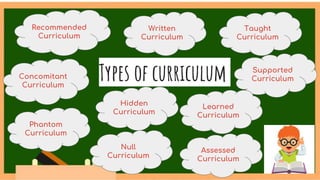
Types of curriculum
Recommended
Curriculum
Written
Curriculum
Taught
Curriculum
Supported
Curriculum
Hidden
Curriculum
Concomitant
Curriculum
Phantom
Curriculum
Null
Curriculum
Learned
Curriculum
Assessed
Curriculum
RECOMMENDED curriculum
- most of the curricula are recommended.
- proposed by scholars and professional organizations.
The curriculum may come from a national agency or any
professional organization who has stake in education
WRITTEN curriculum
- Includes documents, course of study or syllabi for implementation.
- Most written curricula are made by curriculum experts with participation
of teachers.
An example of this is the Basic Education Curriculum (BEC) and the
written lesson plan of each classroom teacher made up of objectives and
planned activities of the teacher.
TAUGHT CURRICULUM
- The different planned activities which are put into action in the classroom
compose the taught curriculum.
- These are varied activities that are implemented in order to arrive at the
objectives or purposes of the written curriculum.
It varied according to the learning styles of the students and the teaching
styles of the teacher.
SUPPORTED curriculum
- In order to have a successful teaching, other than the teacher, there
must be materials which should support of help in the implementation
of a written curriculum.
Support curriculum includes material resources such as textbooks,
computers, audio-visual materials, laboratory equipment,
playgrounds, zoos and other facilities.
Support curriculum should enable each learner to achieve real and
lifelong learning.
assessed Curriculum
- This refers to a tested or evaluated curriculum.
- Series of evaluations are being done by the teachers at the duration
and end of the teaching episodes to determine the extent of teaching or
to tell if the students are progressing.
Assessment tools like pencil-and-paper tests, authentic instruments like
portfolio are being utilized.
LEARNED Curriculum
- This refers to the learning outcomes achieved by the students.
Learning outcomes are indicated by the results of the tests and
changes in behavior which can be either cognitive, affective or
psychomotor.
HIDDEN CURRICULUM
- This is the unintended curriculum which is not deliberately planned but
may modify behavior or influence learning outcomes.
Peer influence, school environment, physical condition, teacher-learner
interaction, mood of the teacher and many other factors make up the
hidden curriculum.
concomitant Curriculum
- Things that are taught at home; those experiences that are part
of a family's experiences, or related experiences sanctioned by
the family.
This type of curriculum may be received at church, in the context
of religious expression, lessons on values, ethics or morals, molded
behaviors, or social experiences based on a family's preferences.
PHANTOM CURRICULUM
The messages prevalent in and through exposure to
media.
null Curriculum
This is what is not taught. Not teaching some particular
idea or sets of ideas may be due to mandates from higher
authorities, to a teacher’s lack of knowledge, or to deeply
ingrained assumptions and biases.
Wilson, 1990
“Humans are born learning, thus the learned curriculum actually
encompasses a combination of all of the following — the hidden, null, written,
political and societal etc.. Since students learn all the time through exposure
and modeled behaviors, this means that they learn important social and
emotional lessons from everyone who inhabits a school — from the janitorial
staff, the secretary, the cafeteria workers, their peers, as well as from the
deportment, conduct and attitudes expressed and modeled by their teachers.
Many educators are unaware of the strong lessons imparted to youth by
these everyday contacts.”
References
Wilson, L. O. (2020). Types of Curriculum. Retrieved from The Second Principle:
https://thesecondprinciple.com/instructional-design/types-of-curriculum/
AL-Rajhi, L. (n.d). Types of Curriculum Operating in Schools Retrieved from:
file:///C:/Users/pc/Downloads/PED%20307-PC_educ15-150130112355-conversion-
gate01.pdf.
Source of Background Photos:
https://www.google.com/search?q=background+for+powerpoint+education&tbm=isch&ved=2ahUKEwjV7bG0v7jrAhULhZQKHZA_B_8Q2-
cCegQIABAA&oq=background+for+powerpoint+educat&gs_lcp=CgNpbWcQARgAMgIIADIGCAAQCBAeMgYIABAIEB4yBggAEAgQHjIGCAAQCBAeMgYIAB
AIEB4yBggAEAgQHjIGCAAQCBAeMgYIABAIEB4yBggAEAgQHjoECAAQQzoFCAAQsQM6BwgAELEDEENQtLMMWKPjDGCw-
AxoAXAAeACAAccBiAHIGpIBBDAuMjKYAQCgAQGqAQtnd3Mtd2l6LWltZ8ABAQ&sclient=img&ei=MiNGX9WMC4uK0gSQ_5z4Dw&bih=625&biw=1366&hl=
en
HAVE FUN LEARNING!
Go, Madeline Labial,
Rhea Joy
Lagura,
Norzen
Cemine,
Charmeyn
Tabal, Hannah
Franchesca
OF
The nature of the elements and the manner in which they are
organized may comprise which we call a curriculum design. There are
four elements of curriculum, which are essential and interrelated to
each other:
1) Curriculum Aims and Objectives
2) Curriculum Content or Subject Matter
3) Curriculum Experience
4) Curriculum Evaluation
Component 1: Curriculum Aims, Goals and Objectives
Aims: Elementary, Secondary, and Tertiary
Goals: School Vision and Mission
Objectives: Educational objectives
Domains:
1. Cognitive – knowledge, comprehension, application, analysis, synthesis,
evaluation
2. Affective – receiving, responding, valuing, organization, characterization
3. psychomotor – perception, set, guided response, mechanism, complex
overt response, adaptation, origination
● Aims and objectives are decided at all the levels central,
state, and local considering philosophy, sociological and
psychological foundations.
● Aims and objectives can be simplified as “what is to be
done”.
● The subject’s content structure, levels of students, and type
of examination components are considered in the
identification of objectives of teaching and learning.
● These objectives are specific and written in behavioral
terms so as to develop learning structures and conditions.
● It tries to capture what goals are to be achieved, the vision,
the philosophy, the mission statement and objectives.
Component 2: Curriculum Content or Subject Matter
Information to be learned in school, another term for
knowledge ( a compendium of facts, concepts,
generalization, principles, theories
1. Subject-centered view of curriculum: The Fund of human knowledge
represents the repository of accumulated discoveries and inventions of man
down the centuries, due to man’s exploration of his world
2. Learner-centered view of curriculum: Relates knowledge to the individual’s
personal and social world and how he or she defines reality.
Jerome Bruner: “Knowledge is a model we construct to give meaning and
structure to regularities in experience”
Criteria used in selection of subject matter for the curriculum:
1. Self-sufficiency – “less teaching effort and educational resources, less learner’s
effort but more results and effective learning outcomes – most economical manner
(Scheffler, 1970)
2. Significance – contribute to basic ideas to achieve overall aim of curriculum,
develop learning skills
3. Validity – meaningful to the learner based on maturity, prior experience,
educational and social value
4. Utility – usefulness of the content either for the present or the future
5. Learnability – within the range of the experience of the learners
6. Feasibility – can be learned within the tile allowed, resources available, expertise of
the teacher, nature of learner
Principles to follow in organizing the learning contents (Palma,
1992)
1. BALANCE Content curriculum should be fairly distributed in depth and
breath of the particular learning are or discipline. This will ensure that the
level or area will not be overcrowded or less crowded.
2. ARTICULATION Each level of subject matter should be smoothly
connected to the next, glaring gaps or wasteful overlaps in the subject
matter will be avoided.
3. SEQUENCE This is the logical arrangement of the subject matter. It
refers to the deepening and broadening of content as it is taken up in the
higher levels.
Component 3 – Curriculum Experience
Instructional strategies and methods
will link to curriculum experiences, the
core and heart of the curriculum.
The instructional strategies and methods
will put into action the goals and use of
the content in order to produce an outcome.
Teaching strategies convert the written curriculum to instruction. Among
these are time-tested methods, inquiry approaches, constructivist and
other emerging strategies that complement new theories in teaching
and learning. Educational activities like field trips, conducting
experiments, interacting with computer programs and other experiential
learning will also form part of the repertoire of teaching.
Whatever methods the teacher utilizes to implement the curriculum, there
will be some guide for the selection and use, Here are some of them:
1. Teaching methods are means to achieve the end.
2. There is no single best teaching method.
3. Teaching methods should stimulate the learner’s desire to develop the
cognitive, affective, psychomotor, social and spiritual domain of the
individual.
4. In the choice of teaching methods, learning styles of the students
should be considered.
5. Every method should lead to the
development of the learning outcome
in three domains.
6. Flexibility should be a consideration
in the use of teaching methods.
Component 4 – Curriculum Evaluation
To be effective, all curricula must have an element of evaluation.
Curriculum evaluation refer to the formal determination of the quality,
effectiveness or value of the program, process, and product of the
curriculum. Several methods of evaluation came up. The most widely used
is Stufflebeam's CIPP Model. The process in CIPP model is continuous and
very important to curriculum managers.
CIPP Model – Context (environment of curriculum), Input (ingredients of
curriculum), Process (ways and means of implementing), Product
accomplishment of goals)- process is continuous.
Regardless of the methods and materials evaluation will utilize, a suggested
plan of action for the process of curriculum evaluation is introduced. These are
the steps:
1. Focus on one particular component of the curriculum. Will it be subject area,
the grade level, the course, or the degree program? Specify objectives of
evaluation.
2. Collect or gather the information. Information is made up of data needed
regarding the object of evaluation.
3. Organize the information. This step will require coding, organizing, storing
and retrieving data for interpretation.
4. Analyze information. An appropriate way of analyzing will be utilized.
5. Report the information. The report of evaluation should be reported
to specific audiences. It can be done formally in conferences with
stakeholders, or informally through round table discussion and
conversations.
6. Recycle the information for continuous feedback, modifications and
adjustments to be made.
Reference
Alonsabe, O. (2009, February 20). Elements/Components of the Curriculum.
https://l.facebook.com/l.php?u=http%3A%2F%2Folga-
curriculum.blogspot.com%2F2009%2F02%2Felementscomponets-of-
curriculum.html%3Ffbclid%3DIwAR3Ym2azg4cBISbtu7CV-
ad7pQ80fXhUJB7cB0fAgDbiLYLqdHpPeToQP_0&h=AT0mGS8wetbvoJdvcaUI9
ZHRldmlqblwVYeYVFdNEjF1UN-x4-syuIoxmTG1GopDfmeTndS0e-
ipSkrpVddI900DaTTlQDM0SodIweImjTbBGiVnnCNoPJkIjt3y2ZI9cM5faw
Socaoco,
Kryssyl Kyss
Nakila,
Christille Dawn
Magada,
Teddy
Mapa,
Vanessa
Salino,
Tiffany
End of presentation
Thank you

Ped 307 l2

  • 1.
    Types and componentsof curriculum PED 307 AY 2020-2021
  • 2.
    Be reminded :) Notto teach the whole curriculum, is to give up on the whole man. - Paul Goodman The whole purpose of education is to turn mirrors into windows. - Sydney J. Harris Hello, Dear! “Curriculum is more than mandates. It is all around us and ever-changing.”
  • 3.
  • 4.
    RECOMMENDED curriculum - mostof the curricula are recommended. - proposed by scholars and professional organizations. The curriculum may come from a national agency or any professional organization who has stake in education
  • 5.
    WRITTEN curriculum - Includesdocuments, course of study or syllabi for implementation. - Most written curricula are made by curriculum experts with participation of teachers. An example of this is the Basic Education Curriculum (BEC) and the written lesson plan of each classroom teacher made up of objectives and planned activities of the teacher.
  • 6.
    TAUGHT CURRICULUM - Thedifferent planned activities which are put into action in the classroom compose the taught curriculum. - These are varied activities that are implemented in order to arrive at the objectives or purposes of the written curriculum. It varied according to the learning styles of the students and the teaching styles of the teacher.
  • 7.
    SUPPORTED curriculum - Inorder to have a successful teaching, other than the teacher, there must be materials which should support of help in the implementation of a written curriculum. Support curriculum includes material resources such as textbooks, computers, audio-visual materials, laboratory equipment, playgrounds, zoos and other facilities. Support curriculum should enable each learner to achieve real and lifelong learning.
  • 8.
    assessed Curriculum - Thisrefers to a tested or evaluated curriculum. - Series of evaluations are being done by the teachers at the duration and end of the teaching episodes to determine the extent of teaching or to tell if the students are progressing. Assessment tools like pencil-and-paper tests, authentic instruments like portfolio are being utilized.
  • 9.
    LEARNED Curriculum - Thisrefers to the learning outcomes achieved by the students. Learning outcomes are indicated by the results of the tests and changes in behavior which can be either cognitive, affective or psychomotor.
  • 10.
    HIDDEN CURRICULUM - Thisis the unintended curriculum which is not deliberately planned but may modify behavior or influence learning outcomes. Peer influence, school environment, physical condition, teacher-learner interaction, mood of the teacher and many other factors make up the hidden curriculum.
  • 11.
    concomitant Curriculum - Thingsthat are taught at home; those experiences that are part of a family's experiences, or related experiences sanctioned by the family. This type of curriculum may be received at church, in the context of religious expression, lessons on values, ethics or morals, molded behaviors, or social experiences based on a family's preferences.
  • 12.
    PHANTOM CURRICULUM The messagesprevalent in and through exposure to media.
  • 13.
    null Curriculum This iswhat is not taught. Not teaching some particular idea or sets of ideas may be due to mandates from higher authorities, to a teacher’s lack of knowledge, or to deeply ingrained assumptions and biases.
  • 14.
    Wilson, 1990 “Humans areborn learning, thus the learned curriculum actually encompasses a combination of all of the following — the hidden, null, written, political and societal etc.. Since students learn all the time through exposure and modeled behaviors, this means that they learn important social and emotional lessons from everyone who inhabits a school — from the janitorial staff, the secretary, the cafeteria workers, their peers, as well as from the deportment, conduct and attitudes expressed and modeled by their teachers. Many educators are unaware of the strong lessons imparted to youth by these everyday contacts.”
  • 15.
    References Wilson, L. O.(2020). Types of Curriculum. Retrieved from The Second Principle: https://thesecondprinciple.com/instructional-design/types-of-curriculum/ AL-Rajhi, L. (n.d). Types of Curriculum Operating in Schools Retrieved from: file:///C:/Users/pc/Downloads/PED%20307-PC_educ15-150130112355-conversion- gate01.pdf. Source of Background Photos: https://www.google.com/search?q=background+for+powerpoint+education&tbm=isch&ved=2ahUKEwjV7bG0v7jrAhULhZQKHZA_B_8Q2- cCegQIABAA&oq=background+for+powerpoint+educat&gs_lcp=CgNpbWcQARgAMgIIADIGCAAQCBAeMgYIABAIEB4yBggAEAgQHjIGCAAQCBAeMgYIAB AIEB4yBggAEAgQHjIGCAAQCBAeMgYIABAIEB4yBggAEAgQHjoECAAQQzoFCAAQsQM6BwgAELEDEENQtLMMWKPjDGCw- AxoAXAAeACAAccBiAHIGpIBBDAuMjKYAQCgAQGqAQtnd3Mtd2l6LWltZ8ABAQ&sclient=img&ei=MiNGX9WMC4uK0gSQ_5z4Dw&bih=625&biw=1366&hl= en
  • 16.
    HAVE FUN LEARNING! Go,Madeline Labial, Rhea Joy Lagura, Norzen Cemine, Charmeyn Tabal, Hannah Franchesca
  • 17.
  • 18.
    The nature ofthe elements and the manner in which they are organized may comprise which we call a curriculum design. There are four elements of curriculum, which are essential and interrelated to each other: 1) Curriculum Aims and Objectives 2) Curriculum Content or Subject Matter 3) Curriculum Experience 4) Curriculum Evaluation
  • 19.
    Component 1: CurriculumAims, Goals and Objectives Aims: Elementary, Secondary, and Tertiary Goals: School Vision and Mission Objectives: Educational objectives Domains: 1. Cognitive – knowledge, comprehension, application, analysis, synthesis, evaluation 2. Affective – receiving, responding, valuing, organization, characterization 3. psychomotor – perception, set, guided response, mechanism, complex overt response, adaptation, origination
  • 20.
    ● Aims andobjectives are decided at all the levels central, state, and local considering philosophy, sociological and psychological foundations. ● Aims and objectives can be simplified as “what is to be done”. ● The subject’s content structure, levels of students, and type of examination components are considered in the identification of objectives of teaching and learning.
  • 21.
    ● These objectivesare specific and written in behavioral terms so as to develop learning structures and conditions. ● It tries to capture what goals are to be achieved, the vision, the philosophy, the mission statement and objectives.
  • 22.
    Component 2: CurriculumContent or Subject Matter Information to be learned in school, another term for knowledge ( a compendium of facts, concepts, generalization, principles, theories 1. Subject-centered view of curriculum: The Fund of human knowledge represents the repository of accumulated discoveries and inventions of man down the centuries, due to man’s exploration of his world 2. Learner-centered view of curriculum: Relates knowledge to the individual’s personal and social world and how he or she defines reality. Jerome Bruner: “Knowledge is a model we construct to give meaning and structure to regularities in experience”
  • 23.
    Criteria used inselection of subject matter for the curriculum: 1. Self-sufficiency – “less teaching effort and educational resources, less learner’s effort but more results and effective learning outcomes – most economical manner (Scheffler, 1970) 2. Significance – contribute to basic ideas to achieve overall aim of curriculum, develop learning skills 3. Validity – meaningful to the learner based on maturity, prior experience, educational and social value 4. Utility – usefulness of the content either for the present or the future 5. Learnability – within the range of the experience of the learners 6. Feasibility – can be learned within the tile allowed, resources available, expertise of the teacher, nature of learner
  • 24.
    Principles to followin organizing the learning contents (Palma, 1992) 1. BALANCE Content curriculum should be fairly distributed in depth and breath of the particular learning are or discipline. This will ensure that the level or area will not be overcrowded or less crowded. 2. ARTICULATION Each level of subject matter should be smoothly connected to the next, glaring gaps or wasteful overlaps in the subject matter will be avoided. 3. SEQUENCE This is the logical arrangement of the subject matter. It refers to the deepening and broadening of content as it is taken up in the higher levels.
  • 25.
    Component 3 –Curriculum Experience Instructional strategies and methods will link to curriculum experiences, the core and heart of the curriculum. The instructional strategies and methods will put into action the goals and use of the content in order to produce an outcome.
  • 26.
    Teaching strategies convertthe written curriculum to instruction. Among these are time-tested methods, inquiry approaches, constructivist and other emerging strategies that complement new theories in teaching and learning. Educational activities like field trips, conducting experiments, interacting with computer programs and other experiential learning will also form part of the repertoire of teaching.
  • 27.
    Whatever methods theteacher utilizes to implement the curriculum, there will be some guide for the selection and use, Here are some of them: 1. Teaching methods are means to achieve the end. 2. There is no single best teaching method. 3. Teaching methods should stimulate the learner’s desire to develop the cognitive, affective, psychomotor, social and spiritual domain of the individual. 4. In the choice of teaching methods, learning styles of the students should be considered.
  • 28.
    5. Every methodshould lead to the development of the learning outcome in three domains. 6. Flexibility should be a consideration in the use of teaching methods.
  • 29.
    Component 4 –Curriculum Evaluation To be effective, all curricula must have an element of evaluation. Curriculum evaluation refer to the formal determination of the quality, effectiveness or value of the program, process, and product of the curriculum. Several methods of evaluation came up. The most widely used is Stufflebeam's CIPP Model. The process in CIPP model is continuous and very important to curriculum managers. CIPP Model – Context (environment of curriculum), Input (ingredients of curriculum), Process (ways and means of implementing), Product accomplishment of goals)- process is continuous.
  • 30.
    Regardless of themethods and materials evaluation will utilize, a suggested plan of action for the process of curriculum evaluation is introduced. These are the steps: 1. Focus on one particular component of the curriculum. Will it be subject area, the grade level, the course, or the degree program? Specify objectives of evaluation. 2. Collect or gather the information. Information is made up of data needed regarding the object of evaluation. 3. Organize the information. This step will require coding, organizing, storing and retrieving data for interpretation.
  • 31.
    4. Analyze information.An appropriate way of analyzing will be utilized. 5. Report the information. The report of evaluation should be reported to specific audiences. It can be done formally in conferences with stakeholders, or informally through round table discussion and conversations. 6. Recycle the information for continuous feedback, modifications and adjustments to be made.
  • 32.
    Reference Alonsabe, O. (2009,February 20). Elements/Components of the Curriculum. https://l.facebook.com/l.php?u=http%3A%2F%2Folga- curriculum.blogspot.com%2F2009%2F02%2Felementscomponets-of- curriculum.html%3Ffbclid%3DIwAR3Ym2azg4cBISbtu7CV- ad7pQ80fXhUJB7cB0fAgDbiLYLqdHpPeToQP_0&h=AT0mGS8wetbvoJdvcaUI9 ZHRldmlqblwVYeYVFdNEjF1UN-x4-syuIoxmTG1GopDfmeTndS0e- ipSkrpVddI900DaTTlQDM0SodIweImjTbBGiVnnCNoPJkIjt3y2ZI9cM5faw
  • 33.
  • 34.