Pragmatics: Classroom
Management – Chapter 6 (pp.
198 - 218
Ebert, E., & Culyer III, R. (2014). Pragmatics:
Assessment and Classroom Management. In School:
An introduction to education. Belmont: Wadsworth.
Where to Begin?
• Is the curriculum “meaningful to the students”?
• Is the teaching “engaging and motivating”?
• What types of things derail these best of plans and intentions?
Some Theory
• Read through the overview of Classroom Management
Theories.
• Are you more teacher-centered, student-centered, or
somewhere in the middle?
• Read the “Teacher Testimonial” on pp. 200 – 201. Which
suggestions make you say “Aha!”?
Terminology
• Classroom management – the things teachers do “to organize students,
space, and time to prevent or minimize behavior problems that would
interfere with instructional time.”
• Discipline (according to the text) – “actions a teacher takes after
misbehavior has occurred.”
• Consequences – must be clear, fair and reasonable, and consistently
enforced. Children will test limits, so be prepared.
• Procedures – “manner in which particular activities are to be carried
out”
• Routines – “automatic” procedures
• Are students aware of the rules?
• Are the rules fair and reasonable?
• Is following the rules in the best interest of the
students?
• Is positive behavior encouraged?
• What is the teacher doing to reduce the need
for reinforcers?
Planning for Classroom Management
• Curriculum is generally static
• Student groups are dynamic
• Organization is a must to keep all groups, no matter their
makeup, maximizing instructional opportunities and
minimizing behaviors that take away from that.
• Much effective classroom management is inherent in what is
not seen. (Note chart 6.4 on p. 205)
Practicing for Classroom Management
• Practice following the rules, procedures, and routines
• Allow the children to experience what it is that the teacher
wants
– What does it look like?
– What does it sound like?
– What does it feel like?
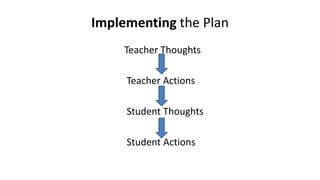
Implementing the Plan
Teacher Thoughts
Teacher Actions
Student Thoughts
Student Actions
Communicate Those Thoughts!
• Communicate expectations
• Involve the students
• Make sure the expectations are positive, facilitate instruction,
and support positive student development.
Why do students misbehave?
• Need to belong
• Need for power
• Need for freedom
• Need for fun
• William Glasser (1997) suggested we lead students rather than
“boss” them and help them make correct choices that help
them fulfill those 4 needs.
Where to Draw the Line?
• Students must understand there are limitations in a society
and that is a part of their educational experience
• If students feel they have a stake in the guidelines, they are
more likely to feel they belong
• Debate “If the rules are worth following, the following of them
should be rewarding”
Which View?
• “’buying’ rule conformity”
• “my way or the highway”
• teacher-centered
• Principles of Effective Discipline
• Emphasis on interpersonal
relationships
– Communicating expectations
– Involving students in development
of rules and procedures
– View rules and procedures as
positive boundaries
Principles for Effective Discipline
• For the soft hearted (and anyone else)
– Respond to the behavior
– Provide appropriate consequences
– Enforce – Always!!!
– Consider extenuating circumstances, but still respond to the inappropriate
behavior
• Excuses
• Power struggles
• Volatile situations
– Recognize situations that go beyond the classroom
– Implement problem-solving conferences as needed (see steps on p. 210)
Note: these are not alternatives to consequences, but are in addition to
consequences
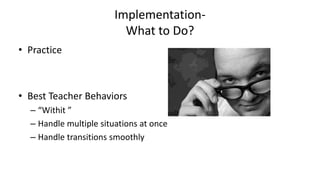
Implementation-
What to Do?
• Practice
• Best Teacher Behaviors
– “Withit ”
– Handle multiple situations at once
– Handle transitions smoothly
Implementation (cont.)
• Room Arrangement
– Efficient
– Accessible
• For “stuff” –pencil sharpeners, materials, etc.
• For moving around and proximity to students
– Visible
• Teachers can see all the activity in the room
• Students can participate and see everything they need to see.
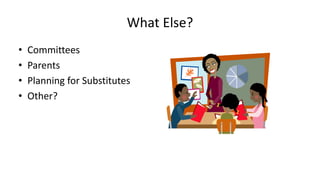
What Else?
• Committees
• Parents
• Planning for Substitutes
• Other?

Chapter 6 pragmatics - classroom management

  • 1.
    Pragmatics: Classroom Management –Chapter 6 (pp. 198 - 218 Ebert, E., & Culyer III, R. (2014). Pragmatics: Assessment and Classroom Management. In School: An introduction to education. Belmont: Wadsworth.
  • 3.
    Where to Begin? •Is the curriculum “meaningful to the students”? • Is the teaching “engaging and motivating”? • What types of things derail these best of plans and intentions?
  • 4.
    Some Theory • Readthrough the overview of Classroom Management Theories. • Are you more teacher-centered, student-centered, or somewhere in the middle? • Read the “Teacher Testimonial” on pp. 200 – 201. Which suggestions make you say “Aha!”?
  • 5.
    Terminology • Classroom management– the things teachers do “to organize students, space, and time to prevent or minimize behavior problems that would interfere with instructional time.” • Discipline (according to the text) – “actions a teacher takes after misbehavior has occurred.” • Consequences – must be clear, fair and reasonable, and consistently enforced. Children will test limits, so be prepared. • Procedures – “manner in which particular activities are to be carried out” • Routines – “automatic” procedures
  • 6.
    • Are studentsaware of the rules? • Are the rules fair and reasonable? • Is following the rules in the best interest of the students? • Is positive behavior encouraged? • What is the teacher doing to reduce the need for reinforcers?
  • 7.
    Planning for ClassroomManagement • Curriculum is generally static • Student groups are dynamic • Organization is a must to keep all groups, no matter their makeup, maximizing instructional opportunities and minimizing behaviors that take away from that. • Much effective classroom management is inherent in what is not seen. (Note chart 6.4 on p. 205)
  • 8.
    Practicing for ClassroomManagement • Practice following the rules, procedures, and routines • Allow the children to experience what it is that the teacher wants – What does it look like? – What does it sound like? – What does it feel like?
  • 9.
    Implementing the Plan TeacherThoughts Teacher Actions Student Thoughts Student Actions
  • 10.
    Communicate Those Thoughts! •Communicate expectations • Involve the students • Make sure the expectations are positive, facilitate instruction, and support positive student development.
  • 11.
    Why do studentsmisbehave? • Need to belong • Need for power • Need for freedom • Need for fun • William Glasser (1997) suggested we lead students rather than “boss” them and help them make correct choices that help them fulfill those 4 needs.
  • 12.
    Where to Drawthe Line? • Students must understand there are limitations in a society and that is a part of their educational experience • If students feel they have a stake in the guidelines, they are more likely to feel they belong • Debate “If the rules are worth following, the following of them should be rewarding”
  • 13.
    Which View? • “’buying’rule conformity” • “my way or the highway” • teacher-centered • Principles of Effective Discipline • Emphasis on interpersonal relationships – Communicating expectations – Involving students in development of rules and procedures – View rules and procedures as positive boundaries
  • 14.
    Principles for EffectiveDiscipline • For the soft hearted (and anyone else) – Respond to the behavior – Provide appropriate consequences – Enforce – Always!!! – Consider extenuating circumstances, but still respond to the inappropriate behavior • Excuses • Power struggles • Volatile situations – Recognize situations that go beyond the classroom – Implement problem-solving conferences as needed (see steps on p. 210) Note: these are not alternatives to consequences, but are in addition to consequences
  • 15.
    Implementation- What to Do? •Practice • Best Teacher Behaviors – “Withit ” – Handle multiple situations at once – Handle transitions smoothly
  • 16.
    Implementation (cont.) • RoomArrangement – Efficient – Accessible • For “stuff” –pencil sharpeners, materials, etc. • For moving around and proximity to students – Visible • Teachers can see all the activity in the room • Students can participate and see everything they need to see.
  • 17.
    What Else? • Committees •Parents • Planning for Substitutes • Other?