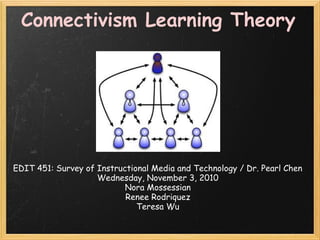
Connectivism Learning Theory
EDIT 451: Survey of Instructional Media and Technology / Dr. Pearl Chen
Wednesday, November 3, 2010
Nora Mossessian
Renee Rodriquez
Teresa Wu
Connectivism
The idea that knowledge exists
everywhere and is accessed and
organized by the learner
Contributing Theories
Behaviorism
"Philosophy and values associated with the measurement and study of human
behavior" (Reiser & Dempsey 11).
 
Cognitivism
"Learning is viewed as a process of inputs, managed in short term memory,
and coded for long-term recall" (Siemens 3).
 
Constructivism
Vygotsky -2 important Elements: Language & Scaffolding
 
Constructionism
Papert - Learning occurs through learners' engaging in creative
experimentation and activity (Kop & Hill 6).
 
Connectivism
A newly developed theory of learning
that started within the blogosphere in
2005 and from there has been, and
continues to be, developed into a
learning theory for the digital age
"Learning is a process that occurs
within nebulous environments of
shifting core elements – not entirely
under the control of the individual"
(Siemens 5).
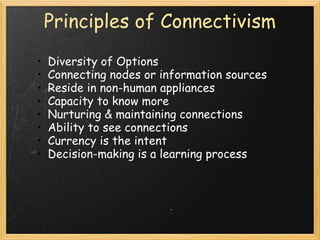
Principles of Connectivism
• Diversity of Options
• Connecting nodes or information sources
• Reside in non-human appliances
• Capacity to know more
• Nurturing & maintaining connections
• Ability to see connections
• Currency is the intent
• Decision-making is a learning process
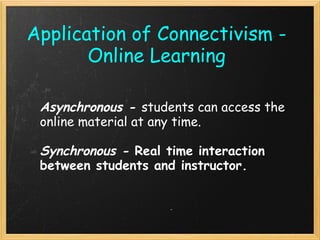
Application of Connectivism -
Online Learning
Asynchronous - students can access the
online material at any time.
 
Synchronous - Real time interaction
between students and instructor.  
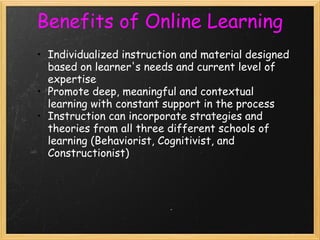
Benefits of Online Learning
• Individualized instruction and material designed
based on learner's needs and current level of
expertise
• Promote deep, meaningful and contextual
learning with constant support in the process
• Instruction can incorporate strategies and
theories from all three different schools of
learning (Behaviorist, Cognitivist, and
Constructionist)
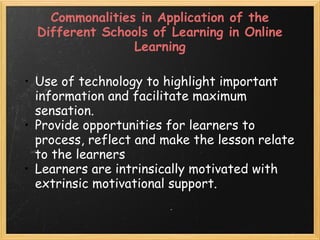
Commonalities in Application of the
Different Schools of Learning in Online
Learning
• Use of technology to highlight important
information and facilitate maximum
sensation.
• Provide opportunities for learners to
process, reflect and make the lesson relate
to the learners
• Learners are intrinsically motivated with
extrinsic motivational support.
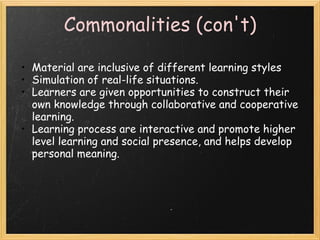
Commonalities (con't)
• Material are inclusive of different learning styles
• Simulation of real-life situations.
• Learners are given opportunities to construct their
own knowledge through collaborative and cooperative
learning.  
• Learning process are interactive and promote higher
level learning and social presence, and helps develop
personal meaning. 
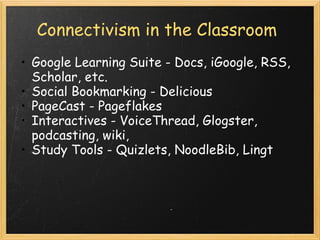
Connectivism in the Classroom
• Google Learning Suite - Docs, iGoogle, RSS,
Scholar, etc.
• Social Bookmarking - Delicious
• PageCast - Pageflakes
• Interactives - VoiceThread, Glogster,
podcasting, wiki,
• Study Tools - Quizlets, NoodleBib, Lingt
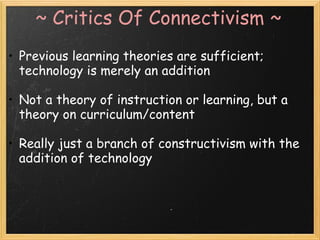
~ Critics Of Connectivism ~
• Previous learning theories are sufficient;
technology is merely an addition
 
• Not a theory of instruction or learning, but a
theory on curriculum/content
 
• Really just a branch of constructivism with the
addition of technology
~ Defending Connectivism ~
• Previous learning theories were developed in a
pre-digital era and are outdated
 
• Network formation *is* learning; both content
and context matter; new research taking place
 
• It can complement constructivism; ability to co-
exist with others
 
• Many theories across disciplines support
fostering connections
~ Useful Websites & Resources ~
*Connectivism: Networked and Social Learning
 George Siemens' WordPress on various connectivist and digital learning topics
http://www.connectivism.ca
 
*elearnspace
George Siemens' main e-learning website, also contains a blog and several articles on
the theory and related ideas.
http://www.elearnspace.org
 
*Stephen's Web
Stephen Downes' website, also full of resources on connectivism and related topics
http://www.downes.ca
 
*Connectivism & Connective Knowledge
Official website of the large online open course taught by Siemens/Downes in 2008
and 2009 on connectivism. Contains course recordings, transcripts, blogs, and wikis.
http://ltc.umanitoba.ca/connectivism
~ Discussion + Q&A ~
~Any questions or comments about this
topic? What do you think of this theory?
~How do theories of learning, theories of
instruction, and epistemological constructs
(aka: definitions of knowledge) work
together?
~What type of learning research can
better support this theory?
~ Bibliography ~
Ally, M. (2004). Foundations of educational theory for online learning [Chapter 1].
Retrieved from http://cde.athabascau.ca/online_book/ch1.html
 
Hamilton, B. (2009). Transforming information literacy for nowgen students.
Knowledge Quest, 37 (5), 48-53. 
 
Kop, R., & Hill, A. (2008). Connectivism: Learning theory of the future or vestige of
the  past?. The International Review of Research in Open and Distance Learning, 9 (3),
Retrieved from http://www.irrodl.org/index.php/irrodl/article/view/523/1103
 
Reiser, R., & Dempsey, J. (2007). Trends and issues in instructional design and
technology. Upper Saddle River, New Jersey: Merrill Prentice Hall.
Siemens, G. (2004). Connectivism: A learning theory for the digital age. Retrieved
from http://www.elearnspace.org/articles/connectivism.htm
 
Siemens, G. (2005). Connectivism: Learning as network-creation. Retrieved from
http://www.astd.org/LC/2005/1105_seimens.htm


~ Bibliography ~
(continued)
Siemens, G. (2006). Connectivism: Learning theory or pastime for the self amused?
Retrieved from http://www.elearnspace.org/articles/connectivism.htm
 
Verhagen, P. (2006). Connectivism: A new learning theory?. Retrieved from
http://www.surfspace.nl/nl/Redactieomgeving/Publicaties/Documents/Connectivism
%20a%20new%20theory.pdf20theory.pdf 
 

Connectivism

  • 1.
    Connectivism Learning Theory EDIT451: Survey of Instructional Media and Technology / Dr. Pearl Chen Wednesday, November 3, 2010 Nora Mossessian Renee Rodriquez Teresa Wu
  • 2.
    Connectivism The idea thatknowledge exists everywhere and is accessed and organized by the learner
  • 3.
    Contributing Theories Behaviorism "Philosophy andvalues associated with the measurement and study of human behavior" (Reiser & Dempsey 11).   Cognitivism "Learning is viewed as a process of inputs, managed in short term memory, and coded for long-term recall" (Siemens 3).   Constructivism Vygotsky -2 important Elements: Language & Scaffolding   Constructionism Papert - Learning occurs through learners' engaging in creative experimentation and activity (Kop & Hill 6).  
  • 4.
    Connectivism A newly developedtheory of learning that started within the blogosphere in 2005 and from there has been, and continues to be, developed into a learning theory for the digital age
  • 5.
    "Learning is aprocess that occurs within nebulous environments of shifting core elements – not entirely under the control of the individual" (Siemens 5).
  • 6.
    Principles of Connectivism •Diversity of Options • Connecting nodes or information sources • Reside in non-human appliances • Capacity to know more • Nurturing & maintaining connections • Ability to see connections • Currency is the intent • Decision-making is a learning process
  • 7.
    Application of Connectivism- Online Learning Asynchronous - students can access the online material at any time.   Synchronous - Real time interaction between students and instructor.  
  • 8.
    Benefits of OnlineLearning • Individualized instruction and material designed based on learner's needs and current level of expertise • Promote deep, meaningful and contextual learning with constant support in the process • Instruction can incorporate strategies and theories from all three different schools of learning (Behaviorist, Cognitivist, and Constructionist)
  • 9.
    Commonalities in Applicationof the Different Schools of Learning in Online Learning • Use of technology to highlight important information and facilitate maximum sensation. • Provide opportunities for learners to process, reflect and make the lesson relate to the learners • Learners are intrinsically motivated with extrinsic motivational support.
  • 10.
    Commonalities (con't) • Materialare inclusive of different learning styles • Simulation of real-life situations. • Learners are given opportunities to construct their own knowledge through collaborative and cooperative learning.   • Learning process are interactive and promote higher level learning and social presence, and helps develop personal meaning. 
  • 11.
    Connectivism in theClassroom • Google Learning Suite - Docs, iGoogle, RSS, Scholar, etc. • Social Bookmarking - Delicious • PageCast - Pageflakes • Interactives - VoiceThread, Glogster, podcasting, wiki, • Study Tools - Quizlets, NoodleBib, Lingt
  • 12.
    ~ Critics OfConnectivism ~ • Previous learning theories are sufficient; technology is merely an addition   • Not a theory of instruction or learning, but a theory on curriculum/content   • Really just a branch of constructivism with the addition of technology
  • 13.
    ~ Defending Connectivism~ • Previous learning theories were developed in a pre-digital era and are outdated   • Network formation *is* learning; both content and context matter; new research taking place   • It can complement constructivism; ability to co- exist with others   • Many theories across disciplines support fostering connections
  • 14.
    ~ Useful Websites& Resources ~ *Connectivism: Networked and Social Learning  George Siemens' WordPress on various connectivist and digital learning topics http://www.connectivism.ca   *elearnspace George Siemens' main e-learning website, also contains a blog and several articles on the theory and related ideas. http://www.elearnspace.org   *Stephen's Web Stephen Downes' website, also full of resources on connectivism and related topics http://www.downes.ca   *Connectivism & Connective Knowledge Official website of the large online open course taught by Siemens/Downes in 2008 and 2009 on connectivism. Contains course recordings, transcripts, blogs, and wikis. http://ltc.umanitoba.ca/connectivism
  • 15.
    ~ Discussion +Q&A ~ ~Any questions or comments about this topic? What do you think of this theory? ~How do theories of learning, theories of instruction, and epistemological constructs (aka: definitions of knowledge) work together? ~What type of learning research can better support this theory?
  • 16.
    ~ Bibliography ~ Ally,M. (2004). Foundations of educational theory for online learning [Chapter 1]. Retrieved from http://cde.athabascau.ca/online_book/ch1.html   Hamilton, B. (2009). Transforming information literacy for nowgen students. Knowledge Quest, 37 (5), 48-53.    Kop, R., & Hill, A. (2008). Connectivism: Learning theory of the future or vestige of the  past?. The International Review of Research in Open and Distance Learning, 9 (3), Retrieved from http://www.irrodl.org/index.php/irrodl/article/view/523/1103   Reiser, R., & Dempsey, J. (2007). Trends and issues in instructional design and technology. Upper Saddle River, New Jersey: Merrill Prentice Hall. Siemens, G. (2004). Connectivism: A learning theory for the digital age. Retrieved from http://www.elearnspace.org/articles/connectivism.htm   Siemens, G. (2005). Connectivism: Learning as network-creation. Retrieved from http://www.astd.org/LC/2005/1105_seimens.htm      
  • 17.
    ~ Bibliography ~ (continued) Siemens,G. (2006). Connectivism: Learning theory or pastime for the self amused? Retrieved from http://www.elearnspace.org/articles/connectivism.htm   Verhagen, P. (2006). Connectivism: A new learning theory?. Retrieved from http://www.surfspace.nl/nl/Redactieomgeving/Publicaties/Documents/Connectivism %20a%20new%20theory.pdf20theory.pdf