LEARNING ENVIRONMENT
Definition:
“A learning environment is a combination of social and physical quantities that
create the classroom experience. It includes classroom management procedures as
well as the way the space is organized, furnished and maintained.”
Features of Classroom
Positive Environment:
Always appreciate and motivate students on their work.
Example:
Appreciate them on maintaining discipline.
Steps for Positive Environment:
 Teachers must try to understand his/her students according to their mentally
need.
 Make students feel physically secure. Welcome socially adapted and value.
 Create effective learning.
Seating Arrangement:
A seating plan is very effective way to organize the classroom to maintain the
classroom.
 Arrange the student’s desk and teacher’s desk so teachers and students can
sit easily and teacher can walk easily.
 Teacher should maintain the classroom for one thing because he/she can see
his/her students easily.
Cluster Seating Cycle:
Cluster is very common in situations. Where there area lot of groups learning and
work.
Arrangements:
In this style four or five desks are put together and students sit around the tales
infront of each other.
Desk Row and Column Styles:
 Desk of all students should be arranged in same row order.
 Also arrange the desk in same column order.
 If teacher arrange desk in row and column so teachers can move easily by
moving the students and keep eyes on his/her students.
Semi-Circle Style:
Semi-circle arrangement is when all desks touch each other, facing the front of the
room in a semi-circle shape.
PHYSICAL ENVIRONMENT
Definition:
“The physical environment of the classroom is talking about the way of classroom
is set up. Some of the key elements are accessibility, visibility and distract ability.”
Explanation:
The material in the classroom should be accessible to the students as needed. The
student should know where supplies are and be able to access them.
Example:
Furniture and seating arrangements should be arranged so that students and
teachers can move easily.
Meaning of Visibility:
Visibility refers to the students ability to see the teachers, board, projection screen
etc. When arranging the desk, teacher should sit in the desk to ensure that the
students will be able to see; also the teacher should be able to see the students at all
times.
Meaning of Distractibility:
“It refers to inherent distractions of a classroom.” Things such as pencil sharpness,
windows, doors, trash, cans etc. Can cause distraction to some students.
Explanation:
The physical environment of the classroom concerns everything about a classroom
including but not limited to classroom size, arrangement of desk bulletin boards
temperature, numbers of students in classroom window, color, on the walls,
acoustics, lightening, organizing etc. Physical environment of the classroom issuer
important to students success.
Dimensions of the Physical Features
The spatial environment:
The spatial dimensions of the classroom are important because it is the setting of
education.
Aspects of the spatial dimensions as according to:
 Size of the room
 Shape of the room
 Locating of the doors
 Location of the windows
 Movement of individuals within the space
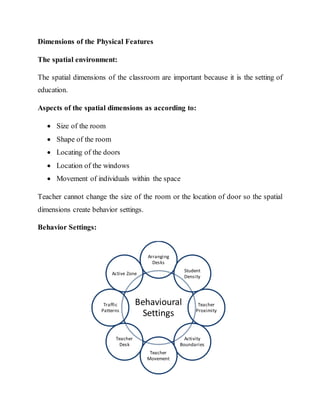
Teacher cannot change the size of the room or the location of door so the spatial
dimensions create behavior settings.
Behavior Settings:
Behavioural
Settings
Arranging
Desks
Student
Density
Teacher
Proximity
Activity
Boundaries
Teacher
Movement
Teacher
Desk
Traffic
Patterns
Active Zone
Application of Dimensions of Physical Environment
The physical environment is crucial to class room management because it influences teachers
and students behavior.
Because teacher cannot change the spatial dimensions of his/her future class room. So its
purpose is:
 Arranging desks of students and teacher so students and teacher can sit and teacher can
walk easily.
 Creating activity boundaries
 Don’t use extra furniture
Good planning and hard work lead to prosperity, but hasty shortcuts lead to poverty.
Effective classroom management requires intentionally hard work. It requires much planning,
thought and effort. Well managed classroom promotes success.
STRATEGIES OF PHYSICAL ENVIRONMENT
Developing a sense of belonging and personal identity
When a student is in a class room where there a personal identity is enhanced, the student will
then feel that they belong and have sense of ownership.
There are six hours that a student spends in school. So in that time student should teach the
children in a way that children does not feel or think about his personality or identity.
Enhancing competence and security
The functional purpose of a space is to provide a sense of security for those in a room. Most of
the students have their own security level sense in their own home. That the same level security
thoughts they have in class room. Where students spends their time in school mostly. The
students need to feel as they thought they will control of their own environment. First step into
helping making a safe environment is choosing furniture the appropriate for students in terms of
size and their learning levels. e.g comfortable seating for students.
Promoting intellectual growth and stimulation
In order to accomplish intellectual growth inside the class room this would require and varied
environment. The class room needs to be dynamic and changing environment for students. Often
class room becomes boring so the teacher should arrange the class room seating in circle way
and arrange quiz questioning etc. so intellectual growth of student can grow.
Accommodating privacy needs
Teacher design the class room to accommodate group activities and social interactions. Privacy
needs should b given to students according to their :mentally needs.
Social Class Profiles:
 Upper class

Learning environment

  • 1.
    LEARNING ENVIRONMENT Definition: “A learningenvironment is a combination of social and physical quantities that create the classroom experience. It includes classroom management procedures as well as the way the space is organized, furnished and maintained.” Features of Classroom Positive Environment: Always appreciate and motivate students on their work. Example: Appreciate them on maintaining discipline. Steps for Positive Environment:  Teachers must try to understand his/her students according to their mentally need.  Make students feel physically secure. Welcome socially adapted and value.  Create effective learning. Seating Arrangement: A seating plan is very effective way to organize the classroom to maintain the classroom.  Arrange the student’s desk and teacher’s desk so teachers and students can sit easily and teacher can walk easily.
  • 2.
     Teacher shouldmaintain the classroom for one thing because he/she can see his/her students easily. Cluster Seating Cycle: Cluster is very common in situations. Where there area lot of groups learning and work. Arrangements: In this style four or five desks are put together and students sit around the tales infront of each other. Desk Row and Column Styles:  Desk of all students should be arranged in same row order.  Also arrange the desk in same column order.  If teacher arrange desk in row and column so teachers can move easily by moving the students and keep eyes on his/her students. Semi-Circle Style: Semi-circle arrangement is when all desks touch each other, facing the front of the room in a semi-circle shape. PHYSICAL ENVIRONMENT Definition: “The physical environment of the classroom is talking about the way of classroom is set up. Some of the key elements are accessibility, visibility and distract ability.”
  • 3.
    Explanation: The material inthe classroom should be accessible to the students as needed. The student should know where supplies are and be able to access them. Example: Furniture and seating arrangements should be arranged so that students and teachers can move easily. Meaning of Visibility: Visibility refers to the students ability to see the teachers, board, projection screen etc. When arranging the desk, teacher should sit in the desk to ensure that the students will be able to see; also the teacher should be able to see the students at all times. Meaning of Distractibility: “It refers to inherent distractions of a classroom.” Things such as pencil sharpness, windows, doors, trash, cans etc. Can cause distraction to some students. Explanation: The physical environment of the classroom concerns everything about a classroom including but not limited to classroom size, arrangement of desk bulletin boards temperature, numbers of students in classroom window, color, on the walls, acoustics, lightening, organizing etc. Physical environment of the classroom issuer important to students success.
  • 4.
    Dimensions of thePhysical Features The spatial environment: The spatial dimensions of the classroom are important because it is the setting of education. Aspects of the spatial dimensions as according to:  Size of the room  Shape of the room  Locating of the doors  Location of the windows  Movement of individuals within the space Teacher cannot change the size of the room or the location of door so the spatial dimensions create behavior settings. Behavior Settings: Behavioural Settings Arranging Desks Student Density Teacher Proximity Activity Boundaries Teacher Movement Teacher Desk Traffic Patterns Active Zone
  • 5.
    Application of Dimensionsof Physical Environment The physical environment is crucial to class room management because it influences teachers and students behavior. Because teacher cannot change the spatial dimensions of his/her future class room. So its purpose is:  Arranging desks of students and teacher so students and teacher can sit and teacher can walk easily.  Creating activity boundaries  Don’t use extra furniture Good planning and hard work lead to prosperity, but hasty shortcuts lead to poverty. Effective classroom management requires intentionally hard work. It requires much planning, thought and effort. Well managed classroom promotes success. STRATEGIES OF PHYSICAL ENVIRONMENT Developing a sense of belonging and personal identity When a student is in a class room where there a personal identity is enhanced, the student will then feel that they belong and have sense of ownership. There are six hours that a student spends in school. So in that time student should teach the children in a way that children does not feel or think about his personality or identity. Enhancing competence and security The functional purpose of a space is to provide a sense of security for those in a room. Most of the students have their own security level sense in their own home. That the same level security thoughts they have in class room. Where students spends their time in school mostly. The students need to feel as they thought they will control of their own environment. First step into helping making a safe environment is choosing furniture the appropriate for students in terms of size and their learning levels. e.g comfortable seating for students.
  • 6.
    Promoting intellectual growthand stimulation In order to accomplish intellectual growth inside the class room this would require and varied environment. The class room needs to be dynamic and changing environment for students. Often class room becomes boring so the teacher should arrange the class room seating in circle way and arrange quiz questioning etc. so intellectual growth of student can grow. Accommodating privacy needs Teacher design the class room to accommodate group activities and social interactions. Privacy needs should b given to students according to their :mentally needs. Social Class Profiles:  Upper class